Revenge Bedtime Procrastination: Why You Stay Up Late and How to Stop
Revenge bedtime procrastination trades sleep for time of your own. The 3 reasons people give for staying up, and 6 low-risk habits to reclaim the night.

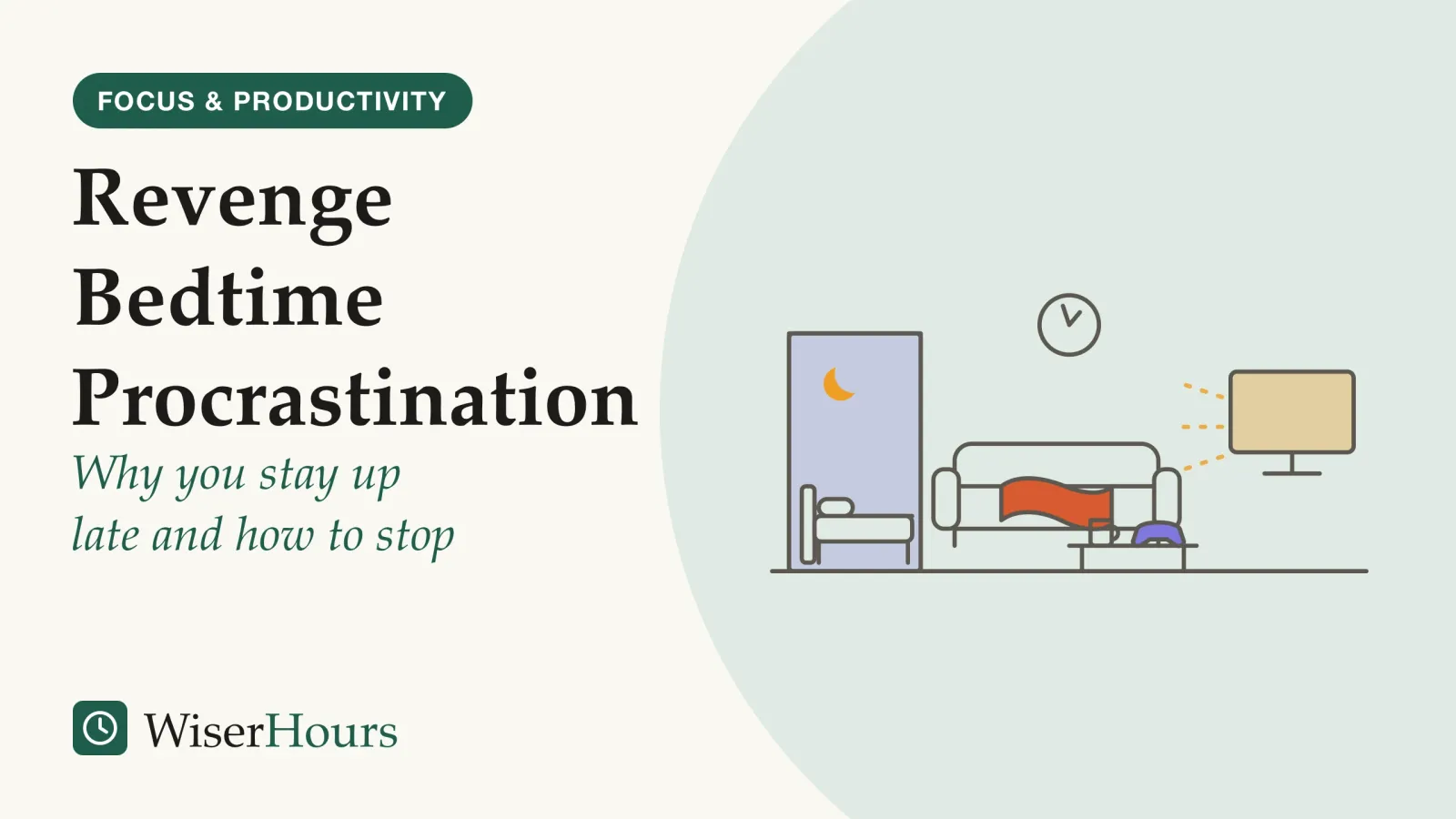
In a 2019 Dutch interview study, a 50-year-old woman explained her late nights plainly. Some evenings she stays up because she enjoys it; on others it is defiance, one more game or one more episode set against a life made of obligations.1
Revenge bedtime procrastination is the popular name for that habit: going to bed later than you meant to, with nothing forcing you to, often to claim time the day did not leave you. People who put off bedtime more tend to sleep less, sleep worse and feel more tired the next day, a 2022 systematic review of the research found, although the studies behind it were mostly one-time surveys that cannot show which comes first.2 The fixes with the best footing are ordinary habits and public-health sleep advice, put in place earlier in the evening than the moment you usually lose:
- Pick a bedtime and count it back from your alarm
- Move some time for yourself earlier in the evening
- Set a wind-down alarm that interrupts the evening
- Put screens and the next episode out of easy reach
- Decide now what happens after “just one more”
- If you stay up because you expect not to sleep, stop forcing it
What revenge bedtime procrastination is, and where “revenge” came from
Bedtime procrastination means going to bed later than you intended when no outside circumstances stop you, the definition Floor Kroese and colleagues at Utrecht University set out in 2014, when they introduced the idea and a short questionnaire to measure it. A crying baby or a night shift does not count; a series you could pause does. The 2014 paper also noticed a twist. Procrastination usually means avoiding an unpleasant task, and going to bed is rarely unpleasant, so the authors suggested the trouble is less a wish to avoid sleep than a reluctance to stop whatever you are doing. In their one-time online surveycross-sectional: Describes a study that measures everyone in its sample at a single point in time. Because the possible cause and the outcome are recorded together, it can show that two things occur together but not which of them came first.Full entry in the glossary, higher scorers more often reported getting too little sleep, beyond what their general self-control explained: a link, not proof that one drives the other.3
That twist is where bedtime delay parts company with the everyday kind explained in why we procrastinate; related guides sit under procrastination and motivation.
The “revenge” part is popular, not scientific. The idea caught on in 2020 after the journalist Daphne K. Lee tweeted a translation of a Chinese term, as NPR’s Life Kit recounted in 2022.4 A 2026 commentary in the journal SLEEP notes that the label is now often used for deliberate delay: putting off sleep to reclaim some freedom once the day’s duties are done.5
- Myth
- Revenge bedtime procrastination is a sleep disorder.
- Fact
- It is a popular name for bedtime procrastination, a behavior researchers measure with questionnaires, not a diagnosis. Lying awake once you are in bed is a different problem.
Picture a parent who gets the children down, clears the kitchen and only then sits down: the show that follows is the first time all day that belongs to no one else, and it runs past midnight. The part of the label worth keeping is the gap between the bedtime you meant and the one you kept. That gap is what researchers measure, and what the steps below try to shrink.
Three reasons people give for staying up late
When Dutch researchers interviewed 17 adults who put off going to bed on three or more nights a week, the explanations fell into three kinds: deliberate delay, losing track of time, and staying up because they expected not to sleep. Many described more than one, sometimes in the same evening. Deliberate delay was among the most common. Nearly everyone named a temptation they gave in to, and about a third said they felt they deserved the time. After days of commuting, work, cooking and caring for children or aging parents, the evening was the only stretch with nothing they had to do.1
It’s a way of revolting against all the obligations that you have.
Mindless delay looked different. People meant to take a quick look at a show or the news, and time “just flies by.” They had not changed their minds about bedtime; they had drifted from it. The third kind, strategic delay, came from people who stayed up because they believed they would lie awake if they went to bed earlier, which the authors say may not be procrastination at all and may point to undiagnosed insomniainsomnia: Trouble falling asleep, staying asleep or waking too early despite having the chance to sleep, with effects on how you feel or function during the day. It is called chronic when it lasts for months; short spells after stress are common.Full entry in the glossary.1
The study was small, based on interviews and partly funded by Philips Research, where the lead author worked, so it maps reasons without saying how common each one is. Its practical point holds: each kind needs a different fix. Time you feel you are owed can be moved earlier, drift needs something that interrupts it, and a fear of lying awake is a sleep question rather than a willpower one.1 In the steps below, that means step 2 for the first kind, steps 3 to 5 for the second and step 6 for the third.
What one more episode costs in sleep
Staying up later than planned tends to come straight out of sleep when work, classes or children fix the time you get up. A 2022 systematic review found that people who delay bedtime more report shorter sleep, poorer sleep and more tiredness during the day.2
The study
Limited evidence
Hill and colleagues' 2022 pooled review of bedtime delay and sleep
Vanessa Hill and colleagues at CQUniversity in Australia pooled the research published since the term was coined. Across 17 studies, people who reported more bedtime procrastination reported shorter sleep, a moderate link (a correlation of about 0.3). Links with poorer sleep quality and more daytime fatigue were of similar size. Because most studies asked people once and relied on their own estimates of sleep, the review cannot say whether delay shortens sleep or people who already sleep badly delay more.2
A moderate correlation means the pattern is clear across a group but leaves plenty of room for any one person: some heavy delayers still sleep enough, and some people who never delay sleep badly.
A 2026 study from Singapore adds a measurement the surveys lack. Researchers tracked students at a university residential college with activity monitors that estimate sleep (actigraphy) for two weeks. The students went to bed later than they intended on about half of all nights, and on those nights they slept close to an hour less, even before a free morning, because they did not sleep in to make up for it. Their mood and sleepiness the next morning were worse. The full paper was not available to us, so these details come from its abstract.6
So price the next episode in sleep rather than in screen time. The amount of sleep adults need, and the daytime habits that protect it, are covered in the guide to how to sleep better; this one sticks to the moment of going to bed.
Six habits that end the evening on time
Six low-risk habits can help you end the evening when you meant to, by moving the decisions to earlier in the day. They come from public-health sleep advice by the US Centers for Disease Control and Prevention (CDC) and the UK’s NHS and from researchers’ own suggestions, and none has been proven to end bedtime procrastination.
Night owls and people who rate their self-control lower report more bedtime procrastination, the 2022 review found, although the individual studies did not all agree and none can show cause.2 The interviews offer another reading: after a day of obligations, the late evening is the only time that feels like your own, and staying up protects it. So let a cue, not a fresh act of will at 11 p.m., end the evening. If you are a natural night owl, a realistic bedtime you keep will serve you better than an early one you break.
The steps assume you have a choice about bedtime, which shift workers, new parents and carers often do not, so treat them as aims rather than a test.
1. Pick a bedtime and count it back from your alarm
The CDC lists going to bed and getting up at the same times each day among habits that can improve sleep.7 Choose your wake time first, count back the sleep you need and put the result in your calendar. Say your alarm goes at 6:30 and, purely as an example, you allow 8 hours in bed: lights out is 10:30, which puts the wind-down alarm in step 3 at 9:30.
2. Move some time for yourself earlier in the evening
If the late hours feel like the only ones you own, take some of that time sooner. The interview study’s authors proposed planning downtime earlier in the evening, so the need for time of your own is not met after midnight; it has not been tested.1 A short stretch after dinner with no chores and no messages is a reasonable start: the same half hour with a book at 8 p.m. costs no sleep at all.
3. Set a wind-down alarm that interrupts the evening
Drift is hard to notice from inside a good show, so let something outside you notice it. The NHS advises putting phones, tablets and computers away for an hour before bed.8 An alarm set for that point turns a vague intention into a moment you have to act on: when it rings, the episode you are watching is the last one.
4. Put screens and the next episode out of easy reach
Problematic smartphone use went with more bedtime procrastination in several studies in the 2022 review.2 Make the next episode harder to start: turn off autoplay and charge the phone outside the bedroom.
5. Decide now what happens after “just one more”
Kroese’s team suggested if-then plansimplementation intention: A plan in if-then form that ties a specific action to a specific situation, such as 'if it is nine o'clock, then I open the report.' It hands the decision about when and where to act to the situation itself.Full entry in the glossary for bedtime delay because they ask little willpower in the moment.3 Write one before the evening starts: if an episode ends after the wind-down alarm, then I get up and put the phone on its charger in the kitchen. Trials of a planning exercise with students are promising but mixed (see the table below).
6. If you stay up because you expect not to sleep, stop forcing it
If you delay bed because you dread lying awake, the NHS advises not forcing sleep: if you are still awake after about 20 minutes, get up, do something relaxing and go back to bed when you feel sleepy.8 That is general sleep advice for anyone, not an insomnia treatment; if this pattern is yours, read the section on when to see a doctor below.
Tonight's setup
What the trials so far show, and what they do not
No approach to bedtime procrastination has strong evidence yet: the trials are few and brief, most enrolled students or young adults, and the everyday habits rest on general public-health sleep advice rather than on bedtime procrastination research.
| What it is | What the best evidence found | Evidence |
|---|---|---|
| Planning exercise with if-then plans | Commitment rose and self-reported minutes of nightly delay fell over one to three weeks, against control groups; the 2022 review notes no difference on a bedtime procrastination questionnaire | Two trials, limited (undergraduates, New York University researchers, 2020; abstract only)92 |
| Structured behavioral program | About 46 fewer minutes of delay a night, by sleep diary, than a wait list | Trial, limited (60 young adults without insomnia, researchers in South Korea, 2023; open-label, abstract only)10 |
| Online screen-time program | Screen use fell and sleep rose in all groups, including the comparison | Pilot trial, limited (55 adults starting their careers, Australian researchers, 2025; abstract only)11 |
Read the table as permission to experiment cheaply, not as proof that any one step works. Try two or three steps for two weeks and judge them by the time you actually turned out the light.
When staying up late is really a sleep problem
Late nights become a medical question when sleepiness puts you at risk, when you stay up because you expect to lie awake, or when poor sleep has lasted for months. The tiers below sort NHS, NIMH and CDC advice by urgency; the sorting is our own.
- Now: never drive while you feel sleepy, the NHS warns.12 If late nights come with thoughts of suicide, the US National Institute of Mental Health (NIMH) points US readers to the 988 Suicide & Crisis Lifeline, by call or text, and to 911 if a life is in danger.13 For the UK, the NHS advice is 999 or A&E if a life is at risk, and NHS 111, choosing the mental health option, for other urgent help.14 Readers elsewhere should use their local emergency number.
- Soon: when new sleep habits have not worked, when bad nights have run on for months, or when it makes day-to-day life hard to manage, the NHS suggests booking a GP appointment; a GP may offer cognitive behavioral therapycognitive behavioral therapy: A structured talking therapy that works on the links between thoughts, feelings and behavior, usually over a set number of sessions with practice between them. It is given by a trained therapist or through guided programs, and versions exist for specific problems.Full entry in the glossary, face to face or online.12 Staying up because you expect to lie awake may be a sign of insomnia, the interview study suggests, and the types and causes of insomnia are a useful next read.1
- Routine: the CDC advises talking to your health care provider if you regularly have problems sleeping or notice signs of a common sleep disorder.7
The bottom line
Staying up late on purpose is a bid for time the day did not leave you, and your sleep pays for it. Give yourself some of that time sooner, decide the bedtime while you still have the resolve to, and let an alarm rather than willpower end the night. If you stay up because you expect to lie awake, or bad nights have lasted for months, talk to a doctor.
This article is general information, not medical advice. If you're worried about your health, talk to a doctor or another qualified professional.
Frequently asked questions
Does scrolling or reading in bed count as bedtime procrastination?
Not by the original definition. Floor Kroese and colleagues, who introduced the term in 2014, defined bedtime procrastination as going to bed later than intended rather than falling asleep later, because once you are in bed the intention to sleep cannot always be carried out. They noted that watching TV in bed may involve some delay too, but called it less clear. The US CDC advises turning devices off at least 30 minutes before bedtime.
Can I make up the lost sleep by sleeping in?
Public-health advice says not to rely on it. The UK's NHS advises sticking to your regular sleeping hours rather than sleeping in after a bad night, and the US CDC lists going to bed and getting up at the same times each day among habits that can improve sleep. In a 2026 study of university students in Singapore, late bedtimes cost sleep even before free mornings, because students did not sleep in to compensate.
Why do I feel wide awake at the time I meant to go to bed?
Some bedtime procrastinators describe exactly that. In a 2019 Dutch interview study, some said they had energy to spare when they should go to bed, or had felt tired earlier in the evening and missed the right moment. The authors suggested that people who see themselves as night owls might be coached to seek bright light in the morning and less light in the evening, an idea their study did not test.
Sources
- The explanations people give for going to bed late: A qualitative study of the varieties of bedtime procrastination. Nauts, S., Kamphorst, B. A., Stut, W., De Ridder, D. T. D. & Anderson, J. H. (2019). Behavioral Sleep Medicine, 17(6), 753-762
- Go to bed! A systematic review and meta-analysis of bedtime procrastination correlates and sleep outcomes. Hill, V. M., Rebar, A. L., Ferguson, S. A., Shriane, A. E. & Vincent, G. E. (2022). Sleep Medicine Reviews, 66, 101697
- Bedtime procrastination: introducing a new area of procrastination. Kroese, F. M., De Ridder, D. T. D., Evers, C. & Adriaanse, M. A. (2014). Frontiers in Psychology, 5, 611
- How to stop revenge bedtime procrastination and get better sleep. NPR Life Kit (US), 16 June 2022, transcript
- Why we postpone sleep: bedtime procrastination beyond self-control failure. Suh, S. (2026). SLEEP, 49(5), zsag061 (commentary)
- Going to bed later than intended is associated with shorter sleep and poorer next-day mood and sleepiness in residential college students. Kok, V. J., Chua, S., Yabuki, H., Rukmini, A. V., Sreenivasulu, B. & Gooley, J. J. (2026). SLEEP, 49(5), zsaf414
- About Sleep. Centers for Disease Control and Prevention (US), last updated 15 May 2024
- How to fall asleep faster and sleep better. NHS Every Mind Matters (UK), checked 24 September 2026
- Using mental contrasting with implementation intentions to reduce bedtime procrastination: two randomised trials. Valshtein, T. J., Oettingen, G. & Gollwitzer, P. M. (2020). Psychology & Health, 35(3), 275-301
- A randomized controlled trial of a behavioral intervention for decreasing bedtime procrastination using a wait-list control group in a non-clinical sample of young adults. Jeoung, S., Jeon, H., Yang, H.-C., An, H. & Suh, S. (2023). Sleep Medicine, 108, 114-123
- A randomised pilot trial for bedtime procrastination: Examining the efficacy and feasibility of the Reducing Evening Screen Time online intervention (REST-O). Hill, V. M., Ferguson, S. A., Rebar, A. L., Meaklim, H. & Vincent, G. E. (2025). Sleep Medicine, 129, 306-315
- Insomnia. NHS (UK), page last reviewed 19 March 2024
- Depression. National Institute of Mental Health, National Institutes of Health (NIH Publication No. 24-MH-8079, revised 2024)
- Where to get urgent help for mental health. NHS (UK), page last reviewed 26 April 2023, checked current 24 September 2026
How we researched this
We searched PubMed, Europe PMC, Crossref and the web in September 2026 for reviews, trials and observational studies of bedtime procrastination, and read CDC, NHS and NIMH pages for the practical and health sections. Sources date from 2014 to 2026; we read four papers in full, eleven at abstract level only, one news transcript and five public-health pages. Main limitation: most research is cross-sectional, self-reported and done with students, and intervention trials are few and short.
Keep reading
How to Stop Procrastinating on Studying
How to stop procrastinating on studying: 5 steps that add the structure a course leaves out, and why one round of advice failed in a 2024 trial.
Intrinsic vs. Extrinsic Motivation: Which Lasts Longer?
Rewards get people moving; interest and personal value keep them going. What 4 decades of research on intrinsic vs extrinsic motivation found.
How to Stop Procrastinating: 15 Strategies Backed by Research
15 ways to stop procrastinating, each matched to the cause of delay it targets and graded by its evidence, from if-then plans to self-set deadlines.
Why Do We Procrastinate? The Psychology Explained
Why do we procrastinate? A 2007 meta-analysis of 691 correlations points to unpleasant tasks, distant rewards, self-doubt and impulsiveness.