A Single Source of Truth: What It Means and How to Get There
A single source of truth gives each key fact one home and one owner. What it means, how it differs from a system of record, and 5 steps for a small team.

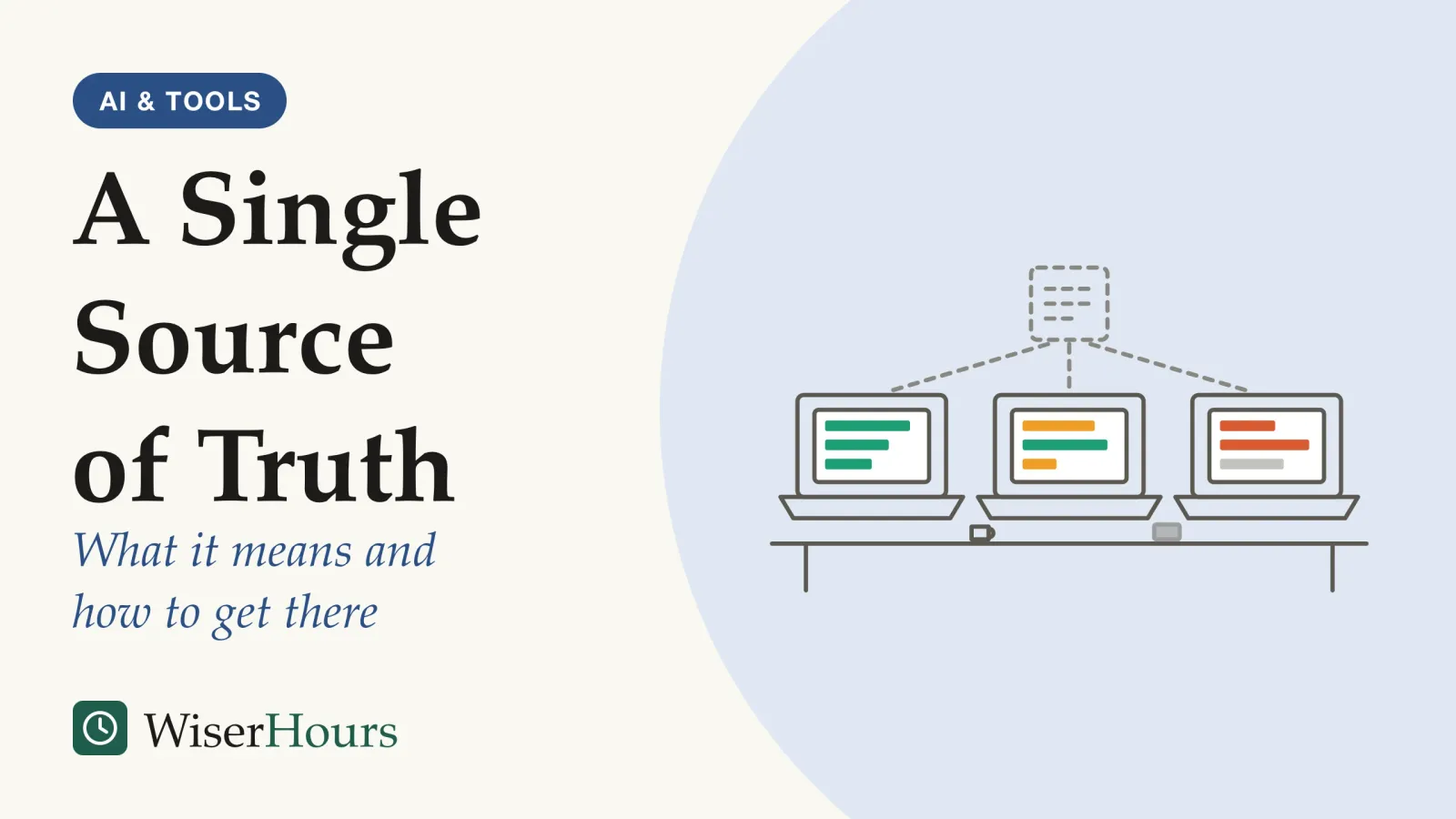
A single source of truth is an agreement about where each important fact lives. The price list, the onboarding steps or the customer’s address is kept and edited in one place, and every other document, chat or slide points back to it instead of holding its own copy. The idea comes from data architecture, where it describes storing each piece of data once, as a master record that other systems refer to.1 For a team, it is mainly a habit and a set of decisions about ownership, which software can hold but no product can supply. A small team gets there in five moves, each set out in the how-to section further down:
- Pick the few facts that matter.
- Name one home and one owner for each.
- Link instead of copying.
- Archive old versions.
- Set a review date.
What is a single source of truth?
In information systems, a single source of truth (sometimes shortened to SSOT) is the practice of structuring data so that every data element is mastered, or edited, in only one place, Wikipedia’s entry on the term explains. Copies elsewhere either do not exist or are references back to that master.1
Definition
A single source of truth is one agreed place where a given fact is created and updated, so that everyone who needs the fact reads it from there or from a copy that points back to it.
The value is easy to see in the failure it prevents. When the same value is stored in two places, someone eventually updates one and forgets the other. The Wikipedia entry puts that first among the advantages: it becomes much harder to end up with a duplicate somewhere that has quietly gone stale.1
A sales team with a price list in a shared drive, a pasted copy in the proposal template and another in the onboarding deck shows the problem. After a price change, at least one of the three is wrong, and nobody can say which version a customer saw.
The data-training and research group TDWI adds a point that matters more for teams than for databases. Two analysts can query the same data warehouse and still report different revenue, because each defined revenue differently. A single source of truth therefore needs agreed definitions as well as one storage place.2 Before you pick a tool, write down what your team means by the two or three terms that cause arguments, such as “active client” or “done”.
Where the idea comes from
The term grew out of database design, where the aim is to store each fact once and let everything else refer to it. Programmers know a close cousin as the DRY principle (“don’t repeat yourself”), set out by Andy Hunt and Dave Thomas in their 1999 book The Pragmatic Programmer.3
Every piece of knowledge must have a single, unambiguous, authoritative representation within a system
Hunt and Thomas applied the rule broadly, to database schemas, test plans, build systems and documentation.3 Documents have their own version, called transclusion: a passage is stored once and shown inside other documents by reference, so a correction made at the source appears everywhere it is used. Ted Nelson coined the term for his 1980 book Literary Machines.4
Most team tools offer a plain form of the same thing: a link, or an embedded view of a live page. A link carries the current version every time it is opened. A pasted copy freezes the version that existed on the day someone pasted it, and from then on it drifts. Wherever your tools let you embed or link a live page, prefer that to pasting its contents.
What is an example of a single source of truth?
The clearest examples come from fields where a wrong copy causes real harm. Wikipedia’s entry gives electronic health records: a patient’s identity should be checked against one reference record, and other systems should point to that record instead of duplicating it, to help prevent medical errors and duplicated work.1
Businesses face the same problem with customers. A sales system, a billing system and a warehouse system may each keep their own customer record, and a change of address entered in one does not reach the others. Wikipedia’s article on master data management uses a bank as its example: if its marketing team and its service desk each hold their own customer list, someone who has just signed a mortgage with the bank could still be sent adverts for one.5
Small teams have humbler versions: one client contact sheet at a design agency, one timetable in a school department, one page of refund rules for a support team. The test is the same at every scale: when the fact changes, is there exactly one place to change it, and does everyone else see the change without anyone sending a new copy?
Single source of truth vs. system of record
A system of record is the authoritative data store for a given piece of information, such as the payroll system for salaries. A single source of truth is the broader rule that everyone takes that information from the authoritative place. The system of record answers “where is the master?”; the single source of truth adds “and nobody keeps a rival version”.6
| Term | What it names | Small-team example |
|---|---|---|
| Single source of truth | The practice of editing each fact in one place and referring to it from everywhere else | Every proposal links to one live price list1 |
| System of record | The authoritative store for a given kind of data | The accounting tool is the master for invoices6 |
| Single version of the truth | A data-warehouse ideal: all data held in one consistent, non-redundant form, usually for reporting | One dashboard that pulls figures from the other tools7 |
| Golden record | The version of one record treated as valid, for example after duplicates are consolidated | The one correct entry for a client who appeared three times8 |
A data warehouse is often treated as the single source of truth, but Wikipedia’s entry notes that it is better described as a single version of the truth, because no data originates there; it reports figures loaded from the operational systems.1 A team can therefore have several systems of record (one for invoices, one for staff details, one for project dates) and still meet the principle, as long as each fact has exactly one of them as its home.
Why teams drift into duplicates
Teams end up with three versions of the same document because copying is always the quickest move. Pasting a paragraph or forwarding an attachment takes seconds; finding the master and linking to it takes longer, and nobody notices the cost until the copies disagree.
Tools add to the drift. Wikipedia’s entry on the term notes that many organizations run several systems that each need data about the same customers or products, and many of those products cannot be changed to point to a master, so each keeps its own copy.1 Departments with different goals also tend to build information silos, where information stays inside one unit and has no effect outside it.9
Spreadsheets are a common route to duplication. In a 2008 survey of more than 200 professionals from 155 companies, run by the research firm Aberdeen Group and summarized on TDWI by one of its analysts, more than two-thirds said spreadsheets were their main tool for analyzing data. The report added that spreadsheets suit one-off analysis but are a poor vehicle for data that changes and is reused by many people.10 That survey was company research, not peer-reviewed, and is now old, but the pattern it describes is familiar: each person’s export becomes a private version.
The practical warning sign is a question such as “which one is the latest?” in a team chat. Each time it appears, note which fact it was about. Those facts are the ones that need a home first.
Why a single source of truth depends on ownership
The research on company data points to people more than software. In a questionnaire study of 90 Danish companies, published in 2011, Anders Haug and Jan Stentoft Arlbjørn found that a lack of clear responsibility for maintaining master data had the largest impact on its quality of any barrier they examined.11
The study
Limited evidence
Unclear ownership topped the barriers to data quality in a 2011 survey of 90 Danish firms
A questionnaire answered by 90 Danish companies asked which barriers most affected the quality of their master data. Lack of delegated responsibility for keeping that data up to date came out as the single biggest factor, and most companies said poor master data had significant negative effects.11
The study was small, relied on what companies reported about themselves and, by the authors’ own account, was the first of its kind, so it shows a link and not a proven cause; the full paper was not consulted here, only the abstract. A larger 2013 survey by the same group, of 787 Danish manufacturers, suggested that companies give primary focus to organizational issues rather than treating poor data quality as an IT problem.12 A single case studycase study: A detailed look at one organization, group, project or event, often with interviews and documents. It can show how something happened in context, but with no comparison group it cannot show that a change caused the result or that it would work elsewhere.Full entry in the glossary by researchers in Finland, which followed two master data projects in one municipality for 32 months, found 15 challenges, among them who owns the data and how it is defined.13
The surveys did not test why ownership matters so much, though a familiar office scene suggests one reason. When the office moves and the address on the shared contact page is still the old one, five people may notice and each can reasonably expect one of the others to fix it. Naming an owner turns that expectation into somebody’s task.
- Myth
- Buying the right platform gives a team a single source of truth.
- Fact
- A platform can hold the master copy, but the surveys and data-management writers cited here point to clear ownership and shared definitions as what keeps it accurate.
How to create a single source of truth for a team
A small team can build a working single source of truth with the five steps listed at the top, taken in order and started small. They follow the advice in the TDWI and trade-press pieces cited here, and no controlled study has tried them, so treat them as sensible practice to adapt.
1. Pick the few facts that matter
Start with the facts that cause arguments or costly mistakes when they are wrong: prices, policies, contact details, current project status, the definition of a key number. TDWI’s 2026 piece argues that strong organizations do not try to govern every field; they make a handful of decision-driving figures trustworthy.2 The 2008 Aberdeen research gave similar advice: start with a single data set and a single department, then widen.10
2. Name one home and one owner for each
Write a short list: fact, where it lives, who updates it. The home can be a page in your wiki, a sheet or a field in an existing tool. The owner is a person, not a team, because the 2011 Danish survey found unclear responsibility to be the biggest barrier.11
Announce the choice plainly. Jeanne Ross of MIT’s Center for Information Systems Research, quoted by InformationWeek in 2011, advised leaders to declare the source and let people improve it from there, and to be modest: start where you know the data’s limits and say so.14
3. Link instead of copying
In proposals, slide decks and chat replies, link to the home page instead of pasting its contents. Where a copy is unavoidable, such as a printed handout, mark it as a dated snapshot. This matches the pattern Wikipedia describes in which copies are only read and only the master is updated.1
4. Archive old versions
Move superseded files to a clearly named archive, or delete them where your records rules allow. Old versions left beside the current one are where stale answers come from. If people need history, a version log in the master page keeps it without creating rivals.
5. Set a review date
Definitions drift as the business changes and new tools arrive, and TDWI warns that organizations that treat a single source of truth as a one-off project tend to find it eroded a year later.2 Give each home a review date, monthly or quarterly depending on how fast the fact changes, and put it in the owner’s calendar.
Your first single source of truth
Why a perfect single source of truth is rare
A complete single source of truth, where every fact in an organization has exactly one agreed home, is an ideal that large organizations seldom reach. Wikipedia’s entry says an ideal implementation is rarely possible in most enterprises.1 TDWI calls a perfect version more an aspiration than an achievable end state.2
Two forces work against it. Bought software often has to keep its own copies, and different departments sometimes need different definitions for good reasons: TDWI’s example is finance counting revenue one way because accounting standards require it while sales counts it another way.2 The system-of-record approach fits best where one authority sits over all users of the data and their needs are similar; in diverse settings, several authorities may legitimately coexist.6
For a team of five or fifty, that narrower target is reachable and useful. If you want the individual version of the same habit, for your own notes and files, the guide to personal knowledge management for beginners covers it, and the note-taking section gathers the rest. Team wikis and internal knowledge bases are larger subjects; the five steps above come first.
The bottom line
A single source of truth is less a tool than a promise that each important fact has one home, one definition and one person who keeps it current. This week, list the three facts your team most often asks “which version is right?” about, give each a home and an owner, and replace the copies with links.
Frequently asked questions
What is a golden record?
A golden record is the version of a record that an organization treats as valid, for example the one customer entry it trusts after merging duplicates. Wikipedia's entry on the term describes it as the valid version of a data element in a single source of truth system. Master data management software is one common way to decide which updates count and to keep that record current.
Can a spreadsheet be a single source of truth?
Yes, for a small team and a small set of facts, provided there is one spreadsheet, one named owner and everyone links to it instead of saving copies. A 2008 TDWI report on Aberdeen Group research noted that spreadsheets suit one-off analysis but are a poor way to share data that changes and is reused by many people.
Does a single source of truth mean there can be no copies at all?
No. Wikipedia's overview describes several patterns: no copies at all, read-only copies where only the master is edited, and editable copies that must be reconciled with the master. For most teams the second pattern is the realistic one: exports and printouts are fine as long as everyone knows they are snapshots and where the live version lives.
How does a single source of truth relate to the DRY principle in software?
They share one idea. The DRY principle, from Andy Hunt and Dave Thomas's 1999 book The Pragmatic Programmer, asks that every piece of knowledge have a single, authoritative representation in a system. Programmers apply it to code, build files and documentation, and teams can apply the same rule to prices, policies and contact lists.
Sources
- Single source of truth. Wikipedia (accessed 2026-10-24)
- What Counts as a Single Source of Truth, and Why So Few Organizations Have One. TDWI (2026). Data 101 blog
- Don't repeat yourself. Wikipedia (accessed 2026-10-24)
- Transclusion. Wikipedia (accessed 2026-10-24)
- Master data management. Wikipedia (accessed 2026-10-24)
- System of record. Wikipedia (accessed 2026-10-24)
- Single version of the truth. Wikipedia (accessed 2026-10-24)
- Golden record (informatics). Wikipedia (accessed 2026-10-24)
- Information silo. Wikipedia (accessed 2026-10-24)
- Is One Version of the Truth Still Achievable? Hatch, D. (2008). TDWI, reporting Aberdeen Group research
- Barriers to master data quality. Haug, A. & Stentoft Arlbjørn, J. (2011). Journal of Enterprise Information Management, 24(3)
- Master data quality barriers: an empirical investigation. Haug, A., Stentoft Arlbjørn, J., Zachariassen, F. & Schlichter, J. (2013). Industrial Management & Data Systems, 113(2)
- Master data management and its organizational implementation: An ethnographical study within the public sector. Vilminko-Heikkinen, R. & Pekkola, S. (2017). Journal of Enterprise Information Management, 30(3)
- How To Get One Version Of The Truth. Murphy, C. (2011). InformationWeek
How we researched this
We read Wikipedia's entries on single source of truth, system of record, single version of the truth, master data management, golden records, transclusion, information silos and the DRY principle, TDWI articles from 2008 and 2026, and a 2011 InformationWeek column. We searched Crossref and OpenAlex in October 2026 for studies of master data quality; three papers were read as abstracts only. Main limitation: no controlled study has tested how small teams build a single source of truth.
Keep reading
Notion vs. Obsidian: Which Fits How You Think?
Notion vs Obsidian: a shared cloud workspace or Markdown files on your device. 8 deciding points, from offline use to switching, checked October 2026.

Logseq Explained: Outliner-Style Notes and Who They Suit
Logseq explained: an outliner where every note is a block, its 2 versions since 2026 (Markdown files or a database), privacy, price and who it suits.
Personal Knowledge Management Explained: A Beginner's Guide
Personal knowledge management explained: where the term began in 1998, a 4-step loop, the main schools, and how little of it has been tested.
The Commonplace Book: What It Is and How to Start One
A commonplace book keeps quotes, facts and ideas with their source under subject headings. Where it came from, and 6 steps to start your own.