Personal Knowledge Management Explained: A Beginner's Guide
Personal knowledge management explained: where the term began in 1998, a 4-step loop, the main schools, and how little of it has been tested.

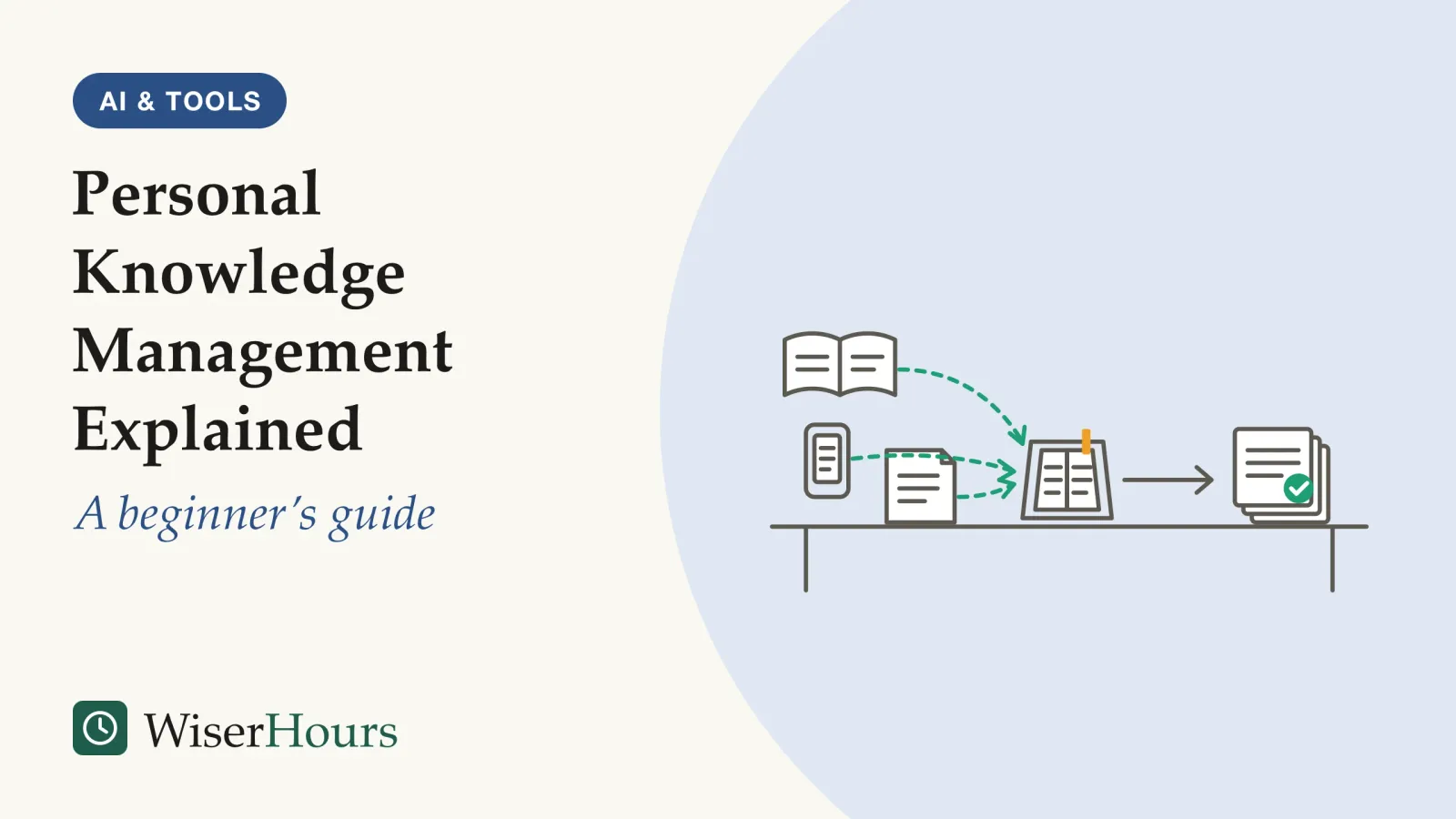
If you have ever bookmarked an article, screenshotted a slide or kept a notes app full of half-finished thoughts, you already do a loose version of personal knowledge management. Personal knowledge management (PKM) is the name for doing it on purpose: the habits one person uses to capture what they read, hear and think, organize it, connect it with what they know already, and put it to use in their work. Wikipedia’s overview calls it a bottom-up approach to knowledge management, driven by the idea that knowledge workers are responsible for their own learning.1
The label dates from the late 1990s and a working paper from the University of California, Los Angeles (UCLA) in the US.2 Most PKM advice you will meet online comes from practitioners’ experience rather than tested research, and the few studies of how people get back to their own saved material suggest that keeping something and being able to use it later are two different things. A useful system can therefore be small: one inbox, a folder for each piece of current work, search for everything else and a short weekly clear-out, set out step by step below. More guides to note-taking methods go deeper on each school.
Prefer to watch? The video covers the same ground as this article.
Where the name PKM came from, and what it covers
Personal knowledge management as a named idea goes back to Jason Frand of UCLA’s Anderson School of Management and Carol Hixson of the university’s library, who presented it at the Educom 98 conference in Orlando, in the US, in October 1998.3 Their working paper, dated December 1999, describes it as a framework for organizing and integrating the information a person judges important, so that it becomes part of their own knowledge.2
Frand and Hixson wrote for MBA students facing a flood of web pages and journals, and their worry was not storage but judgment. In print, editors and librarians had vetted what reached a reader; on the web, that job moved to the individual. Their answer was a routine: whenever you work with information, evaluate it, file it in a structure you understand and be able to retrieve it later, from your mind or your computer.2 The ambition is older still. In 1945 the engineer Vannevar Bush imagined the memex, a desk that would store a person’s books and records and let them follow trails of links between items.4
Definition
Personal knowledge management is the routine one person uses to capture, organize, connect and use what they learn, so that it is there when their work needs it.
Not everyone accepts the label. Wikipedia’s overview records critics who argue that only information can be managed, not knowledge, and that PKM may be a new wrapper for the older field of personal information management.1 The criticism is useful in practice. You cannot file understanding; you can only file notes, and the understanding comes from what you do with them. A project manager with a thousand saved articles about risk has information. The one who can explain, in a meeting, why the last three projects slipped has knowledge. So judge any PKM habit by whether it helps you think or act.
Four moves every personal system repeats
Nearly every personal knowledge system, whatever it is called, repeats four moves: capture material worth keeping, organize it so you can find it, connect it with what you know, and use it to produce something. Harold Jarche, a consultant who teaches his own model, which he calls personal knowledge mastery, compresses it to three verbs: seek, sense and share.5
- 1Capturesave what earns a place
- 2Organizeput it where you will look
- 3Connectlink it to what you know
- 4Useturn it into work, then start again
Then repeat from “Capture”
Each move exists to prevent a familiar failure. Without capture, the idea from Tuesday’s call is gone by Friday. Without organizing, it exists somewhere in three apps. Without connecting, it sits beside hundreds of other notes and never meets the problem it could solve. Without use, the whole system is a museum. Jarche’s version asks you to seek out new ideas, make sense of them and of your own practical experience, and share new practices, continuously rather than once.5
Picture a nurse educator in Nairobi preparing a short training session. She saves two guideline summaries to one folder, notes how each differs from what her ward does now, links that note to last year’s audit, and builds the session from those three pieces. That is the whole loop, done in an afternoon. When you try any system, ask which of the four moves it makes easier, and notice which one you keep skipping.
Second brain, slip-box, commonplace book or folders: what each puts first
The approaches most readers meet online differ mainly in which move of the loop they put first. Tiago Forte’s second brain puts use first, the Zettelkasten puts connection first, the commonplace book puts capture first, and plain folders put organizing first. All four are described by their practitioners; none has been tested against the others.
Forte, who sells courses on his method, describes a second brainsecond brain: Tiago Forte's name for one trusted digital notes system that holds what you want to keep, run through four steps: capture, organize, distill and express. It is a personal method from a course seller, and research supports parts of it, such as offloading reminders, more than the whole.Full entry in the glossary as a single digital store outside your head for what you learn, worked through four steps he calls capture, organize, distill and express.6 Which of those steps research supports is weighed in the building a second brain guide. The Zettelkasten, modeled on the card index of the German sociologist Niklas Luhmann, links many small notes that each hold a single thought; zettelkasten.de calls it a personal tool for thinking and writing.7 How to build one is in the Zettelkasten guide for beginners.
The other two schools are older and plainer. Commonplace books, kept from antiquity and especially in Renaissance Europe, collect quotations, facts and ideas under subject headings; in 1685 the English philosopher John Locke wrote a method for indexing them that was later printed in English.8 China’s biji tradition, whose name means “notebook” or “written notes”, gathered anecdotes, quotations and reflections in a similarly loose form.9 Plain folders, finally, need no method at all, and studies of how people get back to their own files show how firmly they stick with them.
| School | What it puts first | What supports it |
|---|---|---|
| Second brain (Forte) | Using notes to finish projects; filing by project | Practitioner method; parts touched by research, whole untested6 |
| Zettelkasten | Connecting single ideas through links | One documented scholar’s practice; no controlled study7 |
| Commonplace book | Capturing passages under subject headings | Centuries of use, described by historians8 |
| Plain folders and search | Organizing by a structure you already know | Surveys of how people get back to their own files10 |
Two questionnaire studies published in 2008 by Ofer Bergman, Steve Whittaker and their co-authors asked computer users how they got back to files on their own machines: by their own estimates, they browsed folders far more often than they searched, even once better desktop search tools arrived, and turned to search mainly when they could not remember where a file lived.10 Those are people’s own estimates, not logs, but they help explain why folders outlast every new app. Pick a school for the work your notes support. Someone who writes and develops ideas over years gets more from links; someone who mainly needs documents for this quarter’s work is well served by folders and search.
Start small: a personal knowledge management setup in four parts
A starter PKM setup needs four parts: one inbox where everything you capture lands, a folder for each piece of work you are doing now, search for everything else, and a short weekly review. Those four cover every move in the loop without building anything that needs upkeep. Filing by current work rather than by broad subject follows Tiago Forte’s advice to organize around the projects and goals you are committed to now.11
The weekly review is where the loop closes. Spend a few minutes emptying the inbox: delete what no longer matters, move the rest into a work folder, and add one line to each keeper saying why you kept it. That line does the connecting, and deleting early keeps the pile you search small. Any notes app, or a paper notebook with an index, can run this setup; the guide to choosing a note-taking app compares the options.
A secondary-school teacher in São Paulo sends every lesson idea, from podcasts, colleagues and journals, to one notes inbox on her phone. She keeps a folder for each class she teaches this term and lets search find older material. On Sunday evenings she clears the inbox and writes at the top of each note which lesson it could feed; a note that fits no lesson is deleted.

Your four-part starting kit
Download PDF
How much of PKM has been tested
Research on personal knowledge management as a whole is thin: Wikipedia’s overview calls it an under-researched area.1 Searches of PubMed and Crossref for this article in September 2026 turned up surveys and conceptual models, but no controlled study comparing PKM methods or testing any of them against doing nothing. What exists are studies of pieces of the loop, and the most pointed one concerns the gap between saving and using.
The study
Limited evidence
What happened when 50 people went looking for pages they had bookmarked
Ofer Bergman of Bar-Ilan University in Israel, with Steve Whittaker and Joel Schooler of UC Santa Cruz in the US, asked 50 people to find web pages they had visited, some of which they had bookmarked. Only about one in six bookmarked pages was found through the bookmarks, mostly ones sitting in plain view in the browser bar, and bookmarked pages were found no more successfully than pages people had visited without bookmarking them.12
This was a small study of browser bookmarks, supported by a Google research grant and read here as an abstract, not a trial of any PKM system. In the authors’ view, visibility made the difference: bookmarks people could see got used, and the rest were left alone.12 In notes terms, a read-later list buried in a menu behaves like the unused bookmarks, while a short list pinned where you start work each morning behaves like the browser bar.
Memory research adds a second caution. In three lab experiments with university students in Germany, published in 2021, participants who relied more on an external copy while doing a copying task, a habit called cognitive offloadingcognitive offloading: Using something outside your head, such as a note, a calendar alert, a search engine or a chatbot, to cut the mental work a task needs. It usually helps you do the task, though you may remember less of what you handed over.Full entry in the glossary, were quicker but recalled less of the material afterwards; warning them about the upcoming memory test made up for it in some set-ups but not others.13 Why writing notes and going back over them helps is explained in what note-taking does for memory. For material you must hold in your head, the best-supported habits are recall and spacing: in their 2013 review, John Dunlosky and colleagues gave practice testingretrieval practice: Learning by recalling material from memory, for example by quizzing yourself, instead of rereading it. Pulling information out makes it easier to recall later, a result also known as the testing effect.Full entry in the glossary, meaning recalling material from memory, and spreading study out over time a high utility rating, while rereading and highlighting rated low.14 That review covered students, so the fit with office work is loose.
- Myth
- A well-built PKM system makes you remember more.
- Fact
- A system helps you find things again. Remembering depends on recalling what you saved, which no filing scheme does for you.
Treat PKM as a way to find things and to think. Keep the few things you mean to act on where you will see them, and for anything you must know without looking it up, shut the note and try to recall it.
When tending the system replaces the work
The clearest sign of an over-built system is that looking after it has replaced the work it was meant to serve. Forte himself describes much of what people call organizing as procrastination in disguise.11 In daily life that can look like re-sorting tags on the afternoon a report is due.
Other signs follow from the loop. Your inbox grows every week but nothing leaves it. You have rebuilt your tags or switched apps twice this year. You spend more time reading about systems than using yours. The technology journalist Casey Newton described building a linked notes database, waiting for insights that did not come, and concluding that software is probably the wrong place to look for better thinking.15 His account is one person’s experience, not data, but it matches the bookmarks study’s lesson that saving is the easy part.12
The fix is usually subtraction. Archive tags you never search, merge folders you never open, and move back to the four basics above.
The bottom line
Begin with the smallest system that closes the loop: one inbox, folders for current work, search and a weekly clear-out. Add more structure only when a real task asks for it, and judge the system by what it helps you finish.
Frequently asked questions
Is personal knowledge management the same as knowledge management at work?
No. Knowledge management usually means what an organization does to capture and share what its people know, through wikis, databases and processes. Personal knowledge management, as Wikipedia's overview describes it, is the bottom-up version: each person taking responsibility for their own learning and information. The two meet when individuals share what they have organized with a team.
What is the difference between PKM and personal information management?
Personal information management is the older research field on how people keep, find and file their own documents, email and files. Critics summarized on Wikipedia, such as William Jones, argue that only information can be managed, not knowledge itself, so PKM may be a new label for the same practice. In daily use, the difference is mainly the aim: PKM stresses learning and using ideas, not only storing files.
Can personal knowledge management work on paper?
Yes. Commonplace books, kept widely in Renaissance Europe, and similar notebook traditions such as Chinese biji were paper systems. Jason Frand and Carol Hixson's 1999 working paper also argued that one filing scheme can cover paper documents, electronic files, web bookmarks and a home library. Paper costs you full-text search, so an index or a table of contents matters more.
Is PKM a new idea?
The label is recent, the practice is not. Readers have kept organized notebooks of quotations and ideas for centuries, and in 1945 the engineer Vannevar Bush imagined the memex, a desk-sized machine that would store a person's books and records and let them follow trails of links between items. Wikipedia notes that the memex influenced early hypertext and personal knowledge software.
Sources
- Personal knowledge management. Wikipedia (accessed 2026-09-28)
- Personal Knowledge Management: Who, What, Why, When, Where, How? Frand, J. & Hixson, C. (1999). Working paper, UCLA Anderson School of Management (archived copy)
- Personal Knowledge Management: Who? What? Why? When? Where? How? Frand, J. L. & Hixson, C. G. (1998). Presentation at the Educom 98 conference, Orlando, Florida; repository record, USF St. Petersburg
- Memex. Wikipedia (accessed 2026-09-28)
- Seek > Sense > Share (Personal Knowledge Mastery). Jarche, H. (accessed 2026). jarche.com
- Building a Second Brain: The Definitive Introductory Guide. Forte, T. (2023). Forte Labs
- Introduction to the Zettelkasten Method. Fast, S. (2020). zettelkasten.de
- Commonplace book. Wikipedia (accessed 2026-09-28)
- Biji (Chinese literature). Wikipedia (accessed 2026-09-28)
- Improved search engines and navigation preference in personal information management. Bergman, O., Beyth-Marom, R., Nachmias, R., Gradovitch, N. & Whittaker, S. (2008). ACM Transactions on Information Systems, 26(4)
- The PARA Method: The Simple System for Organizing Your Digital Life in Seconds. Forte, T. (2023, updated 2026). Forte Labs
- Out of sight and out of mind: Bookmarks are created but not used. Bergman, O., Whittaker, S. & Schooler, J. (2020). Journal of Librarianship and Information Science, 53(2)
- Consequences of cognitive offloading: Boosting performance but diminishing memory. Grinschgl, S., Papenmeier, F. & Meyerhoff, H. S. (2021). Quarterly Journal of Experimental Psychology, 74(9)
- Improving Students' Learning With Effective Learning Techniques: Promising Directions From Cognitive and Educational Psychology. Dunlosky, J., Rawson, K. A., Marsh, E. J., Nathan, M. J. & Willingham, D. T. (2013). Psychological Science in the Public Interest, 14(1)
- Why note-taking apps don't make us smarter. Newton, C. (2023). Platformer
How we researched this
We read Wikipedia's overviews of personal knowledge management, commonplace books, biji and the memex, Frand and Hixson's 1998 conference record and 1999 working paper, and practitioner sources by Harold Jarche, Tiago Forte and zettelkasten.de. For evidence we searched Crossref, PubMed and the web in September 2026 for studies of refinding, bookmarks, cognitive offloading and study techniques; three papers were read as abstracts only. Main limitation: no controlled study of PKM as a whole exists.
Keep reading
Why Take Notes at All? What Note-Taking Does for Memory and Thinking
Why take notes? A 57-study meta-analysis found only a modest benefit from taking notes; a second found substantial effects from taking and reviewing them.
Notion vs. Obsidian: Which Fits How You Think?
Notion vs Obsidian: a shared cloud workspace or Markdown files on your device. 8 deciding points, from offline use to switching, checked October 2026.
A Single Source of Truth: What It Means and How to Get There
A single source of truth gives each key fact one home and one owner. What it means, how it differs from a system of record, and 5 steps for a small team.

Logseq Explained: Outliner-Style Notes and Who They Suit
Logseq explained: an outliner where every note is a block, its 2 versions since 2026 (Markdown files or a database), privacy, price and who it suits.