Income Protection and Disability Insurance: Covering Your Biggest Asset
Income protection insurance replaces part of your pay if illness stops you working. US Social Security puts a 20-year-old's disability odds at 1 in 4.

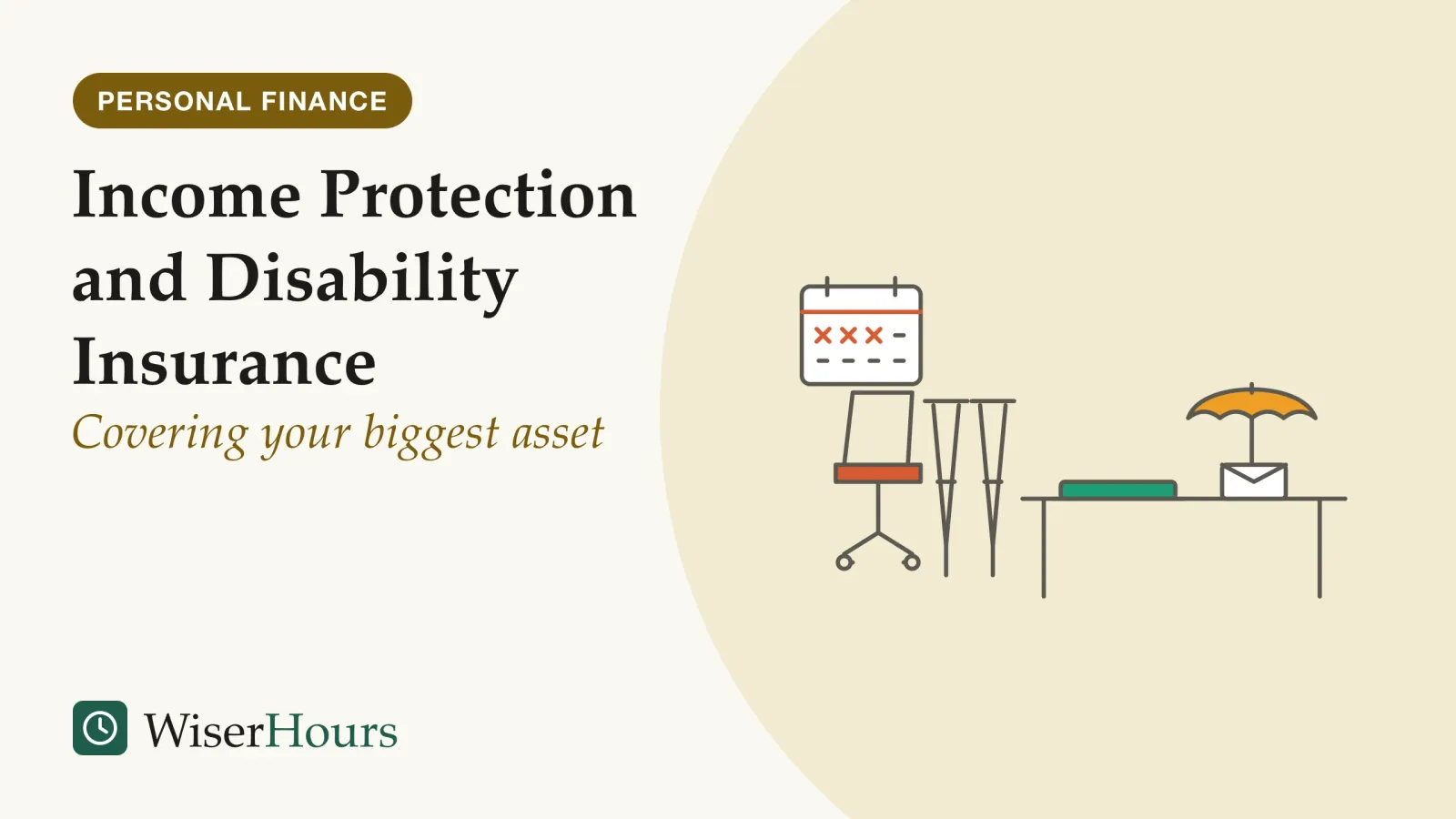
A broken ankle, a cancer diagnosis or a long episode of depression can stop your pay well before it stops your bills. Income protection insurance pays you a regular share of your earnings if illness or injury stops you working. Payments start after a waiting period you choose and last until you can work again, the policy’s time limit runs out or you reach its end age.
The names change at the border. British guides say income protection, American insurers sell the same idea as disability insurance, and in Australia much of it sits inside superannuation funds. Most of this section of WiserHours is about income that doesn’t depend on your hours. This guide covers the income that does: your pay, and how to keep part of it coming when you are too ill to earn.
To judge whether you need cover, work through three checks in order:
- List what you would get anyway: state sick pay or disability benefits, your employer’s sick pay or group cover and, in Australia, any cover inside your super.
- Count how many months those payments and your savings would cover your essential bills.
- If a gap remains, compare policies on the definition of disability, the waiting period and the benefit period before you compare prices.
Prefer to watch? The video covers the same ground as this article.
What is income protection insurance and how does it work?
Income protection insurance replaces part of your income, never all of it, once you have been unable to work for an agreed waiting period. MoneyHelper, a guidance service backed by the UK government, says UK policies typically pay between 50 and 65 percent of income, that the usual waiting periods run from a few weeks to a year, and that a longer wait means a lower premium.1
Why not the full amount? North Carolina’s Department of Insurance, a US state regulator, explains that a policy paying 100 percent would remove the financial reason to return to work, pushing up claims and premiums for everyone.2 So the design leaves a gap on purpose, and your budget has to absorb it.
Every policy, whatever the country calls it, is built from four dials:
- The benefit: the share of your earnings it pays. Policies differ on which earnings count; in Australia, Moneysmart says the benefit is usually based on your earnings in the 12 months before the illness or injury.3
- The waiting period: the deferred period in the UK and Ireland, the elimination period in the US.
- The benefit period: how long payments can run. Moneysmart says most Australian policies offer two or five years, or payment up to a set age such as 65.3
- The definition of disability: the test you must pass to claim, covered in its own section below.
One more rule is easy to miss: other income is usually subtracted. Ireland’s consumer regulator, the CCPC, says insurers deduct employer sick pay, state illness benefit and other income. In its worked example, a worker covered for €2,500 a month received €1,000, because those payments came off first.4 The policy tops you up to a ceiling; it does not stack on top.
- Illness or injury stops work: normal pay ends, though sick pay from an employer or the state may continue for a while
- Waiting period: called the deferred or elimination period; the policy pays nothing yet, so sick pay or savings fill the gap
- Monthly benefit: a share of your earnings, never all of them, paid while you meet the policy’s definition of disability
- Payments stop: when you return to work, the benefit period runs out, or you reach the policy’s end age
Compare policies on all four dials and the offset rule, not on the monthly premium alone. Two policies at the same price can pay very different amounts for the same illness.
How income protection differs from disability, critical illness and life cover
Income protection and disability insurance are the same idea under different national names: both replace part of your earned income when illness or injury stops you working. Wikipedia’s overview of disability insurance notes that some countries call the same concept income protection insurance.5
In the US, the National Association of Insurance Commissioners (NAIC), which brings the state insurance regulators together, splits it in two. Short-term cover typically replaces part of a salary for three to six months; long-term cover generally starts about six months after the disability and can last years, even until retirement age.6
The covers people confuse it with pay out for different events:
| Cover | Pays when | How it pays |
|---|---|---|
| Income protection or disability insurance | Illness or injury stops you working, as the policy defines it | A regular income, part of your earnings, for a set time1 |
| Critical illness insurance | You are diagnosed with a specific serious illness | A one-off lump sum1 |
| Life cover | You die or have a terminal illness | A lump sum or income stream to your beneficiaries7 |
A diagnosis on a critical illness list pays once, whether or not you keep working, while a bad back that keeps you off work for months may not be on any list. Income protection asks one question instead: can you do the work? Life cover, and how much of it a household needs, is a separate decision.
- Myth
- Critical illness cover and income protection do the same job.
- Fact
- Critical illness pays a lump sum for a listed diagnosis. Income protection pays a monthly income for as long as you can't work, whatever the cause the policy covers.
Why your earning power is worth insuring
Your ability to earn is worth protecting because the official odds of losing it for a while are far from small. The US Social Security Administration estimates that a 20-year-old worker has a 1-in-4 chance of developing a disability before reaching full retirement age.8
The NAIC’s 2020 consumer guide puts the reason to care plainly: many people don’t realize that their most valuable asset is their ability to work. It adds that US research by the Department of Education and the National Institute on Disability, Independent Living, and Rehabilitation Research found heart disease, back injury and cancer to be the most common causes of long-term disability, followed by anxiety and depression.6
Your income rarely shows up when you calculate your net worth, because the statement lists only what you own today. Yet early in a career, decades of future pay can be worth more than everything on that list combined.
The public safety net is narrower than the risk. According to the SSA’s July 2026 booklet, US Social Security disability benefits go only to people who cannot work because of a condition expected to last at least a year or to result in death, and nothing is paid for partial or short-term disability. There is generally a five-month waiting period before the first benefit.8 A six-month illness could pass without a single payment.
What own-occupation disability insurance means
Own-occupation cover pays if you can no longer do your own job; any-occupation cover pays only if you cannot do any work that suits your education, training and experience. MoneyHelper describes a middle level, suited occupation, and says own-occupation is usually the most expensive but more likely to end in a successful claim.1
In the US, the definition can change partway through a claim. North Carolina’s insurance department says long-term policies usually use an own-occupation test for the first one or two years, then switch to any-occupation, which for some people is considerably harder to meet.2
A made-up example: a dental hygienist develops a tremor and can no longer treat patients, but could answer phones at the practice. Under own-occupation cover she would likely qualify, depending on the policy wording. Under any-occupation wording, the insurer could argue that the office job suits her experience.
Ireland’s CCPC warns about the far end of the scale: some policies pay only if you are so severely and permanently disabled that you cannot do any paid work, which gives very little protection.4 Read the definition of disability before the price, and check whether it changes after a set time.
What state, employer and super cover already pays
Before buying anything, find out what you already have: state sick pay or disability benefits, sick pay or group cover from your employer and, in Australia, insurance inside your super fund. Private cover fills the gap these leave, so the gap is what you are pricing.
In the United States, workplace cover is far from universal. In March 2026, the Bureau of Labor Statistics found that 44 percent of private-industry workers had access to a short-term disability plan and 37 percent to a long-term one.9 So most US private-sector workers have no employer disability plan to fall back on, and those who do should check what it pays and for how long.
In the United Kingdom, employers pay Statutory Sick Pay of up to £123.25 a week, or 80 percent of normal weekly earnings if that is lower, for up to 28 weeks (GOV.UK, as of October 2026).10 When it ends, you may be able to claim Universal Credit or Employment and Support Allowance.11
In Australia, Moneysmart says most super funds offer default income protection, with premiums taken from your super balance, which reduces your retirement savings. Policies outside super may allow more cover, and their premiums are generally tax-deductible.3
Everywhere else, sick pay as a legal right is far from universal. The International Labour Organization reported in 2024 that about 56 percent of the world’s labor force is legally entitled to sickness benefits, so close to half of workers are not.12 Readers in other countries should start with their government’s sickness and disability benefits and their own employment contract.
Is income protection insurance worth it?
Whether income protection insurance is worth it depends on how long you could pay your essential bills without your salary. The UK’s MoneyHelper says you may not need it if your employer pays sick pay for 12 months or more, if state benefits would cover all your outgoings, if your savings could last a long time, or if a partner’s income would cover you both.1
The study
Moderate evidence
Uncovered households and declined claims: an FCA market study, UK, 2026
The Financial Conduct Authority found that 58% of people in the UK held no protection products, and that 59% of those had never considered their protection needs. Income protection had the lowest claims acceptance rate of the protection products it examined, at 86%. Stakeholders linked declined claims partly to customers not disclosing relatively minor medical conditions, and to how policies define illness.13
These are UK market averages, not a verdict on any single policy, and the FCA concluded that the lower acceptance rate did not on its own show poor outcomes for consumers.
MoneyHelper warns that insurers check your medical history when you claim, so an answer left out at application can cost you the payout. Price follows risk too: it lists your age, occupation, smoking, health, the share of income covered, the waiting period and the range of conditions covered, and contrasts fixed premiums with standard ones the insurer can raise over time.1
Match the wait to your buffers
Our illustration, in any currency: your essential bills are 2,000 a month, your employer pays full sick pay for three months, and your emergency fundemergency fund: Money kept in an account you can reach quickly, to cover unexpected costs or a drop in income without borrowing. How much to hold depends on your circumstances, and official guidance differs by country.Full entry in the glossary covers three months more. A waiting period of about six months lines up with those buffers; a four-week wait would start while sick pay is still coming in, which policies often deduct from the benefit, at a higher premium.
Does income protection cover mental health conditions?
Income protection can pay for a mental health condition that stops you working, but a past condition may lead to an exclusion or narrower terms. Both halves matter when you apply.
Such claims are common. UK industry figures from Group Risk Development, a trade body for employer-paid cover, put mental illness as the second most common cause of new group income protection claims in 2025, at about a fifth, behind cancer.14 That is industry data, not an independent study.
The catch is history. North Carolina’s insurance department says a policy may deny claims from pre-existing conditions, usually ones treated or showing symptoms within a set time before cover began.2 If you have had anxiety, depression or another mental health condition, answer the application’s health questions about it fully and honestly, then ask the insurer or adviser to show you in writing how the policy will treat it.
Questions to answer before you buy
Put these questions to an insurer, broker or adviser, in writing if you can. They cover the dials and traps described above, and Australia’s Moneysmart publishes a similar list.3
Questions for the insurer or adviser
Getting a second opinion, and urgent support
Buying cover is rarely urgent, but your safety can be. The list runs from most to least urgent, and every route in it is credited to its source.
- Now: if money or health worries ever lead to thoughts of suicide or self-harm, your local emergency number comes first. In the US, the 988 Suicide & Crisis Lifeline takes calls and texts, and 911 handles life-threatening emergencies, according to the National Institute of Mental Health.15 In the UK, the NHS lists 999 and A&E for anyone whose life is at risk, along with Samaritans on 116 123.16
- Soon, before you buy, replace or cancel a policy: in the UK, MoneyHelper suggests an independent financial adviser or specialist broker, and notes that some charge a fee while others are paid commission by insurers, so ask how yours is paid.1 Elsewhere, look for a regulated or fee-only adviser and check your own insurance regulator’s consumer pages, and don’t cancel old cover before new cover is in place.
- Routine: review your cover when life changes, such as a new child, a new mortgage or a job with different sick pay.
The bottom line
Your ability to earn pays for almost everything else, and the US Social Security Administration puts a young worker’s odds of a disability before retirement at about 1 in 4. Before you buy cover, find out what sick pay and state benefits you already have. Then compare policies on the definition of disability, the waiting period and the benefit period before you look at price, and answer every medical question in full.
This article is general education, not financial advice. For decisions about your own money, speak to a qualified, regulated adviser.
Frequently asked questions
Are income protection payments taxed?
It depends on the country and on who paid the premiums. The US NAIC's 2020 guide says benefits from an individual policy are generally income tax-free, while part of a benefit from an employer-paid group policy may be taxable. Australia's Moneysmart says payments must go in your tax return, and Ireland's CCPC says benefits are taxable. Check your own tax authority's rules.
Can I get income protection if I'm self-employed?
Yes, self-employed people can buy individual cover, and they often need it most. MoneyHelper notes that the self-employed have no sick pay to fall back on, and Ireland's CCPC says the State's illness benefit there is not available to them. The UK's FCA found self-employed and gig workers among the groups more likely to be left without protection.
Can I cancel an income protection policy after buying it?
Usually, yes. MoneyHelper says UK buyers have 30 days to change their mind for a full refund, and that after cancelling you cannot reinstate the policy. Ireland's CCPC describes a similar 30-day window, though fees may be deducted from the refund. Rules differ elsewhere, so check the cooling-off period in your policy documents.
Does disability cover from my job follow me if I leave?
Often it does not. The US NAIC says extra cover bought through an employer's group policy is not likely to be transferable to another job. In Australia, Moneysmart warns that cover in super can end if you change funds or your account stops receiving contributions. Before you change jobs, find out when your cover ends and what replacing it would cost.
Sources
- What is income protection insurance? MoneyHelper (UK, Money and Pensions Service); read in a web archive copy of 24 September 2026
- A Consumer's Guide to Disability Income Insurance. North Carolina Department of Insurance (US), consumer guide, accessed 6 October 2026
- Income protection insurance. Moneysmart, Australian Securities and Investments Commission (Australia), last updated 17 September 2026; checked live 6 October 2026
- Income protection insurance: how it works and who needs it. Competition and Consumer Protection Commission (Ireland), accessed 6 October 2026
- Disability insurance. Wikipedia, accessed 6 October 2026
- If a Disability Were to Keep You From Earning a Living, How Would You Pay Your Bills? National Association of Insurance Commissioners (US), consumer insight, 20 May 2020; checked live 6 October 2026
- Insurance through super. Moneysmart, Australian Securities and Investments Commission (Australia), last updated 17 September 2026; checked live 6 October 2026
- Disability Benefits (Publication No. 05-10029). Social Security Administration (US), July 2026 edition; read in a web archive copy of 30 September 2026
- Employee Benefits in the United States, March 2026. Bureau of Labor Statistics (US), news release USDL-26-1534, 25 September 2026; checked live 6 October 2026
- Statutory Sick Pay (SSP): what you'll get. GOV.UK (UK government), checked current on 6 October 2026
- Statutory Sick Pay (SSP): eligibility. GOV.UK (UK government), checked current on 6 October 2026
- World Social Protection Report 2024-26: Universal social protection for climate action and a just transition. Executive summary. International Labour Organization (2024)
- Market study into the distribution of pure protection products to retail customers: Final Report (MS24/1.5). Financial Conduct Authority (UK), September 2026
- Sixty-eight per cent of employees who were newly absent returned to work under group income protection benefits in 2025. Group Risk Development (GRiD), UK industry body for group risk insurance, press release, 16 June 2026
- Suicide Prevention. National Institute of Mental Health (US), last reviewed August 2026
- Where to get urgent help for mental health. NHS (England), page last reviewed 26 April 2023; content checked 6 October 2026
How we researched this
In October 2026 we read consumer guidance from regulators and official services in the US (SSA, NAIC, North Carolina Department of Insurance), the UK (MoneyHelper, GOV.UK), Australia (ASIC Moneysmart) and Ireland (CCPC), the FCA's 2026 protection market study, BLS benefits data, UK group insurance claims data from the industry body GRiD and the ILO's World Social Protection Report. Some pages blocked scripts and were read in archived copies. Main limitation: no study compares policy features against outcomes, so the guidance rests on official descriptions.
Keep reading
Life Insurance Explained: Term, Whole-Life, and How to Think About Need
Life insurance term vs whole life: 7 features compared, when each can suit, what happens when a term ends, and a way to think about how much cover you need.
Assets vs. Liabilities: A Plain-English Guide to Your Personal Balance Sheet
Assets vs liabilities explained: where 7 tricky items go, from a mortgaged home to pay-later plans and tax bills, and a one-page balance sheet to fill in.
Dividend Reinvestment Explained: How Payouts Compound Over Time
How dividend reinvestment grows a holding: a hypothetical example where 100 shares become about 219 in 20 years, plus the tax, records and risks to know.
Renting vs. Buying Your Home: The Wealth-Building Case for Each
Renting vs buying: US owners' median net worth is about 43 times renters', yet much of that gap reflects who buys. What decides which builds more wealth.