Interstitial Journaling: Short Notes Between Tasks
Interstitial journaling means a few timestamped lines each time you switch tasks. How to start, a template, 3 formats and the research behind it.

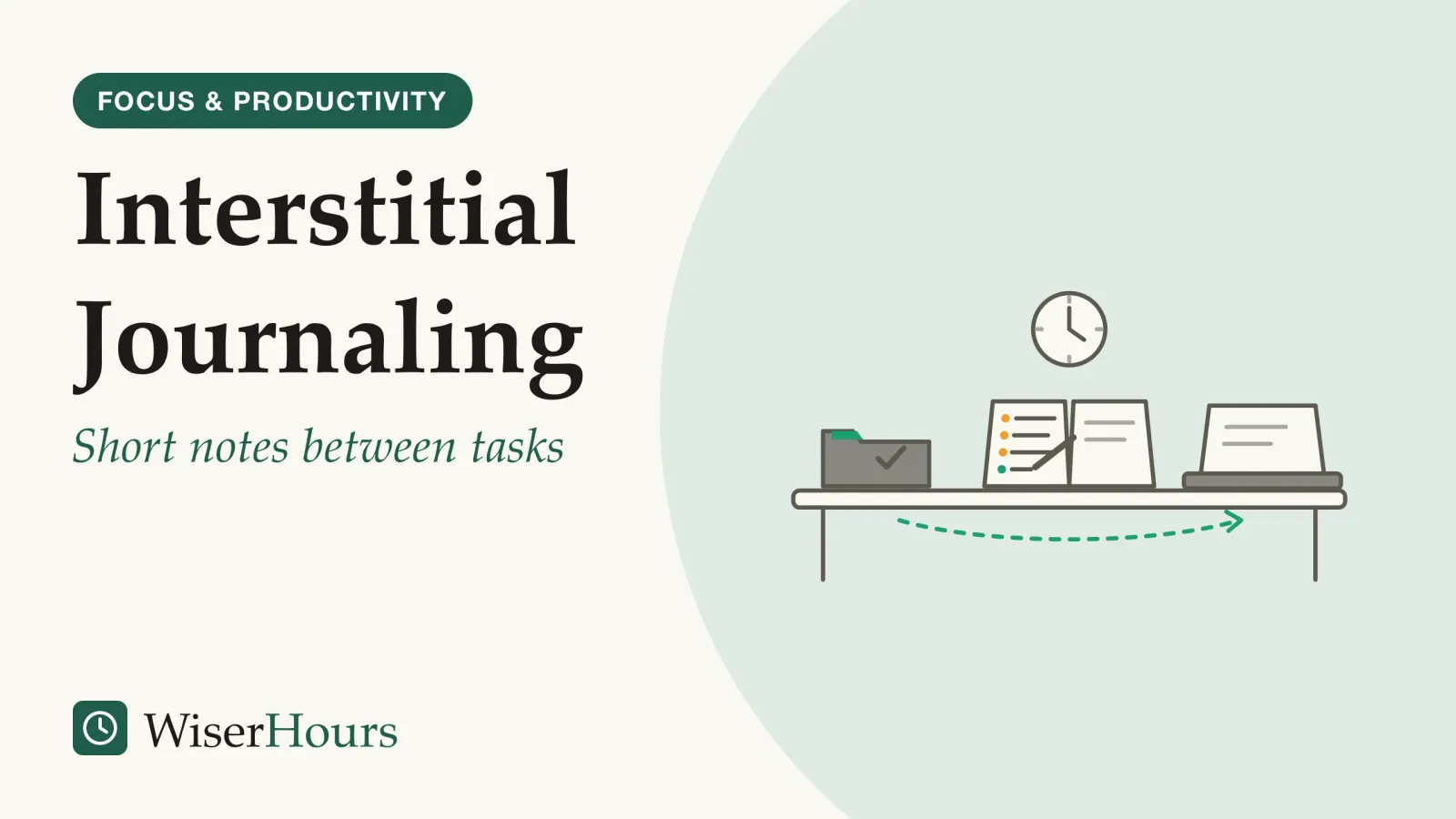
Interstitial journaling is the habit of writing a short, timestamped note every time you move from one task to the next: what you just did, how it went and your opening move on the next one. The notes pile up into one running page that doubles as your to-do list, a rough time log and a record of the day, all at once.1
The method has no study of its own, but its core move borrows from one that does. Two US management researchers reported in four 2018 studies that a quick plan for getting back to interrupted work reduced attention residue, the leftover thinking about the task you set aside.2 To try interstitial journaling:
- Keep one running page open all day
- Write the time whenever you switch
- Close out the last task in a line
- Write the first action of the next task
- Read the log back before you stop work
What is interstitial journaling?
Interstitial journaling is writing a few lines in the gaps between tasks, each entry stamped with the time. Tony Stubblebine, a productivity coach and the founder of the coaching app Coach.me, named the practice; NBC News reported in 2019 that he first described it in an article for Medium’s Better Humans publication in 2017.3 “Interstitial” means lying in the spaces between things, which is where the entries go.
Nobody owns the idea. Stubblebine’s version has three parts: note the time, write a few sentences on what you just worked on and how it went, then write the first action for your next task.3 Anne-Laure Le Cunff of Ness Labs, a newsletter on productivity and learning, described a looser version in 2020 that adds a line every time you take a break, including the unplanned ones.1
It sits among the lighter productivity methods. Next to the bigger frameworks in the major productivity systems compared, it asks for almost nothing: no lists to maintain and no categories to choose. If you already keep a bullet journal’s daily log, interstitial entries can live on the same page.
- Myth
- Journaling means writing a page of reflections every evening.
- Fact
- An interstitial entry is one to four sentences written at a switch, and most of it is practical: the time, a result and a next step.
What do you write in an interstitial journal?
Each entry needs three things: the time, a line on the task you are leaving, and the first action of the task you are starting. Add a word on how you feel or what got in the way when it is useful. Le Cunff’s examples mix goals, notes on getting sidetracked, quick self-reviews and action items in the same running list.1
A template you can copy
Time · Just did: what you finished or where you stopped · How it went: a few words, including anything that got in the way · Next: the first small action of the next task
A morning in a plain text file might read like this (an illustrative example):
- 09:02 Starting. Next: reply to the two supplier emails.
- 09:31 Emails done, one needs a figure from finance. Next: open the Q3 draft at the methods section.
- 10:15 Drafted half the methods; got pulled into the team chat for 15 minutes. Next: finish the sampling paragraph.
- 10:40 Stopped mid-paragraph for the client call. Next after the call: reread the last sentence, then write the limits.
The “how it went” line is where the reset happens. Stubblebine told NBC News that the aim of writing about the last task is to be finished with it, so it stops following you into the next one. He also uses the entry to ask whether he feels resistance to the next task, and why.3
How to do interstitial journaling
Interstitial journaling takes one place to write and a cue to write in it. Stubblebine advises using whatever you already keep your to-do list in, keeping entries short and adjusting the format to the places you tend to get stuck.3
1. Keep one running page open all day
Pick a single page or file for today and leave it where you can reach it in two seconds. A second notebook or a new app you must remember to open adds a step at every switch, and every extra step gives you a reason to skip an entry.
2. Write the time whenever you switch
A switch is any move to different work: finishing a task, leaving for a meeting, being pulled into a chat, taking a break. Le Cunff suggests logging unplanned breaks too, because once every break gets written down, it is easier to resist starting one.1
3. Close out the last task in a line
Note what you finished or exactly where you stopped. If the task is unfinished, add the step you will take when you return. That line is the best-studied part of the method, and the next section describes the research.
4. Write the first action of the next task
Stubblebine builds on David Allen’s “next action”: instead of “create presentation”, write “open PowerPoint”. He argues that a first action feels like an easy task rather than a project, so it meets less resistance.3
5. Read the log back before you stop work
Spend two minutes reading the day’s entries before you stop. Carry any open “next” lines into tomorrow’s plan or your end-of-day review.
At every switch
Why a note between tasks can help
A note at each switch does three jobs that research has studied separately: it gives an unfinished task somewhere to wait, it turns the next task into a concrete first step, and it leaves a record you can learn from. None of these studies tested interstitial journaling itself; each one supports a single part of it.
The first job has the closest evidence. When you leave work half done, part of your mind stays with it, which the guide to how attention residue drags on the next task explains in full. Sophie Leroy and Theresa Glomb, US management researchers, tested a fix that looks a lot like an interstitial entry.
The study
Limited evidence
Planning the return before switching away
The authors report that when people expected to go back to unfinished work with little time to spare, they found it harder to concentrate on the job that had interrupted them. A brief step in which they reflected on the unfinished work and planned how to pick it up again left them with less attention residue, and their performance on the job in between held up.2
The finding fits a busy morning well. A project manager who has to drop a budget draft for a client call can write “10:40, budget half done, next: check the travel line” and walk into the call with less of the budget still in her head. The study did not test a running journal, and the effect was clearest under expected time pressure. Everything above comes from the paper’s abstract, so the finding counts as a promising lead for interstitial journaling and little more.
The one field test of the plan so far adds a caution. In a 2025 Dutch experiment, Ward van Zoonen and Yuri Scharp randomly assigned 50 employees of a technology consultancy either to write a short return plan after each interruption or to carry on as usual, for four working days. The plan group reported less attention residue but more exhaustion overall, and every measure was self-reported.4
Earlier experiments agree. In a 2011 set of experiments, E. J. Masicampo and Roy Baumeister of Florida State University, working mostly with US students, showed that a goal left unfinished kept intruding on people’s thoughts while they did something else, and that writing a specific plan for it stopped the interference, though the goal itself was no closer to done.5 The daily review uses the same finding once, before you stop for the day; the interstitial entry applies it at every switch.
Word the next step as a concrete action. A 2025 meta-analysis pooled 642 tests of if-then plans, which researchers call implementation intentionsimplementation intention: A plan in if-then form that ties a specific action to a specific situation, such as 'if it is nine o'clock, then I open the report.' It hands the decision about when and where to act to the situation itself.Full entry in the glossary. Forming such plans helped across thinking, feelings and behavior, with bigger effects for plans worded in if-then form, though the authors judge the average benefit small once publication bias is allowed for.6 “Open the deck and fix slide 3” is a step you can take in the first minute, while “work on the presentation” leaves the starting decision for later.
- The time: a timestamp on every entry turns the notes into a rough log of the day
- Close the last task: a line on what you did and how it went, so it stops pulling at you
- Open the next one: the first small action, written before you start
- Read it back: the entries become the record for an end-of-day or weekly look
Is interstitial journaling the same as a time log?
Interstitial journaling overlaps with a time log, because every entry carries a timestamp, but it does more than record hours. A time log only says when you did what; an interstitial entry also says how it went and what comes next. The timestamps give you a cheap time log as a side effect.
That side effect is worth having, because memory is a poor clock. Time-use researchers in the US and Belgium compared what employed people estimated they worked in a week with what they recorded in time diaries. On average the estimates ran 5 to 10 percent higher, and most of the gap came from people who estimated long hours.7 Economists at the US Bureau of Labor Statistics later challenged parts of that analysis and concluded that any such bias in the main US survey is small.8
Both papers treat a diary kept at the time as the more accurate record, because it does not rely on memory of a whole week. In both papers the gap varies a lot from person to person, so your own may be larger or smaller than any average.78 Someone who feels they “worked all day” on a report may find the log shows two solid hours and a string of message checks.
Paper, a notes app or a plain text file
Any of the three works, and the best choice is the one already open in front of you. Stubblebine says paper or an app is fine and the tool does not need optimizing; Le Cunff notes that even a text file works.31
Paper suits people who already keep a notebook on the desk. Writing the time by hand takes a glance at the clock, and a page is easy to scan when work is done. It is harder to search later.
A notes app with daily notes, such as Obsidian, Logseq or Roam, can insert the time with a shortcut and link entries to project pages. Le Cunff describes a slash command in Roam that does this.1 The risk is fiddling with templates instead of writing.
A plain text file, one per day or one long file with a date heading, opens instantly on any computer and can be searched for years. A designer who works across three tools all day might keep the file pinned beside them and type an entry in ten seconds.
Try it for a week, then read the log back
Run interstitial journaling for one ordinary working week, then read the whole log in one sitting and look for patterns. Five working days are enough to show your usual switches, and few enough that a skipped entry or two will not spoil the picture.
There is indirect support for writing progress down. In 2016 Benjamin Harkin and colleagues, working from the University of Sheffield in the UK, combined 138 randomized studies in a meta-analysis. Prompts to track progress helped people attain their goals, and the effect was larger when progress was physically recorded or made public.9 Those studies were not about work logs, so the link is borrowed.
Reading the week back in one go is where the log earns its keep. A single entry tells you little, because one interrupted morning looks like bad luck; a week of entries side by side lets the repeats stand out. Set aside half an hour on the last afternoon of your working week, with the log open and a pen for notes.
What the log shows tends to be ordinary and useful: the chat that swallows the half hour after every meeting, the task you have restarted again and again, the first actions that were too vague to start. Keep what helped and drop the parts that felt like paperwork. If you also run a weekly review, the week’s entries make it easier, because you can see what moved instead of trying to remember.1
How much of interstitial journaling has been tested?
Each job an interstitial entry does has some research behind it, but nobody has studied the routine as a whole.
| What it is | What the best evidence found | Evidence |
|---|---|---|
| Planning your return before a switch | Less attention residue under expected time pressure; a small field test also found more exhaustion | Four studies plus one field test, limited24 |
| Writing a plan for an unfinished task | Removed intrusive thoughts and interference, with the goal still unmet | Experiments, limited5 |
| Making the next step an if-then plan | Helped across 642 tests, especially with if-then wording; small average benefit | Meta-analysis, moderate6 |
| Timestamped records instead of estimates | Estimates ran higher than diaries in the US and Belgium; disputed, and the bias in the main US survey is small | Survey comparisons, mixed78 |
| Tracking progress | Better goal attainment, more so with a physical record; not studied for work logs | Meta-analysis, moderate (borrowed)9 |
| The full routine of notes at every switch | No study found | Practitioner advice |
The bottom line
The useful core of interstitial journaling is small: at each switch, write the time, where you left the last task and the first action of the next one. That step is the one the research supports most directly. Start tomorrow with one page open beside your work, write at every switch for five working days, then read the log back and change one thing.
Frequently asked questions
What is a good length for an interstitial journal entry?
Short enough that you will write one at every switch. Tony Stubblebine, who named the method, told an NBC News reporter in 2019 that an entry might run to about four sentences. Anne-Laure Le Cunff's published examples are a single line each: the time and a few words on what happened or what comes next. Keep them short enough that writing one never feels like a chore.
Can interstitial journaling help with procrastination?
It may help you notice it. In the same 2019 interview, Stubblebine said he uses entries to ask whether he feels resistance to the next task and why. Writing a small first action also lowers the bar to starting. No study has tested interstitial journaling on procrastination, so treat this as a practitioner's tip.
Which app works best for interstitial journaling?
None in particular. Stubblebine's own advice is that paper or an app both work and that the tool does not need optimizing. Le Cunff, of Ness Labs, wrote in 2020 that even a text file works well. Apps with daily notes and a quick timestamp shortcut make it a little faster, but a notebook beside the keyboard does the same job.
Sources
- Interstitial journaling: combining notes, to-do and time tracking. Le Cunff, A.-L. (2020). Ness Labs, 15 April 2020
- Tasks Interrupted: How Anticipating Time Pressure on Resumption of an Interrupted Task Causes Attention Residue and Low Performance on Interrupting Tasks and How a “Ready-to-Resume” Plan Mitigates the Effects. Leroy, S. & Glomb, T. M. (2018). Organization Science, 29(3), 380-397
- How 'interstitial journaling' can help you focus your day and work smarter. Compton, J. (2019). NBC News BETTER, 6 August 2019
- Managing daily work intrusions: An intervention to reduce attention residue and exhaustion. van Zoonen, W. & Scharp, Y. S. (2025). International Journal of Stress Management, 32(4), 395-407
- Consider it done! Plan making can eliminate the cognitive effects of unfulfilled goals. Masicampo, E. J. & Baumeister, R. F. (2011). Journal of Personality and Social Psychology, 101(4), 667-683
- The when and how of planning: Meta-analysis of the scope and components of implementation intentions in 642 tests. Sheeran, P., Listrom, O. & Gollwitzer, P. M. (2025). European Review of Social Psychology, 36(1), 162-194
- The overestimated workweek revisited. Robinson, J. P., Martin, S., Glorieux, I. & Minnen, J. (2011). Monthly Labor Review, US Bureau of Labor Statistics, 134(6), 43-53
- Is the workweek really overestimated? Frazis, H. & Stewart, J. C. (2014). Monthly Labor Review, US Bureau of Labor Statistics, June 2014
- Does monitoring goal progress promote goal attainment? A meta-analysis of the experimental evidence. Harkin, B., Webb, T. L., Chang, B. P. I., et al. (2016). Psychological Bulletin, 142(2), 198-229
How we researched this
During November 2026 we looked through the web, OpenAlex and Crossref for the origin of interstitial journaling and for research into plan making, interruptions, time diaries and progress monitoring. We read the studies in full except the 2018 interruption studies, which we saw only as an abstract. The main limit: interstitial journaling itself has never been studied, so each job it does is tied to research on a related practice.
Keep reading
The Bullet Journal Method: A Beginner's Guide
Bullet journal for beginners: set up 4 core pages in one sitting, log in short symbol-led lines, and rewrite each month only the tasks that still matter.
Slow Productivity: Doing Fewer Things, Better
Slow productivity is Cal Newport's 3-principle answer to overload. What the research behind each principle shows, and how to cap projects and pace work.

Hoshin Kanri Explained: Aligning Company Goals the Lean Way
Hoshin Kanri explained: Akao's 6 planning steps, catchball, the X-matrix, how it differs from OKRs, and a worked example for a 50-person company.

The Daily Review: Five Minutes to Stay on Track
A daily review takes about 5 minutes: clear inboxes, check tomorrow, pick 1 to 3 priorities and note what moved, with the research behind each step.