Hoshin Kanri Explained: Aligning Company Goals the Lean Way
Hoshin Kanri explained: Akao's 6 planning steps, catchball, the X-matrix, how it differs from OKRs, and a worked example for a 50-person company.

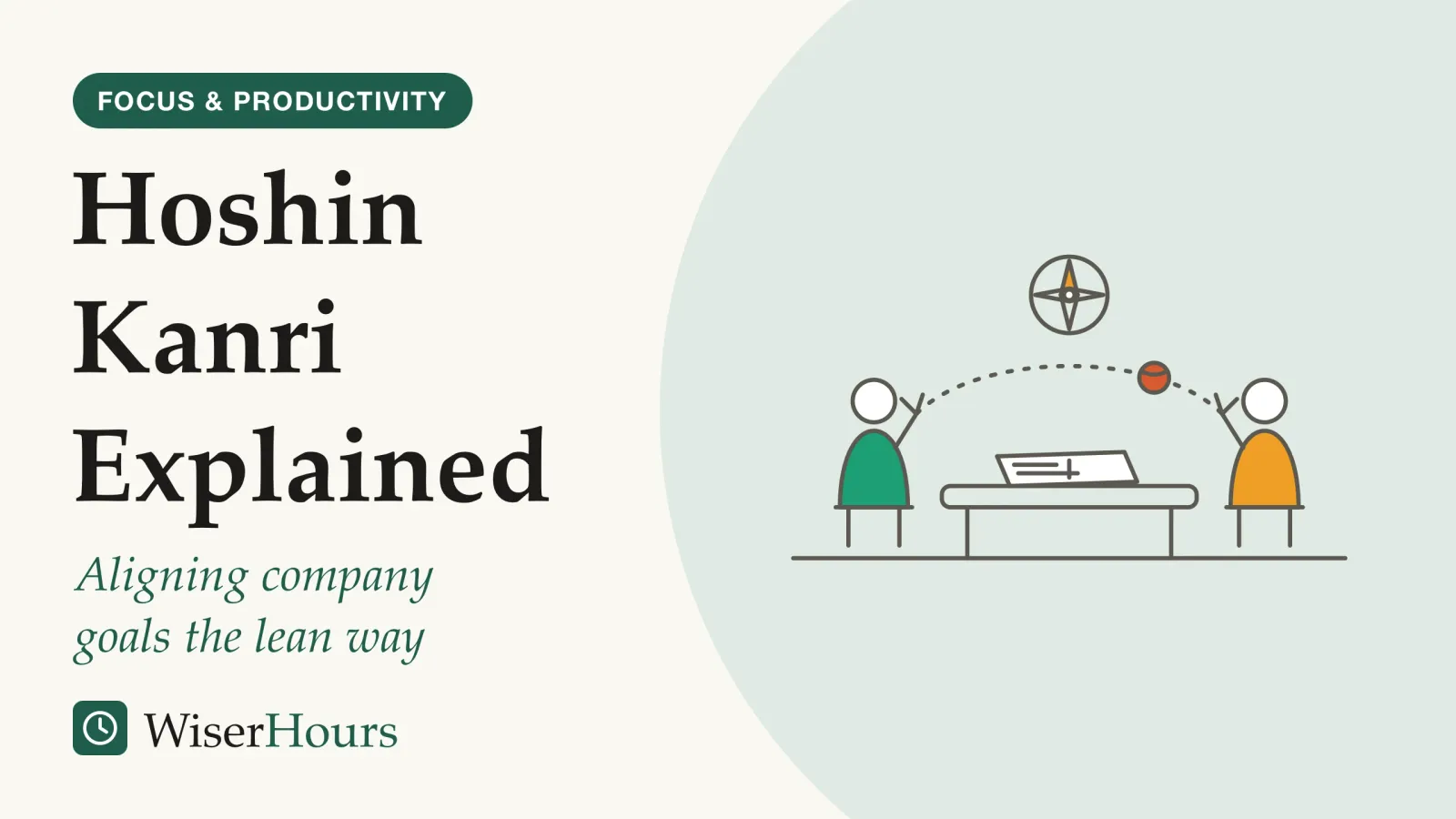
Hoshin kanri, also called policy deployment or strategy deployment, is a way of running a company’s strategy as a yearly management cycle: leaders choose a very few breakthrough objectives, agree with each level what it will do to reach them, and check progress as the year runs. The Lean Enterprise Institute calls it a framework for executing strategy through structured plan-do-check-act thinking, aligned from the chief executive to the front line and across departments.1 The first English-language report on it, published by GOAL/QPC in 1989, put it more bluntly: hoshin planning is “PDCA applied to the planning and execution of a few critical” objectives.2
It sits at the company end of the major productivity methods: where a personal system organizes one person’s week, hoshin kanri organizes a year of work for everyone.
What is Hoshin Kanri?
Hoshin Kanri is a planning and review process that links a company’s few strategic objectives to the daily work of every department. The Japanese characters stand for policy (hoshin) and control or management (kanri). Companies run it in many different styles, Roser notes, but all of them set a long-term plan, break it into short-term goals, act on them and check at the end of the period, usually a fiscal year, whether the goals were met.3
Definition
Hoshin kanri is a yearly cycle that turns a long-term vision into a few breakthrough objectives, agrees targets and means with each level through dialogue, and reviews progress monthly against the plan.
The reason it exists is a gap most managers know. A strategy written at the top tends to stay there, while departments keep doing what they did last year. Barry Witcher of Norwich Business School, who has reviewed the English-language literature, describes hoshin kanri as a way to close the gap between top-down strategy and its bottom-up realization.2
A regional distributor’s leadership team agrees to “become easier to buy from”. By March the warehouse is optimizing for cost, sales for volume, and nobody has changed the ordering process. A hoshin plan would have named the change, given one person a page of targets and means, and put it on the agenda of every monthly review.
Where Hoshin Kanri came from: Bridgestone, Komatsu and Toyota
Hoshin kanri took shape in Japanese companies in the 1950s and 1960s as an adaptation of management by objectives, according to Roser.3 Akao’s book, the most cited English-language work on the subject, traces the term to an internal Bridgestone Tire document of 1962, according to Witcher’s review.2
Komatsu, the Japanese construction-equipment maker, introduced a company-wide quality control program in 1961 and won the Deming Application Prize, Japan’s quality award, in 1964.4 Toyota won the same prize in 1965 and, by its own account, then set policies that included rotating the management cycle rapidly, with particular attention to checks and actions.5 Christoph Roser, a former Toyota employee who writes about lean manufacturing, notes that Bridgestone was one of the early users and that Toyota, often credited with the method, came to it comparatively late.3
The ideas reached the West in the late 1980s, through Akao’s edited book (Japanese 1988, English 1991) and the 1989 GOAL/QPC report. Florida Power and Light was the first Western company to adopt hoshin kanri, and Yokogawa Hewlett-Packard, HP’s joint venture in Japan, was another pioneer.2
That pedigree matters for anyone adopting it now. Hoshin kanri assumes an organization already measures its work and reviews it on a rhythm, the habits behind what process improvement is. A team without those habits will find the planning part easy and the monthly checking hard.
A few breakthrough objectives, kept apart from the daily numbers
Hoshin kanri separates the few changes that must happen this year from the many measures that keep the business healthy. Hewlett-Packard’s version kept two documents: hoshin plans for a very few breakthrough objectives, and a table of business fundamentals with the more numerous key performance indicators for incremental improvement. One of the Japanese authors in Akao’s book used a health comparison, as Witcher summarizes it. Daily management is like sleeping enough and eating well every day; hoshin is the attention you give to an illness or a long-term change, such as joining a health club.2
The list stays short for a practical reason. The Lean Enterprise Institute describes the aim as matching resources with projects so that only those that are desirable, important and achievable are authorized, avoiding the common pattern of many popular initiatives that never finish.6
List everything your leadership team calls a priority, then strike out anything that would happen anyway if nobody pushed it this year; those belong on the dashboard. What remains, often more than you can staff, is the candidate list for one to three hoshin objectives.
What is catchball in Hoshin Kanri?
Catchball is the dialogue in which a plan is passed between levels, questioned and adjusted until both sides agree on targets, means and resources. The Lean Enterprise Institute describes ideas tossed back and forth like a ball between senior managers and project teams about the time and resources a target needs. The process may start top-down when a company first adopts it, the same source says, but should then become top-down and bottom-up, and in mature organizations bottom-top-bottom.6
Toyota’s executives made the point in their own words in 1980, at the close of a manager training program in which they reviewed managers’ one-page reports:
When discussing Hoshin items, you need to carefully listen to your subordinates and have a lot of discussion with them.
A sales director is handed a target of a 20 percent cut in quote turnaround time. In real catchball she throws it back: the cut is possible only if legal approves standard contract terms, which is another department’s work. The plan that comes back names legal’s part, or the target changes. If no target or resource changes during catchball, ask each lead what they would need to hit the number, and write the answer into the plan.
The X-matrix: a 1990s Western layout for the plan on one page
An X-matrix is a one-page chart that sets a hoshin plan’s long-term objectives, annual objectives, priorities, targets and owners around a square cut by an X, with small grids marking which items relate. Roser describes it being filled from the bottom (long-term objectives) clockwise, ending with the people responsible on the far right. He calls it visually impressive but doubts its use, chiefly because it shows no trace of the PDCA review that keeps a plan alive.8
- South: long-term objectives, the direction the company wants to move
- West: this year’s objectives, each tied to a long-term one
- North: the top-level priorities that should deliver them
- East: the numeric targets to improve
- Far right: the people responsible for each priority
The X-matrix is a Western format. Roser writes that it was developed around the 1990s by early lean consultants and companies such as Danaher and Hewlett-Packard, and that it is pretty much unknown in Japan; at Toyota, he says, a hoshin plan is usually a table, and he never saw an X-matrix there.3 Pascal Dennis, a lean author teaching a Lean Enterprise Institute class, told participants that he had never seen the X-matrix at Toyota, according to a 2006 Gemba Academy write-up by Jon Miller.9
What Toyota did use is the A3, a single large sheet. In a two-year program in 1979 and 1980, called Kan-Pro, Toyota trained 1,000 managers and structured the program around the A3 process, according to Isao Yoshino, who helped design it, and John Shook.7
- Myth
- Hoshin Kanri means filling in an X-matrix.
- Fact
- The X-matrix is one Western layout for a hoshin plan. Toyota's practice centers on tables, A3 sheets and the reviews that check them.
If a matrix helps your team see how goals connect, use it; if filling it in becomes the project, a table with one row per objective does the same job.
Six planning steps and the monthly review that keeps them honest
Akao’s book sets out six steps for hoshin planning: a five-year vision, a one-year plan, deployment to departments, execution, a monthly audit and an annual audit, according to its publisher’s description.10 Witcher’s review says the book also outlines a ten-step version close to the GOAL/QPC model.2
- 1Five-year visionwhere the company must be
- 2One-year plana very few breakthrough objectives
- 3Deploy to departmentscatchball on targets and means
- 4Executeone owner and one page per objective
- 5Monthly auditcheck results, adjust the means
- 6Annual auditreview the year and the process itself
Then repeat from “Five-year vision”
The monthly and annual audits are a PDCAplan-do-study-act: A four-step loop for testing a change: plan it with a written prediction, try it on a small scale, study what happened against the prediction, then act by adopting, adapting or dropping it. It comes from the quality methods of Walter Shewhart and W. Edwards Deming.Full entry in the glossary loop applied to strategy, and if you are new to that loop, how the PDCA cycle works in practice covers the stages.
The review asks a specific question when a result is poor. Toyota’s executives, in the Kan-Pro review comments, told managers to explain whether the plan was poorly designed or was not carried out.7 Those two answers lead to different fixes: a better plan next year, or help with execution now. Put that question on the agenda of every monthly review, before any discussion of who is to blame.
A worked example: Hoshin Kanri for a 50-person company
Hoshin kanri needs no software, only one page per objective and a monthly meeting. Research on small manufacturers suggests the deciding factor is how the managers take part.
The study
Limited evidence
Five small manufacturers try hoshin kanri: a Swedish case study, 2021
Researchers at Jönköping University in Sweden helped five small manufacturers put hoshin kanri in place in a project funded by VINNOVA, Sweden’s innovation agency. They found seven factors that helped or hampered it. Management involvement was critical, and how owners took part mattered: of two firms whose owners were equally committed at the start, the one with a demanding owner abandoned the project.11
The study is small and qualitative, and the researchers coached the firms they studied, but its findings fit what practitioners report about catchball run from the top.
The rest of this example is invented to show the mechanics. A 50-person software company sells to accounting firms. Its five-year vision is to be the supplier customers renew without a sales call. In the autumn the founders and four team leads agree one breakthrough objective for next year: new customers live and using the product within 30 days of signing, against about 60 days now.
Catchball takes two weeks. The onboarding lead says 30 days is possible only if engineering builds a data-import tool; engineering says yes if two smaller features slip. The founders accept the trade, and the plan now has two means with named owners. Support response times, churn and revenue stay on the dashboard as routine numbers.
Each owner keeps one page: the target, the current state, the planned actions and a monthly result. A 45-minute review on the first Monday of each month goes through the pages, asks whether misses come from the plan or its execution, and changes the means when needed. In December the team reviews the year and the process itself.
Your first hoshin cycle
Hoshin Kanri vs OKRs: what is the difference?
Hoshin kanri and OKRs both connect a few company goals to team goals, but they differ in rhythm and attitude to targets. In Google’s version of OKRs, goals are set annually and quarterly, graded on a scale of 0 to 1, and deliberately set as stretch goals.12 A hoshin plan, by contrast, is meant to be achievable, as the table below sets out. The basics of OKRs are in how OKRs differ from KPIs.
| Question | Hoshin Kanri | OKRs (Google’s re:Work guide) |
|---|---|---|
| Planning rhythm | A one-year plan under a five-year vision, with monthly and annual audits | Annual and quarterly OKRs, graded at quarterly company meetings1012 |
| How many goals | A very few breakthrough objectives; routine KPIs kept in a separate table | Three to five objectives, each with roughly three key results212 |
| How goals are set | Catchball between levels on targets, means and resources | A mix of top-down and bottom-up suggestions612 |
| Ambition | Only desirable, important and achievable projects are authorized | Stretch goals; the aim is an average score between 0.6 and 0.7612 |
No study testing the two against each other turned up in our search; published comparisons are conceptual, so choose by fit. OKRs suit a fast-changing business that wants to revisit goals every quarter and accepts missing some. Hoshin kanri suits a company whose breakthrough needs a year of coordinated work across departments, with a review routine strong enough to keep it on track. Many organizations borrow from both.
Where Hoshin Kanri fails, and how to spot it early
Three failures recur in the sources on hoshin kanri: too many objectives, catchball that is top-down in disguise, and reviews that lapse. Wikipedia’s entry, citing a management journal, notes that management must avoid picking too many goals in order to stay focused.13 Ten “breakthrough” objectives for 50 people is a to-do list; cut until each objective has an owner with time to work on it.
The second failure is catchball in name only. Dennis told his class he had seen X-matrices used for command and control by an executive who made up everyone else’s matrix, and put the fault on the person using it.9 When a team lead’s page arrives already filled in, catchball has been skipped.
The third failure is the review. A two-year study of three Japanese-owned manufacturers in the UK, published in 2001 by Witcher and Rosemary Butterworth, found that some of the main issues were changes in organization and personnel, problems administering periodic review, and cross-functional working in departmental structures.14 Witcher later noted that senior strategists often treat hoshin kanri as an operations activity and that the annual review is poorly understood in the West.2
Be skeptical of anyone promising results. A 2023 systematic reviewsystematic review: A review that fixes its question and its rules for including studies in advance, then searches out every study that fits and weighs them together. Some systematic reviews pool the results into a meta-analysis; others describe what the studies found without combining the numbers.Full entry in the glossary by American researchers, focused mainly on manufacturing, found relatively little published research on hoshin kanri, most of it from the UK or USA.15 Most of what is known comes from case studies and practitioners, and whether hoshin kanri works better than other planning methods is untested. Judge your own first cycle on its own record: at the annual review, ask whether the objective moved and which part of the process slowed it.
The bottom line
Hoshin kanri earns its keep through a short list of objectives and a monthly review that asks whether the plan or its execution failed; the X-matrix is optional. Start with one breakthrough objective, one owner, one page and a review date in the calendar, and let at least one target change during catchball before you commit to it.
Frequently asked questions
What does hoshin kanri mean in English?
Hoshin kanri is usually translated as policy management or policy deployment. Christoph Roser, a former Toyota employee who writes the AllAboutLean blog, explains that the characters stand for policy (hoshin) and control or management (kanri). Wikipedia adds the looser gloss compass management, and the Lean Enterprise Institute uses strategy deployment as an English name for the same practice.
Is Hoshin Kanri only for manufacturing?
No, though most of what is written about it comes from factories. The Lean Enterprise Institute describes Turner Construction using hoshin kanri with A3 problem-solving, and Barry Witcher's research covers Xerox UK, a service organization. A 2023 review in The TQM Journal focused mainly on manufacturing, so the evidence for offices, hospitals and software teams rests mostly on case reports.
How does Hoshin Kanri relate to the balanced scorecard?
They grew up close together. Barry Witcher writes that the prototype balanced scorecard was built at Analog Devices in 1987 and that hoshin kanri was used there to deploy it. In his reading, the scorecard is strong on what should be done but says little about how, while hoshin kanri supplies the deployment and review process.
Sources
- Hoshin Kanri: A Resource Guide. Lean Enterprise Institute (accessed 24 October 2026)
- Hoshin Kanri. Witcher, B. J. (2014). Perspectives on Performance, 11(1), 16-24 (author's version, University of East Anglia)
- The Evolution of Strategic Management: Hoshin Kanri. Roser, C. AllAboutLean.com (accessed 24 October 2026)
- Bangkok Komatsu wins the Deming Prize. Komatsu Ltd. newsroom (2023)
- Toyota Awarded the Deming Prize. Toyota Motor Corporation, 75 Years of Toyota (accessed 24 October 2026)
- Strategy deployment. Lean Enterprise Institute, Lean Lexicon (accessed 24 October 2026)
- How the A3 Process Developed to Help Build Better Managers. Yoshino, I. & Shook, J. (2020). Lean Enterprise Institute, The Lean Post
- Hoshin Kanri – Part 4: The X-Matrix? Roser, C. AllAboutLean.com (accessed 24 October 2026)
- Hoshin Kanri Lesson: No Plan Goes According to Plan. Miller, J. (2006). Gemba Academy blog
- Hoshin Kanri: Policy Deployment for Successful TQM. Akao, Y. (ed.) (1991; reissued 2020). Productivity Press. Originally published in Japanese by the Japanese Standards Association
- Implementing Hoshin Kanri in small manufacturing companies. Löfving, M., Melander, A., Elgh, F. & Andersson, D. (2021). Journal of Manufacturing Technology Management, 32(9), 304-322
- Guide: Set goals with OKRs. Google re:Work (2016; accessed 24 October 2026)
- Hoshin Kanri. Wikipedia (accessed 24 October 2026)
- Hoshin Kanri: Policy Management in Japanese-Owned UK Subsidiaries. Witcher, B. J. & Butterworth, R. (2001). Journal of Management Studies, 38(5), 651-674
- Current status of Hoshin Kanri. Wilson, R., Cudney, E. A. & Marley, R. J. (2023). The TQM Journal, 36(2), 460-477
How we researched this
We started from the Lean Enterprise Institute's pages on hoshin kanri and strategy deployment, Yoji Akao's book as described by its publisher, and Barry Witcher's review of the English-language hoshin kanri literature, then searched OpenAlex and Crossref for peer-reviewed reviews and case studies, and checked company dates on Toyota's and Komatsu's own sites. Sources span 2001 to 2026. Main limitation: two peer-reviewed papers were read only as abstracts and Akao's book only through its publisher's description, and the claims about Toyota's practice rest on practitioner accounts.
Keep reading

The Daily Review: Five Minutes to Stay on Track
A daily review takes about 5 minutes: clear inboxes, check tomorrow, pick 1 to 3 priorities and note what moved, with the research behind each step.
The Bullet Journal Method: A Beginner's Guide
Bullet journal for beginners: set up 4 core pages in one sitting, log in short symbol-led lines, and rewrite each month only the tasks that still matter.
Toxic Productivity: When Self-Optimization Goes Too Far
Toxic productivity has no clinical definition. What 4 lines of research show, from workaholism to busyness as a status symbol, and when to ease off.

Getting Things Done: A Beginner's Guide to GTD
Getting Things Done for beginners: GTD's 5 steps, a minimal setup and a first-week plan, with each step labelled by what backs it, research or David Allen.