Productivity Systems Explained: A Guide to the Major Methods
7 productivity systems compared, from GTD and Pomodoro to the bullet journal: what each asks of you and what research says about its core idea.

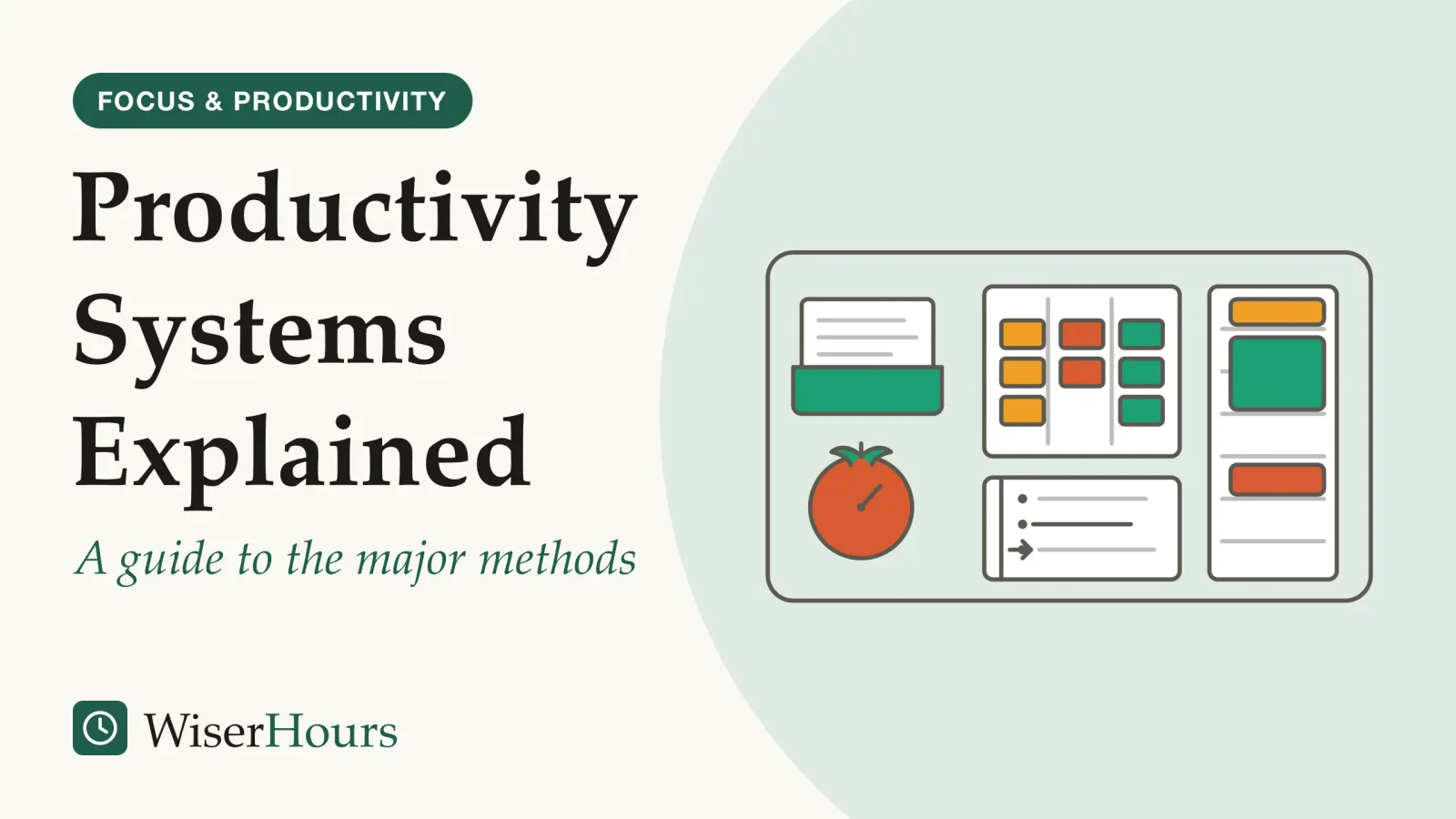
Most productivity systems have never been tested as systems. Of seven well-known methods, the Pomodoro technique is the only one we found compared with another way of working in controlled studies, and the result was modest: in three small studies of university students in the Netherlands, published from 2023 to 2026, Pomodoro-style timed breaks made no clear difference to how much students got done or to their test scores, compared with breaks they timed themselves.123
Productivity systems are repeatable routines for deciding what to work on, when, and where the rest of your commitments wait in the meantime. Each major method rests mainly on its creator’s own account, with a handful of studies that bear on its central idea.
What productivity systems have in common
Productivity systems share three jobs, even when their creators use different words: capturing commitments in a trusted place outside your head, choosing which one deserves attention now, and protecting time to do it.
Capturing matters because unfinished goals can keep intruding on your thoughts. In a set of experiments published in 2011, mostly lab studies with US undergraduates, E. J. Masicampo and Roy Baumeister found that unfulfilled goals caused intrusive thoughts and worse performance on an unrelated task, and that letting people write a specific plan for those goals eliminated the interference.4
Choosing matters because urgency can distort it: in five experiments published in 2018 by Meng Zhu and colleagues, people were more likely to pick a lower-paying task when it merely looked urgent.5 Protecting time may work better when the plan names a trigger: in comparisons across studies, a 2025 meta-analysis of 642 experimental tests found that plans in if-then form had larger effects than plain schedules.6
- Capture: get commitments out of your head (GTD, bullet journal, personal kanban)
- Choose: pick what matters now (Eisenhower matrix, eat the frog)
- Protect: keep time to do it (time blocking, Pomodoro)
Seven major methods compared
The seven major productivity methods differ mainly in which job they lead with, and none except Pomodoro has been tested against another way of working in controlled studies we could find. Our PubMed searches in September 2026 found one trial of GTD-based training against no training, and none of time blocking, the Eisenhower matrix, personal kanban, the bullet journal or eat-the-frog.7
| Method | Associated with | Core move | Research that bears on it | Evidence |
|---|---|---|---|---|
| Getting Things Done (GTD) | David Allen, 2001 | Capture everything, decide each next action, review weekly | One trial against no training, which did not measure output; a 2008 paper argued the case from cognitive science. Experiments found written plans quiet unfinished goals | Method: trial, limited. Idea: trial, limited784 |
| Pomodoro technique | Francesco Cirillo, 1980s | Work in timed intervals with fixed breaks | Three small studies of students from one research group: no clear difference in work done or test scores; mood results conflict | Trial, limited23 |
| Time blocking | Cal Newport (his 2013 version) | Give every task a slot on the calendar | No trials; if-then plans help people act, plain schedules less so | Method: expert. Idea: meta-analysis, moderate6 |
| Eisenhower matrix | A line Eisenhower quoted in 1954; the grid in Stephen Covey’s 1989 book | Sort tasks by urgency and importance | No trials; in five experiments and one independent replication, people were more likely to pick tasks that merely looked urgent | Method: expert. Idea: trial, moderate (five experiments and one independent replication)59 |
| Personal kanban | Jim Benson and Tonianne DeMaria | Put work on a board and cap work in progress | No trials; in two experiments, unfinished tasks hurt performance on the next one | Method: expert. Idea: trial, limited10 |
| Bullet journal | Ryder Carroll | Log tasks in a notebook and rewrite the unfinished ones | No studies found | Expert11 |
| Eat the frog | Brian Tracy | Do the hardest, most important task first | No trials; emergency doctors who picked easier tasks under heavy load had lower complexity-adjusted output | Method: expert. Idea: observational, limited12 |
“Idea” means the research tested the mechanism a method relies on, not the method.
- 1954Eisenhower quotes the urgent-versus-important line
- 1980sCirillo creates the technique with a tomato-shaped timer
- 1989Covey's four quadrants of time management
- 2001Allen's Getting Things Done
- 2011Benson and DeMaria publish Personal Kanban
- 2013Newport describes his time-blocked days
GTD shows how far research trails popularity. In October 2007, Allen’s book topped Amazon’s time management bestseller list, yet Heylighen and Vidal’s search that month found 14 documents citing it, none discussing the method in any detail.8
GTD empties your head into lists you trust
Getting Things Done, or GTD, is David Allen’s method for turning everything that has your attention into lists you review and act on. The David Allen Company describes five steps: capture, clarify, organize, reflect and engage.13
- 1Capturecollect whatever has your attention
- 2Clarifydecide what it is and the next action
- 3Organizefile it on the right list
- 4Reflectreview the lists often
- 5Engagedo the work
The details carry most of the method. In Heylighen and Vidal’s summary of Allen’s 2001 book, anything that takes less than two minutes is done at once rather than filed, anything tied to a specific day and time goes on the calendar, and a weekly review walks through every list so nothing is lost.8
The evidence is mostly theoretical. Heylighen and Vidal wrote in 2008 that no empirical studies yet confirmed the claims made for GTD, and argued its case from research on how the mind relies on its surroundings as external memory.8 The closest experimental support for its central idea is the 2011 Masicampo and Baumeister work above: writing a specific plan for an unfinished goal, much like GTD’s next action, stopped it intruding in these experiments.4
The one trial of the method we found did not measure output: in a 2018 study in China, 128 women with perimenopausal syndrome were randomly assigned to six months of GTD-based training or none. The trained group scored higher on a time management questionnaire, but the main outcomes were health measures, and GTD was not compared with another method.7
The Pomodoro technique: timed work, fixed breaks
The Pomodoro technique divides work into timed intervals separated by short breaks. Francesco Cirillo says he created it in the 1980s because he could not focus on his university studies, and the standard schedule in the research literature is 25 minutes of work followed by a 5-minute break.143 Cirillo himself argues that the 25-minute sessions are only one expression of the technique, not the technique itself.14
The study
Limited evidence
Three break styles, one study session: a randomized test with 94 students
Eva Smits, Niklas Wenzel and Anique de Bruin of Maastricht University randomly assigned students to study for two hours with Pomodoro breaks (5 minutes after every 25), Flowtime breaks (break length set by how long they had studied) or breaks they timed themselves. Motivation fell faster in both timed groups and fatigue rose faster with Pomodoro, but overall fatigue, motivation, productivity, task completion and flow showed no clear difference between the three.2
The authors caution that the sample was small and homogeneous, all psychology students, so the results may not hold for other groups, and a 2-hour session may be too short to show differences.2
The other two studies disagree about mood, and all three share one author, Anique de Bruin of Maastricht University, so none is an independent replication. In a 2023 study of 87 students, those who took breaks on a fixed schedule, including a Pomodoro-style 24 minutes of study and 6 of rest, reported more concentration and motivation and less fatigue than those who chose their own, with no difference in task completion.1 In a preregistered 2026 study of 176 students reading the same text, self-timed breaks led to better moods than 12-minute blocks with 3-minute breaks, and reading-test scores showed no clear difference.3
A 2025 scoping review in BMC Medical Education concluded that Pomodoro intervals improved focus and reduced fatigue, but it searched only to May 2023, and its randomized evidence (87 students on 24- and 12-minute schedules) matches the design and sample of the 2023 study.15
If you like a timer, it is a reasonable way to start a session and to remember breaks during focused work. If you find it disruptive, these studies give you no reason to force it.
Further reading
Getting Things Done: The Art of Stress-Free Productivity
David Allen's full account of Getting Things Done, including the capture list the article suggests when too many loops are open.
The 7 Habits of Highly Effective People
Where Covey set out the urgent-versus-important grid the article suggests trying when everything feels urgent.
Personal Kanban: Mapping Work | Navigating Life
The original guide to the visual board the article suggests when too much is half done: show the work, limit what is in progress.


As an Amazon Associate WiserHours earns from qualifying purchases.
Time blocking gives every task a slot
Time blocking means dividing the working day into blocks on the calendar, each assigned to a specific task. The author Cal Newport described his version in a 2013 blog post: every hour of his day split into labeled blocks, with space beside them to rewrite the plan when the day goes off course.16
In the same post, Newport estimated that a 40-hour time-blocked week produces as much output as a week of 60 hours or more worked without structure. That figure is his own estimate from his experience, not a measurement.16
No trial has tested time blocking as such. The nearest evidence is on planning when and where you will act: Paschal Sheeran, Olivia Listrom and Peter Gollwitzer’s 2025 meta-analysis found that such plans had a small but reliable effect and, in comparisons across studies, that plans written as a schedule had a smaller effect than if-then plans (“if it is 9 a.m., then I open the report”).6 A block on the calendar is a schedule, so adding the if-then trigger may matter. Our guide to time management habits for beginners shows how to phrase one.
The Eisenhower matrix separates urgent from important
The Eisenhower matrix sorts tasks into four boxes by two questions: is it urgent, and is it important? The idea is older than the grid. In a 1954 speech, President Dwight Eisenhower quoted an unnamed former college president who said he had two kinds of problems, urgent and important, and that the urgent ones were not important.17
- Myth
- Eisenhower invented the Eisenhower matrix.
- Fact
- In a 1954 speech, Eisenhower quoted an unnamed former college president on urgent and important problems. The speech contains no grid.
Stephen Covey’s 1989 book The 7 Habits of Highly Effective People set the idea out as four quadrants of time management, and the FranklinCovey website still argues that the best return comes from work that is important but not urgent, such as planning, creative thinking and learning.1819
The grid targets a real bias, though it has not been tested itself. In five experiments, marketing researchers Meng Zhu, Yang Yang and Christopher Hsee found that people were more likely to choose tasks with lower payoffs when those tasks merely looked urgent; the experiments tested choices between tasks, not the grid.5 A 2026 independent replication with 2,374 participants, by researchers at the University of Nottingham, found the effect again: controls for other explanations made it smaller but did not remove it.9
A kanban board caps work in progress
Personal kanban puts your work on a board that shows everything you have taken on, what is in progress and what is done, and limits how many items can sit in “doing” at once. Jim Benson and Tonianne DeMaria published the book Personal Kanban in 2011.20 They reduce the method to two rules, visualize your work and limit your work in progress, with the aim of finishing more instead of juggling half-done work.21
We found no study of personal kanban used by individuals. The case for a limit on work in progress draws on research like Sophie Leroy’s: in two experiments reported in 2009, people struggled to pull their attention away from a task they had not finished, and their performance on the next task suffered.10 That leftover attention is known as attention residue, the pull of an unfinished task.
The bullet journal makes you rewrite what you keep
The bullet journal’s distinctive step is migration: once a new month starts, you review old entries and copy the unfinished tasks you still care about to a new page. The method’s site reasons that an entry not worth the effort of rewriting probably is not important.22
The method is Ryder Carroll’s. Its official site describes it as combining mindfulness, productivity and self-discovery, with short bulleted entries, called rapid logging, whose symbols show each task’s status in monthly, weekly and daily logs.11
We found no published study of the bullet journal method, so its value rests on its creator’s account and on users’ experience.
Eat the frog: hardest task first
Eat the frog means doing your most important and most challenging task before anything else. The phrase comes from Brian Tracy’s book Eat That Frog, which calls that task your frog and says to tackle it first thing each morning.23
No trial has tested the rule, but one study points in its direction. Using six years of data from a hospital emergency department, Diwas KC, Bradley Staats, Maryam Kouchaki and Francesca Gino found in 2020 that physicians facing heavier workloads tended to choose easier tasks. That habit looked efficient at first, but after adjusting for how complex the work was, it was linked to lower output and to slower improvement over time. Drawing also on a lab experiment in the same paper, the authors attribute the pull toward easy tasks to fatigue and to the sense of progress that finishing brings.12 Those are hospital doctors, not office workers, and the field data show a link, not a cause.
Match the method to the problem you have
No method has been shown to be best overall, so the useful question is which problem you are trying to solve. Start with the idea behind each method, because that is what the research tested.
| If your problem is… | Try first | The idea it rests on |
|---|---|---|
| Too many open loops in your head | GTD’s capture list, with a next action for each project | Written plans quieted unfinished goals in experiments4 |
| Trouble starting or staying with a task | A Pomodoro timer, dropped if the fixed breaks break your concentration | Fixed breaks made no clear difference to work done versus self-timed ones2 |
| A calendar that others fill for you | Time blocks for your most important work, each with an if-then trigger | If-then plans had larger effects than plain schedules6 |
| Everything feels urgent | The urgent and important questions, plus a note of what each task is worth | People were more likely to pick tasks that merely looked urgent59 |
| Too many half-done things | A kanban board with a limit on items in progress | Unfinished tasks drag on the next one10 |
| You think best on paper | A bullet journal, letting the monthly rewrite prune the list | The creator’s reasoning; no studies22 |
| You keep avoiding the hard task | Eat the frog: the hard task first, before easy wins crowd it out | Doctors who picked easier tasks had lower complexity-adjusted output12 |
A two-week test
Pick the one problem from the table above that costs you most, and run only that method’s core move for two weeks. At the end, compare what got done with the two weeks before, then keep it, change it or drop it.
The bottom line
Productivity systems are mostly untested bundles of reasonable ideas, and the one tested most, Pomodoro, made no clear difference to how much students got done. Choose by your problem, not by the system’s reputation: a capture list for open loops, calendar blocks with if-then triggers for protected time, and an urgency check before you choose. Keep what works for you after two weeks and drop the rest.
Frequently asked questions
Why is it so hard to test a productivity system?
Many systems have no single agreed outcome to measure. Francis Heylighen and Clément Vidal noted in 2008 that GTD sets no explicit priorities, so there is no obvious standard for its productivity gains. Studies in real settings face a second problem: in a 2025 Pomodoro study, students chose their own study tasks, which differed in difficulty and limited the researchers' control.
Can you combine productivity systems?
Yes. The methods lead with different jobs, so they can sit side by side. GTD itself keeps the calendar for actions tied to a specific day and time, according to Heylighen and Vidal's 2008 summary of the method, so blocking time for other work is an addition rather than part of GTD. A kanban board or a bullet journal can hold the same lists in a different form.
Where does the name Pomodoro come from?
The name comes from a kitchen timer. Francesco Cirillo says he created the technique in the 1980s with a tomato-shaped timer, at a time when he could not focus on his university studies. He has since argued that the familiar 25-minute session is only one expression of the technique, which he describes as a way of changing your relationship with time.
Sources
- Understanding effort regulation: Comparing ‘Pomodoro’ breaks and self-regulated breaks. Biwer, F., Wiradhany, W., oude Egbrink, M. G. A. & de Bruin, A. B. H. (2023). British Journal of Educational Psychology, 93(S2)
- Investigating the Effectiveness of Self-Regulated, Pomodoro, and Flowtime Break-Taking Techniques Among Students. Smits, E. J. C., Wenzel, N. & de Bruin, A. (2025). Behavioral Sciences, 15(7), 861
- When to Take a Break: Comparing Effects of Systematic Short (Pomodoro) and Self-Regulated Breaks on Subjective Experience and Actual Learning. Göksu, A., Wiradhany, W. & de Bruin, A. B. H. (2026). Behavioral Sciences, 16(7), 1158
- Consider it done! Plan making can eliminate the cognitive effects of unfulfilled goals. Masicampo, E. J. & Baumeister, R. F. (2011). Journal of Personality and Social Psychology, 101(4)
- The Mere Urgency Effect. Zhu, M., Yang, Y. & Hsee, C. K. (2018). Journal of Consumer Research, 45(3)
- The when and how of planning: Meta-analysis of the scope and components of implementation intentions in 642 tests. Sheeran, P., Listrom, O. & Gollwitzer, P. M. (2025). European Review of Social Psychology, 36(1)
- Effect of Time Management Training on Anxiety, Depression, and Sleep Quality. Wang, P. & Wang, X. (2018). Iranian Journal of Public Health, 47(12), 1822-1831
- Getting Things Done: The Science behind Stress-Free Productivity. Heylighen, F. & Vidal, C. (2008). Long Range Planning, 41(6)
- Brief Commentary: An Independent Replication Study of the Mere Urgency Effect. Mills, R., Cubitt, R. & Starmer, C. (2026). Journal of Consumer Research, advance article
- Why is it so hard to do my work? The challenge of attention residue when switching between work tasks. Leroy, S. (2009). Organizational Behavior and Human Decision Processes, 109(2)
- What is the Bullet Journal Method? Bullet Journal (website of Ryder Carroll's Bullet Journal method), accessed 2026
- Task Selection and Workload: A Focus on Completing Easy Tasks Hurts Performance. KC, D. S., Staats, B. R., Kouchaki, M. & Gino, F. (2020). Management Science, 66(10)
- What is GTD. David Allen Company, accessed 2026
- Francesco Cirillo: creator of the Pomodoro Technique. Francesco Cirillo FZE-LLC, accessed 2026
- Assessing the efficacy of the Pomodoro technique in enhancing anatomy lesson retention during study sessions: a scoping review. Ogut, E. (2025). BMC Medical Education, 25, 1440
- Deep Habits: The Importance of Planning Every Minute of Your Work Day. Newport, C. (2013). Blog post, calnewport.com
- Address at the Second Assembly of the World Council of Churches, Evanston, Illinois. Eisenhower, D. D. (1954). The American Presidency Project, UC Santa Barbara
- The Seven Habits of Highly Effective People: Restoring the Character Ethic (catalogue record). Covey, S. R. (1989). Simon and Schuster, New York; Open Library record (LCCN 89030464), accessed 2026
- Habit 3: Put First Things First. FranklinCovey, accessed 2026
- Personal Kanban: Mapping Work, Navigating Life (catalogue record). DeMaria Barry, T. & Benson, J. (2011). CreateSpace; Open Library record, accessed 2026
- Personal Kanban. Modus Cooperandi (Jim Benson and Tonianne DeMaria), accessed 2026
- Migration 101: Why and How We Migrate the Contents of Our Bullet Journal. Bullet Journal, accessed 2026
- Eat That Frog!, Fourth Edition. Tracy, B. Berrett-Koehler Publishers, book page accessed 2026
How we researched this
We searched PubMed, Crossref and the web in September 2026 for trials, reviews and theory papers on seven named productivity methods, and read each method's description on its creator's website or publisher page. Sources date from 1954 to 2026. Apart from Pomodoro, PubMed searches found one controlled trial of GTD-based training and none of the other five methods, so most evidence here tests the idea behind a method rather than the method; four papers were read at abstract level only.
Keep reading
Toxic Productivity: When Self-Optimization Goes Too Far
Toxic productivity has no clinical definition. What 4 lines of research show, from workaholism to busyness as a status symbol, and when to ease off.
Checklists: The Simple Tool That Prevents Expensive Mistakes
Why checklists work: from a 1935 bomber crash to a 19-item surgical checklist, the evidence suggests real use matters more than having a list.
The 80/20 Principle: A Complete Guide
The 80/20 rule tested against real data on software bugs, grocery sales and health spending: where the pattern holds, where the ratio breaks, how to use it.
Personal Kanban: Visualize Your Work and Limit Work in Progress
Personal kanban's 2 rules, show your work and cap what is in progress, explained with the research on why fewer open tasks finish sooner.