The Bullet Journal Method: A Beginner's Guide
Bullet journal for beginners: set up 4 core pages in one sitting, log in short symbol-led lines, and rewrite each month only the tasks that still matter.

The bullet journals that fill social media, with brush lettering, color schemes and painted spreads, show decoration layered over a much plainer tool. Strip that away and a bullet journal for beginners is one notebook, one pen and four kinds of page: an index, a future log, a monthly log and daily logs. Ryder Carroll, a digital product designer, worked the method out in college, began sharing it online in 20131 and set it out in full in a 2018 book, The Bullet Journal Method.2
Bullet Journal, the official site of Carroll’s method, says a first bullet journal takes no more than 10 minutes to set up, and that pretty lettering and elaborate art are not central to the method.3 The whole setup, page by page:
- Label the index
- Rule a future log
- Start this month’s log
- Keep a daily log in short lines
- Migrate open tasks when the month turns
A bullet journal is a notebook you date as you go
A bullet journal is a paper method for keeping tasks, events and notes in one notebook, arranged by time rather than by topic. The official site describes it as a blend of productivity, mindfulness and self-discovery, and says Carroll developed it to help with his own ADHD before realizing it could help others. Unlike a printed planner, it dates nothing in advance: the site contrasts it with planners that lock you into fixed dates and leave unused pages stranded.4 You write each date when you reach it, so a quiet week costs no blank pages and a busy day can run onto a second one.
Picture a Monday on which a dentist appointment, a report deadline, a friend’s birthday and an idea for a weekend trip all arrive before lunch. In a bullet journal they land on the same page in the order they turn up, each marked by the kind of thing it is. Nothing needs a separate app or a decision about which list it belongs on, and there is only one place to look later.
Ordering by date is also what sets the method apart from Getting Things Done, which sorts next actions by context. The bullet journal is chronological rather than centered on tasks, as its site puts it,3 and relies on a monthly rewrite, not context lists, to keep the task list short. For how it stacks up against Pomodoro, kanban and time blocking, see seven popular productivity methods compared.
So keep one notebook and carry it: a second list elsewhere is a second place you must remember to check.
The shorthand: bullets, symbols and signifiers
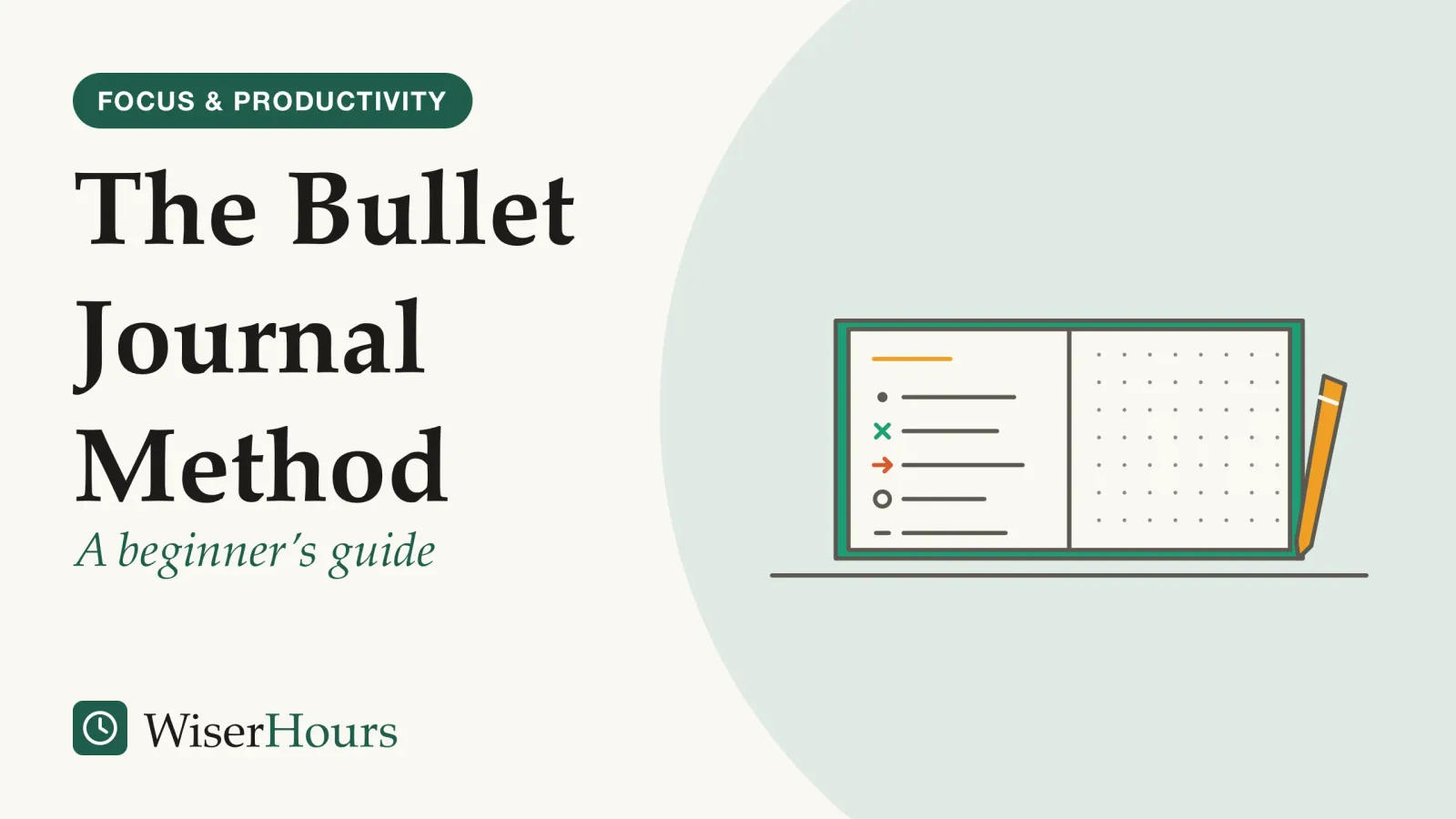
Every page in a bullet journal uses rapid logging: short, objective lines, each led by a symbol that says what kind of entry it is. Bullet Journal’s guide uses three core bullets: a dot for a task, an open circle for an event and a short dash for a note, meaning a fact, idea or observation you want to keep.5
The task dot changes as the task does. It becomes an X when the task is done, a right arrow (→) when you move the task forward into a new monthly log or a collection, and a left arrow (←) when you schedule it further out in the future log. Signifiers are optional marks placed beside a bullet. The guide suggests an asterisk for a priority, an exclamation mark for an inspiration and a small eye for something to look into, and invites you to invent your own once the core bullets feel natural.5
Why so terse? The guide’s example strips a sentence about buying cake at the local bakery down to a few words, and argues that short entries are easier to keep up and less likely to tip into rumination. If an event deserves more, you can write about it at length on the next free page.5 A real Monday might read: a dot for “send Amara the draft”, an open circle for “team lunch”, a dash for “third-floor printer jams on double-sided”. By evening the first dot is an X, and the page shows at a glance what happened.
A starter key
Write this on the inside cover so you never have to remember it: • task, X done, → moved forward, ← moved to the future log, ○ event, – note. Add signifiers only when you notice yourself wanting one.
Rapid logging has more nuance than a beginner needs on day one, from event entries to long-form notes. Three bullets are enough to start.
How to set up a bullet journal for beginners
Setting up a bullet journal works from the long view of time down to today, as Bullet Journal’s beginner guide lays it out: first the index, then the future log, then the current month, then today’s page.6 You need no ruler skills beyond drawing a few straight lines.
- Index: a table of contents you build as you go: each new section’s topic and page numbers
- Future log: months ahead ruled into boxes, for dates and deadlines beyond this month
- Monthly log: a calendar page and a task page for the current month
- Daily log: today’s date, then tasks, events and notes as short bulleted lines
coral loop: migration, when open tasks are rewritten into the next month’s log
1. Label the index
Write “Index” at the top of the first couple of pages and leave them empty. Each time you start a section, add its topic and page numbers here, so the index becomes a table of contents you build as you go. Pages for a single topic, such as a project, a reading list or class notes, are called collections. The guide describes a collection as a bucket for related tasks, notes and events, and it gets an index entry like any other section.6 If your notebook has no printed page numbers, number each page as you use it.
2. Rule a future log
On the next spread, rule the facing pages into boxes, one per coming month; the guide’s example draws two horizontal lines across both pages to make six months. Birthdays, deadlines and trips beyond this month go here: a friend’s wedding in the spring, a car service in the autumn. At each new month, you check the future log and move that month’s entries into your current pages.7
3. Start this month’s log
Use the next spread for the current month. On the left page, list the dates down the margin with the first letter of each weekday, and note events briefly beside them. The right page is the month’s task list: what you want to get to, plus anything carried over from last month or the future log. Bullet Journal’s monthly-log guide suggests setting up each month at the end of the one before, not months in advance, because you cannot know how many pages a month will take.8
4. Keep a daily log in short lines
Write today’s date at the top and log tasks, events and notes as they come up. If the page is not full tomorrow, the next date goes wherever you stopped. The daily-log guide also suggests listing what needs doing as the day begins and sorting the entries once it ends, carrying forward what still needs attention and dropping what you no longer need.9
5. Migrate open tasks when the month turns
When a new month begins, look back over the last one. Mark finished tasks with an X, strike through the ones that no longer matter, and copy the rest onto the new monthly task page, turning each old dot into a right arrow.10
The rewriting is deliberate. The method’s migration page argues that copying an item out by hand makes you pause over it, and that anything you would not bother to write out again is probably not important.10 Migration has more to it than a first month needs, and it repays a closer look once the habit has stuck.

Your first bullet journal, in one sitting
Download PDF
Why writing it down and rewriting it can help
No controlled trial has put the bullet journal as a whole to the test, but two of its habits have lab evidence behind them: getting open tasks onto paper, and giving each one a plan. A PubMed search we ran in September 2026 surfaced only short opinion and practice pieces and one small interview study of UK university students, with no controlled trial among them.11
Those two habits matter because an unfinished goalunfinished goal: A goal or task a person has committed to but not yet completed. Experiments suggest it can keep coming to mind and pull attention from other work, and that making a specific plan for it can quiet it before the work is done.Full entry in the glossary keeps tugging at attention and breaks into whatever you try to do next, as Masicampo and Baumeister found in the experiments below.12 A note gives the task somewhere to wait. A plan, their work suggests, is what lets the mind stop checking on it.
The study
Limited evidence
A written plan versus a finished task: Florida State, 2011
In the first of their experiments, Masicampo and Baumeister randomly assigned students to write about two important tasks they had not yet done, to do the same and then plan each one in detail, down to the when, where and how, or to write about tasks already finished. Everyone then read part of a detective novel. Students left with open tasks reported more distraction from thoughts of them than students whose tasks were finished. Those who planned reported no more than the finished group, and on a secondary measure about a third of them had their minds wander during the reading, against about two thirds of those left with unplanned tasks.12
The relief came from the plan: the planners had done none of their tasks. For a bullet journal, that suggests, though the study did not test it, that migration helps most when it turns a vague dot such as “dentist” into a concrete step with a day attached. The sessions were short, run with students and measured minutes afterward.
The broader case for writing things down is stronger. A 2023 review of reminder experiments by Sam Gilbert’s research group in London concluded that handing intentions to diaries, calendars, notes and phone alerts, a form of cognitive offloadingcognitive offloading: Using something outside your head, such as a note, a calendar alert, a search engine or a chatbot, to cut the mental work a task needs. It usually helps you do the task, though you may remember less of what you handed over.Full entry in the glossary, is highly effective at helping people follow through on their intentions.13
Paper itself is a weaker argument. In a 2021 direct replication of a famous laptop-versus-longhand study, run at Tufts University (US), laptop users wrote more, yet the results gave no support to the idea that handwriting improves immediate learning.14 The case for paper rests on the method’s own reasoning: slower writing makes you decide what is worth keeping.6 The wider pen-and-keyboard debate, including the evidence on the other side, is covered in why taking notes by hand or on a laptop matters for recall.
So choose a notebook for the rewriting habit it builds; the research shows no memory boost from paper.
Where beginners get stuck, and how to avoid it
By Ryder Carroll’s account, journals stall on the setup rather than the method: pages built to look good, and more collections and trackers than anyone can keep up. He wrote in 2018 that when people told him they felt disconnected from their journals, the underlying problem was always the same: it had stopped serving its purpose. His example was a young bullet journalist he met on his book tour who had stopped because her ever more beautiful spreads were drawing fewer likes online. Asked what she had needed the journal for in the first place, she could not remember.15
The second trap is volume: collections and trackers added because they look useful, until upkeep becomes a chore, as Carroll warns in the same post.15 In a guest post on the method’s blog, one user describes giving up on hand-drawing her monthly and weekly pages because it was exhausting, and moving to pre-printed pages for those while keeping a dotted notebook for daily entries.16 That is one person’s account, but it shows a sensible fix: keep the parts that earn their place and replace the rest.
Strip away everything that doesn’t support your purpose. Start simple. Build slowly.
A workable rule for the first month, and our suggestion rather than Carroll’s: add a new page type only after you have needed it twice. Habit trackers, gratitude logs and finance logs can all wait until the four core pages run on their own.
Tested habits versus Carroll’s judgement
Measured against the research, writing tasks down and planning them have experimental support; the monthly rewrite and the minimal setup rest on Carroll’s reasoning. That split matters because the tested habits are the ones to protect when you are short of time.
| What it is | What the best evidence found | Evidence |
|---|---|---|
| One notebook for tasks, events and notes | Outside reminders help people carry out what they intended | Review of experiments, mostly lab13 |
| A specific plan for each open task | Planning quieted intrusive thoughts about unfinished tasks before any work was done | Trial, limited: short lab sessions, mostly students12 |
| Writing by hand instead of typing | A direct replication gave no support to handwriting improving immediate learning | Trial, one replication (read as abstract)14 |
| Rewriting open tasks each month | Not tested; Carroll’s reasoning that rewriting filters out what does not matter | Expert opinion10 |
| Keeping the setup minimal | Not tested; Carroll’s advice from users he met | Expert opinion, anecdote15 |
| The full system | A September 2026 PubMed search found one small interview study and no controlled trial | Gap11 |
The bottom line
Set up the four core pages in plain ink, log in short lines with three symbols, and circle the month’s last day for migration. The research does not show that a bullet journal beats any other system, but it supports the two habits at its center: getting open tasks out of your head and giving each one a plan. Add pages only when a real need shows up.
Frequently asked questions
Can I keep a bullet journal in an app instead of a notebook?
Yes, though the method was built for paper. Bullet Journal's beginner guide calls it primarily analog and says you can use digital tools or skip the notebook, but argues that paper is more flexible and that the slower writing makes you ask whether an entry matters. A 2021 US replication found no support for handwritten notes improving immediate learning, so pick whichever format you will actually keep using.
What if I skip a few days?
Nothing is lost, because the pages are not dated in advance. Bullet Journal's guide to the daily log says to write the date when you start and, if a page is not full, to add the next date wherever you left off. A gap is simply a gap: start a new daily log with today's date and let the month-end migration catch any tasks left open.
Do I need a weekly log as well?
Not to start. Bullet Journal's future-log guide names the core pages as the index, future log, monthly log and daily log, and its monthly-log page says some users add a weekly log, though the site's page on why to bullet journal lists one among the essentials. Add a weekly spread if the monthly task list feels too far from today's page, and drop it if you stop using it.
What notebook and pen do I need for a first bullet journal?
Any notebook and any pen will do. Notebooks made for bullet journaling are sold, but Wikipedia's summary of the method notes they are not required, and the official beginner guide asks only for a notebook, a pen and an idea of what you want to achieve. A dotted page helps keep lines straight, and numbered pages save time when you fill in the index.
Sources
- Bullet journal. Wikipedia, accessed 2026-09-28
- The Bullet Journal Method: Track the Past, Order the Present, Design the Future. Carroll, R. (2018). Portfolio/Penguin; Open Library record
- Why Should I Bullet Journal? Bullet Journal (official site of Ryder Carroll's method), 2023, accessed 2026-09-28
- What is the Bullet Journal Method? Bullet Journal, 2023, accessed 2026-09-28
- What is Rapid Logging?: Understand Rapid Logging, Bullets, and Signifiers. Bullet Journal, 2023, accessed 2026-09-28
- How to Start a Bullet Journal for Beginners. Bullet Journal, 2023, accessed 2026-09-28
- How to Make a Future Log. Bullet Journal, 2023, accessed 2026-09-28
- How to Set Up A Monthly Log. Bullet Journal, 2023, accessed 2026-09-28
- How to Make a Daily Log. Bullet Journal, 2023, accessed 2026-09-28
- Migration 101: Why and How We Migrate the Contents of Our Bullet Journal. Bullet Journal, 2023, accessed 2026-09-28
- Creative Mental Health Literacy Practices: A Qualitative Study Exploring How Students Use Literacy to Promote Wellbeing and Manage Mental Health Conditions While at University. Peach, E. (2023). International Journal of Environmental Research and Public Health, 20(15), 6475
- Consider it done! Plan making can eliminate the cognitive effects of unfulfilled goals. Masicampo, E. J. & Baumeister, R. F. (2011). Journal of Personality and Social Psychology, 101(4), 667-683
- Outsourcing memory to external tools: a review of 'intention offloading'. Gilbert, S. J., Boldt, A., Sachdeva, C., Scarampi, C. & Tsai, P.-C. (2023). Psychonomic Bulletin & Review, 30, 60-76
- Don't Ditch the Laptop Just Yet: A Direct Replication of Mueller and Oppenheimer's (2014) Study 1 Plus Mini Meta-Analyses Across Similar Studies. Urry, H. L. et al. (2021). Psychological Science, 32(3), 326-339
- Back to the Basics. Carroll, R. (2018). Bullet Journal blog, accessed 2026-09-28
- Changing Your Bullet Journal To Make the Method Work for You. Holback, M. (2023). Guest post, Bullet Journal blog, accessed 2026-09-28
How we researched this
We read Bullet Journal's official guides to each core page, rapid logging and migration, two posts on the method's own blog and the Wikipedia entry for background, then ran a PubMed search for any study of the method (September 2026) and read experiments on plan-making, reminders and handwritten notes. One limit runs through it all: the search surfaced no controlled study of the bullet journal itself, so the research speaks only to its parts.
Keep reading

The Daily Review: Five Minutes to Stay on Track
A daily review takes about 5 minutes: clear inboxes, check tomorrow, pick 1 to 3 priorities and note what moved, with the research behind each step.

Toxic Productivity: When Self-Optimization Goes Too Far
Toxic productivity has no clinical definition. What 4 lines of research show, from workaholism to busyness as a status symbol, and when to ease off.

Getting Things Done: A Beginner's Guide to GTD
Getting Things Done for beginners: GTD's 5 steps, a minimal setup and a first-week plan, with each step labelled by what backs it, research or David Allen.
Checklists: The Simple Tool That Prevents Expensive Mistakes
Why checklists work: from a 1935 bomber crash to a 19-item surgical checklist, the evidence suggests real use matters more than having a list.