Checklists: The Simple Tool That Prevents Expensive Mistakes
Why checklists work: from a 1935 bomber crash to a 19-item surgical checklist, the evidence suggests real use matters more than having a list.

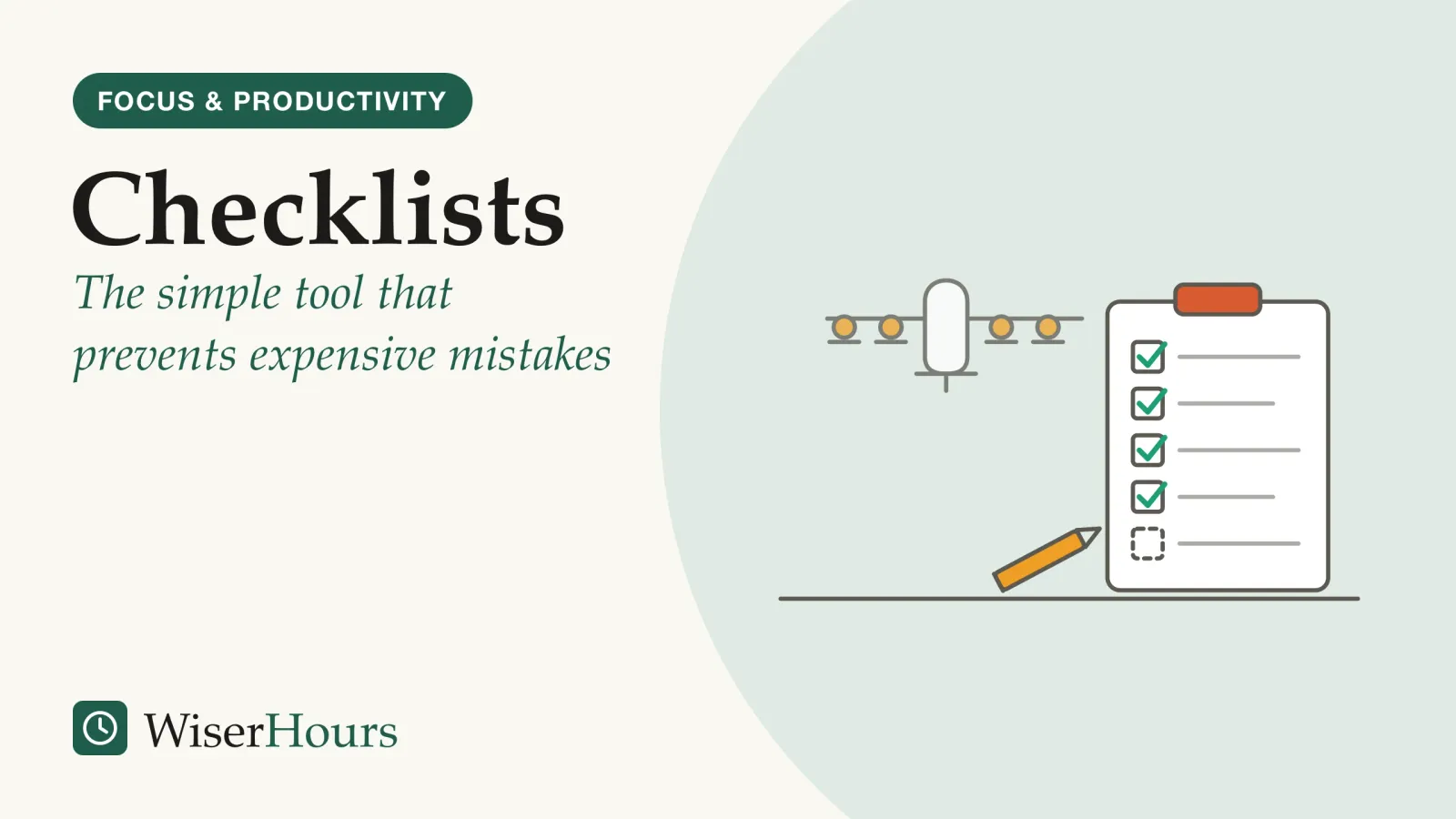
Why checklists work comes down to one thing: they catch the routine steps that skilled people skip when they are rushed or interrupted, and they teach nothing new. That is also their limit, because a list prevents expensive mistakes only when people stop at a set moment and actually use it. A 19-item surgical checklist was linked to fewer deaths in a 2009 study at eight hospitals in eight countries, yet surgical checklists brought no measurable change after Ontario encouraged every hospital to adopt one.12
For your own work, the research and the guidance built on it come down to four moves, each explained further down:
- Pick one pause point where a miss is expensive.
- List only the items that are easy to miss.
- Decide between read-do and do-confirm, that is, whether the list leads the work or checks it afterward.
- Try it on real work, then revise it.
This page stays with one tool. For where it sits among GTD, kanban and the other named methods, read how the best-known productivity methods compare.
Why checklists work: memory drops the easy steps
Checklists work because expert memory is dependable for the hard parts of a job and patchy for the routine ones. The US Army Air Corps drew that conclusion from a bomber crash in 1935, and a 1990 report for NASA described the same weakness in airline cockpits more than fifty years later.
In October 1935, Boeing’s Model 299, the prototype of the bomber later called the B-17, took off from Wright Field in Ohio, pitched up, stalled and crashed. An Army board found that its elevator control had been left locked, and judged that no pilot was likely to notice in time. The crew was very experienced, led by a seasoned test pilot, and checking that the controls moved freely was an ordinary precaution. The Air Corps concluded that the weak point was human memory, not the aircraft, and gave crews checklists for each phase of flight.3
The mechanism is familiar from any skilled work. Steps you have done a hundred times run on autopilot, and autopilot is exactly what an interruption breaks. In a 1990 NASA report, Asaf Degani and Earl Wiener described how distractions break a checklist’s sequence, leaving the pilot to remember where the list stopped and which items were done. They also saw crews speed through lists by calling several items at once and answering in one chunk, which leans on memory, the very thing the list exists to back up.4
Think of sending a quarterly report to a client. You know how to write it. What goes wrong is the attachment left off, last quarter’s figure not updated, or the wrong person copied, usually on a busy afternoon after a phone call. None of those is a knowledge problem. Each is a known step dropped at a moment of pressure, and that is the kind of error a checklist is built to catch.
A checklist is NOT a teaching tool or an algorithm
So give a checklist only the steps you could do half asleep and might still skip, and keep the explaining for training notes or a manual.
What the WHO surgical checklist changed in eight hospitals
The best-known early evidence for checklists came from surgery. In a 2009 study led by Alex Haynes within the World Health Organization’s Safe Surgery Saves Lives program, eight hospitals from Toronto to Ifakara, Tanzania, introduced a surgical safety checklist, and deaths and complications after surgery fell compared with the months before.1
The study
Moderate evidence
Eight hospitals, eight countries, one checklist: Safe Surgery Saves Lives, 2009
Researchers recorded outcomes for consecutive patients aged 16 and over before and after the checklist arrived. Deaths in hospital within 30 days of the operation fell from 1.5 percent to 0.8 percent, about 15 in 1,000 patients to 8 in 1,000, and complications fell from 11.0 percent to 7.0 percent.1
The drop was large, and the design limits what it can prove. Without a randomized comparison group, some of the gain could come from teams knowing they were being watched or from other changes in those months. The authors write that the checklist was designed to improve team communication and consistency of care, so it was meant to do more than jog one person’s memory. We worked from the study’s abstract alone.1 Atul Gawande, one of its authors, later wrote about checklists for general readers in The Checklist Manifesto.6
A well-known result from intensive care fits the same pattern. In a 2006 study of more than a hundred intensive care units, mostly in Michigan, a program to prevent bloodstream infections from central lines, the tubes placed in a large vein, was followed by infection rates falling by up to two-thirds.7 It had no comparison group either, and we saw only its abstract.
What a surgical checklist looks like in practice is a pause. The whole team stops at three moments: before anesthesia, before the first cut and before the patient leaves the operating room.8 Your version might be the minute before you send a contract or start a data migration. A small agency could do it before a campaign goes live: one person reads the items aloud, and anyone who sees a gap can say “not yet”. Tie your checklist to a moment that already exists in the work, so running it costs seconds, not a new meeting.
Why surgical checklists made no measurable difference in Ontario
Hanging a checklist on the wall and using it are different things. When Ontario, Canada, adopted surgical checklists through a province-wide policy, David Urbach and colleagues compared outcomes in the three months before and after each hospital’s adoption, across 101 hospitals. Death and complication rates barely moved, and the small differences were not statistically significant.2
The study, funded by the Canadian Institutes of Health Research, is the clearest test we found of checklists spreading by policy across typical hospitals. We read only its abstract, which reports nothing on how thoroughly teams used the lists, so the result cannot show that Ontario’s surgeons skipped them. It shows only that adoption by policy came with no measurable gain.2
Other research points to use as the missing piece. In a meta-analysismeta-analysis: A study that combines the results of earlier studies on the same question into one overall estimate. Pooling makes the estimate more precise, but it cannot repair the studies it pools: a meta-analysis of surveys is still survey evidence.Full entry in the glossary published in 2018 that added an international patient cohort to earlier studies, Abbott and colleagues found better outcomes where checklists were used, but they warned this could simply reflect better overall care in those hospitals.9 A 2025 review found that, in the studies that measured it, only about half of surgical checklists were filled in completely, and that training, management support and regular feedback went with better use.10
Armstrong and colleagues’ systematic reviewsystematic review: A review that fixes its question and its rules for including studies in advance, then searches out every study that fits and weighs them together. Some systematic reviews pool the results into a meta-analysis; others describe what the studies found without combining the numbers.Full entry in the glossary of hundreds of surgical checklist studies, published in 2022, found that most never described how the checklist was actually completed, which, its authors argue, is why it is hard to tell where it works and where it fails.11 None of these studies proves that thin use explains Ontario’s result; they show that use is often thin and rarely measured. The Michigan infection program, built around a checklist of five infection-control steps, shows what real use involved. Mary Dixon-Woods and colleagues argued in 2011 that crediting its success to “a simple checklist” was a myth: units wrote their own versions, a nurse watching each line insertion could stop it if a step was skipped, and infection rates were fed back to every unit.12
Office teams fall into the same trap. Picture a release checklist added to a ticket template because a manager asked for one: within weeks, people tick every box in one go just before closing the ticket. The list exists, and nothing is being checked. Before you judge any checklist, find out whether it was run item by item at the moment it was meant for; a list ticked from memory is a to-do list, not a check.
Further reading
The Checklist Manifesto: How to Get Things Right
Gawande, an author of the 2009 surgical study, on why skilled people skip routine steps and how to write a checklist a team will run.
As an Amazon Associate WiserHours earns from qualifying purchases.
Read-do or do-confirm: two ways to run a checklist
There are two ways to run a checklist, and choosing the right one matters more than the wording of the items. Aviation research calls them challenge-response, where the crew sets things up from memory and then verifies the critical items, and do-list, where the list leads the crew step by step.4
- Read-do: read one item, do it, then read the next; suited to rare, unfamiliar or urgent tasks where order matters
- Do-confirm: do the work from memory, then pause and check every item; suited to routine work done by people who know it
A 2023 medical review in the journal Anaesthesia uses plainer names, read-do and do-confirm, and explains when each fits. Read-do suits emergencies, where actions may need to happen in order and there may be no time to recover from a missed step; do-confirm suits less urgent work, where you act first and then check for gaps. Pooling randomized trials of cognitive aids, mostly in simulated medical emergencies, the review found that teams with an aid missed far fewer care steps, from roughly four in ten to about one in ten, with moderate-quality evidence.13 Those were simulations with clinicians, not real offices, so treat them as proof of the principle rather than a promise for your desk.
Carried over to office work, which is our reading rather than anything the review tested, do-confirm fits the tasks you do weekly: send the report, then run the checks before it goes. Read-do fits the tasks you do once a year or in a crisis, such as closing the books, restoring a backup or handing over a project when a colleague leaves suddenly. For those, memory has had no practice, so let the list lead.
Back to the client report from the first section. Written as a do-confirm list, it is short enough to run in under a minute, and each item covers a slip that has probably happened to you before.
Five checks before the client report goes out
Write the report as usual, then confirm: the right attachment, this quarter’s figures, the right recipients, a subject line that states the quarter, and one reread of the opening paragraph. Nothing on the list says how to write the report, because that part is already in your head.
Evidence from knowledge work is thin. In a 2022 experiment, professional software developers were randomly assigned to review code with no aid, a checklist or a guided checklist. The authors report that the checklist supported reviewers on the more complex review, but they found no strong overall link between the aid and review performance.14 That is one study, mostly of reviewers new to code review, so treat it as a hint, not a rule.
How to build a checklist people will actually run
A checklist that people actually run is short, tied to a natural pause and revised after real use. Ariadne Labs, a center for health systems innovation, sums up the method in a one-page guide.5 The steps below follow that guide; they are expert advice, not tested one by one.
1. Pick one pause point where a miss is expensive
Choose a moment in the work that already exists, such as before sending, before launching or before signing, and where a skipped step costs real money, time or trust. One checklist per pause point keeps each list short.
2. List only the items that are easy to miss
Include an item only if skipping it is dangerous and nothing else catches it. Ariadne’s guide suggests fewer than 10 items per pause point and wording simple enough to read aloud.5 Degani and Wiener’s observation that crews take shortcuts through long, time-consuming lists is the reason to keep cutting.
3. Decide between read-do and do-confirm
Use read-do for rare, unfamiliar or urgent tasks, and do-confirm for routine ones you know well. Say which at the top of the list so nobody has to guess.
4. Try it on real work, then revise it
Run the list on the next few real cases and note which items people skip or question. Ariadne’s guide asks for trials with the people who will use the list, changes after repeated trials and a date on every version.5 For a team, agree that anyone may pause the work when an item is missed, which was part of what made the Michigan program work.
Before you rely on a new checklist
The evidence behind each step, from strongest to weakest:
| Question | What the best evidence found | Evidence |
|---|---|---|
| Do checklists cut missed steps? | Across 13 randomized trials, mostly simulated emergencies, teams with a cognitive aid missed fewer steps | Pooled randomized trials, moderate13 |
| Do surgical checklists save lives? | Fewer deaths after introduction in eight hospitals; no measurable change under Ontario’s policy | Observational, mixed12 |
| Is patchy use the problem? | About half of surgical checklists were filled in completely where measured | Pooled observational studies, limited10 |
| Do checklists help office work? | One trial with 67 developers: helped on a complex code review, no strong overall link | Trial, limited14 |
| How should a checklist be designed? | Short, tied to a pause point, tested with users and revised | Expert guidance5 |
The bottom line
Use a checklist for the step you know well and might still skip, and expect nothing more from it. Infections fell in the Michigan program, where units wrote their own lists and a nurse could stop a procedure when a step was missed; under Ontario’s adoption policy, checklists made no measurable difference. Start with one pause point in your week where a miss is expensive, write fewer than 10 items, and run the list every time for a month before you judge it.
Frequently asked questions
Why did the Boeing Model 299 crash in 1935?
An Army board found that the bomber's elevator control was still locked when it took off from Wright Field, Ohio, on 30 October 1935, according to a 2013 Air Force Magazine history. Its nose rose far higher than normal, it stalled and crashed, and two of the five men aboard died. The board judged that no pilot was likely to notice the lock in time.
Is a checklist the same as a to-do list?
No. A to-do list holds tasks you will do once and then cross off. A checklist is reused every time the same job comes round, at a set moment, to confirm the steps that matter. Ariadne Labs, a center for health systems innovation, says a checklist is not a teaching tool or an algorithm.
Are digital checklists better than paper ones?
Nobody has tested this for office work that we could find. Aviation research gives one reason to prefer a tool that shows progress: a 1990 NASA report by Asaf Degani and Earl Wiener noted that a paper checklist cannot show where it was interrupted or which items are done, so an interrupted pilot has to remember.
Sources
- A surgical safety checklist to reduce morbidity and mortality in a global population. Haynes, A. B., Weiser, T. G., Berry, W. R., et al., Gawande, A. A. (2009). New England Journal of Medicine, 360(5), 491-499
- Introduction of surgical safety checklists in Ontario, Canada. Urbach, D. R., Govindarajan, A., Saskin, R., Wilton, A. S. & Baxter, N. N. (2014). New England Journal of Medicine, 370(11), 1029-1038
- The Checklist. Boyne, W. J. (2013). Air Force Magazine, August 2013, pp. 52-56
- Human Factors of Flight-Deck Checklists: The Normal Checklist (NASA Contractor Report 177549). Degani, A. & Wiener, E. L. (1990). NASA Ames Research Center
- A Checklist for Checklists. Ariadne Labs (last updated 14 January 2010), accessed 2026
- The Checklist Manifesto: How to Get Things Right (catalogue record). Gawande, A. (2010). Metropolitan Books, New York; Open Library record, accessed 2026
- An intervention to decrease catheter-related bloodstream infections in the ICU. Pronovost, P., Needham, D., Berenholtz, S., et al. (2006). New England Journal of Medicine, 355(26), 2725-2732
- Tool and Resources: WHO Surgical Safety Checklist. World Health Organization, accessed 2026
- The surgical safety checklist and patient outcomes after surgery: a prospective observational cohort study, systematic review and meta-analysis. Abbott, T. E. F., Ahmad, T., Phull, M. K., et al. (2018). British Journal of Anaesthesia, 120(1), 146-155
- Beyond compliance: examining the completeness and determinants of WHO surgical safety checklist - a systematic review and meta-analysis. Habtie, T. E., Feleke, S. F., Terefe, A. B. & Adisu, M. A. (2025). BMC Health Services Research, 25, 504
- Effect of the surgical safety checklist on provider and patient outcomes: a systematic review. Armstrong, B. A., Dutescu, I. A., Nemoy, L., et al. (2022). BMJ Quality & Safety, 31(6), 463-478
- Explaining Michigan: Developing an Ex Post Theory of a Quality Improvement Program. Dixon-Woods, M., Bosk, C. L., Aveling, E. L., Goeschel, C. A. & Pronovost, P. J. (2011). The Milbank Quarterly, 89(2), 167-205
- Cognitive aids in the management of clinical emergencies: a systematic review. Greig, P. R., Zolger, D., Onwochei, D. N., et al. (2023). Anaesthesia, 78(3), 343-355 (published online December 2022)
- Do explicit review strategies improve code review performance? Towards understanding the role of cognitive load. Wurzel Gonçalves, P., Fregnan, E., Baum, T., Schneider, K. & Bacchelli, A. (2022). Empirical Software Engineering, 27, 99
How we researched this
Searches of PubMed, NASA's technical reports server and general web results, run in September 2026, covered the history of aviation checklists, trials and reviews of surgical and emergency checklists, and studies of checklists outside medicine. Sources date from 1990 to 2025. Most evidence comes from hospitals and cockpits, so applying it at a desk is our inference. For five papers, including the 2009 surgical study, we had the abstract but not the full text, and the article claims nothing those abstracts do not state.
Keep reading
Toxic Productivity: When Self-Optimization Goes Too Far
Toxic productivity has no clinical definition. What 4 lines of research show, from workaholism to busyness as a status symbol, and when to ease off.
The 80/20 Principle: A Complete Guide
The 80/20 rule tested against real data on software bugs, grocery sales and health spending: where the pattern holds, where the ratio breaks, how to use it.
Personal Kanban: Visualize Your Work and Limit Work in Progress
Personal kanban's 2 rules, show your work and cap what is in progress, explained with the research on why fewer open tasks finish sooner.
Getting Things Done: A Beginner's Guide to GTD
Getting Things Done for beginners: GTD's 5 steps, a minimal setup and a first-week plan, with each step labelled by what backs it, research or David Allen.