Catastrophizing: How to Catch Worst-Case Thinking and Test It
Catastrophizing turns a setback into a disaster in your head. Test the thought in 6 steps at work, and see what CBT trials found about changing it.

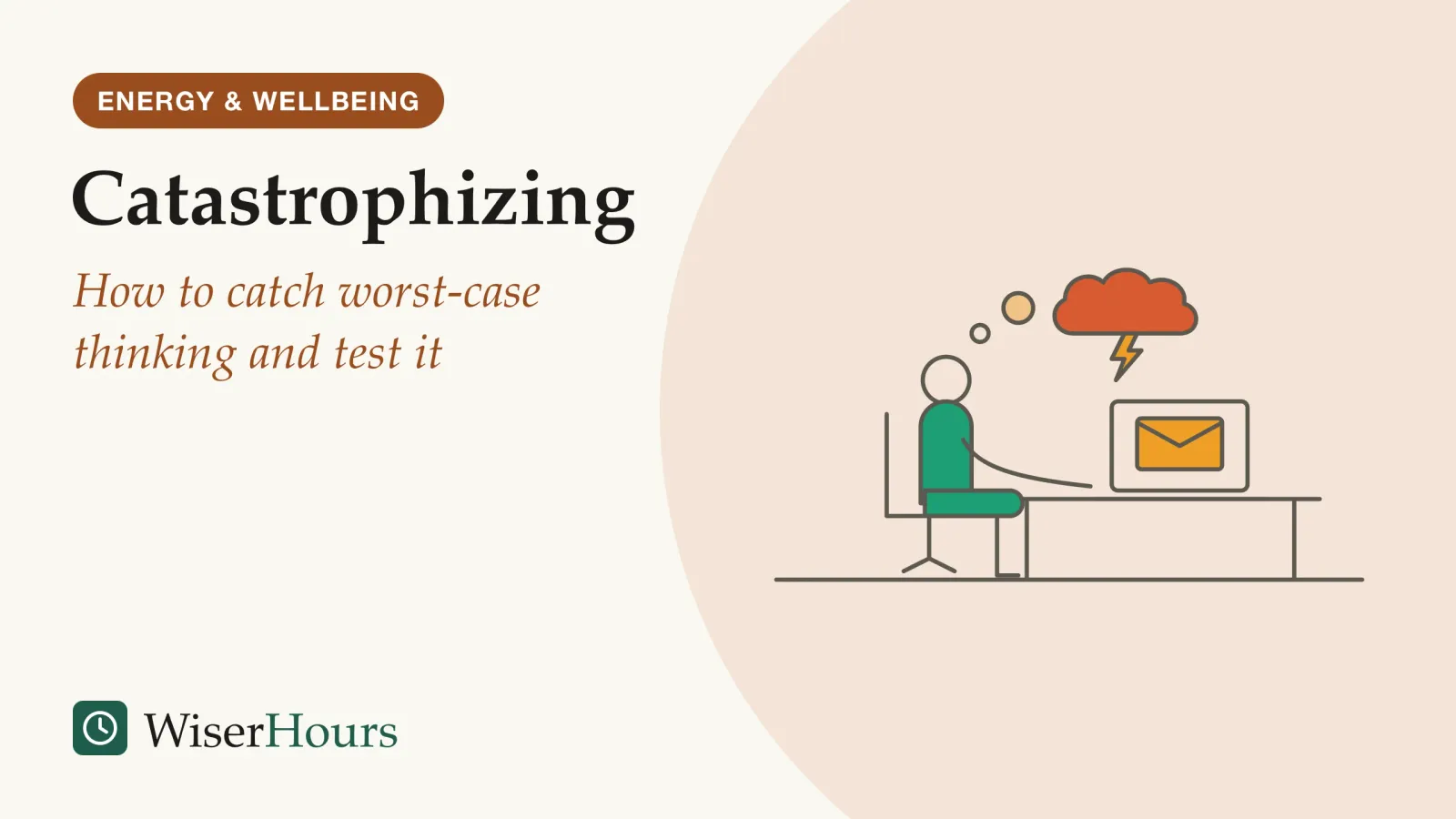
Catastrophizing is the habit of treating a setback as a disaster before anything has happened: assuming the worst possible outcome, or treating a hard situation as one you could not bear. It can turn a two-line work message into a lost job in about two minutes.
A manager’s note lands at 4:50 p.m.: “Need to talk about the Henderson file. Tomorrow 9am.” By 4:52 its reader has replayed every mistake of the quarter, pictured a warning at the next review and started rehearsing a difficult talk at home about money. Nothing in the message says any of that. The thought can be tested in six steps:
- Notice the thought
- Name it as catastrophizing
- Estimate the realistic odds
- List the other outcomes
- Plan for the worst case, briefly
- Decide what is in your control
The steps borrow from cognitive behavioral therapycognitive behavioral therapy: A structured talking therapy that works on the links between thoughts, feelings and behavior, usually over a set number of sessions with practice between them. It is given by a trained therapist or through guided programs, and versions exist for specific problems.Full entry in the glossary, and the evidence that catastrophizing can change comes from therapy trials, not from self-help. A 2018 meta-analysis of randomized trials in adults with chronic pain found that catastrophizing can be reduced, with some of the strongest evidence for cognitive behavioral therapy, though the gains were usually modest.1
What is catastrophizing?
Catastrophizing is exaggerating the negative consequences of events or decisions, according to the APA Dictionary of Psychology. People do it when they expect the worst possible outcome, or when they react to a situation that is serious and upsetting, but not disastrous, as if it were a catastrophe. The psychologist Albert Ellis coined the verb, along with its synonym “awfulize”.2
Aaron Beck then adapted the idea to describe a thinking style in people with anxiety and depression; at the core of both men’s definitions sat an irrationally negative forecast of the future.3 In Beck’s tradition, catastrophizing is one of the cognitive distortions, biased thought patterns that distort how a situation is read, and it is classed as a form of magnification.4
Having distortions is normal: the APA dictionary calls cognitive distortion a normal process that happens in everyone to some degree.5 The practical point is that the thought feels like news about the future, when it is a forecast made under stress, and forecasts can be checked. That is why none of the steps below asks you to stop having the thought, only to examine it.
Two forms: “it will go wrong” and “I couldn’t stand it”
Catastrophizing shows up in two forms: giving the worst possible outcome more weight than its likelihood deserves, and experiencing a situation as unbearable or impossible when it is just uncomfortable.4 The first is a prediction error; the second is an error about size and coping.
The first form jumps ahead. A deadline slips by a day, and within a minute the thought is “the client will drop us, and it’s my fault”. Each step feels plausible, but the chain skips every likelier ending, such as an apology, a new date and a mildly annoyed client.
The second form magnifies. The review meeting has not happened, but the feared criticism already feels unsurvivable: “if she says the report was weak, I can’t face the team”. The problem is not the odds but the size. An honest description of most criticism at work is “unpleasant, and survivable”, and this form of the thought deletes the second half.
Ask which claim the thought is making. “It will happen” calls for checking odds; “I couldn’t stand it” calls for a plan.
How do you stop catastrophizing?
Stopping catastrophizing means testing the thought, not suppressing it. The NHS’s self-help version of cognitive behavioral therapy calls this “catch it, check it, change it”: spot the unhelpful thought, weigh the evidence for it and look for other ways to see the situation.6 The six steps below expand that sequence for work and add a short plan for the worst case.
These are habits for everyday worst-case thoughts, not treatment for an anxiety disorder, chronic pain or trauma. If the thoughts concern a past trauma or come with panic attacks, work through them with a professional.
- 1Noticethe jolt, the replay
- 2Namethat is catastrophizing
- 3Estimate the oddshow likely, on the evidence?
- 4List other outcomesbest, worst, most likely
- 5Plan brieflyif the worst came, then what?
- 6Act on what you controlone next step
1. Notice the thought
Catastrophizing often arrives as a jolt in the stomach or a replay of the email before it arrives as words. Treat the jolt as your cue. Write the thought down in the exact words your mind used: “I’m going to be fired” is easier to examine on paper than in your head.
2. Name it as catastrophizing
Putting a label on the thought, such as “this is my mind jumping to the worst case”, creates a little distance from it. The NHS’s first step is to know the types of unhelpful thought, and “always expecting the worst outcome” heads its list.6 A label does not argue with the thought; it reminds you that you have met this pattern before.
3. Estimate the realistic odds
Next, ask how likely the feared outcome is and what evidence supports it. Use your own track record as the baseline: how many curt emails from this manager led to anything serious? If the answer is “dozens, and none”, the forecast deserves a low number, even if it still feels high.
4. List the other outcomes
Write at least two other endings: the best case and the most likely case. The NHS suggests asking whether there are other explanations and what you would say to a friend who was thinking this way.6 For the Henderson email, the list might read: they found an error and want it fixed; the client has a new request; they are rushed and short with everyone this week.
- Myth
- If you cannot swap a catastrophic thought for a positive one, the exercise has failed.
- Fact
- The NHS says not to worry if you cannot change a thought: the process is about learning to think more flexibly, and a neutral view counts.
Aim for a fair reading of the email, not a cheerful one.
5. Plan for the worst case, briefly
Then face the worst case once, on purpose, and ask how you would respond if it happened. Decatastrophizing, a term Ellis coined for a technique that Beck, among others, later developed, examines whether the effects of a feared event have been overestimated and the person’s ability to cope underestimated.7 A missed deadline that does cost the client still leaves next steps: an honest account, a recovery plan, a talk about workload. Write the list, then stop: the NHS’s problem-solving guide suggests 5 or 10 minutes for working on one solvable problem.8
6. Decide what is in your control
Last, sort what you can act on from what you cannot. The NHS separates problems you can tackle by doing something practical from worries about things outside your control, and advises a specific plan for the solvable ones.8 Before the 9 a.m. meeting you can reopen the Henderson file and note what you would fix; you cannot control your manager’s mood.
Worries with nothing practical attached need other tools, such as a set time to worry. If the thoughts follow you home, the evening habits for mentally switching off from work pick up where these steps stop.
Testing a worst-case thought
Do the steps work? What therapy trials can tell you
The six steps are self-help versions of techniques from cognitive behavioral therapy (CBT), and almost all the evidence for them comes from therapy delivered by clinicians. The NHS says CBT is usually done with a therapist, though many of its ideas can be practised alone.9 The clearest test of whether catastrophizing itself can change comes from pain research.
The study
Moderate evidence
Can catastrophizing be reduced? Yes, modestly, across 79 pain trials
Schütze and colleagues pooled randomized trials measuring pain catastrophizing in about 9,900 adults with chronic pain. Nine kinds of treatment reduced it compared with a waiting list, usual care or another active treatment; the best evidence was for cognitive behavioral therapy, multimodal pain programs and acceptance and commitment therapy. Effects were generally medium-sized, of questionable clinical importance, and larger in trials of people who catastrophized a lot.1
So catastrophizing can shift, but these were people with chronic pain working with clinicians, not office workers with a checklist, and we had the abstract only. On CBT more broadly, a 2012 review of 106 meta-analyses by Stefan Hofmann and colleagues found the strongest support for anxiety disorders, general stress and a few other problems.10
| What it is | What the best evidence found | Evidence |
|---|---|---|
| Treatments aimed at pain catastrophizing | Reduced it, usually modestly; CBT had among the best evidence | Meta-analysis of trials, moderate1 |
| Catch it, check it, change it | Recommended self-help steps for unhelpful thoughts | Health service guidance, expert opinion6 |
| These six steps, used alone at work | No trial of this exact sequence found | Untested |
Untested does not mean useless: the steps are a way to practise skills drawn from therapies that helped in trials, and a realistic aim is a thought that feels less certain, not one that vanishes. For habits that lower stress in general, rather than testing single thoughts, see how to reduce stress.
What causes catastrophic thinking?
Nobody has pinned down a single cause of catastrophic thinking, and researchers do not yet agree on exactly what it is. A 2020 narrative review of pain catastrophizing by Laura Petrini and Lars Arendt-Nielsen in Denmark says there is no general theoretical agreement on the concept, and links it to worry, ruminationrumination: Repetitive, passive dwelling on problems, feelings or their causes and consequences, without moving toward a solution. It is linked to depression and anxiety, and when it is about work it can keep the job on your mind long after the working day ends.Full entry in the glossary, emotion regulation and sensitivity to body signals.11 The worst-case thought sits close to worry and to going over things again and again, which is how one alarming email can fill an evening.
Graham Davey and Suzannah Levy offered a clue to how the chain builds in a 1998 paper reporting six studies. They used a catastrophizing interview, which asks people to keep spelling out what they fear would follow. Chronic worriers catastrophized more than non-worriers, even when asked about a positive part of their life, and they tended to frame their steps in terms of their own personal inadequacy.12 We had only the abstract to go on, but the pattern will be familiar to anyone who has turned a typo into a dismissal.
- A curt two-line emailthe event
- “My manager is annoyed with me”the first leap
- “My review will be bad”the chain grows
- “I will lose my job”the catastrophe
- Exit: “They were rushing between meetings”the likelier outcome the chain skipped
Circumstances matter too: the NHS lists pressure at work, money worries, health problems and difficult past experiences among possible causes of anxiety.13
Look at where a chain like that turns. The event stays the same size while the story moves from “the email was curt” to “I am the problem”, and once it is about you, each later step can feel deserved. Find that turn in your own chain and test it first.
Is catastrophizing a symptom of anxiety?
Catastrophizing is not a diagnosis, but it overlaps with anxiety. The UK’s NHS lists “fear of the worst happening” among the mental symptoms of anxiety.13
A 2016 review by Resham Gellatly and Aaron Beck describes catastrophic thinking across many conditions, including panic, health anxiety, obsessive-compulsive disorder and post-traumatic stress, with content that differs from one condition to the next (we read the abstract only).14 What separates an ordinary worst-case moment from a problem is less the thought itself than how often it comes, how long it stays and what it stops you doing.
The best-studied form is pain catastrophizing, the tendency to magnify pain, feel helpless about it and be unable to stop thinking about it. A 2009 review in Expert Review of Neurotherapeutics links it to more severe pain, more disability and, when measured before an operation, to worse pain afterward. Because the research behind these links is observationalobservational study: A study in which researchers record what people already do or are exposed to, rather than assigning anyone to anything. It can show that two things go together, not that one causes the other, because the groups being compared may differ in other ways as well.Full entry in the glossary, they are associations, not proof that the thoughts cause the pain.3
In practice, a worst-case thought before a hard meeting is ordinary. If worst-case thinking arrives most days and stops you sleeping or acting, mention it to a doctor; the tiers below say how soon.
When worry is more than a habit
Worst-case thinking that comes with thoughts of suicide or self-harm needs help straight away; worry you cannot manage, or that self-help has not shifted, is worth booking a doctor for soon, within days or weeks. This advice comes from NHS pages in the UK (checked October 2026) and the 988 Lifeline in the US; treat the named services as examples and look up the equivalents where you live.
- Now: if you might act on thoughts of suicide or self-harm, or you are not sure you can keep yourself safe, phone your local emergency number or get to an emergency department without waiting. The NHS’s UK route is 999 or A&E, and it also points to Samaritans, on 116 123, as someone to talk to.15 In the US, calls and texts to 988 reach the 988 Lifeline, free and confidential at any hour.16 For other countries, the Find A Helpline directory lists free crisis lines.17
- Soon: the NHS advises making an appointment with a GP, or a family doctor elsewhere, if anxiety, fear or panic feels hard to cope with, or if your own efforts are not helping. People in England can also contact NHS talking therapies directly, without a GP referral, from age 18 (16 in some areas).13
- Routine: bring up at your next appointment any worry that never seems to lift, regular panic attacks, or flashbacks and nightmares about past events; the NHS connects these with generalized anxiety disorder, panic disorder and post-traumatic stress disorder.13
The bottom line
Catastrophizing is a forecast made under stress, and it makes two claims you can test: that the worst will happen, and that you could not cope if it did. Write the thought down, check it against your own track record, list the likelier endings, and give the worst case a few minutes of planning. Then take one step you control. If worst-case thinking is crowding out sleep or work despite this, talk to a doctor.
This article is general information, not medical advice. If you're worried about your health, talk to a doctor or another qualified professional.
Frequently asked questions
Is catastrophizing the same as overthinking?
Not quite. Overthinking is a loose everyday word for thinking too long about something, while catastrophizing is a specific pattern: the APA Dictionary of Psychology defines it as exaggerating the negative consequences of events or decisions. You can overthink without predicting disaster, and you can catastrophize in a single fast thought.
Who coined the term catastrophizing?
The psychologist Albert Ellis coined the verb catastrophize and its synonym awfulize, according to the APA Dictionary of Psychology. A 2009 review of pain research adds that Aaron Beck later adapted the idea to describe a thinking style in people with anxiety and depression.
Can catastrophizing make physical pain worse?
It is linked to worse pain outcomes. A 2009 review in Expert Review of Neurotherapeutics reports that pain catastrophizing has been associated with more severe pain, more disability and, when measured before surgery, with pain after it. Most of the studies are observational, so it shows an association, not proof that catastrophizing causes the pain.
Sources
- How Can We Best Reduce Pain Catastrophizing in Adults With Chronic Noncancer Pain? A Systematic Review and Meta-Analysis. Schütze, R., Rees, C., Smith, A., Slater, H., Campbell, J. M. & O'Sullivan, P. (2018). The Journal of Pain, 19(3)
- catastrophize. APA Dictionary of Psychology, American Psychological Association (entry updated 19 April 2018)
- Pain catastrophizing: a critical review. Quartana, P. J., Campbell, C. M. & Edwards, R. R. (2009). Expert Review of Neurotherapeutics, 9(5)
- Cognitive distortion. Wikipedia (accessed 6 October 2026)
- cognitive distortion. APA Dictionary of Psychology, American Psychological Association (entry updated 19 April 2018)
- Reframing unhelpful thoughts. Every Mind Matters, NHS (UK)
- Decatastrophizing. Wikipedia (accessed 6 October 2026)
- Problem solving. Every Mind Matters, NHS (UK)
- Self-help CBT techniques. Every Mind Matters, NHS (UK)
- The Efficacy of Cognitive Behavioral Therapy: A Review of Meta-analyses. Hofmann, S. G., Asnaani, A., Vonk, I. J. J., Sawyer, A. T. & Fang, A. (2012). Cognitive Therapy and Research, 36(5)
- Understanding Pain Catastrophizing: Putting Pieces Together. Petrini, L. & Arendt-Nielsen, L. (2020). Frontiers in Psychology, 11
- Catastrophic worrying: personal inadequacy and a perseverative iterative style as features of the catastrophizing process. Davey, G. C. L. & Levy, S. (1998). Journal of Abnormal Psychology, 107(4)
- Get help with anxiety, fear or panic. NHS (UK), page last reviewed 13 July 2026
- Catastrophic Thinking: A Transdiagnostic Process Across Psychiatric Disorders. Gellatly, R. & Beck, A. T. (2016). Cognitive Therapy and Research, 40(4)
- Where to get urgent help for mental health. NHS (UK), page last reviewed 26 April 2023
- 988 Suicide & Crisis Lifeline. 988 Suicide & Crisis Lifeline (US)
- Find A Helpline. Find A Helpline (ThroughLine), international directory of crisis lines
How we researched this
We searched Europe PMC, PubMed and Crossref in October 2026 for reviews of catastrophizing and its treatment, and read the APA Dictionary of Psychology and NHS self-help CBT pages for definitions and practical steps. Sources span 1998 to 2026. Two reviews and one six-study paper were read as abstracts only. Main limitation: the trials behind the steps tested therapy, mostly in people with chronic pain or anxiety disorders, not self-help at work.
Keep reading
Cognitive Defusion: Stepping Back From Thoughts Instead of Fighting Them
Cognitive defusion, from ACT, means stepping back from a thought instead of arguing with it. Learn 6 exercises and what lab studies found.
High-Functioning Anxiety: What the Term Means and What It Misses
High-functioning anxiety is not a diagnosis, but 6 months of hard-to-control worry may signal GAD. What clinicians assess, and why doing well is not mild.
Physical Symptoms of Anxiety: What's Common and When to See a Doctor
Physical symptoms of anxiety, from a racing heart to poor sleep: 9 common ones, why the body makes them, and the warning signs that need a doctor first.
The Yerkes–Dodson Curve: Is There an Ideal Amount of Pressure?
The Yerkes-Dodson law grew from a 1908 mouse study, not office stress. What it found, how the inverted U was added later, and what holds up for people.