The Yerkes–Dodson Curve: Is There an Ideal Amount of Pressure?
The Yerkes-Dodson law grew from a 1908 mouse study, not office stress. What it found, how the inverted U was added later, and what holds up for people.

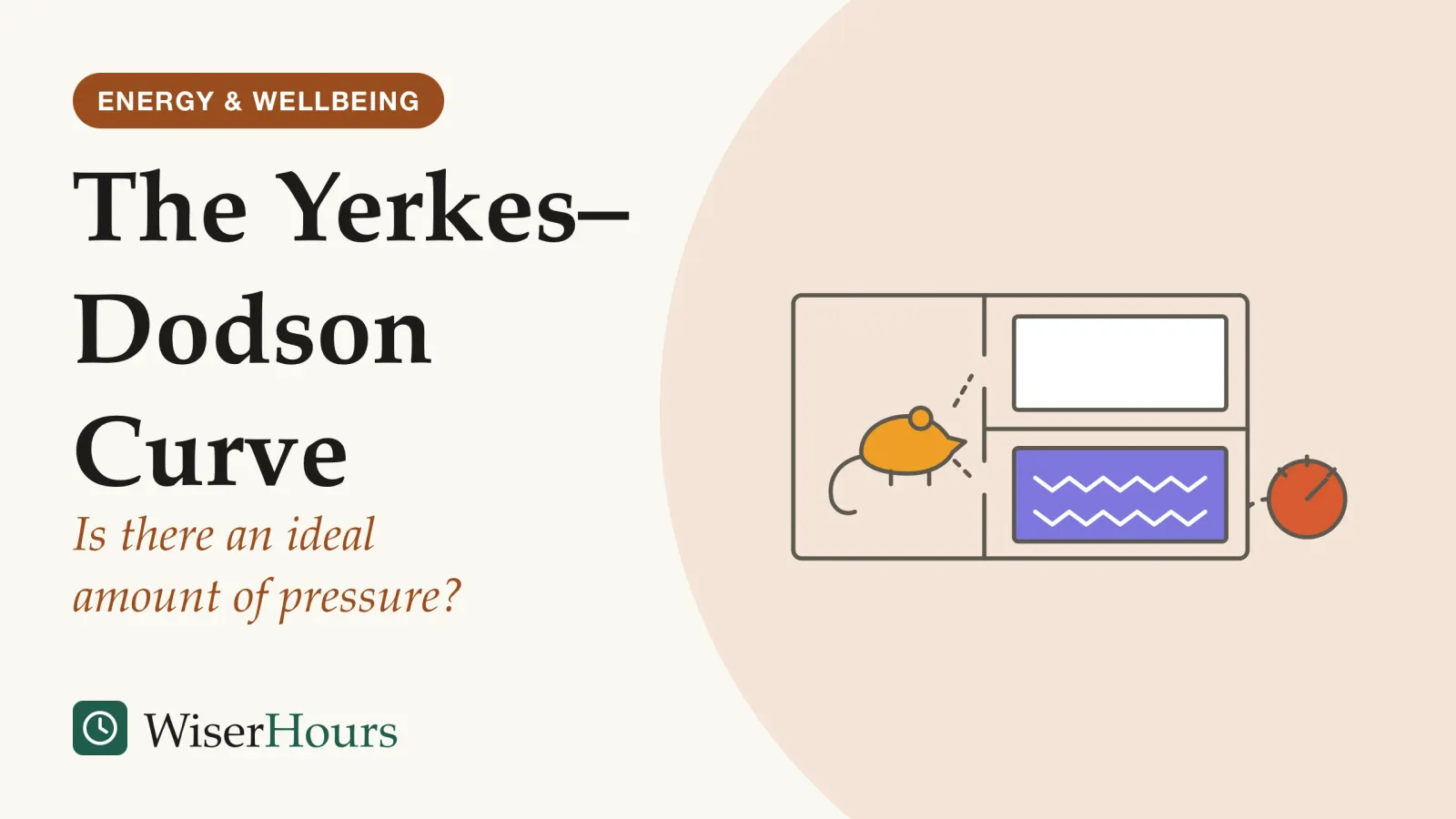
Mice sit at the root of the Yerkes-Dodson law. The experiment behind it, published in 1908, trained dancing mice to pick a white box over a black one and gave them an electric shock when they chose wrong; it never measured stress, anxiety or arousal in people.1 Yet the law is now taught as a rule for human performance under pressure.
The Yerkes-Dodson law says performance rises with arousal up to a point and then falls, drawn as an inverted U. The original 1908 finding was narrower and more useful: the best strength of shock depended on how hard the task was, with the hardest choice learned best under a fairly weak shock.1 Treat any “ideal level of pressure” as a loose rule of thumb, not a measured number, and use the part that holds up: give hard, unfamiliar work your calmest conditions, and let deadline pressure fall on routine tasks.
What does the Yerkes-Dodson law say?
The Yerkes-Dodson law, in the version most people meet, states that the relation between motivation or arousal and performance can be drawn as an inverted U, as the American Psychological Association’s dictionary puts it.2 Too little arousal and you coast; too much and you fall apart; in between sits a sweet spot.
The picture is popular because it matches ordinary experience. A report with no deadline drifts for weeks; the same report with a deadline tomorrow gets written; and the same report due in an hour, with your manager reading over your shoulder, comes out muddled. A single curve seems to explain all three.
The trouble is that this curve is not what Yerkes and Dodson found, and the parts later writers added have far less evidence behind them than the original finding. Telling the two apart is what lets you predict when a deadline will help and when it will get in the way.
What the 1908 experiment tested
Robert Yerkes and John Dodson asked a narrow question: does the strength of an electric shock change how fast mice learn to avoid the wrong box, and which strength works best? They varied two things, the shock and how different the two boxes looked, which made the choice easy, medium or hard.1
The study
Limited evidence
Forty dancing mice, three levels of difficulty: the hardest choice suited a fairly weak shock
Forty young dancing mice learned to enter a white box rather than a black one, with a shock for each wrong choice. When the boxes differed greatly in brightness and the choice was easy, learning sped up as the shock got stronger, up to the strongest shock the researchers were willing to use. When the boxes looked almost alike and the choice was hard, both weak and strong shocks slowed learning, and a fairly weak shock worked best. The harder the task, the closer the most helpful shock sat to the weakest one the mice could feel.1
The authors were frank about the limits: only four mice per shock strength in the easy condition (ten, they wrote, would probably have smoothed the curve), only three strengths in the medium condition, and a tentative easy-task result, because they stopped short of shocks that could injure the animals. The paper never uses the words stress, arousal or law. Its own summary is about tasks: an easy habit formed readily under strong stimulation, a difficult one only under fairly weak stimulation.1
That is a claim about difficulty, and it is the part of the story that has aged best. Ask how hard a task is before asking how much pressure it can take.
- Easy task: in 1908 the mice learned an easy choice faster as the shock got stronger, up to the strongest shock the researchers were willing to use
- Hard task: learning a difficult choice was slow under both weak and strong shocks
- The best level moves: the harder the task, the closer the most helpful shock sat to the weakest one that the mice could feel
- The textbook curve: one symmetric inverted U for all tasks, drawn by later arousal theorists; it leaves task difficulty out
How the inverted U was added later
The single inverted U came from arousal theory in the 1950s, not from the 1908 data. A 2007 review by David Diamond and colleagues traces it to writers such as Donald Hebb, in 1955, and Elizabeth Duffy, who described the link between arousal and performance as a single curve without citing Yerkes and Dodson; from the 1960s, introductory textbooks taught that single curve under the Yerkes-Dodson name.3
- 1908Yerkes and Dodson: shock strength and task difficulty in dancing mice
- 1955Hebb draws one curve for arousal and performance
- 1959Easterbrook: strong emotion narrows attention
- 1960s onTextbooks teach one inverted U under the Yerkes-Dodson name
- 1994Teigen traces how the law was rewritten
- 2015Corbett calls it folklore with no basis in fact
Something was lost in the merger. Diamond and colleagues argue that Hebb’s version wrongly implies strong emotion harms every kind of performance, when the original data showed strong stimulation helping on the easy task.3 Karl Halvor Teigen’s 1994 history in Theory & Psychology found that later researchers and textbook authors retold the law with many different causes, from reward and drive to anxiety and stress, and many different outcomes, from learning to coping and memory. The task variable was sometimes dropped altogether, and the changes were often credited to Yerkes and Dodson themselves.4
A second idea was bolted on to explain the downward slope. James Easterbrook proposed in 1959 that strong emotion narrows the range of cues a person attends to: on a simple task that turns on a single cue that helps, while on a complex task that needs many cues it hurts.3 Yaniv Hanoch and Oliver Vitouch, in a 2004 critique, argue that the collapsed single curve is far too simplistic, that arousal cannot be treated as one quantity on one axis, and that narrower attention is not always a disadvantage.5 So when a training slide or a manager uses the hump to argue for more pressure, they are quoting the later version, not the experiment.
Is the Yerkes-Dodson law true for humans?
Partly. No study has shown a precise, universal sweet spot of stress for human performance, and critics go further: Martin Corbett’s 2015 paper in the Journal of Managerial Psychology concludes that the law has no basis in empirical fact and warns managers against raising employee stress to lift performance.6 What does hold up is the narrower claim that pressure hurts demanding thinking more than simple, practiced work.
The best human evidence comes from lab experiments that put volunteers through either a stressful task or a calm control condition, then test their thinking. A 2016 meta-analysismeta-analysis: A study that combines the results of earlier studies on the same question into one overall estimate. Pooling makes the estimate more precise, but it cannot repair the studies it pools: a meta-analysis of surveys is still survey evidence.Full entry in the glossary of 51 such studies, led by Grant Shields at the University of California, Davis, found that acute stress impaired working memoryworking memory: The small mental workspace that holds and handles the information you are using right now, such as a phone number you are about to dial. Its capacity is limited, which is why juggling several things at once quickly overloads it.Full entry in the glossary and the ability to switch between rules, while it showed no clear overall effect on inhibition, the ability to hold back a response. The working-memory effect was small: visible as an average over many volunteers, hard to spot in any one individual. The studies used brief lab stressors, such as tasks that put volunteers under social evaluation or mild pain, not months of workplace strain.7
Earlier research fits the same pattern. A 2009 review by the neuroscientist Amy Arnsten recounts that early post-war studies found stress impaired tasks needing complex, flexible thinking but could improve simpler or well-rehearsed ones, and that people who felt in control of the situation were often not impaired.8 Wikipedia’s summary of the field adds that research has found the correlation Yerkes and Dodson described, but no settled cause for it.9
- Myth
- Everyone performs best at one ideal amount of stress, so a bit more pressure always helps.
- Fact
- No study has pinned down one ideal level. The useful part of the 1908 finding is that hard tasks tolerate less pressure than easy ones.
So the answer depends on which version you mean. The single curve with a fixed peak is a teaching cartoon; the idea that hard, new tasks suffer first under pressure has reasonable support in human experiments. A more useful question is how new and demanding the task in hand is.
How task difficulty changes the Yerkes-Dodson curve
Task difficulty moves the peak. In the 1908 mouse data, learning on the easy task kept improving as the shock got stronger, while on the hard task it peaked early, under a fairly weak shock. The early human studies in Arnsten’s review show a similar split: pressure could help simple or well-rehearsed tasks and hurt complex ones.8
The likely reason in people is that hard tasks lean on working memory, the mental scratchpad that keeps a problem in view while you reason about it, and the lab experiments above show stress squeezing that workspace. Arnsten’s review describes the prefrontal cortex, the brain region behind this kind of reasoning, as the region most sensitive to stress, while engrained habits run on other circuits that stress spares or even enhances.8
Consider two tasks on one afternoon. Clearing a backlog of invoices you have processed a hundred times may go faster with a deadline at five. Writing a first proposal in a field you have never worked in needs you to hold several unfamiliar ideas at once, which is exactly the load pressure makes harder to carry. The same deadline helps one task and hurts the other.
Is some stress good for you? What the optimal level of arousal means
Some stress is normal and can help: the World Health Organization says a small amount of stress is useful for getting through daily tasks, while too much can harm both physical and mental health.10 None of the sources here offers a measurable optimal level of arousal you could aim for: the right amount differs by task, and, as the critics above argue, arousal is not a single dial.
How the body produces that response is covered in how the stress response works. For performance, the type of demand matters more than the amount. A 2005 meta-analysis of workplace studies by Jeffery LePine and colleagues sorted work demands into two kinds, which the authors call challenge stressors and hindrance stressors. Challenge stressors had a positive direct link to performance and hindrance stressors a negative one, though challenge stressors also brought more strain, which pulled performance the other way; the summary here comes from its abstract only.11 A 2019 review and meta-analysis by Joseph Mazzola and Ryan Disselhorst adds a caution, again judged from its abstract: both kinds of stressor were consistently linked to more psychological strain and poorer physical health.12
That fits ordinary experience at work. A stretching project with clear goals can feel energizing, while the same hours spent fighting approval queues or unclear roles drain you without improving the work. If you want to dig into the conditions that make a job stressful in the first place, the common causes of work stress sets them out. Helpful versus harmful pressure deserves a separate piece, which will join our stress and anxiety guides.
Using the curve at work: calmer conditions for hard, new tasks
For knowledge work, the Yerkes-Dodson law suggests protecting calm, low-interruption time for hard and unfamiliar tasks, and using deadlines and pressure for routine work you already do well. This follows the task-difficulty finding and the human lab evidence above; it is a reasonable inference, not something a workplace trial has tested.
| What the popular curve says | What the evidence shows | Evidence |
|---|---|---|
| One inverted U fits every task | The best level of pressure depended on task difficulty in the 1908 experiment1 | Limited: one small mouse study |
| Strong emotion always harms performance | Early studies found pressure hurt complex thinking but could help simple, well-rehearsed tasks8 | Narrative review of older studies |
| A little stress sharpens thinking | Short lab stressors modestly impaired working memory in human experiments7 | Meta-analysis of lab experiments |
| More pressure means more output at work | Challenge demands were linked to better performance, hindrances to worse11 | Meta-analysis of existing workplace studies |
In practice, where your schedule allows, that can mean scheduling the hardest thinking of the day before meetings and messages start, and saving deadline sprints for tasks with a clear routine. It can also mean practicing a high-stakes task, such as a presentation, until it feels routine, so that more of it runs on habit when nerves arrive; this is our reading of the early studies, not a tested method. Because a sense of control seemed to protect performance in those studies, asking for clear priorities may matter more than willpower, though that idea was not tested in the work cited here.8
A quick test before a deadline
Sort today’s tasks into new-and-hard or practiced-and-routine. Give the first group your quietest hours, and let the routine group carry the deadline pressure.
When pressure stops being performance and becomes a health problem
Pressure that comes with poor sleep, constant worry or physical symptoms is no longer only a performance question. The tiers below draw on the European Commission, the 988 Lifeline and the NHS; numbers and services vary between countries, so check the ones for your country.
- Now: if you have thoughts of suicide, have harmed yourself, or someone is in immediate danger, call your local emergency number. In the EU, 112 is free from any phone.13 In the US, the 988 Lifeline answers calls and texts 24 hours a day, for free and in confidence.14 In the UK, the NHS says to call 999 or go to A&E.15
- Soon: the NHS advises seeing a doctor (a GP in the UK) when stress is getting too much to manage or self-help is not making a difference; in England, NHS 111 handles needs that are urgent but not emergencies.15
- Routine: lasting changes such as sleeping too much or too little, eating more or less than usual, or drinking more appear on the NHS list of stress symptoms; mention them at your next check-up.15
The bottom line
The Yerkes-Dodson law began as a mouse experiment about shocks and task difficulty, and the tidy inverted U was added decades later. The part worth keeping is the original one: hard, new tasks suffer first when pressure rises, while routine work can tolerate it. Give your most demanding thinking your calmest hours, and treat any promise of an ideal stress level with suspicion.
This article is general information, not medical advice. If you're worried about your health, talk to a doctor or another qualified professional.
Frequently asked questions
Who were Yerkes and Dodson?
Robert M. Yerkes and John Dillingham Dodson were US psychologists, according to the American Psychological Association's dictionary. Their 1908 paper in the Journal of Comparative Neurology and Psychology reported experiments with dancing mice, and they wrote that they did not want to rest their conclusions on the mouse alone and planned to repeat the work with other animals.
Why is it called a law if the evidence is so thin?
The label came from later writers, not from Yerkes and Dodson, whose 1908 paper never uses the word. Wikipedia, summarizing a 2015 paper by Martin Corbett, notes that the study was cited only ten times in the following half century, yet four of those citing articles already called the finding a psychological law.
How is the Yerkes-Dodson curve different from flow?
The curve links a single level of arousal to performance, while flow theory looks at the match between the challenge of a task and a person's skill. Wikipedia's summary of the field describes flow as a less simplistic account of that match, and notes that reversal theory, another model of arousal, rejects the Yerkes-Dodson curve outright.
Sources
- The relation of strength of stimulus to rapidity of habit-formation. Yerkes, R. M. & Dodson, J. D. (1908). Journal of Comparative Neurology and Psychology, 18(5), 459-482 (doi:10.1002/cne.920180503); text from Classics in the History of Psychology, York University
- Yerkes–Dodson law. APA Dictionary of Psychology, American Psychological Association (updated 19 April 2018)
- The temporal dynamics model of emotional memory processing: A synthesis on the neurobiological basis of stress-induced amnesia, flashbulb and traumatic memories, and the Yerkes-Dodson law. Diamond, D. M., Campbell, A. M., Park, C. R., Halonen, J. & Zoladz, P. R. (2007). Neural Plasticity, 2007
- Yerkes-Dodson: A law for all seasons. Teigen, K. H. (1994). Theory & Psychology, 4(4)
- When less is more: Information, emotional arousal and the ecological reframing of the Yerkes-Dodson law. Hanoch, Y. & Vitouch, O. (2004). Theory & Psychology, 14(4)
- From law to folklore: work stress and the Yerkes-Dodson Law. Corbett, M. (2015). Journal of Managerial Psychology, 30(6)
- The effects of acute stress on core executive functions: A meta-analysis and comparison with cortisol. Shields, G. S., Sazma, M. A. & Yonelinas, A. P. (2016). Neuroscience & Biobehavioral Reviews, 68
- Stress signalling pathways that impair prefrontal cortex structure and function. Arnsten, A. F. T. (2009). Nature Reviews Neuroscience, 10(6)
- Yerkes–Dodson law. Wikipedia (accessed 11 October 2026)
- Stress. World Health Organization, questions and answers
- A meta-analytic test of the challenge stressor–hindrance stressor framework: An explanation for inconsistent relationships among stressors and performance. LePine, J. A., Podsakoff, N. P. & LePine, M. A. (2005). Academy of Management Journal, 48(5)
- Should we be "challenging" employees?: A critical review and meta-analysis of the challenge-hindrance model of stress. Mazzola, J. J. & Disselhorst, R. R. (2019). Journal of Organizational Behavior, 40(8)
- 112: the European emergency number. European Commission (accessed October 2026)
- 988 Suicide & Crisis Lifeline. 988 Suicide & Crisis Lifeline (US)
- Stress. NHS (UK)
How we researched this
We read the 1908 Yerkes and Dodson paper in full, reviews of its history (Teigen 1994, Diamond and colleagues 2007, Hanoch and Vitouch 2004, Corbett 2015), a 2016 meta-analysis of acute stress and thinking, two workplace meta-analyses (2005, 2019), and WHO, NHS and APA pages, in October 2026. Several reviews were read as abstracts only. Main limitation: no study has measured an ideal level of pressure for real work tasks.
Keep reading
What Is Stress? How the Stress Response Works in Plain English
What is stress? How the fast and slow stress response works, which lab tasks 208 studies linked to the biggest cortisol rise, and when to see a doctor.
Cognitive Defusion: Stepping Back From Thoughts Instead of Fighting Them
Cognitive defusion, from ACT, means stepping back from a thought instead of arguing with it. Learn 6 exercises and what lab studies found.
High-Functioning Anxiety: What the Term Means and What It Misses
High-functioning anxiety is not a diagnosis, but 6 months of hard-to-control worry may signal GAD. What clinicians assess, and why doing well is not mild.
Physical Symptoms of Anxiety: What's Common and When to See a Doctor
Physical symptoms of anxiety, from a racing heart to poor sleep: 9 common ones, why the body makes them, and the warning signs that need a doctor first.