Cognitive Defusion: Stepping Back From Thoughts Instead of Fighting Them
Cognitive defusion, from ACT, means stepping back from a thought instead of arguing with it. Learn 6 exercises and what lab studies found.

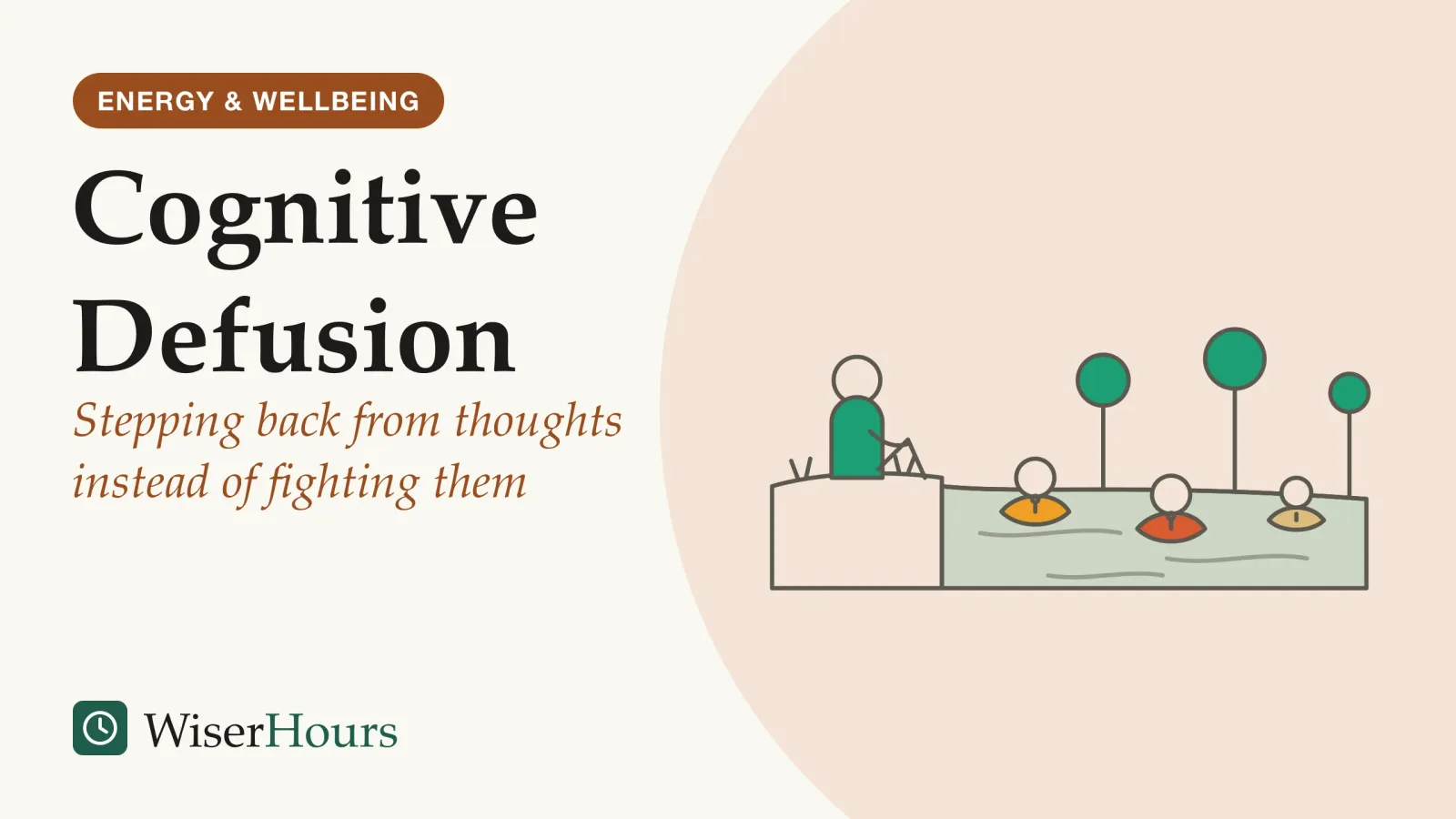
Cognitive defusion is a skill from acceptance and commitment therapy (ACT): you notice a thought as a thought, a passing string of words and pictures, instead of arguing with what it says or doing what it tells you. The ACT author Russ Harris describes it as stepping back to observe your thinking without getting caught up in it.1
Ten minutes before a quarterly review, a project lead hears the familiar line: “You’re going to freeze, and they’ll see you’re out of your depth.” Arguing back (“I’ve prepared for weeks”) can start a debate that runs right up to the meeting. Defusion lets the sentence stay and takes away its vote. Six exercises teach it:
- Say “I’m having the thought that…”
- Name the story
- Put thoughts on leaves on a stream
- Repeat the word until it is just a sound
- Sing the thought or give it a silly voice
- Thank your mind
The evidence is promising but narrow. A 2012 meta-analysismeta-analysis: A study that combines the results of earlier studies on the same question into one overall estimate. Pooling makes the estimate more precise, but it cannot repair the studies it pools: a meta-analysis of surveys is still survey evidence.Full entry in the glossary of 66 laboratory studies of ACT’s components found that defusion exercises had positive effects compared with inactive conditions, though these were short lab tests, and we found no trial of this list of exercises as self-help at work.2 The exercises sit alongside the other ways to manage stress in this section.
What is cognitive defusion in ACT?
Cognitive defusion is one of the six core processes of acceptance and commitment therapy, alongside acceptance, present-moment awareness, the observing self, values and committed action. In Russ Harris’s 2006 overview, it means learning to see thoughts, images and memories as what they are, bits of language, rather than as threats, rules that must be obeyed or objective facts. Harris counts more than a hundred defusion techniques in the ACT literature, and none of them involves evaluating or disputing the unwanted thought.1
Defusion changes how you hold a thought and leaves the thought itself alone. Akihiko Masuda, Steven Hayes and colleagues describe the techniques as altering the context a thought occurs in, without trying to change its content, frequency or triggers.3
- Myth
- Defusion is a clever way to make unwanted thoughts go away.
- Fact
- Defusion leaves the thought where it is and changes how much it steers you; any drop in discomfort is a side effect.
A thought such as “I’m not good enough for this role” keeps the same words after defusion. What changes is whether those words decide what you do in the next hour. Judge any exercise by whether you can keep working on the report with the thought present.
What is cognitive fusion?
Cognitive fusion is the state defusion loosens: being so caught up in a thought that it seems like the literal truth, a rule you must follow or a danger you must get rid of. When we fuse with thoughts, Harris writes, they gain enormous influence over what we do.1 A 2014 questionnaire by David Gillanders and colleagues measures fusion on the ACT premise that how you relate to a thought can predict its effects on feelings and behavior better than its content.4
- Fused“I’m going to freeze” feels like a fact, and the path ahead disappears
- Defused“I’m having the thought that I’m going to freeze”: the same words, held where you can see them
Fighting a thought tends to keep it close. A 2001 meta-analysis of controlled lab studies by Jonathan Abramowitz and colleagues found a small to moderate rebound effect: suppressed thoughts tended to come back more afterward, by an amount that varied with the kind of thought and the measure.5 Defusion is built to sidestep that trap, since it asks nothing of the thought.
A project lead who hears “you’ll freeze” and cancels the presentation is obeying the thought; one who spends the morning rehearsing counterarguments is wrestling with it. Both are fused, and either moment is the cue for an exercise below.
Six cognitive defusion techniques, step by step
Each technique below comes from Russ Harris’s published ACT material or from lab research by Steven Hayes’s group, and takes a few seconds to a few minutes. Practise on an ordinary nagging thought while calm, so the skill is familiar before a tense moment. These are self-help habits and do not replace treatment for an anxiety disorderanxiety disorder: A mental health condition in which worry or fear is persistent, out of proportion to the situation and hard to control, and gets in the way of daily life. It differs from ordinary anxiety, which passes, and it is diagnosed by a clinician.Full entry in the glossary. If one leaves you more upset, stop and try another.
1. Say “I’m having the thought that…”
Harris’s simplest exercise has two steps. First, bring to mind a recurring self-judgment in the form “I am X”, such as “I’m incompetent”, and believe it as much as you can for several seconds. Then repeat it with a phrase in front: “I’m having the thought that I’m incompetent.” Harris reports that most people notice some distance from the thought, which then has less impact, even though nobody tried to remove or change it.1
Before the quarterly review, the line becomes “I’m having the thought that I’ll freeze.” The sentence is still there, now with a speaker attached, and the speaker is your mind.
2. Name the story
When the same theme keeps returning in different words, give the whole theme a name. Harris lists naming the story among his simple defusion techniques, and his exercises ask people to identify their own “not good enough” story, the familiar set of criticisms their mind makes of them.6 A name lets you recognize the theme in one beat: “Ah, the impostor story again.” It works well for thoughts that arrive as a long chain of reasons, because you label the chain instead of answering each link.
3. Put thoughts on leaves on a stream
Leaves on a stream is a guided visualization that a handout from East London NHS Foundation Trust in the UK credits to Russ Harris (2009). You sit comfortably, picture a gently flowing stream with leaves floating past, and for a few minutes place each thought that comes, pleasant, painful or neutral, on a leaf and let it float by. You don’t hurry the stream along. If your mind says “I’m bored” or “I’m not doing this right”, those thoughts go on leaves too, and when a thought hooks you and pulls you away, you gently return to the stream.7
This is the slowest of the six and best practised at home; getting hooked and coming back is part of it.
4. Repeat the word until it is just a sound
The oldest technique on the list, often called the milk exercise, comes from the psychologist Edward Titchener, who argued in a 1916 textbook that saying a word aloud over and over strips away its literal meaning.3 Masuda and colleagues used it in their 2004 study:
- Say “milk” once and notice what it brings to mind: white, creamy, cold.
- Repeat “milk” out loud, as fast as you can, for about 30 seconds, and notice what happens to the meaning.
- Shrink your negative thought to one word (“useless”) and repeat that word quickly for about 30 seconds.
Every participant described the meaning of “milk” fading until it was just a sound.3 A follow-up study by the same group found that discomfort bottomed out after 3 to 10 seconds of repetition, while believability took 20 to 30 seconds to bottom out.8 Do this one somewhere private, since it is loud.
5. Sing the thought or give it a silly voice
Harris suggests singing an unpleasant thought to the tune of “Happy Birthday” or imagining it in the voice of a cartoon character. In one case example, a client pictured “I’m a loser” as karaoke words with a bouncing ball and, within minutes, was chuckling at a thought that had brought him to tears.1 The aim is to hear the thought differently, without mocking yourself; for a thought about a real loss, the first exercise may suit better.
6. Thank your mind
When a worry shows up, silently say “Thanks, mind”, as if it had handed you an interesting thought. Harris’s 2006 overview lists it and argues that anticipating and solving problems was probably language’s biggest evolutionary advantage, so a mind warning you about a meeting is doing its usual job, a little too keenly.1
Practising defusion this week
Cognitive defusion vs cognitive restructuring: what is the difference?
Cognitive restructuring, a core technique of cognitive behavioral therapycognitive behavioral therapy: A structured talking therapy that works on the links between thoughts, feelings and behavior, usually over a set number of sessions with practice between them. It is given by a trained therapist or through guided programs, and versions exist for specific problems.Full entry in the glossary (CBT), challenges whether a negative thought is accurate; cognitive defusion encourages acceptance of the thought without judging whether it is true. Thomas Barrera and colleagues name this as one of the main differences between CBT and ACT for anxiety.9
Head-to-head comparisons are few and brief. In a 2016 study by Andreas Larsson and colleagues, people used a restructuring technique, a defusion technique or no instructions on a personal negative thought for five days. Defusion lowered how believable the thought felt and raised comfort and willingness to have it more than either other group, though restructuring also eased discomfort within its own group (we could read only its abstract).10 In Barrera’s experiment with people with social anxiety disorder, defusion plus a public-speaking task, restructuring plus the task and the task alone produced similar drops in discomfort.9
Choose by what happens when you try. If checking the evidence settles a thought, as the steps for testing worst-case thinking do for many people, restructuring is doing its job. If checking turns into a debate you keep losing, or the thought is a judgment such as “I’m boring” that no evidence can settle, defusion gives you a way out of the argument.
What do the lab studies on defusion show?
Short laboratory experiments show that defusion exercises can make negative self-judgments feel less believable and less upsetting for a while. The 2004 milk-exercise study by Masuda, Hayes and colleagues at the University of Nevada, Reno, in the US, was one of the first tests of a single technique.
The study
Limited evidence
Eight students, one word said fast: each thought felt less believable than after the comparison task (Masuda and colleagues, 2004)
Eight students each picked two negative thoughts about themselves and shrank them to one word, such as “fat”. For one word they did the rapid-repetition exercise; for the other they read an article about Japan or tried to control the thought. For every participant, the thought rated after repetition felt less uncomfortable and less believable than the one handled the other way. By chance, most starting ratings were higher for the repeated word, and the authors say the study does not show the technique is clinically useful.3
Eight people in a lab cannot show how much an exercise helps on a hard morning at work. A randomized experiment and a meta-analysis since then point the same way.
| Question | What the studies found | Evidence |
|---|---|---|
| Defusion components in general | Positive effects against inactive conditions; exercises beat a rationale alone | Meta-analysis of 66 lab studies, moderate for short lab outcomes2 |
| Repeating a negative word aloud | Lowered discomfort and believability more than distraction, also in students with raised depressive symptoms | Randomized lab experiment with undergraduates, limited11 |
| Defusion compared with restructuring | Better on several measures in one study; similar drops in discomfort in the other | Two brief experiments, limited910 |
| These six exercises used alone at work | No study found | Untested |
Most studies lasted minutes to a week, and much of the lab work cited here came from researchers close to ACT’s developers, Hayes among them. Expect an exercise to loosen a thought’s grip for the next stretch of work and to need repeating when the thought returns. The meta-analysis also found larger effects when conditions included exercises or metaphors than with a rationale alone, so before a tense meeting, run the exercise itself instead of reminding yourself how it works.
Does cognitive defusion work for anxiety?
We found no trial of defusion on its own as a treatment for an anxiety disorder, so the answer rests on ACT as a whole. When A-Tjak and colleagues pooled 39 randomized trials of ACT in 2015, it outperformed waitlists, psychological placebo and usual care and showed no clear difference from CBT. Those trials covered anxiety disorders alongside depression, addiction and physical illness, and the review also used information from the ACBS, the professional community around ACT.12
For everyday worry, defusion is a reasonable skill to practise. For anxiety that shapes your days, the evidence supports ACT as a full therapy, where defusion is one part of six; the comparison of therapy options for anxiety explains how it differs from CBT and exposure.
When thoughts need more than a technique
Unwanted thoughts are normal, and the UK’s NHS says almost everyone has them, including sudden violent or offensive images. A thought that persists, dominates your thinking and causes distress or harms your quality of life can be part of obsessive compulsive disorder.13 The services named below are UK and US examples, so check what your own country offers.
- Now: if you feel you cannot keep yourself or someone else safe, including from thoughts of suicide or self-harm, call your local emergency number or go to the nearest emergency department. In the UK, NHS advice is to ring 999 or go to A&E, and Samaritans take calls on 116 123.14 The US has 988, a free, confidential line you can call or text day and night.15 In other countries, the Find A Helpline directory lists free local crisis lines.16
- Soon: the NHS suggests seeing a doctor when anxiety or fear feels like more than you can manage, or self-help has made no difference. In England, people aged 18 or over (16 in some areas) can refer themselves to NHS talking therapies without seeing a GP first.17
- Soon, too: if a thought keeps coming back and has a significant impact on your life, the NHS says it is important to get help;13 a doctor can refer you on, and the NHS lists talking therapy, usually CBT, and medicine as the main treatments for OCD.18
The bottom line
Cognitive defusion trades the argument with a thought for a step back from it, and small lab studies suggest that step can make a harsh self-judgment feel less believable within a minute. Pick one exercise, “I’m having the thought that…” is the easiest start, and practise it on an ordinary nagging thought this week. If a thought keeps returning and disrupting your life, book an appointment with a doctor.
This article is general information, not medical advice. If you're worried about your health, talk to a doctor or another qualified professional.
Frequently asked questions
Is cognitive defusion the same as mindfulness?
They overlap without being the same. A 2014 paper by David Gillanders and colleagues lists mindfulness, decentering and metacognition as concepts close to defusion. Mindfulness covers attention to anything in the present moment, while defusion is aimed at thoughts, and exercises such as leaves on a stream sit where the two meet.
Who came up with cognitive defusion?
Defusion is part of acceptance and commitment therapy, which Steven Hayes, Kirk Strosahl and Kelly Wilson set out in a 1999 book. Some techniques are much older: the word-repetition exercise goes back to a 1916 psychology textbook by Edward Titchener, as Hayes's own research group notes in a 2004 study.
Can cognitive defusion help with intrusive thoughts?
It may help with everyday unwanted thoughts, which the UK's NHS says almost everyone has. A thought that keeps returning, dominates your thinking and causes real distress can be a sign of obsessive compulsive disorder, and the NHS says it is important to get help, since its main treatments are talking therapy and medicine.
Sources
- Embracing Your Demons: an Overview of Acceptance and Commitment Therapy. Harris, R. (2006). Psychotherapy in Australia, 12(4)
- The impact of treatment components suggested by the psychological flexibility model: a meta-analysis of laboratory-based component studies. Levin, M. E., Hildebrandt, M. J., Lillis, J. & Hayes, S. C. (2012). Behavior Therapy, 43(4), 741-756
- Cognitive defusion and self-relevant negative thoughts: examining the impact of a ninety year old technique. Masuda, A., Hayes, S. C., Sackett, C. F. & Twohig, M. P. (2004). Behaviour Research and Therapy, 42(4), 477-485
- The development and initial validation of the Cognitive Fusion Questionnaire. Gillanders, D. T. et al. (2014). Behavior Therapy, 45(1)
- Paradoxical effects of thought suppression: a meta-analysis of controlled studies. Abramowitz, J. S., Tolin, D. F. & Street, G. P. (2001). Clinical Psychology Review, 21(5)
- Using the ACT Companion App for defusion. Harris, R. (2016). ImLearningACT.com
- Leaves on a Stream: Cognitive Defusion Exercise. East London NHS Foundation Trust (UK), after Harris (2009)
- A parametric study of cognitive defusion and the believability and discomfort of negative self-relevant thoughts. Masuda, A., Hayes, S. C., Twohig, M. P., Drossel, C., Lillis, J. & Washio, Y. (2009). Behavior Modification, 33(2), 250-262
- An Experimental Comparison of Techniques: Cognitive Defusion, Cognitive Restructuring, and in-vivo Exposure for Social Anxiety. Barrera, T. L., Szafranski, D. D., Ratcliff, C. G., Garnaat, S. L. & Norton, P. J. (2016). Behavioural and Cognitive Psychotherapy, 44(2), 249-254
- Using Brief Cognitive Restructuring and Cognitive Defusion Techniques to Cope With Negative Thoughts. Larsson, A., Hooper, N., Osborne, L. A., Bennett, P. & McHugh, L. (2016). Behavior Modification, 40(3), 452-482
- The effects of cognitive defusion and thought distraction on emotional discomfort and believability of negative self-referential thoughts. Masuda, A., Twohig, M. P., Stormo, A. R., Feinstein, A. B., Chou, Y.-Y. & Wendell, J. W. (2010). Journal of Behavior Therapy and Experimental Psychiatry, 41(1), 11-17
- A Meta-Analysis of the Efficacy of Acceptance and Commitment Therapy for Clinically Relevant Mental and Physical Health Problems. A-Tjak, J. G. L., Davis, M. L., Morina, N., Powers, M. B., Smits, J. A. J. & Emmelkamp, P. M. G. (2015). Psychotherapy and Psychosomatics, 84(1), 30-36
- Symptoms: Obsessive compulsive disorder (OCD). NHS (UK), page last reviewed 4 April 2023
- Where to get urgent help for mental health. NHS (UK), page last reviewed 26 April 2023
- 988 Suicide & Crisis Lifeline. 988 Suicide & Crisis Lifeline (US)
- Find A Helpline. Find A Helpline (ThroughLine), international directory of crisis lines
- Anxiety, fear and panic. NHS (UK), page last reviewed 13 July 2026
- Overview: Obsessive compulsive disorder (OCD). NHS (UK), page last reviewed 4 April 2023
How we researched this
We searched Europe PMC and Crossref in October 2026 for laboratory studies, comparisons and meta-analyses of cognitive defusion, and read Russ Harris's published ACT overview and exercise guides for the techniques. Sources span 2001 to 2026. One lab study was read in full; the meta-analyses and other studies only as abstracts. Most of the evidence is from brief lab experiments, often with students, run largely by researchers close to ACT's developers, which limits how far it applies to daily work.
Keep reading
Catastrophizing: How to Catch Worst-Case Thinking and Test It
Catastrophizing turns a setback into a disaster in your head. Test the thought in 6 steps at work, and see what CBT trials found about changing it.
High-Functioning Anxiety: What the Term Means and What It Misses
High-functioning anxiety is not a diagnosis, but 6 months of hard-to-control worry may signal GAD. What clinicians assess, and why doing well is not mild.
Physical Symptoms of Anxiety: What's Common and When to See a Doctor
Physical symptoms of anxiety, from a racing heart to poor sleep: 9 common ones, why the body makes them, and the warning signs that need a doctor first.
The Yerkes–Dodson Curve: Is There an Ideal Amount of Pressure?
The Yerkes-Dodson law grew from a 1908 mouse study, not office stress. What it found, how the inverted U was added later, and what holds up for people.