High-Functioning Anxiety: What the Term Means and What It Misses
High-functioning anxiety is not a diagnosis, but 6 months of hard-to-control worry may signal GAD. What clinicians assess, and why doing well is not mild.

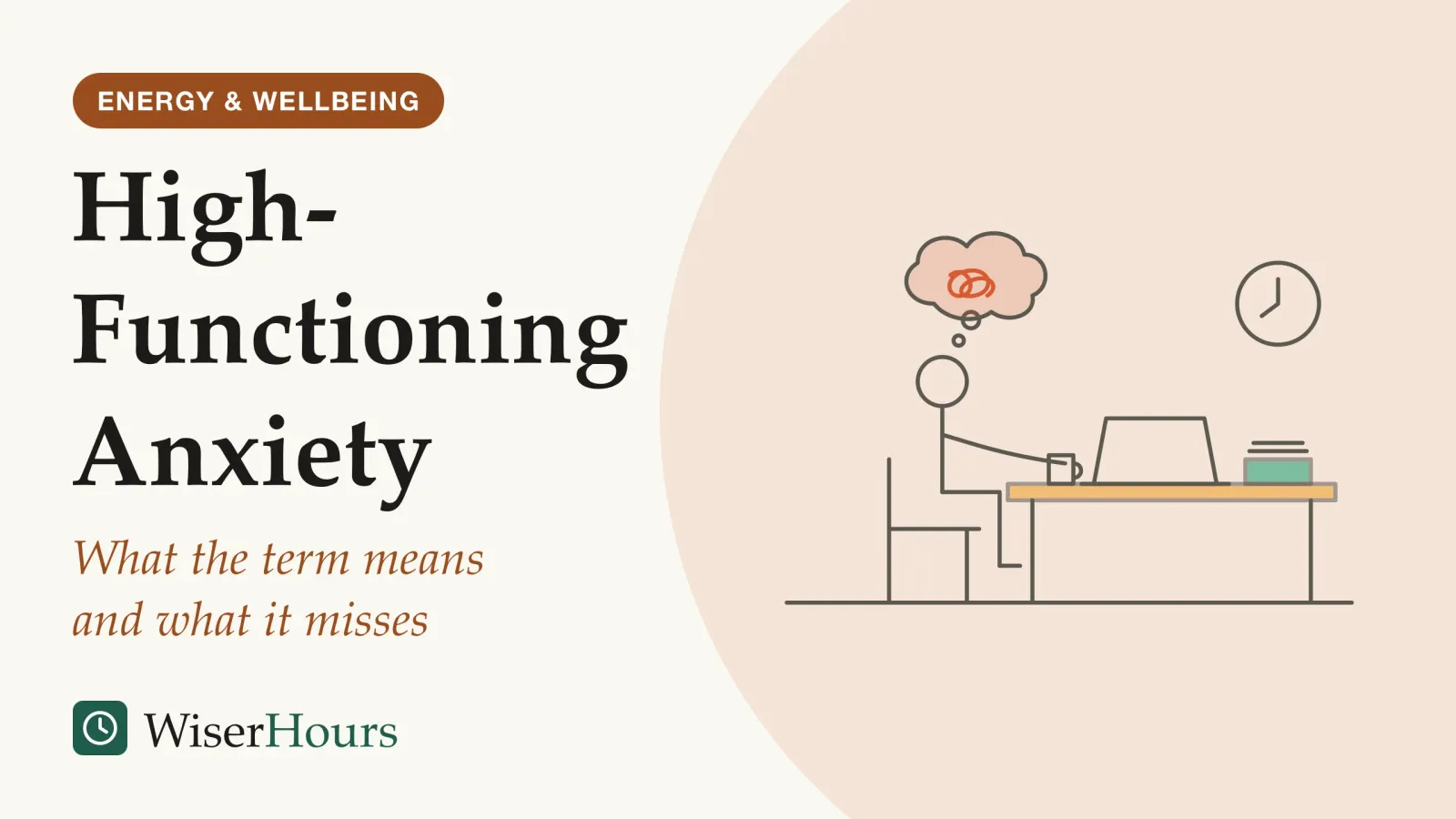
High-functioning anxiety names a pattern many people see in themselves: delivering at work, looking composed and keeping every commitment while worrying hard most days underneath. It is not a diagnosis. Neither the American Psychiatric Association’s DSM-5-TRDSM-5: The Diagnostic and Statistical Manual of Mental Disorders, fifth edition, the American Psychiatric Association's handbook of criteria for diagnosing mental disorders; the current version is the text revision, DSM-5-TR. Burnout and impostor feelings are not diagnoses in it.Full entry in the glossary nor the World Health Organization’s ICD-11ICD-11: The World Health Organization's International Classification of Diseases, eleventh revision, the global standard for recording diseases and health conditions, in effect since 2022. It also lists some factors that are not illnesses, such as burnout, classed as an occupational phenomenon.Full entry in the glossary lists it, but both describe conditions that fit the pattern, and those conditions can be assessed and treated.
The term spreads because the details ring true: the overpreparing, the late-night replay of a meeting, the sense that slowing down would let something slip. Where it misleads is the hint that anxiety you can work through must be mild. Other articles on managing stress and anxiety cover coping with pressure more broadly.
Is high-functioning anxiety a real diagnosis?
High-functioning anxiety is not a diagnosis in either of the two systems clinicians use worldwide. WHO’s ICD-11 names its anxiety or fear-related disorders one by one, from generalized anxiety disorderanxiety disorder: A mental health condition in which worry or fear is persistent, out of proportion to the situation and hard to control, and gets in the way of daily life. It differs from ordinary anxiety, which passes, and it is diagnosed by a clinician.Full entry in the glossary to selective mutism, and none of them is called “high-functioning”.1 Nor does the list of anxiety disorders that the American Psychiatric Association publishes from DSM-5-TR.2
The experience behind the label is real, and the diagnostic manuals have room for it. ICD-11 says generalized anxiety disorder causes significant distress or significant impairment, and adds that if functioning is kept up, it takes significant extra effort.1 A person who meets every deadline because they work late every night to quiet their worry may fit that part of the description.
Research has barely touched the term itself. A 2019 review published in Work, which compared news stories about high-functioning anxiety with the research literature, noted that the concept had so far escaped a research spotlight.3 A title search of the Europe PMC research database in October 2026 found no paper using the phrase.
If the label fits you, use it as the opening line at an appointment and let the assessment supply the answer. Before you go, keep a short note for a few weeks: on how many days the worry shows up, whether you can set it aside when you want to, and what it costs you in sleep, health and time with people. Each of those points comes up in the table below, and “I seem to function, but I am anxious most of the time” is a fair way to start the conversation. If thoughts of suicide or self-harm are part of the picture, go straight to the help section near the end, which starts with crisis lines.
What are the signs of high-functioning anxiety?
The signs people describe are mostly the symptoms of recognized anxiety conditions, seen through a working life. What turns a sign into a possible disorder is how long it has lasted, how hard it is to control and what it costs, and those are the points a clinician would want to know about.
| Sign people describe | What a clinician would assess | Where it is described |
|---|---|---|
| Worrying about work, health, money or family on most days, and struggling to switch it off | Generalized anxiety disorder: hard-to-control worry about several areas of life, most days, for months | NIMH description of generalized anxiety disorder4 |
| Seeking reassurance, avoiding what sets off the worry, or putting tasks off | Behaviors ICD-11 describes in generalized anxiety disorder as efforts to reduce worry or prevent bad outcomes | ICD-11, 6B001 |
| Dreading meetings, presentations or being watched, and rehearsing for days beforehand | Social anxiety disorder: fear of being judged or scrutinized, sometimes only in performance situations | NIMH description of social anxiety disorder5 |
| Very high standards, harsh self-criticism, fear of mistakes | Perfectionism, a trait linked to several conditions rather than a diagnosis itself | 2017 meta-analysis of perfectionism research6 |
| Poor sleep, tiredness, tension, trouble concentrating | Physical and mental symptoms counted toward generalized anxiety disorder | NIMH description of generalized anxiety disorder4 |
Several rows can apply to one person, and the body signals in the last row have causes other than anxiety too. The guide to physical symptoms of anxiety covers how to tell them apart and which need a doctor first.
A project manager who checks every report three times, sleeps badly before each client review and never misses a deadline would tick three rows. Read the table by duration and control. A rough month during a restructure is different from a year in which the worry never lets up.
Is high-functioning anxiety the same as generalized anxiety disorder?
High-functioning anxiety often overlaps with generalized anxiety disorder (GAD), but the two are not interchangeable. GAD has defined criteria, and plenty of people who use the label would not meet them, while others would meet them in full without ever having been told.
For a diagnosis of GAD, the US government’s National Institute of Mental Health (NIMH) says a person must find worry hard to control on most days over a period of at least 6 months and have at least three of six symptoms: restlessness, fatigue, poor concentration, irritability, muscle tension or sleep problems.4 The UK’s NHS describes the same core in plainer terms: frequent worry about many different things that affects daily life, is hard to control and has lasted at least 6 months.7
Two other possibilities come up often. Social anxiety disorder centers on fear of judgment, and NIMH notes that for some people it appears only when they have to perform, for example when giving a speech.5 Perfectionism is not a disorder. A 2017 meta-analysis of 284 studies set its two main dimensions, perfectionistic strivings and perfectionistic concerns, against anxiety disorders, depression and other conditions, and concluded that both dimensions were linked to various forms of these problems.6 Someone whose worry is mostly about making mistakes may be dealing with perfectionism as much as with GAD.
This distinction matters because the treatments are tailored. A person whose dread is limited to presentations needs a different plan from one who lies awake worrying about everything, and only an assessment can tell which picture fits.
- Myth
- If you can still do your job well, your anxiety is mild.
- Fact
- WHO's ICD-11 allows a diagnosis of generalized anxiety disorder when someone keeps functioning, if it takes significant extra effort.
What the label misses: the cost of keeping up
Doing well at work says little about how severe anxiety is, because severity is measured by distress and cost as well as output. The American Psychiatric Association describes anxiety disorders as persistent, hard to control and interfering with daily functioning, and the hours, sleep and relationships traded to keep performing are part of that interference.2
The hidden cost shows up when anxiety is measured. In the 2006 study that validated the GAD-7, a seven-question screening tool, higher scores were strongly linked to worse functioning across every area of a standard health survey and to more days lost to disability.8 The patients came from US primary care clinics, not from people who call themselves high-functioning, so the study shows a general pattern: higher anxiety scores tended to come with a heavier toll on daily life.
- What others see: work delivered, deadlines met, a calm manner in meetings
- Worry most days: hard-to-control worry about several areas of life, on more days than not for months
- The body pays: trouble sleeping, tiredness, muscle tension, a mind that will not settle
- Extra effort to keep it up: seeking reassurance, avoiding triggers or putting things off; WHO's ICD-11 says that in generalized anxiety disorder, functioning that is kept up takes significant extra effort
A lawyer who bills full hours but has dropped exercise, avoids friends on weekends to catch up and needs a drink to fall asleep is functioning on paper. The cost is being paid somewhere else. When you judge your own anxiety, count what you have given up as well as what you have produced.
When a reassuring label delays help
The label can delay help by making anxiety sound like a personality quirk that comes with success. That fits a wider pattern: across many countries, people with anxiety disorders often wait years before their first contact with any treatment.
The study
Moderate evidence
Years pass before people with anxiety disorders first seek treatment, in 15 countries
The WHO World Mental Health Surveys interviewed 76,012 adults in 15 countries, from Nigeria and Colombia to Japan, the Netherlands and the US, and asked when each disorder began and when they first sought treatment for it. Among people with anxiety disorders who eventually made contact, the median delay ranged from 3 years in Israel to 30 years in Mexico.9
The survey did not ask people why they waited, and ages were recalled years later; the authors expect such recall errors to understate the delays rather than inflate them.9 The survey does show that putting off help for anxiety is common worldwide; a label that tells people they are coping could plausibly add to the reasons for waiting, though no study has measured that. NIMH notes that people with social anxiety disorder are less likely to seek help for it.5 Worldwide, WHO estimates, about 1 in 4 people who have an anxiety disorder receive treatment for it.10
A manager who has worried every Sunday evening for five years may never have mentioned it to a doctor, because the work always got done. Ask how you would answer a friend who described the same five years: that it sounds like coping, or that it is time to talk to someone.
Can high-functioning anxiety lead to burnout?
Anxiety and burnout tend to go together, but no study has tested whether high-functioning anxiety leads to burnout. WHO’s ICD-11 lists burnout as an occupational phenomenon rather than a medical condition, a syndrome that comes from chronic stress at work which has not been brought under control.11
A 2019 meta-analysis pooled 36 studies with about 41,000 participants and found a moderate association between burnout and anxiety: people with more burnout tended to report more anxiety, but the two were distinct.12 Almost all the studies were cross-sectionalcross-sectional: Describes a study that measures everyone in its sample at a single point in time. Because the possible cause and the outcome are recorded together, it can show that two things occur together but not which of them came first.Full entry in the glossary, measuring both at a single time point, so the direction of the link is unknown.
The mechanism people describe is plausible, though untested: worry pushes someone to overwork, overwork drains their reserves, and exhaustion makes the worry harder to manage. If a weekend or a holiday no longer restores you, act on the workload and the anxiety together. The job side, from workload to control over your hours, is covered in the guide to work stress.
How do you treat high-functioning anxiety?
Because it is not a diagnosis, high-functioning anxiety has no treatment of its own; treatment depends on what an assessment finds. For generalized anxiety disorder, NIMH calls cognitive behavioral therapycognitive behavioral therapy: A structured talking therapy that works on the links between thoughts, feelings and behavior, usually over a set number of sessions with practice between them. It is given by a trained therapist or through guided programs, and versions exist for specific problems.Full entry in the glossary (CBT) well studied and the “gold standard” talking therapy, with acceptance and commitment therapy (ACT) as another option and medication for some people.4
The NHS in the UK says a GP will usually suggest talking therapies before medicine, and adults in England can self-refer to NHS talking therapies, with no GP referral needed.7 Elsewhere, the first stop is often a family doctor or primary care clinic; check what your own health system, insurer or employer covers. CBT, exposure therapy and ACT work in different ways, and the guide to therapy for anxiety sets them side by side.
- 1Notice the patternworry most days, for months
- 2Screena questionnaire such as the GAD-7
- 3Assessmenta doctor or therapist asks about history and cost
- 4Treatment plantalking therapy, medication or both
A screening questionnaire can be a useful starting point. The GAD-7 identified probable GAD with a sensitivity of 89 percent and a specificity of 82 percent at its chosen cut point in the 2006 US validation study: it caught most cases and flagged some people who did not have GAD.8 A high score is a reason for an assessment, and a low one is no reason to ignore symptoms that are costing you.
Alongside treatment, WHO lists everyday habits that support it: cutting down on alcohol, exercising regularly, keeping regular sleep and meals, and learning relaxation techniques such as slow breathing.10 None of them replaces an assessment.
Medication is a prescriber's decision
NIMH notes that antidepressants used for anxiety can take several weeks to work, and that some anti-anxiety sedatives are prescribed only for short periods because people can become dependent on them.4 Start, stop or change any medicine only with the doctor or pharmacist who knows your history.
When worry needs a professional, and how soon
Anxiety calls for help at different speeds depending on the signs, from right away for any thoughts of suicide to a routine check-up for a pattern that is not yet costing much. This grouping is ours, drawn from what WHO, NIMH and the NHS describe.
- Now. Thoughts of suicide or self-harm, or anyone in immediate danger, mean calling your local emergency number now, without waiting for an appointment. The US crisis number is 988, the Suicide & Crisis Lifeline, which also accepts texts.4 In the UK, Samaritans answer calls on 116 123.7 Find A Helpline lists free, confidential crisis lines country by country.13
- Soon. NIMH’s advice is to seek professional help once anxiety starts causing problems at work, at school or with friends and family.4 Book an appointment within days or weeks if worry fills most days, sleep has been poor for weeks, or you are using alcohol or other substances to cope.
- Routine. Mention it at your next routine appointment if the pattern sounds familiar but is not costing you much yet, or if you would like to go through a screening questionnaire with a professional.
The bottom line
The high-functioning label describes a real pattern, but your output is a poor gauge of what the anxiety is costing you. If worry has filled most of your days for months, take your note of what it costs you in sleep, health and time to a doctor or a talking-therapy service, and ask whether it fits generalized anxiety disorder, social anxiety or perfectionism.
This article is general information, not medical advice. If you're worried about your health, talk to a doctor or another qualified professional.
Frequently asked questions
Is the GAD-7 questionnaire a diagnosis?
No. The GAD-7 is a seven-question screening tool, validated in a 2006 US study in 15 primary care clinics against interviews by mental health professionals. A high score suggests probable generalized anxiety disorder and is a reason for a proper assessment; a clinician makes the diagnosis after asking about history, duration and other causes.
Does high-functioning anxiety make you better at your job?
The evidence is thin. A 2019 review in the journal Work read eight news articles and 36 research papers and found themes of both strengths, such as quality and quantity of work, and challenges, such as overreaching, perfectionism and overthinking. It was a review of themes and did not measure whether people with anxiety perform better.
Is high-functioning anxiety the same as perfectionism?
Not quite, though they often travel together. Perfectionism is a personality trait, not a diagnosis. A 2017 meta-analysis of 284 studies covering anxiety disorders, depression and other conditions linked both of its main dimensions, perfectionistic strivings and perfectionistic concerns, to various mental health problems, so it is worth raising with a clinician if it drives your worry.
Sources
- 6B00 Generalised anxiety disorder (ICD-11 for Mortality and Morbidity Statistics). World Health Organization, ICD-11 (2026-01 release)
- What are Anxiety Disorders? American Psychiatric Association (reviewed May 2026)
- Neuro magnifico! An exploratory study critically reviewing news text reporting of anxiety-related work performance strengths, challenges and support measures. Mellifont, D. (2019). Work, 63(3), 435-446
- Generalized Anxiety Disorder: What You Need to Know. National Institute of Mental Health, US National Institutes of Health (revised 2025)
- Social Anxiety Disorder: What You Need to Know. National Institute of Mental Health, US National Institutes of Health (revised 2025)
- The Relationship Between Perfectionism and Psychopathology: A Meta-Analysis. Limburg, K., Watson, H. J., Hagger, M. S. & Egan, S. J. (2017). Journal of Clinical Psychology, 73(10), 1301-1326
- Generalised anxiety disorder (GAD). NHS (UK), page last reviewed 22 October 2024, next review due 22 October 2027
- A Brief Measure for Assessing Generalized Anxiety Disorder: The GAD-7. Spitzer, R. L., Kroenke, K., Williams, J. B. W. & Löwe, B. (2006). Archives of Internal Medicine, 166(10), 1092-1097
- Delay and failure in treatment seeking after first onset of mental disorders in the World Health Organization's World Mental Health Survey Initiative. Wang, P. S., Angermeyer, M., Borges, G., et al. (2007). World Psychiatry, 6(3), 177-185
- Anxiety disorders (fact sheet). World Health Organization (15 September 2026)
- Burn-out an "occupational phenomenon": International Classification of Diseases. World Health Organization (28 May 2019)
- The Relationship Between Burnout, Depression, and Anxiety: A Systematic Review and Meta-Analysis. Koutsimani, P., Montgomery, A. & Georganta, K. (2019). Frontiers in Psychology, 10, 284
- Find A Helpline: free, confidential crisis support worldwide. ThroughLine Limited (New Zealand), accessed October 2026
How we researched this
Sources were found in October 2026 through Europe PMC, Crossref and the websites of WHO, NIMH, the NHS and the American Psychiatric Association. Definitions come from WHO's ICD-11 (2026-01 release), APA, NIMH and NHS pages, all read in full; the treatment-delay survey and burnout meta-analysis were read in full, the GAD-7, perfectionism and news-review papers as abstracts only. Main limitation: the term itself has almost no research behind it, so the article maps it onto conditions that do.
Keep reading
Cognitive Defusion: Stepping Back From Thoughts Instead of Fighting Them
Cognitive defusion, from ACT, means stepping back from a thought instead of arguing with it. Learn 6 exercises and what lab studies found.
Physical Symptoms of Anxiety: What's Common and When to See a Doctor
Physical symptoms of anxiety, from a racing heart to poor sleep: 9 common ones, why the body makes them, and the warning signs that need a doctor first.
The Yerkes–Dodson Curve: Is There an Ideal Amount of Pressure?
The Yerkes-Dodson law grew from a 1908 mouse study, not office stress. What it found, how the inverted U was added later, and what holds up for people.
Progressive Muscle Relaxation for Beginners: A Guided Walkthrough
Progressive muscle relaxation: tense one muscle group, then release it. How to do it, and what a review of 46 studies found for stress and anxiety.