Eustress vs. Distress: When Pressure Helps and When It Harms
Eustress vs distress: Selye saw one stress response behind both. A 2019 review of 14 lab studies found reframing eased feelings more than the body.

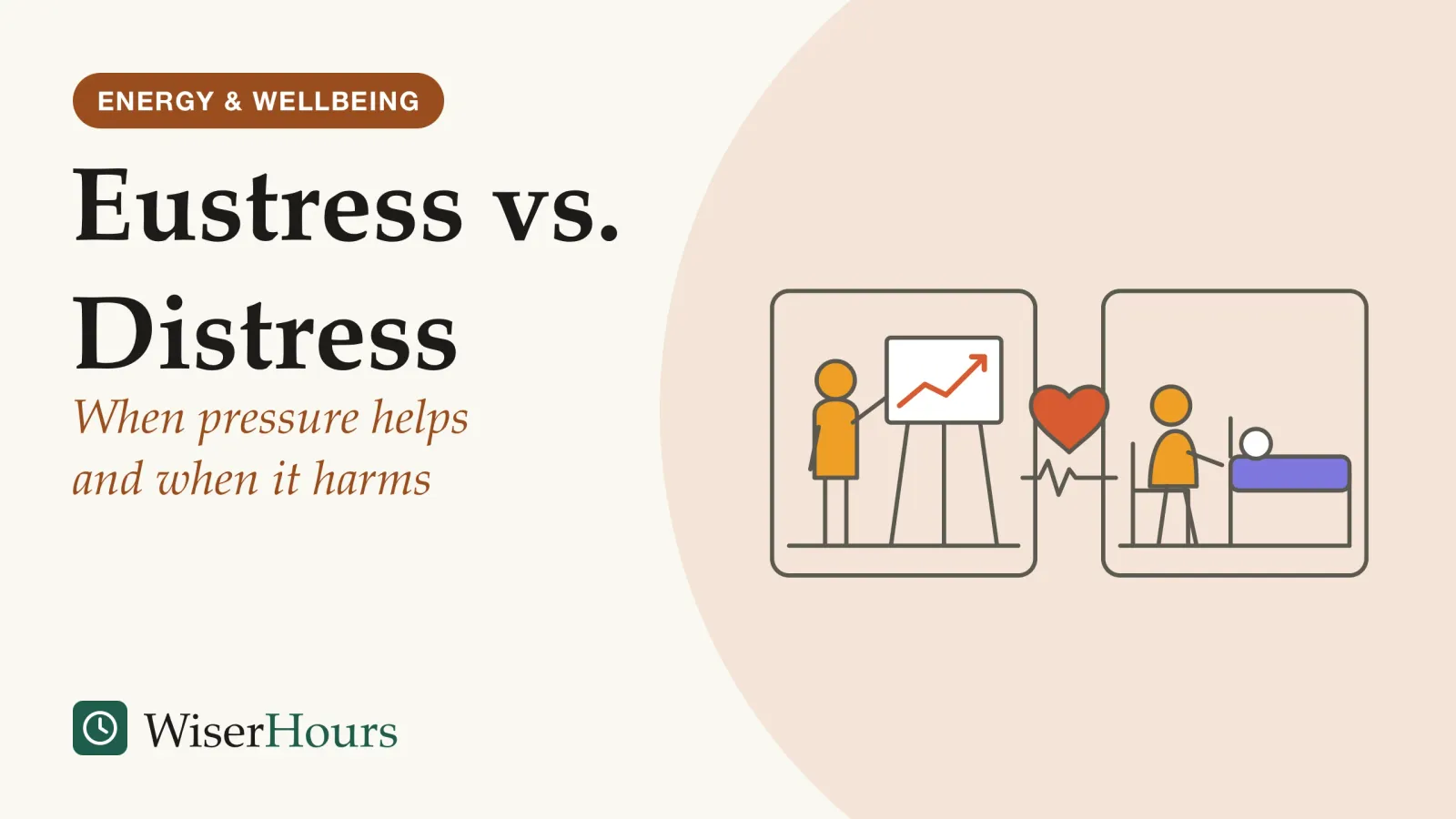
A wedding and a funeral can set off the same racing heart, yet in the mid-1970s the endocrinologist Hans Selye gave the experience two names: eustress for pressure that helps and distress for pressure that harms. When people compare eustress vs distress, the difference lies less in the body than in how a demand is judged and how long it lasts. Eustress is pressure you feel equipped to meet, often with a sense of meaning or energy. Distress is pressure that feels beyond your resources or never lets up, and it is the kind linked to health problems.1 The idea is useful, but the evidence behind it is thinner than many popular articles suggest.
Eustress vs distress: what is the difference?
Eustress and distress describe the same physical stress response felt in two ways. Selye, writing in the mid-1970s, used eustress for stress that improves functioning and distress for persistent stress that coping and adaptation do not resolve, which he linked to anxiety and withdrawal.1 He also argued that the response itself is identical whether the trigger is pleasant or unpleasant.2
The physical chain behind it, from fast nerve signals to a slower cortisolcortisol: A hormone made by the adrenal glands that helps regulate energy, blood pressure and the body's response to stress. Its level follows a daily rhythm, high on waking and low at night, so a single reading says little on its own.Full entry in the glossary wave, is laid out step by step in the stress hub’s account of the body’s alarm system. A promotion and a layoff can set off the same fast response; the label comes later, from what you make of the moment and whether it ends.
The World Health Organization makes the same everyday point: a little stress helps people get through daily tasks, and too much of it can lead to problems with physical and mental health.3 A deadline that sharpens your attention for an afternoon, then passes, fits the description. The same deadline repeated every week for a year, with no slack and no say in it, is the pattern Selye called distress.
Two questions to sort it
Does this feel like something I can meet, and will it end? Two yes answers point toward eustress. A no to either is worth noticing.
Challenge or threat: what tips pressure one way
Pressure tends toward the helpful side when you judge that your resources match the demand, according to the biopsychosocial model of challenge and threat, as a 2012 paper by Jeremy Jamieson, Matthew Nock and Wendy Berry Mendes describes it. When people judge their resources sufficient, they show a challenge response; when the demands seem to exceed their resources, they show a threat response. In this model, both switch on the fast stress system, but challenge goes with more efficient heart pumping and wider blood vessels, an approach-ready state, while threat goes with narrower vessels and a body braced for damage or defeat.4 These are short-term lab measures, and none of them tracks long-term health.
- Demands: what the task asks of you: how hard it is, what is at stake and how little time there is
- Resources: what you bring: skill, practice, information, time and people who can help
- Challenge: resources judged sufficient; in lab studies, more efficient heart pumping and an approach-ready body
- Threat: demands judged greater than resources; in lab studies, narrower blood vessels and a body braced for defeat
Performance follows the same split. A 2019 systematic review by Adrian Hase and colleagues found that a challenge state went with better performance across 38 studies, though the studies measured challenge and threat in many different ways; only its abstract was available to us.5 How the right amount of pressure depends on the task is the subject of the Yerkes-Dodson curve and pressure.
A manager who has rehearsed twice, knows the audience and has a colleague ready to field technical questions is likely to read her pounding heart as readiness. The same manager, handed the slides an hour before, with a senior executive known for cutting people off, has the same heart rate but far fewer resources. Most of the levers for shifting a threat toward a challenge sit on the resources side: practice, information, help and time.
Everyday examples of eustress, and how they can turn
Eustress usually comes with events you chose or want: starting a new job, training for a race, a first public talk, planning a wedding or a hard course of study. Wikipedia’s summary of the research describes eustress as a goal pushed slightly beyond what you can handle, but still in sight, with hope and active engagement as its markers. The same events can turn. Researchers in the positive organizational behavior tradition note that normally positive stressors can become distress when they come too strong or last too long.1 A new job is a common case. The first weeks are often exciting and draining at once; if the learning curve flattens and the role becomes clear, the pressure fades. If expectations stay vague and the hours keep stretching, the excitement can drain away while the strain stays.
Caring for a sick parent shows both sides at the same time. MedlinePlus, the health information service of the National Library of Medicine in the US, says caregiving can be rewarding and can strengthen a bond with a loved one, but can also be stressful and even overwhelming, often with complex demands and no training. It adds that long-term caregiver stress may raise the risk of health problems, including depression, anxiety and a weaker immune system.6 A caregiver can find the work deeply worthwhile and still be running a stress response with no end date.
Signs that pressure has turned harmful
Pressure has likely tipped into distress when it starts changing how you sleep, eat, think and behave, and when it no longer eases once the demand is over. The UK’s NHS lists headaches, muscle tension, stomach problems and a faster heartbeat among physical signs, and trouble concentrating, feeling overwhelmed and constant worry among mental ones. The behavioral changes it lists include irritability, sleeping or eating noticeably more or less, keeping away from people or places, and drinking or smoking more, and it adds that stress can be hard to spot as the reason.7 For caregivers, MedlinePlus adds feeling alone or deserted, feeling tired most of the time and losing interest in activities you used to enjoy.6
How long it lasts matters too. The WHO says that when a mental health condition develops, it may be because symptoms of stress have become persistent and have started affecting daily functioning, at work or at school.3 A student who sleeps badly the week before an exam is under ordinary pressure. The same student still sleeping badly a month after it, avoiding friends and dreading the next term, is showing a different pattern.
How to keep a challenge on the helpful side
The three steps below come from the challenge-and-threat research and from general advice by the WHO and MedlinePlus. They are everyday habits for ordinary pressure; conditions such as anxiety or depression need health care, the WHO notes.3
Start by adding resources
Because challenge depends on resources matching demands, adding resources is a direct lever.4 Rehearse the talk, ask for the missing information, break the project into parts, or ask someone to take one task. MedlinePlus gives the caregiving version: learn better ways to help your loved one, use respite or adult day services where they exist, and make a list of ways others can help.6
Read the racing heart as preparation
In Jamieson’s trial, people were told that the body’s response to stress evolved to help them meet a demand, without being told the task was any easier.4 Before a pitch or exam, you can try the same reading: the pounding heart is your body getting ready. A 2019 meta-analysis of such brief instructions found a modest, uncertain effect on how people felt and no clear change in physical signs, so treat the reframe as a small extra.8 It fits a pounding heart before a stressor you can name; palpitations that will not settle or come with chest pain, breathlessness or fainting belong with the help routes below.
Give pressure an end point and recovery time
Selye’s line between the two kinds of stress rested partly on duration: distress is the stress that does not resolve.1 Put a finish date on intense periods where you can, and protect the WHO’s basics in between: a daily routine, plenty of sleep, regular exercise and time with people you trust.3 Shift work, caregiving or disability can make those hard, and in those cases asking for practical help usually matters more than routine.
Before a high-pressure stretch
Can changing how you see stress make it helpful?
Changing how you interpret a stressful moment can change how it feels, but trials show a smaller and less reliable effect on the body. That is the fair summary of a 2019 meta-analysis in PLOS ONE, which pooled lab experiments that taught people to see stress as useful.
In a 2013 study, Alia Crum, Peter Salovey and Shawn Achor took 388 employees of a US financial firm going through downsizing and assigned them at random to short videos that framed stress as either enhancing or debilitating, or to a no-video control. Those shown the enhancing videos reported fewer psychological symptoms and better work performance afterwards; every measure was self-reported, and the study did not track the effects beyond about two weeks.9 In Jamieson’s 2012 experiment with about 50 young US adults, those randomly told that their racing heart during a stressful speech was helping them reported more resources and showed a more efficient, challenge-type heart response than the comparison groups.4
The study
Mixed evidence
Does seeing stress as useful change the body? 14 lab studies pooled (Liu and colleagues, 2019)
Across 14 studies with 36 samples, brief instructions to see stress as useful eased how stressed or anxious people said they felt during lab stressors. Heart rate, blood pressure and cortisol showed no clear difference, and the individual studies disagreed a good deal.8
The self-reported benefit is also fragile. When the authors set aside one study that pulled the pooled result upward, the benefit shrank and was no longer statistically clear, and an adjustment for possibly missing studies shrank it further. They also noted that their review covered only brief, one-off instructions, and that deeply held beliefs about stress may need more intensive help.8 A 2024 meta-analysis of randomized trials by Michel Bosshard and Patrick Gomez found a small improvement in performance on stressful tasks.10
Larger trials are more encouraging but narrower. In 2022, David Yeager and colleagues reported six randomized, double-blind experiments with US secondary and university students, in which a roughly 30-minute online module combined a growth mindset with the idea that the stress response can fuel performance. It improved measures ranging from stress appraisals to daily cortisol and anxiety symptoms. The authors say the module is meant for the normal stress of learning and was not designed for serious, uncontrollable stressors such as trauma or abuse; part of the funding came from Google’s Empathy Lab, alongside US government grants.11
- Myth
- If you think of stress as good, it becomes good for you.
- Fact
- In a 2019 pooled analysis of lab trials, reframing eased how stressed people felt but made no clear difference to heart rate or cortisol. The best-tested program was not built for trauma or abuse.
A reframe suits a demand you chose and can meet, such as an exam, an interview or a pitch. For a situation that is unsafe, unfair or simply too much, changing the situation or getting support comes first.
Where the terms came from, and why some researchers want to drop them
Selye built eustress from the Greek prefix eu-, meaning good.1 He spread his stress ideas through popular books such as Stress Without Distress in 1974, by which time many experimental physiologists already found his concepts too vague to measure, according to Wikipedia’s account of his career.2
In a 2020 essay in BioEssays, Julie Bienertova-Vasku and colleagues argued that there is no such thing as eustress or distress, because the body’s adaptation to stress is not good or bad in itself; its effect depends on many interactions with the environment and on a person’s history. They also found that different fields use the word in different ways, and suggested replacing both terms with plain stress. Their case is an argument from the literature, and we had access to the abstract alone.12
When a writer says eustress is good for you, it helps to ask which meaning they intend: a pleasant feeling, better performance or better health. Evidence for one of those says little about the other two.
Getting help when pressure stops lifting
Pressure that feels unmanageable, outlasts its cause or comes with thoughts of self-harm calls for help from other people as well as any change of outlook. Emergency numbers and services vary, so look up the ones that apply in your country.
- Now: call your local emergency number straight away if anyone is in immediate danger, if you have harmed yourself or if you are thinking about suicide. Across the EU that number is 112, which costs nothing from a mobile or a landline.13 The US 988 Lifeline is open around the clock for calls, texts and chats, free and confidential.14 UK readers are told by the NHS to ring 999 or go to A&E.7 The NHS also treats palpitations that do not go away, or that come with chest pain, shortness of breath or fainting, as an emergency; elsewhere, call your local emergency number.15
- Soon: if stress is getting hard to manage or your own efforts are making no difference, the NHS advises seeing your family doctor (in the UK, a GP); in England, the NHS 111 line covers urgent needs that are not emergencies.7
- Routine: raise lasting shifts in sleep, appetite, drinking or mood at your next check-up, and mention any caregiving load, since MedlinePlus reminds caregivers to keep up with their own checkups and screenings.6
The bottom line
Eustress and distress share one stress response, and what usually separates them is whether you can meet the demand and whether it ends. Reframing a racing heart may ease how a hard moment feels, but the evidence for changing the body is weak. Before your next demanding stretch, add one resource and set an end date, and if the pressure never lifts, talk to a doctor.
This article is general information, not medical advice. If you're worried about your health, talk to a doctor or another qualified professional.
Frequently asked questions
Is eustress the same as being motivated?
Not quite. Wikipedia's summary of the research describes eustress as a positive response to a stressor, marked by signs such as hope, meaning and vigor. Motivation can exist without any stressor at all, while eustress needs a demand that stretches you. A goal that pushes slightly beyond what you can comfortably handle, but stays in sight, is the classic eustress setting.
Can the same event be eustress for one person and distress for another?
Yes. In the biopsychosocial model of challenge and threat described by Jeremy Jamieson and colleagues in 2012, the same task produces a challenge response in someone who judges their resources sufficient and a threat response in someone who judges the demands greater than their resources. Skill, support, sleep and past experience all change that judgment.
Does the body react differently to eustress and distress?
Selye argued the core stress response is the same whether the trigger is positive or negative. Later lab research on challenge and threat found differences in the details: challenge was linked to more efficient heart pumping and wider blood vessels, threat to narrower vessels. Those are short-term lab measures, not proof of long-term health effects.
Sources
- Eustress. Wikipedia (accessed 2 November 2026)
- Hans Selye. Wikipedia (accessed 2 November 2026)
- Stress. World Health Organization, questions and answers
- Mind over matter: Reappraising arousal improves cardiovascular and cognitive responses to stress. Jamieson, J. P., Nock, M. K. & Mendes, W. B. (2012). Journal of Experimental Psychology: General, 141(3), 417-422
- The relationship between challenge and threat states and performance: A systematic review. Hase, A., O'Brien, J., Moore, L. J. & Freeman, P. (2019). Sport, Exercise, and Performance Psychology, 8(2), 123-144
- Caregiver Health. MedlinePlus, US National Library of Medicine
- Stress. NHS (UK)
- The efficacy of stress reappraisal interventions on stress responsivity: A meta-analysis and systematic review of existing evidence. Liu, J. J. W., Ein, N., Gervasio, J. & Vickers, K. (2019). PLOS ONE, 14(2), e0212854
- Rethinking stress: The role of mindsets in determining the stress response. Crum, A. J., Salovey, P. & Achor, S. (2013). Journal of Personality and Social Psychology, 104(4), 716-733
- Effectiveness of stress arousal reappraisal and stress-is-enhancing mindset interventions on task performance outcomes: a meta-analysis of randomized controlled trials. Bosshard, M. & Gomez, P. (2024). Scientific Reports, 14, 7923
- A synergistic mindsets intervention protects adolescents from stress. Yeager, D. S., Bryan, C. J., Gross, J. J. and colleagues (2022). Nature, 607, 512-520
- Eustress and Distress: Neither Good Nor Bad, but Rather the Same? Bienertova-Vasku, J., Lenart, P. & Scheringer, M. (2020). BioEssays, 42(7), e1900238
- 112: the European emergency number. European Commission
- 988 Suicide & Crisis Lifeline. 988 Suicide & Crisis Lifeline (US)
- Heart palpitations. NHS (UK)
How we researched this
We read the 2019 PLOS ONE and 2024 Scientific Reports meta-analyses of reappraisal trials, the 2022 Nature report of six mindset trials, and lab studies by Jamieson (2012) and Crum (2013) in full, the 2020 BioEssays critique and a 2019 systematic review as abstracts, plus WHO, NHS and MedlinePlus pages, in November 2026. Main limitation: most trials are short lab studies of US students.
Keep reading
Stress vs. Anxiety: What's the Difference and Why It Matters
Stress vs anxiety: stress follows a cause and eases when it ends; anxiety can last with no threat. When worry lasting 6 months or more may be a disorder.
The Yerkes–Dodson Curve: Is There an Ideal Amount of Pressure?
The Yerkes-Dodson law grew from a 1908 mouse study, not office stress. What it found, how the inverted U was added later, and what holds up for people.
What Is Stress? How the Stress Response Works in Plain English
What is stress? How the fast and slow stress response works, which lab tasks 208 studies linked to the biggest cortisol rise, and when to see a doctor.
The Perceived Stress Scale: How Researchers Measure Stress
The perceived stress scale explained: what its 10 questions ask, how the 0-40 score works, what typical scores look like, and why it has no official cut-offs.