Stress vs. Anxiety: What's the Difference and Why It Matters
Stress vs anxiety: stress follows a cause and eases when it ends; anxiety can last with no threat. When worry lasting 6 months or more may be a disorder.

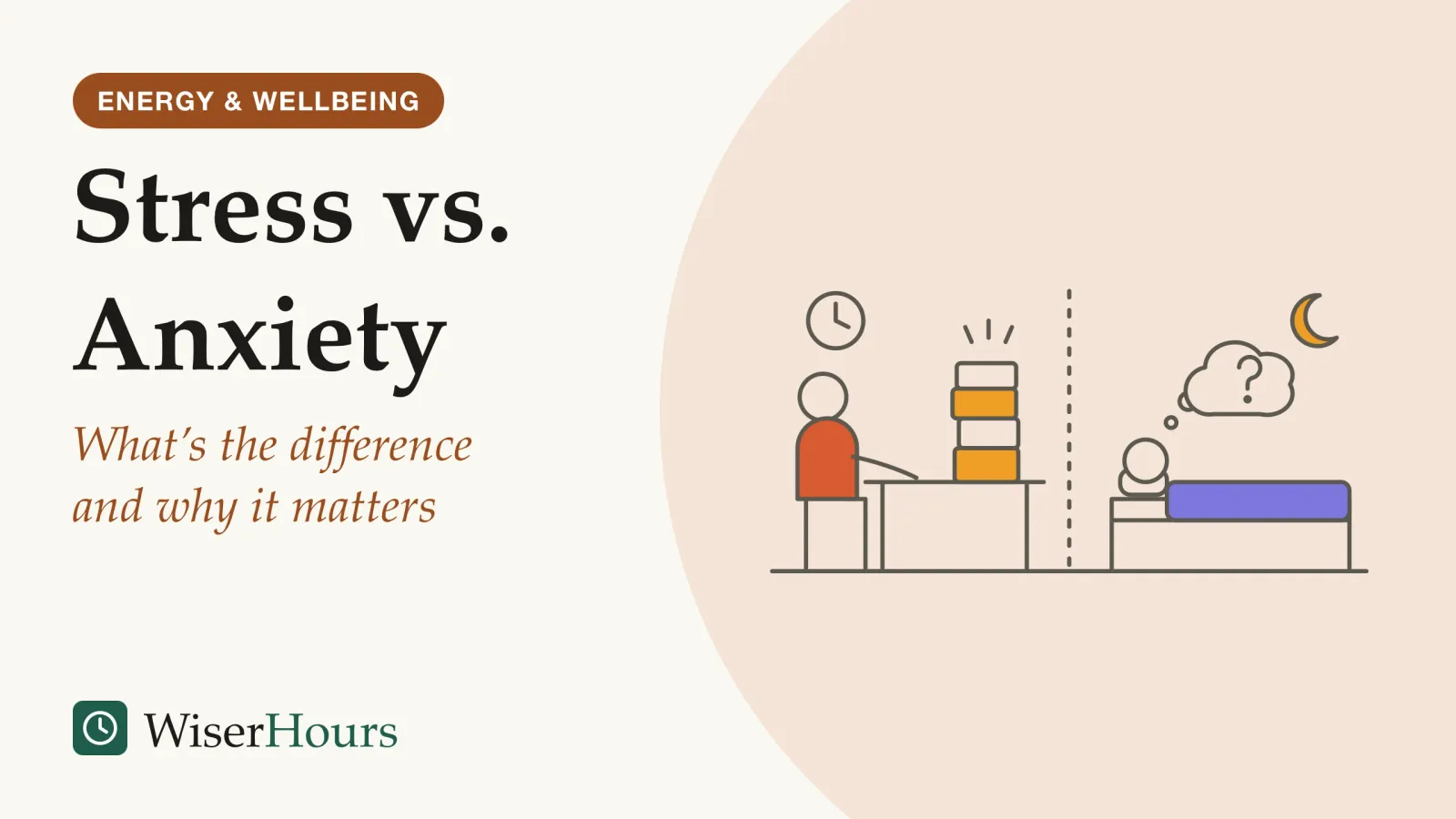
Stress is a response to something outside you, such as a deadline or an illness, and it generally eases once the problem is dealt with. Anxiety usually involves a persistent feeling of dread or apprehension that can carry on with no immediate threat in sight, according to the US National Institute of Mental Health (NIMH), which also notes that everyone feels stress from time to time.1
So the quickest test for stress vs anxiety is to watch what happens after the cause ends: stress tends to leave with it, while anxiety can stay, or arrive with no cause at all. Anxiety becomes a health question when it is out of proportion, lasts for months and starts to shape how you live, and five questions further down help you check which pattern fits.
Stress vs anxiety, side by side
Stress and anxiety differ mainly in their trigger, their timing and what they are about, while the body signs overlap. NIMH’s fact sheet on the two lays out the contrast, and the American Psychiatric Association separates fear, which answers a threat that is here now, from anxiety, which looks ahead to a concern in the future.2
| Stress | Anxiety | |
|---|---|---|
| Trigger and focus | Generally an external cause in front of you now, such as a big test or an argument with a friend | Your body’s reaction to stress; it can occur with no current threat1 |
| How long it lasts | Usually fades once the situation is resolved | More persistent; in a disorder it persists for months or returns again and again12 |
| Body and mind signs | Excessive worry, uneasiness, tension, headaches or body pain, high blood pressure and lost sleep | The same list: NIMH places these signs under both1 |
| Can it help? | It can, for example by spurring you to meet a deadline, or harm, by costing you sleep | Occasional anxiety is a normal part of life12 |
The pattern behind the table is about time. Stress is tied to a cause with a beginning and an end, so it rises and falls with that cause. Anxiety looks forward, so it can attach to things that have not happened, or may never happen, and nothing in the outside world has to change for it to continue.
A project manager with a launch on Friday feels tense all week, sleeps badly on Thursday and feels the pressure drain away on Saturday. That is stress following its cause. If the same person lies awake the next Sunday worrying about a review that has not been scheduled, and the worry keeps finding new targets after the launch has gone well, the feeling has come loose from its cause. That shift is the first thing to notice in yourself, and it is easier to spot when you ask what the worry is about and whether it ended with the event.
How do I know if I have anxiety or just stress?
You can get a good first reading by asking how long the feeling lasts, what it is about and what it is costing you. The questions below are drawn from NIMH’s and the American Psychiatric Association’s descriptions. They are a prompt for reflection and not a test: only a qualified health professional can make a diagnosis.2
- Can you name what is pressing on you, and did the feeling ease the last time a similar pressure ended?
- Is the worry about a demand in front of you now, or mostly about what might happen?
- Has it been there most days for weeks, or for months?
- When you try to set the worry aside, can you?
- Is it changing what you do: avoiding places or people, falling behind at work, losing sleep, pulling back from friends?
Answers that point to a clear cause, a present demand and a feeling you can set down describe stress. Answers that point the other way, especially on how long it lasts, how far you can set it down and what it costs you, match what NIMH says may put you at risk of an anxiety disorderanxiety disorder: A mental health condition in which worry or fear is persistent, out of proportion to the situation and hard to control, and gets in the way of daily life. It differs from ordinary anxiety, which passes, and it is diagnosed by a clinician.Full entry in the glossary: stress symptoms that interfere with everyday life, make you avoid doing things or seem always present.1
Jot your answers down with the date. A note of how long the feeling has lasted and what it has stopped you doing is the information a doctor will want, and it is easy to forget once you are in the room.
Why the same body signs show up in both
Stress and anxiety produce many of the same physical signs because they run on the same alarm system. The UK’s NHS says that when you feel anxious or scared the body releases stress hormones such as adrenaline and cortisolcortisol: A hormone made by the adrenal glands that helps regulate energy, blood pressure and the body's response to stress. Its level follows a daily rhythm, high on waking and low at night, so a single reading says little on its own.Full entry in the glossary, which can bring a faster heartbeat and sweating.3 A separate guide explains how the body’s stress response unfolds, from the first seconds to the slower hormone wave.
The NHS symptom lists for the two overlap heavily. Its stress page names headaches or dizziness, muscle tension, stomach problems, a racing heart or chest pain, constant worrying and sleeping more or less than usual.4 Its anxiety page names a faster or more noticeable heartbeat, light-headedness, headaches, chest pains, stomach upset, breathlessness, being unable to relax and not being able to sleep.3
A tight jaw and a churning stomach therefore tell you that your alarm is on; they cannot tell you which kind of alarm it is. What the body cannot settle, the pattern can: whether the signs come and go with a known pressure, or stay on most days without one. Some signs, chest pain among them, need checking before anyone puts them down to stress or anxiety, and a separate guide to the physical symptoms of anxiety sets out which ones need a doctor or emergency help first.
- Myth
- If your body feels the same, stress and anxiety must be the same thing.
- Fact
- They share body signs, but NIMH separates them by cause and timing: stress generally eases when its cause is resolved, while anxiety can persist without an immediate threat.
Can stress turn into anxiety?
Stress can lead to anxiety problems, according to the World Health Organization. It says stressful situations can bring on or worsen mental health conditions, anxiety and depression most often, and that a condition may develop when symptoms of stress become persistent and start to affect daily functioning at work or school.5
NIMH says external causes, such as a traumatic event or a stressful environment, may raise a person’s risk of developing generalized anxiety disorder, alongside genetics, brain chemistry and biology.6 A 2003 observational study of more than 7,000 adult twins from a population-based registry found that episodes of generalized anxiety, defined there with a shorter two-week minimum, were more likely to begin after high-threat life events that rated higher for loss and danger.7 The NHS lists a history of stressful or traumatic experiences among the things that increase the chances of generalized anxiety disorder.8
A stressful stretch does not have to end in a disorder. The WHO adds that for many people stress reduces over time as the situation improves or as they learn to cope with it.5 A long restructuring at work is a common example: months of uncertainty can leave someone worrying about every email from their manager. If that worry fades within weeks of the new structure settling, it was stress. If it stays, spreads to other parts of life and is still there months later, it deserves a doctor’s attention.
- The cause: something outside you with a start and an end, such as a deadline or an illness
- Stress: rises with the cause and generally eases once the situation is resolved
- Anxiety: can carry on after the cause has gone, or start with no immediate threat at all
- Worth a professional view: worry that is hard to control, lasts for months and gets in the way of daily life
Where everyday anxiety ends and an anxiety disorder begins
Anxiety crosses into an anxiety disorder when it is out of proportion to what is happening, persistent and interferes with daily functioning, the three tests the American Psychiatric Association gives for a diagnosis.2 The WHO says people with anxiety disorders typically have symptoms over an extended period, at least several months, and usually avoid the situations that make them anxious.9
For generalized anxiety disorder, the diagnosis built around ongoing worry about everyday things, NIMH summarizes the threshold as worry that a person struggles to control on most days for 6 months or longer, together with three or more of six symptoms: restlessness or feeling on edge, tiredness, difficulty concentrating, irritability, tense muscles and poor sleep.6 The NHS uses the same 6-month marker when it describes how a GP may diagnose the condition.8 The American Psychiatric Association’s descriptions of these disorders follow the DSM-5-TRDSM-5: The Diagnostic and Statistical Manual of Mental Disorders, fifth edition, the American Psychiatric Association's handbook of criteria for diagnosing mental disorders; the current version is the text revision, DSM-5-TR. Burnout and impostor feelings are not diagnoses in it.Full entry in the glossary, its diagnostic handbook.
Why such a high bar? Most worry is reasonable. A person worried about rent in a month when hours were cut is reacting to a real problem, and NIMH says that occasional worry, or anxiety brought on by stressful life events, differs from generalized anxiety disorder.6 What defines the disorder is worry out of proportion to the facts that the person cannot switch off.
The study
Moderate evidence
Half of adults with recent generalized anxiety disorder reported severe impairment, in surveys from 26 countries (2017)
Ruscio and colleagues analyzed household surveys of 147,261 adults in 26 countries, interviewed face to face between 2001 and 2012 with a structured diagnostic interview scored against DSM-5 criteria. About 4 in 100 adults had met the criteria for generalized anxiety disorder during their lifetime, and the disorder tended to persist: nearly half of lifetime cases still had it in the year before the interview. About half of those past-year cases reported severe impairment in at least one part of life: home, work, close relationships or social life.10
The survey answers a common doubt, that persistent worry is a minor problem. Across very different countries, a disorder defined by worry often came with serious disruption to work and home life. Three cautions apply. Lifetime symptoms were recalled in a single interview with trained lay interviewers, rates varied widely between countries, and the survey initiative was funded by government agencies, foundations and several drug companies.10
Scale matters here too. The WHO estimates that 470 million people had an anxiety disorder in 2023, which makes anxiety disorders the most common of all mental disorders.9 If the second list below sounds familiar, you are far from alone, and a doctor can help work out what is behind it.
Why the difference matters for what helps
The label changes what tends to help. For stress, the useful moves aim at the cause and at recovery: NIMH suggests learning what triggers your stress and which coping techniques work for you, with steps such as regular exercise, a sleep routine, less caffeine and talking to people who help you cope.1 A guide to everyday ways to reduce stress covers these habits and the evidence behind each.
An anxiety disorder is a treatable health condition. The WHO calls its treatments highly effective and says psychological treatments based on the principles of cognitive behavioral therapy have the most evidence, yet only about 1 in 4 people in need receive any treatment.9 Among the barriers it names is a lack of awareness that this is a treatable condition.
That is the practical reason to tell the two apart. Someone who calls months of uncontrollable worry “just stress” may keep trying to fix a cause that is not driving it, and put off help that could work. The site’s comparison of therapy approaches for anxiety explains what treatment involves.
When should you see a doctor about anxiety or stress?
Suicidal thoughts or urges to hurt yourself call for help straight away; stress or worry you cannot manage, or that does not lift, is a reason to book a doctor soon; and passing stress with a clear cause can be raised at a routine visit. WiserHours grouped the advice into these three tiers, and each line names the body it comes from.
Now, soon or at your next check-up
Now: when thoughts of ending your life or harming yourself are present, or anyone is in immediate danger, call your local emergency number first. US readers can phone or text the 988 Suicide & Crisis Lifeline on 988; calls are free and confidential, and someone answers 24 hours a day.11 For the UK, the NHS tells people to call 999 or go to A&E if there is a risk to life, and Samaritans take calls on 116 123.12 In other countries, the Find A Helpline directory lists free, confidential services it has verified in more than 175 countries.13
Soon: NIMH advises talking to a professional when the symptoms of stress or anxiety will not go away.1 The NHS suggests a GP appointment when you are struggling to cope with stress or your own efforts have not helped; in England it suggests NHS 111 when help is urgent but not an emergency, and people aged 18 or over (16 in some areas) may refer themselves to the NHS talking therapies service.4
Routine: stress with a clear cause that lifts when the cause passes can wait until your next check-up; book sooner if it starts coming back more often.
Bring the notes from the self-check. NIMH says a provider may ask when symptoms started, how long they have lasted, how often they happen and how they affect your life, and may examine you to check that another physical health problem is not behind them.6 In any country the local emergency number is the first call in a crisis, and a family doctor or local clinic can point you to mental health services nearby.
The bottom line
Time is the most useful test: worry that fades when its cause is dealt with is behaving like stress, and worry that stays, spreads or starts without a cause points toward anxiety. If it is hard to control, has lasted for months and is getting in the way of your life, see a doctor, because anxiety disorders are common and treatable. If suicidal thoughts are part of the picture, contact your local emergency number or a crisis line such as 988 in the US today.
This article is general information, not medical advice. If you're worried about your health, talk to a doctor or another qualified professional.
Frequently asked questions
Can you have stress and anxiety at the same time?
Yes, and it is common. The US National Institute of Mental Health describes anxiety as the body's reaction to stress, and the World Health Organization lists anxiety among the emotions that stress can bring. A hard week at work can leave you both stressed by the workload and anxious about what comes next. The question worth asking is whether the anxiety fades once the pressure lifts.
Can children and teenagers have anxiety disorders?
Yes. The World Health Organization says symptoms of anxiety disorders often begin in childhood or adolescence and can continue into adulthood. NIMH notes that children and teens with generalized anxiety disorder often worry about school, friendships and the future. A child's doctor or school health service is the place to start, and the UK's NHS has separate guidance for children and young people.
Can caffeine make anxiety worse?
It can. The UK's NHS advises people with generalized anxiety disorder not to drink lots of coffee, tea, cola or energy drinks, because caffeine can disrupt sleep and make anxiety harder to control. The US National Institute of Mental Health also lists avoiding excess caffeine among its coping steps for stress and anxiety. Cutting back is self-care that may help, but it does not treat an anxiety disorder.
Sources
- I'm So Stressed Out! Fact Sheet. National Institute of Mental Health, US National Institutes of Health (NIH Publication No. 20-MH-8125)
- What are Anxiety Disorders? American Psychiatric Association (physician review May 2026)
- Get help with anxiety, fear or panic. NHS (UK), page last reviewed 13 July 2026
- Stress. NHS (UK), page last reviewed 6 March 2026
- Stress. World Health Organization, questions and answers (30 March 2026)
- Generalized Anxiety Disorder: What You Need to Know. National Institute of Mental Health, US National Institutes of Health (revised 2025)
- Life event dimensions of loss, humiliation, entrapment, and danger in the prediction of onsets of major depression and generalized anxiety. Kendler, K. S., Hettema, J. M., Butera, F., Gardner, C. O. & Prescott, C. A. (2003). Archives of General Psychiatry, 60(8)
- Generalised anxiety disorder (GAD). NHS (UK), page last reviewed 22 October 2024
- Anxiety disorders. World Health Organization fact sheet (15 September 2026)
- Cross-sectional Comparison of the Epidemiology of DSM-5 Generalized Anxiety Disorder Across the Globe. Ruscio, A. M., Hallion, L. S., Lim, C. C. W., et al. (2017). JAMA Psychiatry, 74(5)
- 988 Suicide & Crisis Lifeline. 988 Suicide & Crisis Lifeline (US)
- Where to get urgent help for mental health. NHS (UK), page last reviewed 26 April 2023
- Find A Helpline. Find A Helpline, powered by ThroughLine (helplines verified in more than 175 countries)
How we researched this
Sources were found in October 2026 on the websites of the WHO, NIMH, the American Psychiatric Association and the NHS, and through Europe PMC for population studies. Official health pages were preferred for definitions and help routes; the key cross-national survey was read in full. Sources date from 2003 to 2026. Main limitation: the DSM-5-TR and ICD-11 were not opened, and the 2003 twin study was read as an abstract only.
Keep reading
The Yerkes–Dodson Curve: Is There an Ideal Amount of Pressure?
The Yerkes-Dodson law grew from a 1908 mouse study, not office stress. What it found, how the inverted U was added later, and what holds up for people.
What Is Stress? How the Stress Response Works in Plain English
What is stress? How the fast and slow stress response works, which lab tasks 208 studies linked to the biggest cortisol rise, and when to see a doctor.
The Perceived Stress Scale: How Researchers Measure Stress
The perceived stress scale explained: what its 10 questions ask, how the 0-40 score works, what typical scores look like, and why it has no official cut-offs.
Cognitive Defusion: Stepping Back From Thoughts Instead of Fighting Them
Cognitive defusion, from ACT, means stepping back from a thought instead of arguing with it. Learn 6 exercises and what lab studies found.