Progressive Muscle Relaxation for Beginners: A Guided Walkthrough
Progressive muscle relaxation: tense one muscle group, then release it. How to do it, and what a review of 46 studies found for stress and anxiety.
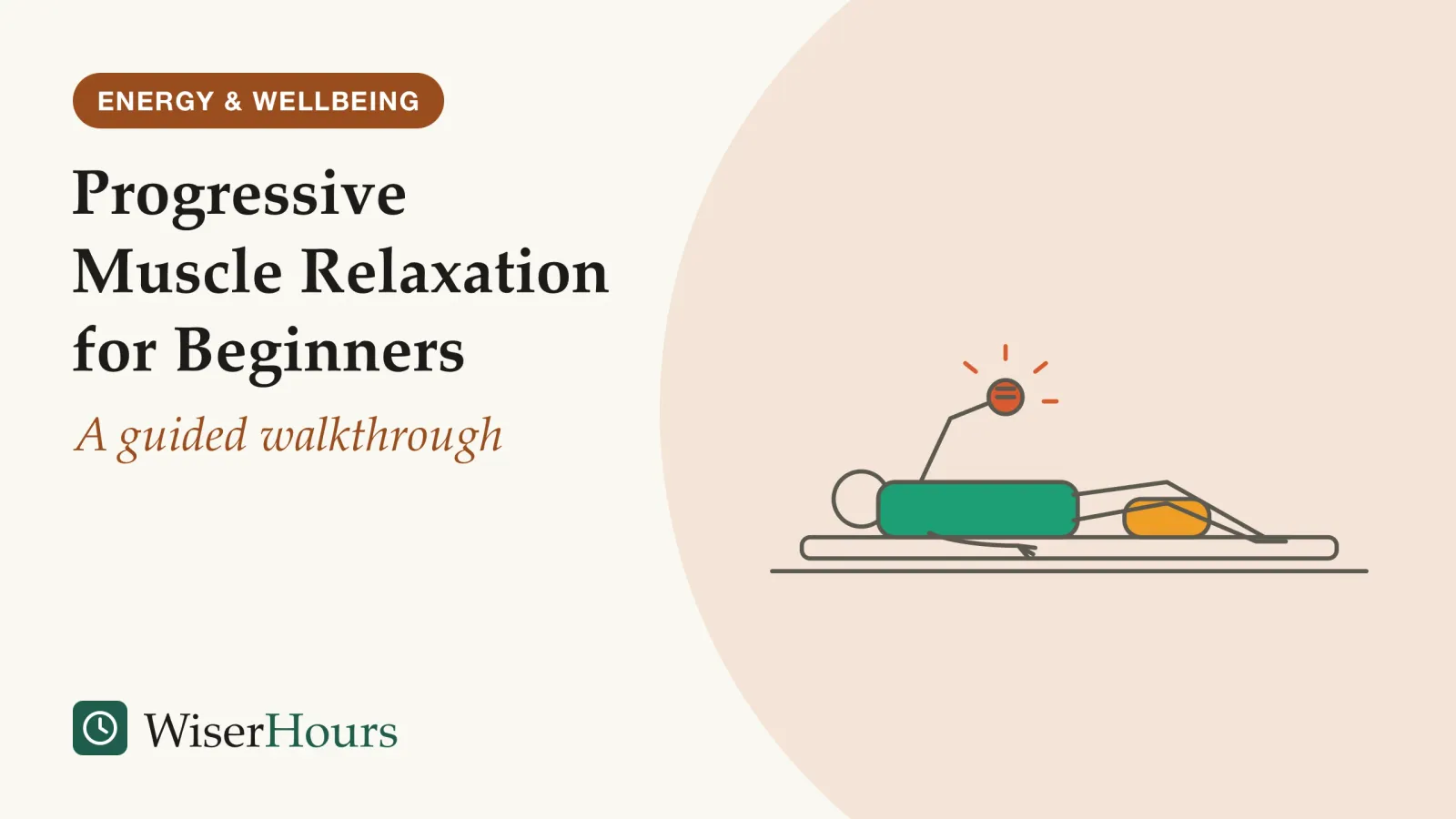
To loosen a muscle, this method first asks you to tighten it. Progressive muscle relaxation is a technique in which you tense one group of muscles for a few seconds, then let go and notice how the release feels, moving through the body one area at a time. A 2008 meta-analysismeta-analysis: A study that combines the results of earlier studies on the same question into one overall estimate. Pooling makes the estimate more precise, but it cannot repair the studies it pools: a meta-analysis of surveys is still survey evidence.Full entry in the glossary that pooled 19 controlled studies found that relaxation training, most often progressive muscle relaxation, eased anxiety by a medium amount compared with control conditions.1
For a first try, work through it in this order:
- Lie or sit somewhere quiet and comfortable
- Tense one muscle group for a few seconds
- Breathe out, release, and notice the difference
- Move through the body, skipping anything that hurts
- Practice most days, then shorten the round
Prefer to watch? The video covers the same ground as this article.
Why the method starts with a squeeze
Edmund Jacobson developed progressive muscle relaxation in the 1920s: you contract muscles on purpose to create tension, then release it, repeating the cycle until the body is fully relaxed.2 The method rests on two principles, as a 2016 German trial report summarizes them: tension and relaxation cannot occupy the same muscle at once, and what the muscles do and what the mind does affect each other.3
The tensing is a teaching device. Most people carry tension they have stopped noticing: shoulders that creep toward the ears during a long email thread, a jaw that sets in a tense meeting. A deliberate squeeze makes that feeling loud for a moment, and the release that follows gives you a clear contrast to learn from. The skill you are building is the ability to spot tension early and drop it, which is why practice matters more than any single session.
A 1973 training manual by Bernstein and Borkovec teaches a version that shrinks as you learn, as a 2023 Spanish trial protocol shows step by step.4 The German report adds that some older studies taught the method in one or two sessions, which the manual’s authors consider too few.3 So expect your first rounds to feel slow and mechanical. They are meant to; speed comes once you can feel the difference between tight and loose.
A first session of progressive muscle relaxation, area by area
These steps are based on the routine published by NHS inform, Scotland’s public health information service, and they describe a low-risk habit for healthy adults, not a treatment.5 Read the section on who should take care before you start.
1. Lie or sit somewhere quiet and comfortable
Lie on your back, as NHS inform suggests; if you cannot, a chair that supports you is a practical alternative. If you have lower back problems, it also suggests a pillow under your knees. Pick a time you can repeat, such as just before bed or a quiet spell after lunch.
2. Tense one muscle group for a few seconds
Breathe in and tighten the muscles in one area, starting with your right hand and arm, and hold the tension for a few seconds. For the hand and arm, that might mean making a fist and bracing the forearm. Aim for tension you can clearly feel, not strain: the 2016 German trial, following the same manual, had people tense each group only slightly.3
3. Breathe out, release, and notice the difference
Breathe out and let the muscles go all at once. Then stay with that area for a moment. Noticing is part of the method, since the Spanish protocol has people direct attention to the feelings of tension and of relaxation.4
4. Move through the body, skipping anything that hurts
NHS inform lists an order you can follow: right hand and arm, left hand and arm, right leg and foot, left leg and foot, stomach, chest, back, shoulders, neck and throat, then face. At the end, scan each area again and let any leftover tension go as you breathe out. If an area is painful, leave it out.5
- Right hand and arm
- Left hand and arm
- Right leg and foot
- Left leg and foot
- Stomach
- Chest
- Back
- Shoulders
- Neck and throat
- Face
In each area, breathe in and tense for a few seconds, then breathe out and let go. Finish with a scan of each area, and skip any area that hurts. Number 7, the back, sits behind the chest.
5. Practice most days, then shorten the round
Programs that asked people to practice at home were linked to larger drops in anxiety in the 2008 meta-analysis by Gian Mauro Manzoni and colleagues, and so were longer programs.1 The Bernstein and Borkovec manual then shrinks the round in stages: the Spanish protocol starts with 16 muscle groups, combines them into 7 and then 4 larger groups over later sessions, and ends by relaxing the same 4 groups without tensing them first.4
- 16 groups: the long version, used in the first two sessions: each group tensed and released in turn
- 7 groups: groups combined into fewer, larger ones for the next two sessions
- 4 groups: larger groups again, for the two sessions after that
- Release only: the same 4 groups relaxed without tensing them first
That last stage is the one you could use at a desk, where squeezing your fists in a meeting would look odd. Once the full round feels familiar, try fewer, larger groups, and later see whether you can let a group go without tensing it first.
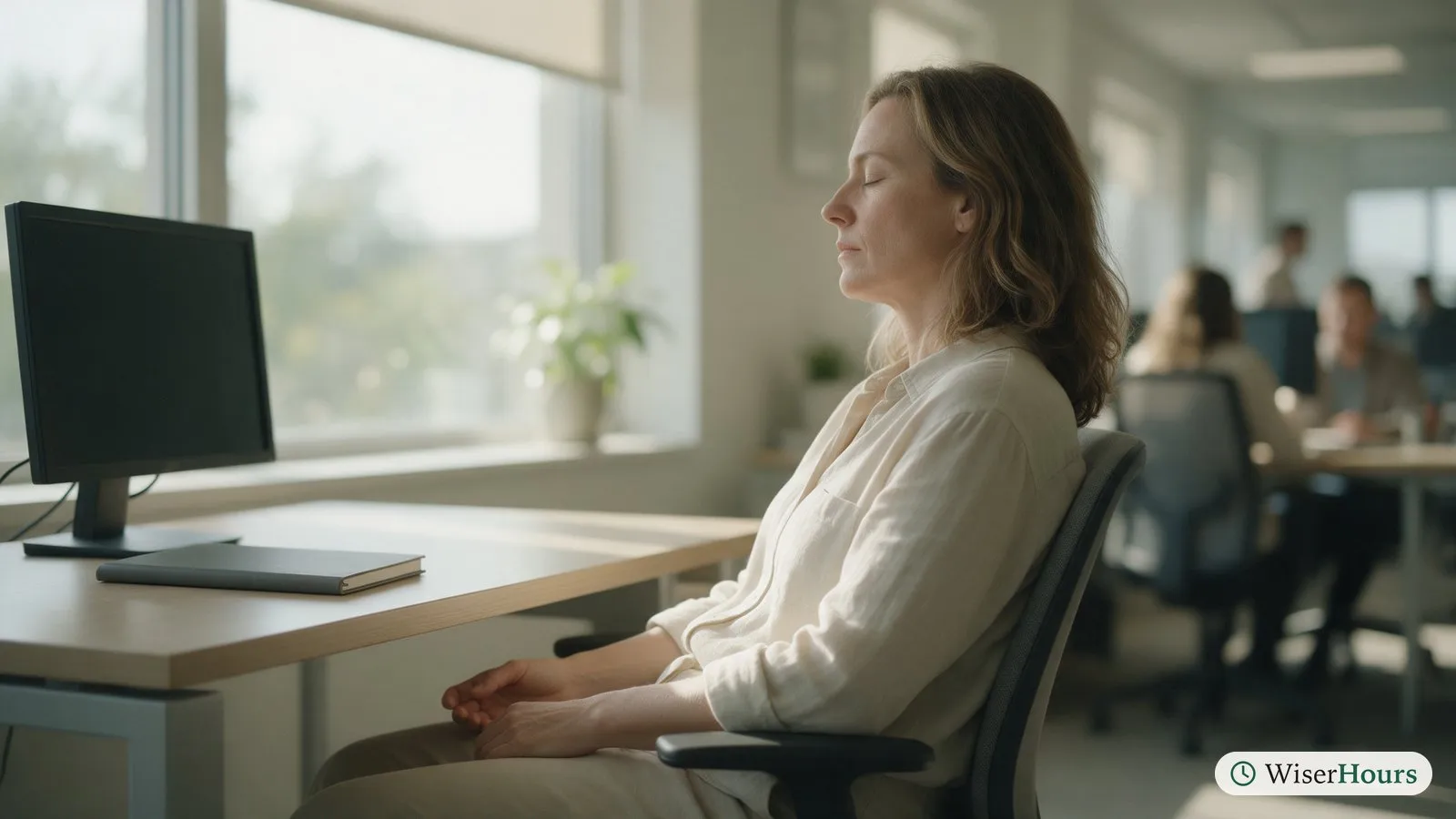
Set up for a first session
Download PDF
Less anxiety with practice, though other methods match it
In trials, progressive muscle relaxation helped people feel more relaxed right after a session, and reviews link regular practice to lower anxiety, but it has not beaten other relaxation methods head to head, and most studies are small. The anxiety evidence is the strongest part; the best trial comparisons are the most modest.
Manzoni’s team pooled studies from 1997 to 2007, mostly using questionnaires that ask how anxious people feel. Progressive relaxation was the most common method among the controlled studies, and the comparison groups usually waited, lay down or read a newspaper. Results were inconsistent across studies, some studies lacked a control group, and the authors warn that unpublished negative results may be missing.1 Medium is the middle of the yardstick researchers use for effect sizes: a real change, not a dramatic one, and the review did not report how long the change lasted.
A head-to-head comparison is the cleanest test of whether the tensing adds anything, and the one below is small.
The study
Limited evidence
Muscles, breath or imagery: 60 US students felt equally relaxed after one session
Students assigned to progressive muscle relaxation, deep breathing or guided imagery all felt more relaxed afterwards than students who read news or sports magazines, and the three methods did not differ from each other. Skin conductance, a sign of arousal, fell steadily during the muscle and imagery sessions, while in the breathing group it rose at first and then fell. Heart rate changes did not clearly differ between groups.2
One evening in a lab with healthy young students says little about a stressful workweek. What it does suggest is that the muscle route is one good way to relax among several.
The widest recent review is broad but loose. Syazwina Muhammad Khir and colleagues, funded by Malaysia’s Ministry of Higher Education, gathered 46 studies of adults without a diagnosed illness from 16 countries, many of them nurses and students. Most reported less stress, anxiety or depression after practice, but many compared people only with themselves before and after, the review did not pool results into one estimate, and non-significant results turned up more often in general adult samples.6 A before-and-after comparison cannot separate the method from simply taking a quiet break, which is why the controlled studies above matter more. In its fact sheet on anxiety disorders, the World Health Organization names progressive muscle relaxation, next to slow breathing, as a relaxation skill people with anxiety can learn as self-care, which it says can support treatment.7
Slow breathing, which sits among the ways to reduce stress day to day, is the obvious alternative, and box breathing gives it a fixed count. In that trial of 60 students, arousal in the breathing group rose before it fell. If attending to your breath makes you tense, a routine built around your muscles gives the mind a different, physical target.
Sleep and headaches: where the evidence is thinner
For chronic insomnia and recurring headaches, relaxation training has some support, but reviewers and guideline panels rate it only low or conditional, and it mostly comes from people with a diagnosis, not from healthy adults having a bad week.
Further reading
The Relaxation and Stress Reduction Workbook
Has a chapter on progressive muscle relaxation plus breathing and other methods, if you want to try more than one.
As an Amazon Associate WiserHours earns from qualifying purchases.
For sleep, a 2021 US guideline by the American Academy of Sleep Medicine (AASM) strongly recommends multicomponent cognitive behavioral therapy for insomniainsomnia: Trouble falling asleep, staying asleep or waking too early despite having the chance to sleep, with effects on how you feel or function during the day. It is called chronic when it lasts for months; short spells after stress are common.Full entry in the glossary (CBT-I), while relaxation therapy used by itself gets only a conditional recommendation, meaning clinicians should weigh it case by case.8 The World Sleep Society’s international guidelines committee endorsed the same ranking in 2023.9 Pooling randomized trials from China, Turkey, Iran and Egypt, a 2026 meta-analysis found better self-ratedself-report: A measure in which people describe their own behavior, feelings or circumstances, usually by answering a questionnaire. When the same person supplies both of the things being compared, shared habits of answering can make the link between them look stronger than it is.Full entry in the glossary sleep quality after progressive muscle relaxation, but every participant had an illness, results varied widely and the authors found signs that some studies may be missing.10
Headaches follow the same pattern. A 2025 review for the US Agency for Healthcare Research and Quality found that, for adults with migraine, relaxation training may reduce migraine frequency by about one day a month, with low strength of evidence.11 Pooling psychological treatments for tension-type headache, a 2025 meta-analysis found in a secondary analysis that relaxation training did not reduce headache intensity more than control conditions, while mindfulness-based approaches did.12
| What it is used for | What the best evidence found | Evidence |
|---|---|---|
| Anxiety | Medium drop compared with control conditions | Meta-analysis of mostly small studies, moderate1 |
| Chronic insomnia | Suggested on its own only conditionally; CBT-I preferred | US guideline, conditional8 |
| Sleep quality in people with an illness | Better self-rated sleep, with wide variation | Meta-analysis of trials, limited10 |
| Migraine prevention | May cut about one migraine day a month | Review of trials, low strength of evidence11 |
| Tension-type headache | No clear drop in headache intensity versus control | Subgroup of a meta-analysis, limited12 |
A round in bed is a reasonable wind-down for a poor sleeper, but insomnia that lasts for months deserves a clinician and CBT-I, not a better relaxation script.
Who should take care before tensing
Progressive muscle relaxation is low-risk for most healthy adults, but injured or painful areas should be left out, and a few groups should ask a clinician first.
The US National Center for Complementary and Integrative Health (NCCIH) says relaxation techniques are generally considered safe for healthy people. It also notes that people occasionally report unpleasant experiences, such as more anxiety, intrusive thoughts or a fear of losing control, and that rare reports suggest some techniques may worsen symptoms in people with epilepsy, certain psychiatric conditions, or a history of abuse or trauma.13 If a round leaves you more on edge, stop, open your eyes and do something ordinary for a few minutes. If that keeps happening, or one of those conditions applies to you, talk it over with a health professional before you carry on.
Ask first if any of these apply
Skip any muscle that is injured or painful. If you are pregnant, or have a heart condition or another long-term illness, ask your doctor or midwife before you start: the German migraine trial, for example, excluded pregnant women and people with chronic physical or psychiatric illness, so the studies say little about these groups.3
These cautions come from exclusions and gaps rather than documented harms, and some routines may not suit shift workers or carers with no quiet half hour. A shorter four-group round, the manual’s later stage, still follows the method.
Signs you need more help than a relaxation routine can give
Stress or anxiety that keeps hanging on, or any thought of harming yourself, calls for a person rather than another round of tensing and releasing. Sorted from most to least urgent, the routes below draw on three public health bodies: NIMH and NCCIH in the US, plus the UK’s NHS.
- Now: wherever you live, dial your local emergency number first if someone’s life may be at risk. Two national examples follow. In the US, NIMH lists 911 for life-threatening situations, and the 988 Suicide and Crisis Lifeline, reachable by phone or text, for people with suicidal thoughts or in emotional distress.14 For the UK, NHS guidance is to ring 999 or go to an A&E department in a life-threatening emergency; when help is urgent but not life-threatening, it suggests calling 111 and picking the mental health option, and Samaritans answer on 116 123.15 Elsewhere, your own health service can give you the equivalent lines.
- Soon: NCCIH recommends a health care provider for severe or long-lasting symptoms of any kind, and a qualified professional when anxiety or depression persists.13 If sudden surges of intense fear are the problem, the guide to how a panic attack differs from an anxiety attack covers when a doctor should see you.
- Routine: at an ordinary appointment, mention months of poor sleep and ask about CBT-I; for headaches that keep coming back, ask whether a behavioral prevention approach could help.
The bottom line
Tensing an area for a few seconds, releasing it and noticing the difference, repeated through the body, is all progressive muscle relaxation asks, and it costs nothing. Small studies link regular practice to less anxiety, but it has not beaten slow breathing or guided imagery, so choose whichever you will practice. Leave out painful areas, ask first if you are pregnant or have a heart or long-term condition, and get professional help when anxiety or poor sleep persists.
This article is general information, not medical advice. If you're worried about your health, talk to a doctor or another qualified professional.
Frequently asked questions
How long does a progressive muscle relaxation session take?
Anything from a few minutes to about half an hour. In the 2024 systematic review by Syazwina Muhammad Khir and colleagues, sessions people did on their own ran from 5 to 28 minutes, and the authors saw no clear sign that longer or more frequent sessions changed the results. A short round you can manage every day is a sensible starting point.
Can I learn progressive muscle relaxation from a recording?
Yes, several studies teach it that way. A 2021 US trial used a 20-minute audio recording; in a 2023 Spanish trial protocol, people taught a mix of muscle relaxation, breathing and imagery get a 30-minute recording for daily home practice; and the 2008 meta-analysis by Gian Mauro Manzoni and colleagues linked programs that asked people to practice at home, with or without tapes, to larger drops in anxiety.
Does progressive muscle relaxation work as well for older adults?
It may help less, though the evidence is thin. The 2008 meta-analysis by Manzoni and colleagues found smaller drops in anxiety in studies of older people and suggested the physical exercises may be harder for them. A 2026 sleep review of people with an illness saw no clear benefit in those aged 55 or over, but the difference between age groups was not statistically clear.
Sources
- Relaxation training for anxiety: a ten-years systematic review with meta-analysis. Manzoni, G. M., Pagnini, F., Castelnuovo, G. & Molinari, E. (2008). BMC Psychiatry, 8, 41
- Effectiveness of Progressive Muscle Relaxation, Deep Breathing, and Guided Imagery in Promoting Psychological and Physiological States of Relaxation. Toussaint, L., Nguyen, Q. A., Roettger, C., et al. (2021). Evidence-Based Complementary and Alternative Medicine, 2021, 5924040
- Progressive muscle relaxation reduces migraine frequency and normalizes amplitudes of contingent negative variation (CNV). Meyer, B., Keller, A., Wöhlbier, H.-G., Overath, C. H., Müller, B. & Kropp, P. (2016). The Journal of Headache and Pain, 17, 37
- Cost-effectiveness of transdiagnostic group cognitive behavioural therapy versus group relaxation therapy for emotional disorders in primary care (PsicAP-Costs2): Protocol for a multicentre randomised controlled trial. González-Blanch, C., Barrio-Martínez, S., Priede, A., et al. (2023). PLOS ONE, 18(3), e0283104
- Progressive muscle relaxation. NHS inform, Public Health Scotland (UK), last updated 9 December 2025
- Efficacy of Progressive Muscle Relaxation in Adults for Stress, Anxiety, and Depression: A Systematic Review. Muhammad Khir, S., Wan Mohd Yunus, W. M. A., Mahmud, N., et al. (2024). Psychology Research and Behavior Management, 17, 345-365
- Anxiety disorders (fact sheet). World Health Organization (2026)
- Behavioral and psychological treatments for chronic insomnia disorder in adults: an American Academy of Sleep Medicine clinical practice guideline. Edinger, J. D., Arnedt, J. T., Bertisch, S. M., et al. (2021). Journal of Clinical Sleep Medicine, 17(2), 255-262
- World Sleep Society international sleep medicine guidelines position statement endorsement of the AASM guideline on behavioral and psychological treatments for chronic insomnia disorder in adults. Morin, C. M., Bei, B., Bjorvatn, B., Poyares, D., Spiegelhalder, K. & Wing, Y. K. (2023). Sleep Medicine, 109, 164-169
- The effects of progressive muscle relaxation on sleep quality in adults: a systematic review and meta-analysis of randomized controlled trials. Li, K., Chen, S., Liu, Y. & Yu, N. (2026). Frontiers in Public Health, 14, 1906525
- Behavioral interventions for migraine prevention: A systematic review and meta-analysis. Treadwell, J. R., Tsou, A. Y., Rouse, B., et al. (2025). Headache, 65(4), 668-694
- Efficacy of psychological treatment for tension-type headache: a systematic review and meta-analysis. Yuan, L., Pantila, K., Niu, X.-Y., Zhang, Y.-X., Yang, F. & Zheng, H. (2025). The Journal of Headache and Pain, 27, 1
- Relaxation Techniques: What You Need To Know. National Center for Complementary and Integrative Health, US National Institutes of Health (last updated June 2021)
- Help for Mental Illnesses. National Institute of Mental Health, US National Institutes of Health (last reviewed April 2026)
- Where to get urgent help for mental health. NHS (UK), page last reviewed 26 April 2023
How we researched this
Searches of Europe PMC, PubMed, Crossref and the NHS, WHO, NIMH and NCCIH websites in September 2026 looked for meta-analyses, systematic reviews, guidelines and randomized trials of progressive muscle relaxation for stress, anxiety, sleep and headache. Sources span 2008 to 2026; two sleep guideline papers were read as abstracts only, the rest in full. Main limitation: most studies are small, many lack a proper control group, and outcomes are mostly self-reported.
Keep reading
How to Calm Down Quickly: Short Techniques and the Evidence Behind Them
How to calm down quickly: 5 short techniques graded by evidence, from slow breathing (12 trials pooled) to grounding, and who each may not suit.
Eustress vs. Distress: When Pressure Helps and When It Harms
Eustress vs distress: Selye saw one stress response behind both. A 2019 review of 14 lab studies found reframing eased feelings more than the body.
Stress vs. Anxiety: What's the Difference and Why It Matters
Stress vs anxiety: stress follows a cause and eases when it ends; anxiety can last with no threat. When worry lasting 6 months or more may be a disorder.
The Perceived Stress Scale: How Researchers Measure Stress
The perceived stress scale explained: what its 10 questions ask, how the 0-40 score works, what typical scores look like, and why it has no official cut-offs.