What Is the Ideal Team Size? What the Research Says
There is no single ideal team size: a 2023 review of 208 team results found no overall link. Here is when size matters more, when it matters less, and why.

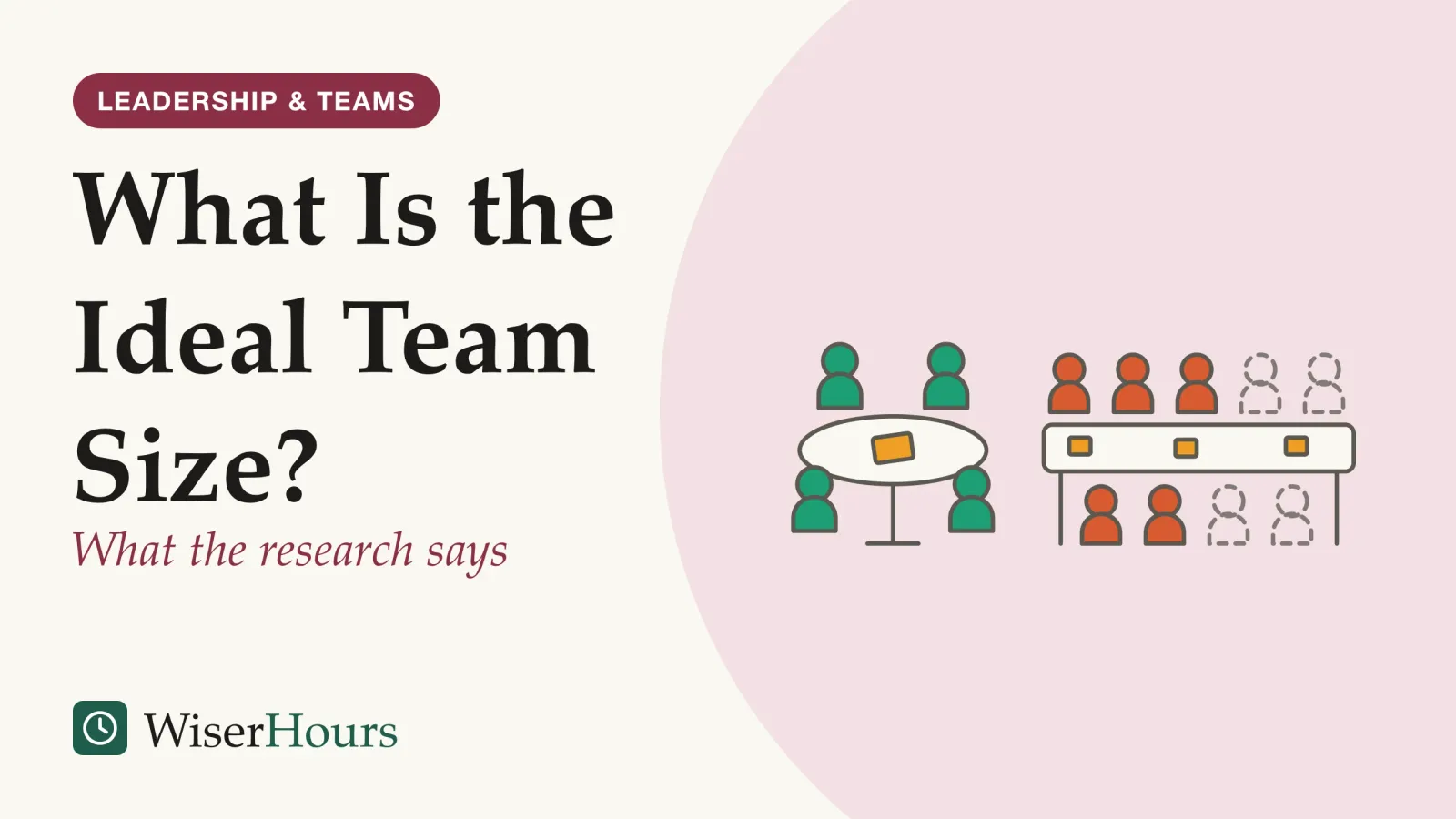
Researchers have looked for the ideal team size for more than half a century, and the best recent evidence says there isn’t one. A 2023 meta-analysis of 208 team-level results found no overall link between team size and how well teams performed their tasks, and the results varied widely from study to study.1 The useful question is narrower: what does this task need, and what will each extra person cost?
The short version: team size was more strongly tied to performance on complex work, and less strongly on simple work that needed a lot of coordination.1 People on larger teams often feel less supported, planners underestimate how much extra effort a bigger team needs, and small and large teams tend to produce different kinds of work.
In practice, ask three things before you add a person: what skill does the task need that the team lacks, how much of the work forces everyone to stay in step, and will each member still know who to ask for help? A team of five building a new service may well gain from a sixth member with legal knowledge; a team of five approving routine expense claims mostly gains another handoff. The sections below explain the evidence behind each question, and the checklist at the end turns them into six checks.
Why there is no single ideal team size
The 2023 review by Jeremy Bernerth and colleagues pooled team-level studies and found that size, on average, predicted nothing about task performance. It also showed where the average hides differences: size was more strongly linked to performance when tasks were complex, and less strongly when heavy coordination met simple work.1
The authors frame it as two forces pulling against each other. More people bring more human capital, meaning skills, knowledge and hands. More people also bring more process loss, the time and attention spent getting everyone to work as one.1 Which force wins depends on the work. A product launch that needs engineering, design and sales expertise gains something real from each specialist. A team processing routine requests, where every item passes through the same chain of approvals, mostly gains another link in the chain.
- Myth
- Research has found a magic number, such as five or seven, that works for every team.
- Fact
- A 2023 review of 208 team results found no overall link between size and performance; the link was stronger for complex tasks and weaker where simple work needed heavy coordination.
An older meta-analysismeta-analysis: A study that combines the results of earlier studies on the same question into one overall estimate. Pooling makes the estimate more precise, but it cannot repair the studies it pools: a meta-analysis of surveys is still survey evidence.Full entry in the glossary of 93 studies on team design, by Greg Stewart in 2006, found that project and management teams had slightly higher performance when they included more members.2
Google’s own Project Aristotle saw no significant link between size and effectiveness across its teams, although its re:Work guide mentions that many researchers have found smaller teams, under 10 people, more beneficial.3 What mattered more than headcount at Google, and in wider research, is set out on the page about what makes a team effective.
So size a team from the task outward. List the distinct skills the work truly needs, then ask how much of it requires everyone to coordinate. The evidence favors larger teams mainly for complex tasks, and calls for caution where the work is simple but everyone must stay in step.
Bigger groups can feel worse even when they perform the same
A widely cited 1970 laboratory study by J. Richard Hackman and Neil Vidmar separated how groups perform from how members feel. Students at two universities worked in groups of two to seven people on short tasks: size barely changed how well groups performed, but it strongly changed members’ reactions.4
Pairs tended to be the most satisfied, and dissatisfaction rose in a roughly straight line as groups grew. Its abstract lists the question of an optimal group size among the implications the authors discuss but gives no number, so be wary of any exact figure attributed to the paper. Against the authors’ expectations, task type made no substantial difference to how size played out.4 That contrasts with the 2023 review, which pooled many studies and found that task complexity did matter.1
Why would bigger groups feel worse even when they do no worse? The study’s published summary does not say. Later field research, in the next section, offers one candidate: in larger teams people feel less sure that help and support are there when they need them. Think of a seven-person working session where you never quite know whose job it is to answer your question.
The caveat matters. These were students doing tasks of about 15 minutes, not colleagues working together for months. Still, the practical point travels: when a group grows, ask members how it feels to work in, not only how much it produces, because their experience can slip even when output holds.
Why each person tends to do worse in a bigger team
A team can grow its total output while each member contributes less than they would on a smaller team. Jennifer Mueller’s 2012 field study of 212 knowledge workers in 26 US project teams found that people on larger teams were rated lower by their peers and leaders, and linked much of that to what she called relational loss: the sense that support is harder to find.5
When Mueller tested the usual explanations, coordination problems accounted for only part of the drop, and lower motivation was not linked to team size at all. Relational loss held up as a mediatormediator: A variable that carries the effect of one thing to another: the first changes the mediator, and the mediator changes the outcome. When all of it is measured at the same time, the result shows a pattern that fits such a chain rather than evidence that the chain is real.Full entry in the glossary: part of the path from bigger team to lower individual rating ran through the feeling that help, advice and encouragement were scarce, even with the other two taken into account. The study was observational, and the seven companies were a convenience sample rather than a random one, so the results show a pattern, not proof that size causes the drop.5
The mechanism is familiar. On a team of five you know who to ask when you are stuck. On a team of fifteen, you hesitate to interrupt someone you barely know, the helpful expert is always busy, and you lose an afternoon to a problem a colleague could have solved in minutes. The Ringelmann effect, in which a rope-pulling group falls short of its members’ combined solo strength, is a separate story about effort, told in the page on social loafing and pooled effort.
Mueller’s practical suggestion, which her study did not test, is to make support visible in larger teams: give named people a formal role in helping teammates, and encourage people to ask for help.5 If you manage a growing team, check whether newer or quieter members know exactly who to turn to; that sense of available support is what Mueller found size wears down.
Bigger teams cost more than planners expect
People underestimate how much extra effort a larger team needs, a bias Bradley Staats, Katherine Milkman and Craig Fox named the team scaling fallacy in 2012 and found in three separate studies. Their explanation, backed by one experiment, is that planners pay more attention to how work can be divided among more hands than to the time needed to coordinate those hands and fit their work back together.6
The study
Moderate evidence
Four builders, one LEGO model and a forecast that fell short
Teams of two or four people assembled the same LEGO model. In the second experiment, four-person teams used about 54% more total person-minutes than pairs, yet most estimators, including team members forecasting their own work, predicted a smaller gap. In three years of records from 1,118 software projects at a large international company, larger teams were linked to bigger underestimates of the effort needed.6
The lab tasks were short and simple, and the field data came from one company in one industry, where the link is a correlation. Still, the same bias turned up in all three settings, among outsiders and insiders alike, which is why it deserves attention in any plan that adds people.6
The arithmetic behind it is simple. The number of possible pairs in a team is its size multiplied by one less than its size, divided by two.6 Four people have six pairs to keep in step; eight people have 28.
- Four people, six pairs: each line is one pair of people who need to stay informed
- Eight people, 28 pairs: twice the people, more than four times the pairs to keep informed, which raises the potential for coordination losses
In the experiment, estimators who mentioned the benefits of more hands more than the costs of coordinating them made bigger errors.6 A hypothetical but familiar case: a manager plans a report that one analyst would finish in four weeks and assigns four analysts, expecting one week. The sections do get drafted faster, but agreeing on a structure, reconciling numbers and merging four writing styles eat much of the saving.
Anyone who plans work can budget coordination as its own line. The authors suggest scaling estimates by a factor learned from your own past projects of different team sizes. They also set the bias apart from the planning fallacyplanning fallacy: The tendency to underestimate how long your own tasks will take, even when you know similar tasks ran late before. Estimating from your track record on past tasks, rather than from the plan, tends to correct it.Full entry in the glossary, which distorts people’s forecasts of their own work: the team scaling fallacy misled outsiders too, so an independent estimator is no cure on its own.6 Estimating and scheduling in general belong to project management.
Two lists before you add a person
Before you add people to a piece of work, write two lists: what the extra hands will speed up, and what they will add in meetings, handoffs and merging. If the second list is short, look again, because in the 2012 experiment estimators who dwelt on the gains made bigger errors.
Small teams may disrupt, large teams tend to develop
Team size is also linked to what kind of work comes out. Lingfei Wu, Dashun Wang and James Evans analyzed more than 65 million papers, patents and software products from 1954 to 2014 and reported in Nature in 2019 that smaller teams tended to disrupt their fields with new ideas, while larger teams tended to develop existing ones.7
Work from large teams built on recent, popular developments and got attention quickly. Work from small teams reached further into the past, was viewed as more disruptive and tended to be recognized later, if at all. Differences in topic and research design explained only a small part of the pattern; most of it showed up within the same people as they moved between smaller and larger teams, and the authors concluded that science needs both kinds of team.7
The logic translates to ordinary work. A large team is good at pushing a known direction forward: many specialists can refine, test and extend it at once. A small team has fewer people to convince and less need for consensus, which leaves room for an odd idea to survive. The data come from science, patents and code, and they show associations rather than the result of assigning team sizes, so the parallel to an office team is a reasonable inference, not a finding. The disruption measure itself is also disputed: a 2025 reanalysis by Alexander Petersen and colleagues, using the SciSciNet database of scientific papers, found the link between team size and disruption remarkably small overall, turning positive for teams of eight or more coauthors.8
So if you need a genuinely new approach, a small group given room to explore is still a reasonable bet, even though the size of the effect is disputed. When the direction is settled and the job is to build it out well, adding specialists makes more sense.
How to choose a size for your team
No study hands you a number, but the evidence gives you a sequence of questions. Start from the work, count the real costs of each addition, and check the effect on individuals as well as on output.
| Question | What the best evidence found | Evidence |
|---|---|---|
| Does size affect performance? | No overall link; size was more strongly tied to performance on complex tasks, less where simple work needed heavy coordination | Meta-analysis, 2023; abstract only1 |
| Which teams gain from more members? | Project and management teams performed slightly better with more members | Meta-analysis of 93 studies, 20062 |
| How do members feel as groups grow? | Satisfaction fell as lab groups grew from two to seven people, while performance barely changed | One lab study with students, 19704 |
| What happens to each person? | Individuals on larger teams were rated lower, linked to feeling that support was less available | Observational field study, 26 US teams, 20125 |
| Can planners judge the extra effort? | Estimators underestimated the extra effort a larger team needed, in the lab and at one company | Two lab experiments and field data, 20126 |
| What kind of work comes out? | Small teams tended to disrupt and large teams to develop existing ideas; a 2025 reanalysis found the link small | Observational, papers, patents and software, 2019; contested78 |
Two related questions deserve their own treatment: whether Amazon’s small-team rule works in other companies, and what to do once a team has already grown too large. The checks below apply before either comes up.
Six checks as a team grows
The bottom line
Headcount on its own predicts little about how well a team performs; what counts is whether the size fits the task. Larger teams are linked to better performance mainly when the work is complex, and less so when simple work demands constant coordination. Before adding someone, ask what skill they bring that the task needs, budget the coordination they will add, and make sure every member still knows where to find help.
Frequently asked questions
Are two-person teams better than bigger ones?
Pairs are a special case rather than a winner. In Hackman and Vidmar's 1970 lab study of groups of two to seven students, pairs tended to be the most satisfied, but group size made little difference to how well groups performed short tasks. A 2023 meta-analysis also found team size more strongly linked to performance on complex tasks.
Does the best team size differ between countries?
Not according to a 2023 meta-analysis. Bernerth and colleagues tested whether national culture altered the link between team size and team task performance and found that it did not. The review could only test the countries its studies came from, so it is worth checking whether local norms differ.
Do bigger teams have more conflict or misbehavior?
They tend to, a little. The 2023 meta-analysis by Bernerth and colleagues found that larger teams were linked to somewhat more deviant behavior and more passive withdrawal, and to slightly less positive team attitudes. These are associations across studies, not proof that size itself causes them.
Does adding people to a late project speed it up?
Often not as much as hoped. Staats, Milkman and Fox note that adding people late in a project can inflate labor costs and still miss the deadline, because newcomers must be brought up to speed and their work integrated. Their own studies show planners already underestimate the extra effort larger teams need.
Sources
- The more the merrier or too many cooks spoil the pot? A meta-analytic examination of team size and team effectiveness. Bernerth, J. B., Beus, J. M., Helmuth, C. A. & Boyd, T. L. (2023). Journal of Organizational Behavior, 44(8)
- A Meta-Analytic Review of Relationships Between Team Design Features and Team Performance. Stewart, G. L. (2006). Journal of Management, 32(1)
- Guide: Understand team effectiveness. re:Work Editorial Team, Google (2015). re:Work
- Effects of Size and Task Type on Group Performance and Member Reactions. Hackman, J. R. & Vidmar, N. (1970). Sociometry, 33(1)
- Why individuals in larger teams perform worse. Mueller, J. S. (2012). Organizational Behavior and Human Decision Processes, 117(1)
- The team scaling fallacy: Underestimating the declining efficiency of larger teams. Staats, B. R., Milkman, K. L. & Fox, C. R. (2012). Organizational Behavior and Human Decision Processes, 118(2)
- Large teams develop and small teams disrupt science and technology. Wu, L., Wang, D. & Evans, J. A. (2019). Nature, 566(7744)
- The disruption index suffers from citation inflation: Re-analysis of temporal CD trend and relationship with team size reveal discrepancies. Petersen, A. M., Arroyave, F. & Pammolli, F. (2025). Journal of Informetrics, 19(1)
How we researched this
Crossref, OpenAlex and the reference lists of two team-size meta-analyses (2006 and 2023) were searched for work published from 1970 to 2023. Primary papers were read in full where available. Main limitation: the 2023 and 2006 meta-analyses, the 1970 lab study, the 2019 Nature paper and a 2025 reanalysis were read only as abstracts, so only their abstract claims are used.
Keep reading
Tuckman's Stages of Team Development: Forming, Storming, Norming, Performing
Forming, storming, norming, performing and adjourning: where Tuckman's 1965 stages of team development came from, and how to use them at work.
The RACI Matrix Explained: A Step-by-Step Guide With Examples
A RACI matrix shows who does, owns, advises on and hears about each task. How to build one in 6 steps, with examples and what the evidence says.
What Makes a Team Effective? What Decades of Research Show
What makes a team effective? Decades of research point less to star talent than to how a team is set up and works together. Here is the evidence.