Tuckman's Stages of Team Development: Forming, Storming, Norming, Performing
Forming, storming, norming, performing and adjourning: where Tuckman's 1965 stages of team development came from, and how to use them at work.

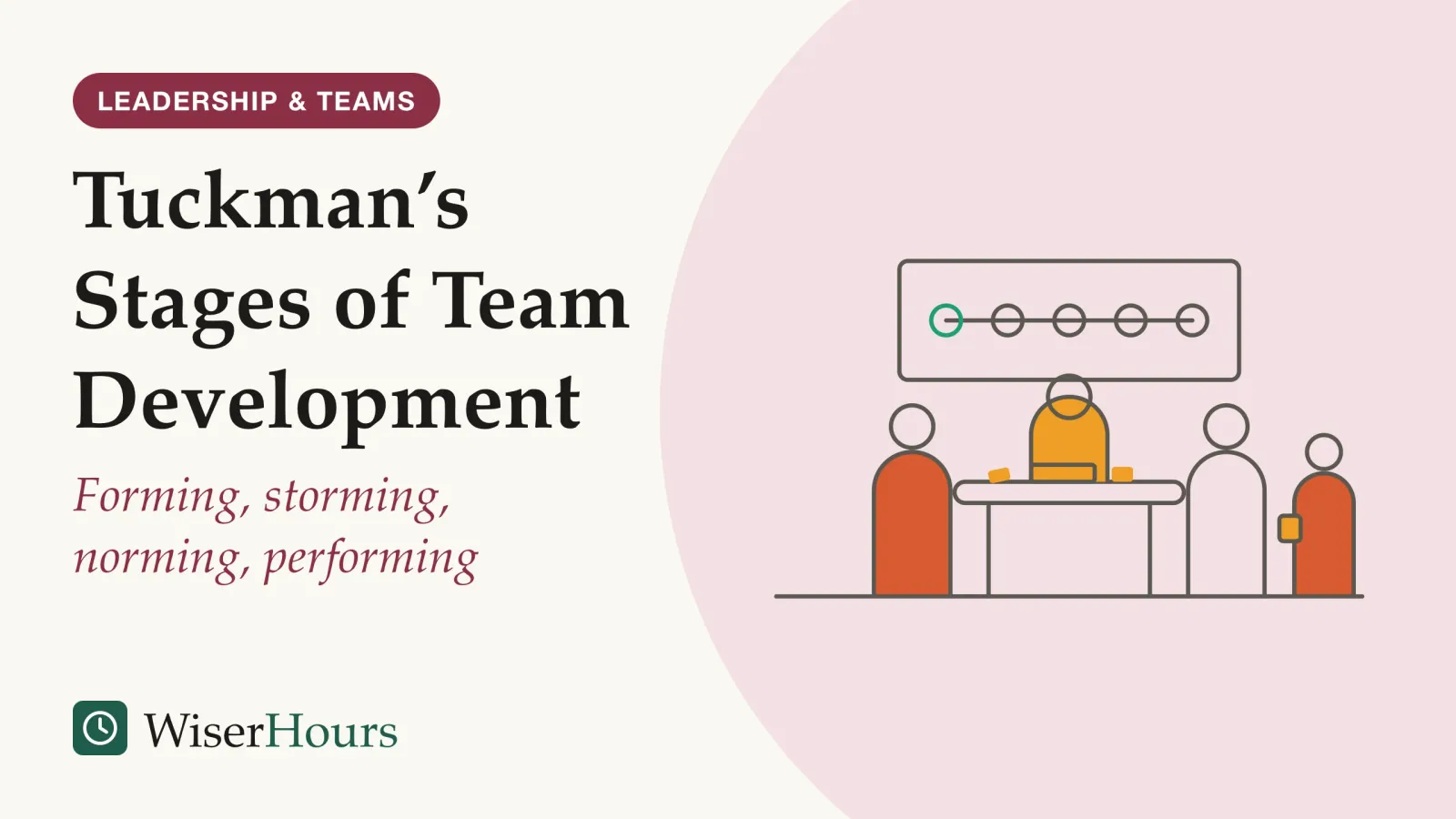
Forming, storming, norming and performing were coined in 1965 by a researcher at a US Navy institute who was reading mostly about psychotherapy groups. Those four words, the best-known stages of team development, describe a new group that first tests the ground, then pushes back, then settles its norms and finally puts its energy into the work. The model began as a hypothesis drawn mainly from therapy and training groups, and it is best used as a vocabulary for what a team is going through, not as a timetable it must follow.1 Bruce Tuckman added a fifth stage, adjourning, with Mary Ann Jensen in 1977.2
What are the stages of team development?
Tuckman’s stages of team development are forming, storming, norming and performing, with adjourning added in 1977 by Tuckman and Mary Ann Jensen. Each stage describes two things at once: how members relate to one another, and how they approach the work.2
That double description is easy to miss, and it is what makes the model useful. Tuckman separated what he called group structure, the way members act and relate as people, from task activity, the content of their interaction about the task at hand. His claim was that the two develop in step.1
- FormingTesting what is acceptable; leaning on the leader; working out what the task is
- StormingConflict and resistance, to each other and to the demands of the task
- NormingCohesion; new norms and roles; open exchange of views
- PerformingRoles become flexible and functional; energy goes into solutions
- AdjourningThe group finishes and separates (added in 1977)
Picture a new product team in its first fortnight. People are polite, ask the manager what is expected and quietly check how blunt they can be. That is forming in both realms: testing the boundaries between people, and orienting to the task by working out its ground rules.1 Later, the same team can argue about the plan while getting on fine as colleagues, or get on warmly while avoiding the plan.
So when a team feels stuck, ask two separate questions rather than one. Do we agree on what we are building and how? And do people say what they actually think to each other? A “no” to either one tells you which of the two needs your attention first.
Forming and storming: why new teams test before they settle
Forming is orientation. In Tuckman’s account, members test which behaviors the group will accept, depend on the leader or existing norms for guidance, and work out what the task is. Storming follows: members resist the group’s emerging structure and react emotionally to the task’s demands, and unity is visibly missing.1
Tuckman traced the pattern to newness. In a new group nobody yet knows the rules, so people look to whoever seems to hold them, usually the leader. Once the newness wears off, the group’s demands start to press on each person’s own way of working, and some friction follows.1 In a new analytics team, that might be the week two senior people disagree loudly about which data counts and the junior members go quiet.
- Myth
- Every team has to go through a storming stage before it can perform.
- Fact
- Tuckman expected emotional reaction to the task mainly in therapy and training groups, and much less on impersonal work.
Tuckman himself said the emotional response to task demands would be most evident when the task is self-understanding and considerably less visible in groups working on impersonal, intellectual tasks.1 The 1977 update described two studies of student nurses in which open conflict between members hardly appeared at all.2
Not all conflict looks alike in the research, either. A 2012 meta-analysismeta-analysis: A study that combines the results of earlier studies on the same question into one overall estimate. Pooling makes the estimate more precise, but it cannot repair the studies it pools: a meta-analysis of surveys is still survey evidence.Full entry in the glossary of 116 studies by Frank de Wit and colleagues found that relationship and process conflict went consistently with worse group outcomes, while task conflict showed no strong negative association with group performance.3 Those are associations, not proof that one causes the other.
So do not schedule a storm, and do not panic when one arrives. In the first two weeks, write down who decides what, how disagreements get raised and what “done” means, so people do not have to find the rules by bumping into them. When an argument starts, ask whether it is about the work or about each other, and deal with the second kind privately and early.
Norming and performing: when relationships become a tool
Norming is the stage where members accept the group and one another, create new norms to keep it going, and speak more openly about the task. Performing follows: in Tuckman’s words, interpersonal structure becomes the tool of task activities, roles become flexible and functional, and the group’s energy is channeled into the task.1
- FormingTesting and dependenceOrientation to the task
- StormingIntragroup conflictEmotional response to task demands
- NormingGroup cohesion, new normsOpen exchange of views
- PerformingFlexible, functional rolesSolutions emerge
In Tuckman’s account, performing comes last because relationships stop needing so much attention: once they are settled, energy that went into them can go into the task.1 When people know how to disagree, who is good at what and what the group will tolerate, less effort goes into managing each other and more into the work. Roles can then shift with the task: the person who led the research phase can step back when the build starts. The conditions that help a group reach this point are set out in the category hub, what makes a team effective.
Norming carries a trap that the popular diagram hides. Tuckman described the cohesion stage as a time when harmony matters most and task conflicts are avoided to keep it.1 A team that has just become friendly may start agreeing too easily, because challenging the plan can feel like a threat to the harmony it has just built.
One cheap safeguard: before the team commits to a big decision, ask one person to make the strongest case against it, and rotate the job so it never becomes one member’s personality.
Adjourning: the fifth stage added in 1977
Adjourning is the stage in which a group completes its work and breaks up. Tuckman and Mary Ann Jensen added it in 1977, after reviewing about 22 empirical studies published since the original paper. Among them, two studies and a review had described a final stage of termination that the four-stage model missed. One of those studies followed student nurses who met weekly to talk through their work in a state mental hospital. The review tied the new stage to training and therapy groups, where members presumably develop strong feelings for one another, and to researchers who saw separation as an issue throughout a group’s life and as a distinct final stage.2
Work teams end too, and usually less tidily. A project closes on a Friday, a reorganization splits a team by email, or people drift to other work one at a time. Without a marked ending, open tasks can lose their owners, and what the team learned leaves with whoever happened to learn it.
Plan the ending
Before a project team disbands, hold one last session: review what the team learned, hand over open work with named owners, and say clearly who contributed what. The hub guide covers the evidence on debriefs.
A model built on therapy groups: how solid is it?
The evidence behind Tuckman’s model is a 1965 literature review, not an experiment. Working at the Naval Medical Research Institute, he read published accounts of groups developing over time and proposed four stages that fit most of them. The accounts came mainly from therapy groups and human-relations training groups, known as T-groups.1
The study
Limited evidence
Fifty group histories, mostly from therapy rooms: the 1965 review
Tuckman sorted the articles by setting, then fitted the stages each described into four general stages in two realms, interpersonal and task. He reported a good fit, but warned that the literature over-represented therapy groups, under-represented natural and laboratory groups, and rested mostly on qualitative observation of single groups by their own therapist or trainer.1
That caveat matters more than any single stage. Therapy and training groups exist to change how their members see themselves and others, so emotional conflict is part of the job. A project team exists to deliver something for other people. And with one group per study, nothing could be varied on purpose to see what moved a group from one stage to the next.1
Tuckman was open about this. He called the model a set of hypotheses reflecting his own biases, and described it this way:
a conceptual statement suggested by the data presented and subject to further test.
In a 1984 look back, he recalled that the journal’s editor first rejected the paper because the reviewed studies were weak, then accepted it once Tuckman argued he was drawing inferences from them rather than defending them. He also suggested that the catchy stage names probably explain much of its popularity.4 Twelve years after the original paper, the 1977 update found only one study that had set out to test the model directly: three classroom groups of college students, watched by observers who were given Tuckman’s stage descriptions in advance. The authors noted that this design invites observer bias.2
For a manager, the practical reading is this: the stages are a well-named lens, not a measured law. Where your own team does not follow the order, trust what you observe over the diagram.
Gersick’s midpoint: project teams on a different clock
A 1988 field study by Connie Gersick of the University of California, Los Angeles, found a different pattern in project teams with a deadline. Instead of moving gradually through stages, each team kept the approach set in its first meeting for half its time, then changed course in one concentrated burst at the midpoint.5
She followed eight teams, from student groups to a bank task force, with lives from seven days to six months. Whatever the length, the shift came halfway between the first meeting and the deadline. Gersick likened the midpoint to an alarm clock that made members compare where they were with where they needed to be. Gersick called her study hypothesis-generating rather than a test, and limited it to groups with a deadline and some freedom to change how they work.5 How her pattern fits with Tuckman’s is a bigger question than this guide covers.
Picture a six-week project. On this pattern, whatever the team decides in its first meeting is likely to run unchallenged until about week three, when someone asks whether the plan will actually get them there. That is the moment to be ready for, not to fear. Gersick’s own advice for managers points the same way: prepare the first meeting carefully, and treat the midpoint as a chance to renew contact with the managers outside the team.5 For running that meeting well, see why meetings fail and what fixes them.
How to use the stages without forcing them
The stages of team development work best as a diagnostic vocabulary: a shared way to name what a team is going through and choose a response. They work badly as a schedule, because the model never measured timing, and Tuckman allowed that setting, task and a group’s life span could change the content, speed and even order of the stages.1
Later research gives the sequence some support. Susan Wheelan and colleagues reported in 2003 that members of work groups that had been meeting longer made fewer dependency and fight statements and more work statements, and saw their groups as functioning at higher stages of development.6 Only the abstract was available to us, and it reports differences between groups of different durations, not how any one group changed over time.
| Stage | What you may notice | What a team lead can do |
|---|---|---|
| Forming | Politeness, questions to the leader, testing what is acceptable | Make goals, roles and working rules explicit early1 |
| Storming | Pushback on the plan, the leader or each other; uneven participation | Separate disagreement about the work from personal friction3 |
| Norming | Cohesion, shared norms, more open talk | Invite challenge to the plan so harmony does not replace debate1 |
| Performing | Flexible roles, energy on the task | Protect the team’s time and resources; avoid reshuffling for its own sake1 |
| Adjourning | Winding down, members leaving, separation | Hold a closing review and hand over open work2 |
Ask that question at a retrospective and compare the answers. Disagreement is useful information: it may show that the people and task realms are moving at different speeds, or that newer members are still forming while others are performing.
The bottom line
Forming, storming, norming, performing and adjourning give teams simple words for a real experience: new groups test, push back, settle and then get to work, and every group eventually ends. But the model was a hypothesis drawn mostly from therapy and training groups, and project teams with deadlines may change course at the midpoint instead. Use the stages to name what is happening, not to predict when it will happen, and put your effort into three moments you can plan: the first meeting, the midpoint and the ending.
Frequently asked questions
How long does each stage of team development last?
The model does not say, because Tuckman's review never measured time. He wrote in 1965 that the studies he reviewed did not give enough timing data to calculate how fast groups moved. He noted that laboratory groups meeting for a few hours seemed to follow the same course as therapy groups meeting for a year, and he expected the length of a group's life to affect how fast it develops.
Can a team go back to an earlier stage?
Tuckman's model describes a forward sequence, but the work around it suggests groups do not always move one way. His 1965 review cited William Schutz, who saw stages cycling continually over time, and Warren Bennis and Herbert Shepard, who described cohesion followed by a second period of conflict. The 1977 update noted that new members joining a therapy group made its stages hard to identify.
Why is the fifth stage called adjourning?
Tuckman and Mary Ann Jensen added the stage in 1977, after two studies and a review described a final stage of termination that the original model had missed. Looking back in a 1984 commentary on the original paper, Tuckman wrote that the new stage was one for which a perfect rhyme could not be found, so they called it adjourning.
Sources
- Developmental sequence in small groups. Tuckman, B. W. (1965). Psychological Bulletin, 63(6)
- Stages of Small-Group Development Revisited. Tuckman, B. W. & Jensen, M. A. C. (1977). Group & Organization Studies, 2(4)
- The paradox of intragroup conflict: A meta-analysis. de Wit, F. R. C., Greer, L. L. & Jehn, K. A. (2012). Journal of Applied Psychology, 97(2)
- This Week's Citation Classic: Tuckman B W. Developmental sequence in small groups. Tuckman, B. W. (1984). Current Contents/Social & Behavioral Sciences, 34, 14
- Time and Transition in Work Teams: Toward a New Model of Group Development. Gersick, C. J. G. (1988). Academy of Management Journal, 31(1)
- Group Development Across Time: Reality or Illusion? Wheelan, S. A., Davidson, B. & Tilin, F. (2003). Small Group Research, 34(2)
How we researched this
We read Tuckman's 1965 review, the 1977 update with Mary Ann Jensen and Tuckman's 1984 commentary in full, then searched Crossref, OpenAlex, publisher sites and the web in September 2026 for empirical tests of group development stages in work teams. Sources date from 1965 to 2012. Main limitation: we found no systematic review testing the sequence in work teams, and two sources were read as abstracts only.
Keep reading
What Is the Ideal Team Size? What the Research Says
There is no single ideal team size: a 2023 review of 208 team results found no overall link. Here is when size matters more, when it matters less, and why.
The RACI Matrix Explained: A Step-by-Step Guide With Examples
A RACI matrix shows who does, owns, advises on and hears about each task. How to build one in 6 steps, with examples and what the evidence says.
What Makes a Team Effective? What Decades of Research Show
What makes a team effective? Decades of research point less to star talent than to how a team is set up and works together. Here is the evidence.