Framing Effects: How the Way You Present an Idea Changes the Answer
The framing effect explained: why the same facts get different answers, what a 36-sample retest found, and how to frame work proposals honestly.

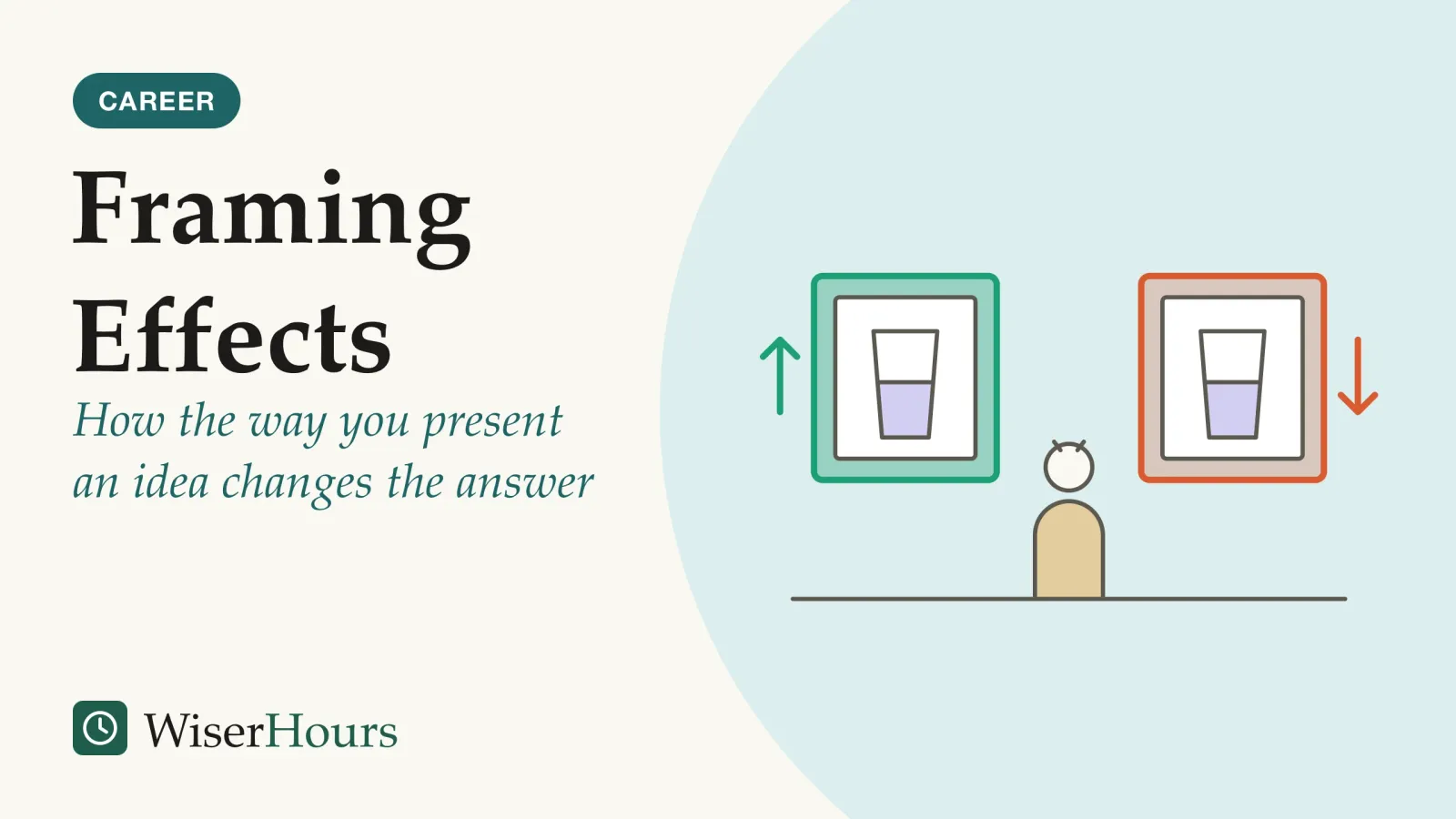
The framing effect is the shift in people’s choices when the same facts are described in different words: a plan that “saves 200 people” wins support that the identical plan that lets “400 people die” loses. Amos Tversky and Daniel Kahneman named it in a 1981 paper in Science.1 When the Many Labs project repeated their problem in 2014 in 36 samples, 11 of them outside the US, framing replicated clearly, at about half the size reported in 1981.2
So the wording of a proposal, a status update or a request changes how it is received, though less than the famous version suggests. A budget can shrink or be mostly kept; a project can be late against the plan or early against last month’s estimate. Choosing between those descriptions is one of the quieter communication skills used at work, and this guide covers how the frame moves the answer and how to choose one honestly.
What is the framing effect?
The framing effect is a change in judgment or choice caused by how equivalent information is described rather than by the information itself. Tversky and Kahneman defined a decision frame as the way a person sees the options, outcomes and odds, shaped partly by how the problem is worded and partly by the person’s own habits.1
Definition
The framing effectframing effect: The tendency for a choice to change when the same facts are described differently, for example as lives saved rather than lives lost. It is one of the effects that held up when large teams ran the original experiments again.Full entry in the glossary is the tendency for people to choose or judge differently when the same facts are presented in different terms, such as gains versus losses or success rates versus failure rates.
“Framing” covers more than one thing, and mixing them up explains much of the confusion online. In a 1998 review, US psychologists Irwin Levin, Sandra Schneider and Gary Gaeth argued that studies had been testing different effects under one name, and sorted them into three kinds.3
| Kind of framing | What the frame changes | Classic example | At work |
|---|---|---|---|
| Risky choice | Willingness to take a gamble | Lives saved versus lives lost1 | A safe plan versus a bolder one, described as gains or losses |
| Attribute | How good one feature seems | Beef labeled 75% lean versus 25% fat4 | A success rate versus a failure rate |
| Goal | How persuasive a message is | Benefits of acting versus costs of not acting3 | “Adopting this saves time” versus “skipping it costs time” |
Each kind behaves differently, so a rule learned from one (“people avoid risk when you talk about gains”) does not automatically carry over to the others. Before borrowing a framing tip, check which kind it came from.
The classic example: lives saved or lives lost
The best-known example of the framing effect is Tversky and Kahneman’s “disease problem”, in which two groups chose between the same pair of public-health programs and reversed their preferences because one group read about lives saved and the other about deaths.
The study
Moderate evidence
Same 600 lives, opposite majorities: the disease problem
Students at Stanford University (US) and the University of British Columbia (Canada) read about a disease expected to kill 600 people. When one program would save 200 people for certain and the other had a one-in-three chance of saving everyone, 72% chose the sure program. A second group read the same two programs as deaths: 400 people would die for certain, or a one-in-three chance that nobody dies. Now only 22% chose the sure program.1
The two versions are logically identical, yet the majority flipped from playing safe to gambling. The authors described a common pattern: choices involving gains tend to be risk averse, and choices involving losses tend to be risk seeking. They reported the same reversal in other groups, including university faculty and physicians.1 The disease problem was hypothetical, answered on paper with nothing at stake for the respondent.
Attribute framing is gentler but closer to daily work. In a 1988 study, Levin and Gaeth had consumers rate ground beef labeled either “75% lean” or “25% fat”; the lean label drew more favorable ratings, and the gap shrank once people actually tasted the meat.4 A label moves opinions most when people have little else to go on, so when you want a fair hearing for an idea, a demo, a pilot or the raw figures will do more than a flattering adjective.
The disease problem also appears in our guide to how cognitive biases work and which ones survived retesting, so the rest of this article stays with what the effect means when you are the one choosing the words.
Why does the framing effect happen?
The framing effect happens because people judge outcomes as gains or losses from a reference point, not in absolute terms, and because a speaker’s choice of words carries real hints about what the speaker thinks.
The first cause comes from prospect theoryprospect theory: Kahneman and Tversky's account of how people choose under risk: outcomes are judged as gains or losses from a reference point, and losses weigh more than gains of the same size. Its main patterns have held up when the original questions were run again in many countries.Full entry in the glossary, Kahneman and Tversky’s account of choice under risk. Outcomes are felt as positive or negative changes from a neutral reference outcome, and the value people place on them is S-shaped: steeper for losses than for gains.1 Change the reference point and the same result moves from the gain side to the loss side. “Saved 200” invites you to count up from the 600 expected deaths; “400 will die” invites you to count down from nobody dying.
Levin and colleagues point to encoding: whether information is labeled in positive or negative terms shapes how people take it in, and that colors the judgment.3 “75% lean” makes you think about leanness; “25% fat” makes you think about fat.
Shlomi Sher and Craig McKenzie, psychologists at UC San Diego, argued in 2006 that equivalent frames are often not equivalent in what they reveal.5 Speakers tend to describe things in terms of what has increased relative to a reference point. In their first experiment, US undergraduates asked to hand over “a half-empty cup” were more likely to pick the cup that had started full than people asked for “a half-full cup”.5
- Left (teal), filled up from empty: speakers lean toward calling it half full: the description follows what has increased.
- Right (coral), poured down from full: speakers lean toward calling it half empty, so the words hint at where things started.
Dashed lines: where each glass started. Thin gray line: the level both glasses share now.
The same paper describes a 1989 study in which people playing research managers were more generous in funding a team described by its successes than one described by its failures, with the same record. Sher and McKenzie then showed that people describing a weak team were more likely to mention its failures than people describing a strong team with the same record.5 So a listener who reads “30 successes” as good news is not being foolish: the frame is a hint about the speaker’s view.
Framing a budget cut, a delay or a change at work
At work, framing is mostly a choice of reference point: what you compare the news to, and whether you describe what is kept or what is lost. The order in which options appear is a related influence. The illustrative examples below show each choice with a true version on both sides.
A budget cut. “Training keeps most of its budget” and “Training loses a slice of its budget” are both true. The kept frame invites acceptance; the lost frame invites a fight to win it back. If the people affected will feel the loss, name it: they will find the numbers anyway, and a sunny frame they later see through costs you credibility.
A project delay. The same new date can be “two weeks behind the plan” or “a week ahead of last month’s revised estimate”. The honest one is the date your reader committed to and planned around, with the more recent comparison added if it is genuinely useful.
A change to how the team works. Prospect theory treats outcomes as gains or losses from a reference point, often the status quo, so a new process can land as a list of losses unless you also show what people gain.1 Describe the gain plainly, then acknowledge what people give up.
Order is not framing in the strict sense, but it works just as quietly. In a 2012 US study at a Boston train station, Dana Carney and Mahzarin Banaji found that people choosing between two near-identical pieces of gum within about a second mostly took the one placed first, while people told to think it over split roughly evenly.6 If you list options in a message that will get a fast reply, put your recommendation first and say that it is your recommendation, rather than letting position do the persuading.
Do not assume loss frames always hit harder, either. A 2007 meta-analysis of 93 studies of disease-prevention messages by Daniel O’Keefe and Jakob Jensen, known to us from its abstract, found gain-framed and loss-framed appeals almost equally persuasive.7 Pick the frame that is accurate and relevant to the reader.
How strong is the framing effect, and when does it fade?
The framing effect is reliable but modest, and its size depends heavily on how the choice is set up. A large retest and two pooled analyses agree that it is real and smaller than the 1981 numbers suggest; whether expertise weakens it is still unsettled.
The Many Labs project, whose first authors were Richard Klein and Kate Ratliff, replaced “the United States” in the problem with each sample’s own country. Neither the setting (lab or online) nor the location (US or elsewhere) changed the results much.2 Framing is not an American classroom curiosity. An effect of this size works as a nudge, and wording is most likely to matter when two options are close.
The pooled studies point the same way. Anton Kühberger, at the University of Salzburg in Austria, combined 136 papers in a 1998 meta-analysismeta-analysis: A study that combines the results of earlier studies on the same question into one overall estimate. Pooling makes the estimate more precise, but it cannot repair the studies it pools: a meta-analysis of surveys is still survey evidence.Full entry in the glossary and found a small-to-moderate overall effect with large differences between designs; among the features that mattered most was whether a study shifted the reference point or simply made one outcome more prominent.8 A 2018 reanalysis by Alexander Steiger and Kühberger, correcting for the bias toward publishing significant results, put the effect higher and close to the Many Labs estimate, and found that its size changes with how the framing task is built.9 Both summaries rest on the papers’ abstracts.
Whether knowing a field protects people is less clear. In a 1995 US study of internists, residents and medical students given 12 hypothetical clinical cases, framing changed decisions on only 2 cases for the doctors and none for the students, according to the abstract.10 Yet Kühberger’s meta-analysis found no clear difference between studies of students and studies of other groups,8 and in James Druckman’s 2004 experiment, described below, expertise reduced framing only when people also discussed the problem.11 Treat expertise as no guarantee: give specialists the same honest frame you would give a newcomer.
How can you avoid being influenced by framing?
The best-tested way to blunt a framing effect is to hear the other frame too. In a 2004 US experiment with 580 participants, most of them students, political scientist James Druckman found that giving people both versions of a problem removed the framing effect, and that discussion with people who had read the other version shrank it.11
Druckman’s explanation is that the second frame prompts more deliberate thinking and offers another way of seeing the problem.11 The train-station study points the same way for the order of options: people told to think it over showed no pull toward the first one.6 On your side of the desk, this turns into a few habits:
- Restate any key number in its opposite form before deciding: if you are told a plan is 90 percent on time, say aloud that it is late one time in 10.
- Ask what the comparison is: compared with what, and who chose that baseline?
- For a decision that matters, discuss it with someone who saw a different summary before you commit.
Framing honestly: where a good frame turns into spin
Framing is unavoidable, so using it ethically means choosing a frame that is true, relevant to the reader’s decision and one you would defend if they saw the alternative. It turns into spin when the reference point is picked to hide the comparison the reader would care about.
Persuasion through framing is not suspect in itself; the question is what the reader would conclude if they had both frames. It is the same test that closes our guide to ethos, pathos and logos: would the reader feel informed or handled if they saw how you built the message? Because frames carry information about the speaker’s view, a frame you would not stand behind is a small misstatement, even if every number in it is correct.5
Three practical lines help. Keep the reference point the reader cares about, usually the original plan or last year’s actual figure. Give both versions of any number a decision rests on, which is also what the counter-framing evidence suggests protects listeners.11 And state your recommendation as a recommendation rather than burying it in an order or a label.
Before you send a framed proposal or update
If an item fails, the fix is usually one added sentence.
The bottom line
The framing effect has replicated across countries but works as a nudge, strongest when people have little else to go on and weaker when they hear both sides. Your frame tells your reader what you think, so pick the reference point they care about, name the losses as well as the gains, and give them the other frame yourself when a decision matters.
Frequently asked questions
Is the framing effect a cognitive bias?
Yes, it is usually listed among cognitive biases, because people's preferences change with wording when the facts do not. Some researchers, such as Shlomi Sher and Craig McKenzie in a 2006 paper, argue that part of it is sensible inference: the way a speaker frames something often hints at what they think, and listeners pick that up.
Is loss framing more persuasive than gain framing?
Not reliably. A 2007 meta-analysis by Daniel O'Keefe and Jakob Jensen of 93 studies of disease-prevention messages found gain-framed messages very slightly more persuasive overall, with the difference driven mainly by dental hygiene messages and no clear difference for other behaviors. Choose the frame that is accurate and relevant, not the one you assume works harder.
Do experts fall for framing effects?
Sometimes. Tversky and Kahneman reported the 1981 reversal in groups that included university faculty and physicians. A 1995 US study gave 12 hypothetical clinical cases to internists, residents and medical students: framing changed the doctors' decisions on only 2 cases and the students' on none. Anton Kühberger's 1998 meta-analysis, though, found no clear difference between student and other samples, so expertise is no reliable shield.
How is framing different from anchoring?
Framing changes the description of the same options, such as saved versus lost. Anchoring is the pull of a number you saw first on an estimate you make next. Both held up in the 2014 Many Labs retest, and both can work in one message, for example a budget described as a cut from last year's figure.
Sources
- The Framing of Decisions and the Psychology of Choice. Tversky, A. & Kahneman, D. (1981). Science, 211(4481), 453-458
- Investigating variation in replicability: A “Many Labs” replication project. Klein, R. A., Ratliff, K. A., Vianello, M., et al. (2014). Social Psychology, 45(3), 142-152
- All Frames Are Not Created Equal: A Typology and Critical Analysis of Framing Effects. Levin, I. P., Schneider, S. L. & Gaeth, G. J. (1998). Organizational Behavior and Human Decision Processes, 76(2), 149-188
- How Consumers are Affected by the Framing of Attribute Information Before and After Consuming the Product. Levin, I. P. & Gaeth, G. J. (1988). Journal of Consumer Research, 15(3), 374-378
- Information leakage from logically equivalent frames. Sher, S. & McKenzie, C. R. M. (2006). Cognition, 101(3), 467-494
- First Is Best. Carney, D. R. & Banaji, M. R. (2012). PLoS ONE, 7(6), e35088
- The Relative Persuasiveness of Gain-Framed Loss-Framed Messages for Encouraging Disease Prevention Behaviors: A Meta-Analytic Review. O'Keefe, D. J. & Jensen, J. D. (2007). Journal of Health Communication, 12(7), 623-644
- The Influence of Framing on Risky Decisions: A Meta-analysis. Kühberger, A. (1998). Organizational Behavior and Human Decision Processes, 75(1), 23-55
- A Meta-Analytic Re-Appraisal of the Framing Effect. Steiger, A. & Kühberger, A. (2018). Zeitschrift für Psychologie, 226(1), 45-55
- Pervasiveness of framing effects among physicians and medical students. Christensen, C., Heckerling, P., Mackesy-Amiti, M. E., Bernstein, L. M. & Elstein, A. S. (1995). Journal of Behavioral Decision Making, 8(3), 169-180
- Political Preference Formation: Competition, Deliberation, and the (Ir)relevance of Framing Effects. Druckman, J. N. (2004). American Political Science Review, 98(4), 671-686
How we researched this
Sources, dated 1981 to 2018, were located via Crossref, OpenAlex and PubMed (October 2026). Tversky and Kahneman's Science paper, the Many Labs replication and the experiments on reference points, counter-framing and option order were read in full; Levin, Schneider and Gaeth's typology, Kühberger's meta-analysis, its 2018 reanalysis and three other studies only as abstracts. Main limitation: almost all framing studies use hypothetical choices, and none we found tests workplace messages directly.
Keep reading
Ethos, Pathos, Logos: Aristotle's Persuasion Toolkit for Modern Work
Ethos, pathos and logos explained with 4 work examples, how each appeal fails when overdone, what kairos adds, and what persuasion research says.
Assertiveness for Beginners: Saying What You Mean Without Steamrolling
How to be more assertive at work in 6 steps, from I-statements to handling pushback, and why too little and too much assertiveness both cost you.
The Culture Map Explained: Eight Scales for Working Across Borders
The Culture Map's 8 scales, from feedback to scheduling, why relative position matters, what the research behind it shows, and a team mapping exercise.
Communication Styles Explained: Passive, Aggressive, Passive-Aggressive, Assertive
The 4 communication styles, where the model comes from, why your style shifts with the situation, and what style tests like DISC can and cannot tell you.