Assertiveness for Beginners: Saying What You Mean Without Steamrolling
How to be more assertive at work in 6 steps, from I-statements to handling pushback, and why too little and too much assertiveness both cost you.

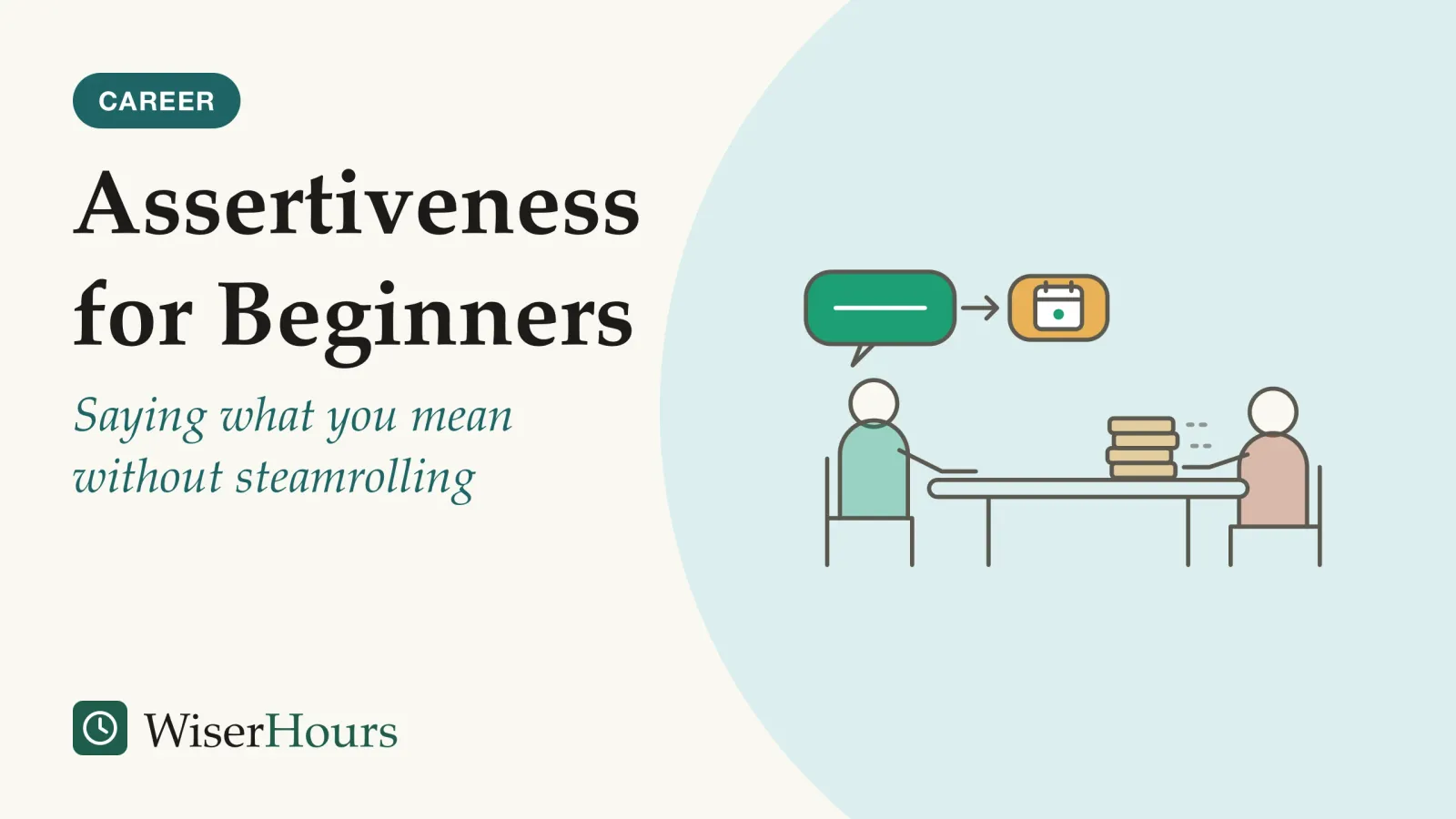
At five in the afternoon a colleague messages: could you run tomorrow’s 8 a.m. client call for her? Your own report is due at noon. You type “Of course, happy to” and set an early alarm, quietly annoyed. Or you reply “You always do this,” and the chat goes silent for the rest of the week.
Learning how to be more assertive means learning to say plainly what you think, need or will do, while leaving the other person room to do the same. For a beginner, it comes down to six small moves you can rehearse:
- Start with what you think or need, not a verdict on them
- Ask for what you need in one specific sentence
- Say no with a short reason and an alternative
- Repeat your answer calmly when pushed
- Meet pushback by agreeing with what is true
- Practice where the stakes are low, then check how you came across
Getting the balance right matters more than being bold. In 2007 studies led by Daniel Ames of Columbia University, when coworkers described what held US business-school students back as leaders, they mentioned assertiveness more often than intelligence, conscientiousness or charisma, and the complaints split almost evenly between too much and too little.1 It is one of the core communication skills, and ordinary work moments test it daily.
Prefer to watch? The video covers the same ground as this article.
Assertive sits between giving way and running over people
Assertiveness is saying what you think, want or feel directly and honestly, without overriding the other person’s rights. A 2018 review by three Stony Brook University psychologists, led by Brittany Speed, places it on a continuum with problems at both ends: too much agreeableness, which looks submissive, and too much hostility, which looks aggressive. The review traces a definition that still holds up to Robert Alberti and Michael Emmons, authors of the first assertiveness book aimed at general readers, in 1970: standing up for your own interests and rights without trampling anyone else’s.2
A counseling handout from the University of Sydney in Australia draws the same line. Passive communication holds back honest thoughts and feelings, so you give up your own rights; aggressive communication makes your point at the other person’s expense.3 The four communication styles set out the whole model, including the passive-aggressive style that mixes the two.
Both easy defaults fail for a practical reason: they leave the other person with wrong or missing information. “Of course, happy to” tells your colleague your morning is free when it is not. “You always do this” tells her you are annoyed, but not what you could do. “I can’t run the call tomorrow, because my report is due at noon. I could send you my notes from the last one tonight” gives her the facts and something she can use.
- Myth
- Being assertive means getting your way.
- Fact
- Assertiveness means saying clearly what you want. The other person still decides, and a compromise is a normal outcome.
The Sydney handout makes the same point: speaking up assertively does not mean you will get what you want, and sometimes the result is a compromise both sides can accept.3 So judge an assertive reply by whether the other person now knows exactly where you stand and still has a genuine choice.
How to be more assertive: six moves to practice at work
Being more assertive at work mostly comes down to wording you have rehearsed, tried first in easy moments. One of the moves below has a rating study behind it; the rest come from counseling guidance and classic assertiveness manuals with little direct testing, so treat them as well-worn practice rather than proven methods.
1. Start with what you think or need, not a verdict on them
An I-statement describes your view or your situation instead of judging the other person. In a 2018 study at Edith Cowan University in Australia, 253 university students rated possible opening lines for conflicts with colleagues, friends and partners. Lines in I-language, and lines that acknowledged both people’s views, were judged less likely to put the listener on the defensive than accusing you-statements.4 The students rated written lines rather than holding real conversations, so treat this as limited evidence about first impressions.
The Sydney handout offers a simple template: I feel, when you, because, I want or need.3 At work that might sound like: “I’m worried about Friday, because the data only arrives Thursday night. I’d like to move the review to Monday.” The SBI feedback model rests on the same habit: describe what happened, not what kind of person did it.
2. Ask for what you need in one specific sentence
A vague hint is easy to miss and easy to refuse. Guidance from Mayo Clinic, a US medical center, recommends keeping requests simple, specific and clear, and phrasing them as “I would like you to help with this” rather than “You need to do this.”5 “It would be nice to have more support on this project” leaves your manager guessing; “Could Sam review the budget section by Wednesday noon?” names who, what and when.
3. Say no with a short reason and an alternative
A clear no, a brief true reason and, when you can offer one, a different way forward can keep a refusal from sounding like a rejection of the person. Mayo Clinic’s guidance says to be direct, that a no needs no explanation, and to keep any explanation brief when one is appropriate.5 “I can’t take the client report this week, because the audit is due. I could start it Monday, or brief Priya today so she can take it.”
- 1A clear noin the first sentence
- 2A short, true reasonoptional; one clause is enough
- 3An alternativeonly one you would deliver
Saying no at work takes refusals further, with six steps of its own.
4. Repeat your answer calmly when pushed
The broken-record technique means calmly restating your request or refusal each time you meet resistance, instead of adding new arguments. It comes from Manuel Smith’s 1975 book When I Say No, I Feel Guilty, and Wikipedia’s summary of the assertiveness literature notes its risks: repeated too often, a request loses force, and blank repetition can slide into nagging.6 Each new argument opens a fresh debate, while the same sentence, said evenly, shows the answer has not changed. Keep the core sentence the same and acknowledge what you heard: “I understand it’s urgent. I still can’t take it this week.” If the third repeat does not settle it, change route, for example by agreeing a time to decide together.
5. Meet pushback by agreeing with what is true
Pushback lands more softly when you first agree with the part that is fair. Smith called this fogging: agreeing in part or in principle with a critic while keeping your position.6 “You’re right that this client matters a lot. The report still can’t be done well by Friday.” You concede the fact and keep the decision.
If you feel your temper rising, Mayo Clinic suggests pausing where possible, breathing slowly and keeping your voice even and firm.5
6. Practice where the stakes are low, then check how you came across
Rehearsal is the core of assertiveness training: the Stony Brook review describes modeling, role play and rehearsal, along with challenging worries about other people’s reactions.2 Mayo Clinic suggests saying the words out loud, writing a script first, role-playing with a friend or colleague and asking for clear feedback, and trying new skills in low-risk situations before a difficult one at work.5 Start with a small request, such as asking a colleague to move a meeting.

Before a conversation where you need to hold your ground
Download PDF
Why your own sense of “too pushy” is a poor guide
Where you sit between too soft and too forceful is hard to see from the inside, and the fix runs in opposite directions depending on where you start. In studies of US business-school students and managers, Ames and his coauthor Francis Flynn reported costs at both ends: low assertiveness went with reaching fewer goals, and high assertiveness with damaged working relationships.1
The study
Moderate evidence
Coworkers' complaints about future leaders, split down the middle
In the first study, 168 full-time MBA students on the US East Coast collected written comments from former coworkers about their leadership strengths and weaknesses. Assertiveness was the most common theme among the weaknesses, and those comments divided almost evenly: 48% said too much, 52% too little. In a second study of 388 students and a third in which 213 MBA students rated their most recent manager, those seen as highly assertive got clearly lower leadership ratings than moderate ones; the cost of low assertiveness was mixed in the second study but clear in the third.1
The third study fills in the trade-off. Moderately assertive managers were rated better at getting things done than the least assertive ones, and better at relationships than the most assertive ones.1 These were ratings gathered at one point in time, mostly about US business-school students, so they show a pattern in how people are judged, not proof that changing your style changes your results.
- Too little: relationships hold up, but goals and requests slip
- The middle: the work gets done and relationships hold up
- Too much: the work gets done, but relationships strain
Arrows: in these studies, people near the middle were generally rated better leaders than those at either end, so the same advice ("push harder" or "ease off") suits one person and not another.
Later work by Ames, with Abbie Wazlawek, suggests you cannot simply trust your own reading of where you sit. In negotiation studies, people whom their counterparts saw as under- or over-assertive tended to think they had been about right. Many whom counterparts saw as appropriately assertive wrongly believed they had come across as too pushy, an effect the authors call the line-crossing illusion.7 Only the abstract of that 2014 paper could be read for this article, so no effect sizes are given here.
Picture asking a client for an extra week. They sigh and say it will be difficult, and you spend the evening sure you overstepped. That sigh may be tactics rather than hurt. In the same research, counterparts’ orchestrated displays of discomfort, which the authors call strategic umbrage, turned up widely in real-world negotiations, and in a controlled negotiation they were linked to the line-crossing illusion.7
Does assertiveness training work? The best tests come from hospitals
Assertiveness training has a long history but a thin modern evidence base, and the strongest recent studies come from healthcare, where speaking up affects patient safety. The Stony Brook review traces the method to the late 1940s and notes that most studies date from the 1970s, 1980s and 1990s, largely in clinical settings.2
Mieko Omura and colleagues, based mainly in Australia, pulled the recent studies together in 2017. Their systematic reviewsystematic review: A review that fixes its question and its rules for including studies in advance, then searches out every study that fits and weighs them together. Some systematic reviews pool the results into a meta-analysis; others describe what the studies found without combining the numbers.Full entry in the glossary found eight studies of assertiveness training for healthcare professionals and students published between 2001 and 2016: five from the US and one each from Australia, Ireland and Taiwan. Training was reported to help to some degree in every group except experienced anesthesiologists, who got a single short session. The authors called the evidence suggestive rather than conclusive: only three studies were randomized, behavior was judged in simulations, the self-report scales measured attitudes rather than actual behavior, and no study checked whether the skills carried over to real clinical work. They pointed to face-to-face programs that mix several methods, and support from leaders, as the approaches most likely to help.8
Because none of the reviewed studies tested transfer to real work, treat a one-off workshop as a start: pick one real request for the coming week, rehearse it with a colleague and ask how it sounded. Repeated rehearsal with feedback is a better bet, ideally where your manager wants people to speak up.
| Technique or claim | What the best evidence found | Evidence |
|---|---|---|
| Aim for the middle, not the maximum | Highly assertive people were rated clearly weaker leaders than moderate ones; the cost of low assertiveness was clear in one study, mixed in another | Observational, 3 studies; moderate1 |
| I-statements | Rated less likely to put the listener on the defensive than you-statements | One rating study of students; limited4 |
| Specific requests, brief refusals | Recommended by counseling guidance; not tested directly | Expert opinion5 |
| Broken record and fogging | Described in a 1975 self-help book; no trial found | Expert opinion6 |
| Rehearsal-based training | Gains in simulations and self-reports; transfer to real work not tested | Systematic review of 8 studies; limited8 |
Adjusting for culture and hierarchy
What counts as appropriately assertive differs between societies and workplaces, so calibrate to your setting instead of copying one standard. The GLOBE project, a survey of more than 17,000 middle managers in 62 cultures published in 2004 and 2007, treated assertiveness as one of nine dimensions on which societies differ. It defines that dimension as how assertive, confrontational and aggressive people are, and believe they should be, in their dealings with others.9
That definition blends assertion with aggression, which assertiveness training keeps apart, so a society’s score is a rough guide to local norms rather than advice. The Omura review adds that almost all its training studies came from Western countries and that results may not transfer between Asian and Western settings.8 A 2023 review from South Korea’s Yonsei University, of 14 nursing studies mostly from Asian countries, found mixed, mostly self-reported results, but practice opportunities helped.10
In practice, keep the content fixed and adjust the delivery. In a steep hierarchy, a private conversation may land better than a challenge in a meeting. One approach from the healthcare studies, advocacy-inquiry, pairs a plain statement of your view with an open question about theirs.8 “I think the Friday date puts quality at risk. How do you see it?” To calibrate, watch how respected colleagues decline or disagree, and ask one of them how your own requests come across.
The bottom line
Say what you need in one sentence, and when the answer is no, add a short reason and an alternative you would deliver. If pushed, repeat that sentence calmly. Then ask someone you trust how it landed, since your own sense of having gone too far is often wrong.
Frequently asked questions
Is assertiveness a personality trait or a skill you can learn?
Mostly a skill. A 2018 review by Stony Brook University psychologists describes assertiveness training built on modeling, rehearsal and challenging worries about other people's reactions, and Mayo Clinic's guidance says people who are not naturally assertive can learn to be. Some people start closer to the middle than others, but the moves themselves can be practiced.
Does body language matter when you are being assertive?
Counseling guides say it does. A University of Sydney counseling handout suggests a calm voice, normal volume, an even pace and low physical tension, and Mayo Clinic adds an upright posture and regular eye contact. Both guides come from Australia and the US, and what reads as confident or pushy differs between cultures, so watch what is usual where you work.
Is there a quick way to become more assertive?
Not a reliable one. Mayo Clinic's guidance says learning to be assertive takes time and practice, especially after years of staying quiet, and suggests formal assertiveness training if self-practice stalls, or talking with a mental health professional if anger, stress, anxiety or fear keep getting in the way.
Sources
- What breaks a leader: The curvilinear relation between assertiveness and leadership. Ames, D. R. & Flynn, F. J. (2007). Journal of Personality and Social Psychology, 92(2), 307-324
- Assertiveness training: A forgotten evidence-based treatment. Speed, B. C., Goldstein, B. L. & Goldfried, M. R. (2018). Clinical Psychology: Science and Practice, 25(1), e12216
- Effective communication (student handout). Counselling and Psychological Services, The University of Sydney (handout 1117/CAPS24)
- I understand you feel that way, but I feel this way: the benefits of I-language and communicating perspective during conflict. Rogers, S. L., Howieson, J. & Neame, C. (2018). PeerJ, 6, e4831
- Being assertive: Reduce stress, communicate better. Mayo Clinic Staff (2024, January 20). Mayo Clinic
- Assertiveness. Wikipedia (accessed September 28, 2026)
- Pushing in the dark: Causes and consequences of limited self-awareness for interpersonal assertiveness. Ames, D. R. & Wazlawek, A. S. (2014). Personality and Social Psychology Bulletin, 40(6), 775-790
- The effectiveness of assertiveness communication training programs for healthcare professionals and students: A systematic review. Omura, M., Maguire, J., Levett-Jones, T. & Stone, T. E. (2017). International Journal of Nursing Studies, 76, 120-128
- 2004, 2007 Studies. GLOBE Project (Global Leadership and Organizational Behavior Effectiveness), accessed September 28, 2026
- Assertiveness educational interventions for nursing students and nurses: A systematic review. Lee, S. E., Kim, E., Lee, J. Y. & Morse, B. L. (2023). Nurse Education Today, 120, 105655
How we researched this
Searches of Crossref, OpenAlex, PubMed and the open web in September 2026 looked for reviews and studies of assertiveness training, assertiveness at work and the techniques beginners are taught; we also read counseling guidance from the University of Sydney and Mayo Clinic and the GLOBE project's account of its culture study. Research sources date from 2007 to 2023, with one review covering work back to the 1940s. Main limitation: the everyday techniques have few direct tests, and two studies could be read only as abstracts.
Keep reading
Framing Effects: How the Way You Present an Idea Changes the Answer
The framing effect explained: why the same facts get different answers, what a 36-sample retest found, and how to frame work proposals honestly.
Ethos, Pathos, Logos: Aristotle's Persuasion Toolkit for Modern Work
Ethos, pathos and logos explained with 4 work examples, how each appeal fails when overdone, what kairos adds, and what persuasion research says.
The Culture Map Explained: Eight Scales for Working Across Borders
The Culture Map's 8 scales, from feedback to scheduling, why relative position matters, what the research behind it shows, and a team mapping exercise.
Communication Styles Explained: Passive, Aggressive, Passive-Aggressive, Assertive
The 4 communication styles, where the model comes from, why your style shifts with the situation, and what style tests like DISC can and cannot tell you.