Ethos, Pathos, Logos: Aristotle's Persuasion Toolkit for Modern Work
Ethos, pathos and logos explained with 4 work examples, how each appeal fails when overdone, what kairos adds, and what persuasion research says.

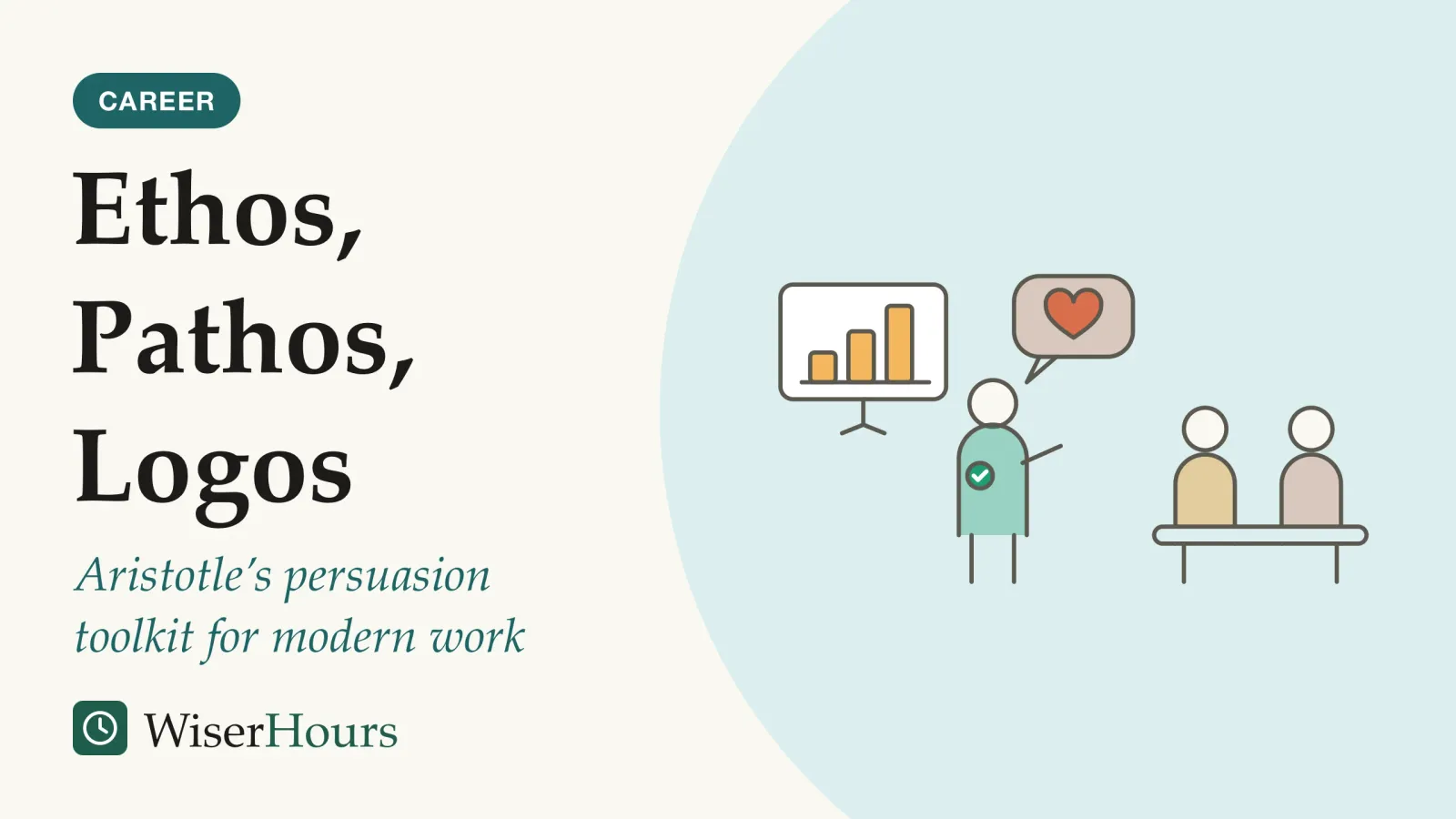
Aristotle’s Rhetoric names three means of persuasion: the speaker’s credibility (ethos), the feelings of the audience (pathos) and the argument itself (logos).1 Often run together as “ethos pathos logos”, the trio works as a quick test for any pitch, budget email or update: does it give the reader a reason to trust you, a reason to care and a reason to agree?
Most explanations of the three appeals lean on advertising: the celebrity endorsement, the sad puppy, the “nine out of ten dentists” claim. Work is different. Your audience knows you, will check your numbers and has to act on what you ask. In a classic 1981 US experiment, students judged a proposal that affected them by the strength of its arguments, and one that did not mostly by who was behind it, so the listener’s stake decides which appeal counts most.2 Persuasion sits beside listening and clear writing among the communication skills that matter at work; the sections below put Aristotle’s version to use on everyday messages.
What ethos pathos logos means, one appeal at a time
Ethos, pathos and logos answer three questions every listener asks: should I trust this person, why should I care, and is the claim true?
Three appeals in one line each
- Ethos is credibility the speaker earns in the message: competence, good character and goodwill toward the audience.
- Pathos is the emotional state the message creates in the listener, which shapes the judgment they reach.
- Logos is the argument: evidence and reasoning that prove, or seem to prove, the point.
In J. H. Freese’s 1926 translation, Aristotle insists that ethos must come from the speech itself, not from what the audience already thought of the speaker.3 The Stanford Encyclopedia of Philosophy entry, by the philosopher Christof Rapp, adds that Aristotle named three things a speaker must show to be believed: practical good sense, good character and goodwill. Show only competence, and listeners may doubt your motives; show competence and character without goodwill, and they may suspect you are keeping the best advice to yourself.1
A senior title gets you a hearing, but the reader still asks whether you know this area, will be straight with them and have their interests in mind. Answer all three in the text, briefly, and your title stops doing all the work.
| Appeal | The listener’s question | At work it sounds like | Aristotle’s wording |
|---|---|---|---|
| Ethos | Should I trust you on this? | “I ran the last two migrations, and I know what went wrong on the first.” | The moral character of the speaker3 |
| Pathos | Why should I care? | “This is the delay our support team has been absorbing every Monday.” | Putting the hearer into a certain frame of mind3 |
| Logos | Is it true, and does it follow? | “Option B costs less over two years, because licenses fall after year one.” | The speech itself, in so far as it proves or seems to prove3 |
Purdue University’s Online Writing Lab notes that the words have drifted: logos first meant the content of a speech and how it was organized, and pathos covered any of the audience’s sensibilities, not only strong emotion.4 So the order of your points is part of the argument too. Before drafting a request, write one rough sentence per row; a row you cannot fill is the gap a skeptical reader will find.
Ethos, pathos and logos examples from ordinary work
The three appeals are easiest to learn in situations you already face, because you know the reader and the stakes. Each illustrative example below shows one line per appeal; in a real message they blend into a few sentences.
A project pitch
You want two weeks to rebuild a slow internal report. Ethos: “I built the original version, so I know where the time goes.” Pathos: “Finance spends every month-end Friday waiting on it.” Logos: “Rebuilding the three slowest queries removes most of the wait; here is the test run.” The pathos line names people the listener knows and a cost they already feel; turning that cost into a short story is covered in telling stories when you present.
A budget email
Whoever approves money has to defend it to others, so logos leads. Put the amount and the decision in the first lines, then the reason it pays off, then the risk of waiting. Ethos comes from showing you have checked the cheaper options: “I compared three vendors; the cheapest lacks the audit log we need.” Pathos can be one line about what the team stops doing. The email itself follows the same rules as any professional email: request first, background last.
A status update after a mistake
After a mistake, ethos is the appeal at risk, and Aristotle’s three ingredients show how to rebuild it. Good sense: say plainly what went wrong and why. Good character: own your part without blaming the tool or a colleague. Goodwill: show what you have already done for the people affected. “The invoices went out with last month’s rates because I skipped the check after the update. I have resent them, and the check is now automatic.” Logos then gives the evidence that the fix holds; pathos is acknowledging the inconvenience, briefly.
A request to a senior leader
Senior readers have little time and many requests, so the logos must be short and the ask explicit. Your ethos rests less on rank than on precision: one recommendation, the cost and the alternative you rejected. Pathos at this level is usually about what the leader cares about, such as a goal they set, rather than how you feel. Timing matters as well (the Greeks called it kairos): a request tied to a decision already on their calendar is easier to say yes to than one that arrives out of nowhere.
Which is most persuasive: ethos, pathos or logos?
No single appeal is the most persuasive. Persuasion research suggests the answer depends on the listener: people personally affected by a decision examine the arguments, while people with little at stake rely more on cues such as who is speaking. The best-known test of that idea is a 1981 experiment at the University of Missouri in the US.
The study
Moderate evidence
Petty, Cacioppo and Goldman (1981): who cares decides what persuades
In a lab experiment, 145 undergraduates at the University of Missouri heard a recorded proposal that seniors pass a comprehensive exam before graduating. For half, the change would start next year and affect them; for the rest, it would start in 10 years. The message was said to come from a commission chaired by a Princeton professor or from a local high-school class, and it contained either strong or weak arguments. Students who would be affected were swayed mainly by argument quality; those who would not were swayed mainly by the source’s expertise.2
Close reading takes effort, and people spend it when the outcome lands on them. A team whose workload your proposal changes will read every line, so weak reasoning will not be rescued by your title. An executive skimming a full inbox may decide on a quick signal of credibility, so put that signal where they will see it, and make sure the case holds up when someone checks. The study used students and one campus issue, so it shows a principle and cannot say what each appeal is worth.
A 2004 review of five decades of research by Chanthika Pornpitakpan, of Monash University Malaysia, reaches a similar verdict on ethos: a high-credibility source generally helps, but credibility can become a liability under some conditions, depending on factors such as the message, the channel and the audience.5 (This article draws on the review’s abstract only.)
Logos and pathos also do different jobs. A meta-analysis of health-campaign studies by a University of Amsterdam team in the Netherlands, known here from its abstract alone, found that statistical evidence had more influence on beliefs and attitudes, while stories had more influence on what people intended to do.6 In a work setting, that points to numbers for convincing people a problem is real and a concrete case for moving them to act on it.
How each appeal backfires when overused
Each appeal fails in its own way when it carries a message alone: credentials without substance, emotion without a way to act, and evidence piled so high it dilutes the strongest point.
- Ethos (teal): why this speaker is worth hearing. Overdone: credentials without substance.
- Pathos (coral): why the listener should care. Overdone: pressure that reads as manipulation.
- Logos (amber): why the claim holds. Overdone: a data dump that buries the best point.
Center check mark: a message that gives the listener a reason to trust, a reason to care and a reason to agree. Dashed symbols outside: one appeal pushed on its own.
Credentials without substance
Leaning on rank or past wins works best on readers with little at stake, which is exactly why it fails with the people a decision affects. In the Missouri experiment, the expert source made a significant difference only for students with little at stake; for those the change would affect, the quality of the arguments mattered most.2 Replace “trust me, I have done this for years” with one specific detail that only someone experienced would know.
Emotion that reads as manipulation
Emotional appeals are not suspect in themselves. Melanie Tannenbaum’s team at the University of Illinois pooled studies of fear appeals, mostly in health and safety messages, in a 2015 meta-analysis: the appeals generally worked, the team found no conditions where they backfired, and they worked better when they included statements about what people could do.7 Guilt is riskier. A 2023 meta-analysis of guilt appeals by a team of US researchers found only a small average effect, and noted that such appeals are sometimes seen as manipulative and that spelling out what people should do to make amends can make them feel coerced.8 At work, name the cost honestly, then give the listener a concrete step that would help, and stop there.
Data dumps
More evidence feels safer, but it can lower the overall impression. People judging a presentation tend to average what they see, so mildly favorable items dilute highly favorable ones. Across seven studies published in 2012, marketing researchers Kimberlee Weaver, Stephen Garcia and Norbert Schwarz showed that presenters do not expect this and include everything favorable, which makes their case look weaker, as the paper’s abstract sums up.9 Cut the weakest supporting points from a pitch.
- Myth
- Logos is the safe appeal: the more data you include, the stronger the case.
- Fact
- Readers tend to average what they see, so weaker points can dilute the strongest one. Choose the evidence that carries the claim and cut the rest.
Aristotle saw the risk too. The Stanford entry notes that he accepted rhetoric can be misused, like most useful things, but held that it is easier to persuade people of what is true and just than of its opposite.1
Who created ethos, pathos and logos?
The Greek philosopher Aristotle set out ethos, pathos and logos in his Rhetoric, which defines rhetoric as the faculty of discovering the possible means of persuasion on any subject. In Freese’s translation they are “artificial” proofs (scholars today often say technical), the ones a speaker constructs by system and effort, as opposed to evidence that already exists, such as witnesses and contracts.3
Two parts of what is now taught as Aristotle’s toolkit came later or from elsewhere. Writing-center handouts draw the three appeals as a triangle with the writer, audience and text at its corners; a handout from the writing center at Indiana University-Purdue University Indianapolis, in the US, says it is later rhetoricians who called the appeals the rhetorical triangle.10 Aristotle’s text names three proofs; the diagram is a teaching device.
What is kairos?
Kairos is the ancient Greek idea of the right or critical moment: the opening when a message can land. Purdue OWL describes it as the parts of a speech that draw support from the particular setting, time and place.4 It was central to the Sophists, the teachers of rhetoric Aristotle and Plato criticized, who stressed adapting to changing circumstances.11
Aristotle did not list kairos as a fourth proof, but he did use it. In a 2000 paper, known here from its abstract, the rhetoric scholars James Kinneavy and Catherine Eskin counted 16 references to kairos in the Rhetoric and argued that the idea runs through his treatment of emotional appeals and style.12 Teachers often list it beside the three appeals because it asks the question they skip: is this the moment?4 A strong budget case sent the week after a hiring freeze is announced may be the right case at the wrong time, so before you send, check what else is landing on the reader’s desk that week.
Audit your own message before you send it
An audit takes two minutes and works on any message that asks for something: read the draft once as the recipient and check each appeal in turn.
Start with the reader’s stake, because it tells you where to put the weight: if the decision changes their work, spend your words on the reasoning; if they are deciding quickly from a distance, put your credibility and the ask in the first lines.
- 1Reader's stakeaffected, or deciding from a distance?
- 2Trustone detail that shows you know this
- 3Carea real cost and a step they can take
- 4Agreethe evidence that carries the claim
- 5Timingis this the moment?
Then run the checklist on the draft itself.
Before you send a message that asks for something
If an item fails, fix that line.
The bottom line
Give the reader a reason to trust you, a reason to care and a reason to agree, each in a sentence or two. Weight them by the reader’s stake, since people affected by a decision read the argument and busy readers lean on credibility. Then check the timing and cut whatever is only there to impress.
Frequently asked questions
Is logos the same as logic?
Not quite. In Aristotle's Rhetoric, as the Stanford Encyclopedia of Philosophy describes it, logos is persuasion through argument: proving, or seeming to prove, that something is the case, using examples and short chains of reasoning built on what the audience already accepts. It is everyday reasoning about likely outcomes, not formal logic with certain conclusions.
Did Aristotle think appealing to emotion was dishonest?
No. The Stanford Encyclopedia of Philosophy explains that Aristotle treated emotion as a legitimate means of persuasion because our feelings change the judgments we make, and a speaker may need to calm feelings that would stop listeners weighing the evidence. He also accepted that rhetoric can be misused, like most useful skills.
How do I identify ethos, pathos and logos in a text?
Writing-center handouts, such as one from Indiana University-Purdue University Indianapolis, offer guiding questions: how the writer shows credibility (ethos), whether examples engage the reader's emotions and values (pathos), and whether strong reasons and evidence support the thesis (logos). In short, ask whether a passage gives a reason to trust, to care or to believe. Most persuasive passages do more than one at once, so label the main job each sentence does rather than forcing it into a single box.
Sources
- Aristotle's Rhetoric. Rapp, C. (2002; substantive revision 2022). Stanford Encyclopedia of Philosophy
- Personal involvement as a determinant of argument-based persuasion. Petty, R. E., Cacioppo, J. T. & Goldman, R. (1981). Journal of Personality and Social Psychology, 41(5), 847-855
- Rhetoric, Book 1, Chapter 2 (translated by J. H. Freese). Aristotle. Aristotle in 23 Volumes, Vol. 22. Harvard University Press and William Heinemann, 1926; Perseus Digital Library, Tufts University
- Aristotle's Rhetorical Situation. Purdue Online Writing Lab (OWL), Purdue University
- The Persuasiveness of Source Credibility: A Critical Review of Five Decades' Evidence. Pornpitakpan, C. (2004). Journal of Applied Social Psychology, 34(2), 243-281
- The Differential Impact of Statistical and Narrative Evidence on Beliefs, Attitude, and Intention: A Meta-Analysis. Zebregs, S., van den Putte, B., Neijens, P. & de Graaf, A. (2015). Health Communication, 30(3), 282-289
- Appealing to fear: A meta-analysis of fear appeal effectiveness and theories. Tannenbaum, M. B., Hepler, J., Zimmerman, R. S., Saul, L., Jacobs, S., Wilson, K. & Albarracín, D. (2015). Psychological Bulletin, 141(6), 1178-1204
- When guilt works: a comprehensive meta-analysis of guilt appeals. Peng, W., Huang, Q., Mao, B., Lun, D., Malova, E., Simmons, J. V. & Carcioppolo, N. (2023). Frontiers in Psychology, 14, 1201631
- The Presenter's Paradox. Weaver, K., Garcia, S. M. & Schwarz, N. (2012). Journal of Consumer Research, 39(3), 445-460
- The Rhetorical Triangle: Understanding and Using Logos, Ethos, and Pathos. University Writing Center, School of Liberal Arts, Indiana University-Purdue University Indianapolis (handout hosted by Louisiana State University)
- Kairos. Wikipedia (accessed October 6, 2026)
- Kairos in Aristotle's Rhetoric. Kinneavy, J. L. & Eskin, C. R. (2000). Written Communication, 17(3), 432-444
How we researched this
We read Aristotle's Rhetoric in J. H. Freese's 1926 translation, the Stanford Encyclopedia of Philosophy entry on it, and teaching pages from Purdue OWL and Indiana University's writing center, then searched Crossref and OpenAlex in October 2026 for experiments and meta-analyses on source credibility and emotional and statistical appeals. Research sources date from 1981 to 2023. Main limitation: most persuasion studies test students or health campaigns, not workplace messages, and four were read as abstracts only.
Keep reading
Framing Effects: How the Way You Present an Idea Changes the Answer
The framing effect explained: why the same facts get different answers, what a 36-sample retest found, and how to frame work proposals honestly.
Assertiveness for Beginners: Saying What You Mean Without Steamrolling
How to be more assertive at work in 6 steps, from I-statements to handling pushback, and why too little and too much assertiveness both cost you.
The Culture Map Explained: Eight Scales for Working Across Borders
The Culture Map's 8 scales, from feedback to scheduling, why relative position matters, what the research behind it shows, and a team mapping exercise.
Communication Styles Explained: Passive, Aggressive, Passive-Aggressive, Assertive
The 4 communication styles, where the model comes from, why your style shifts with the situation, and what style tests like DISC can and cannot tell you.