Problem-Solving Skills: A Step-by-Step Process for Any Problem
Problem-solving skills as a 6-step process: define it, find causes, generate options, choose, test small and review, with a work and a home example.

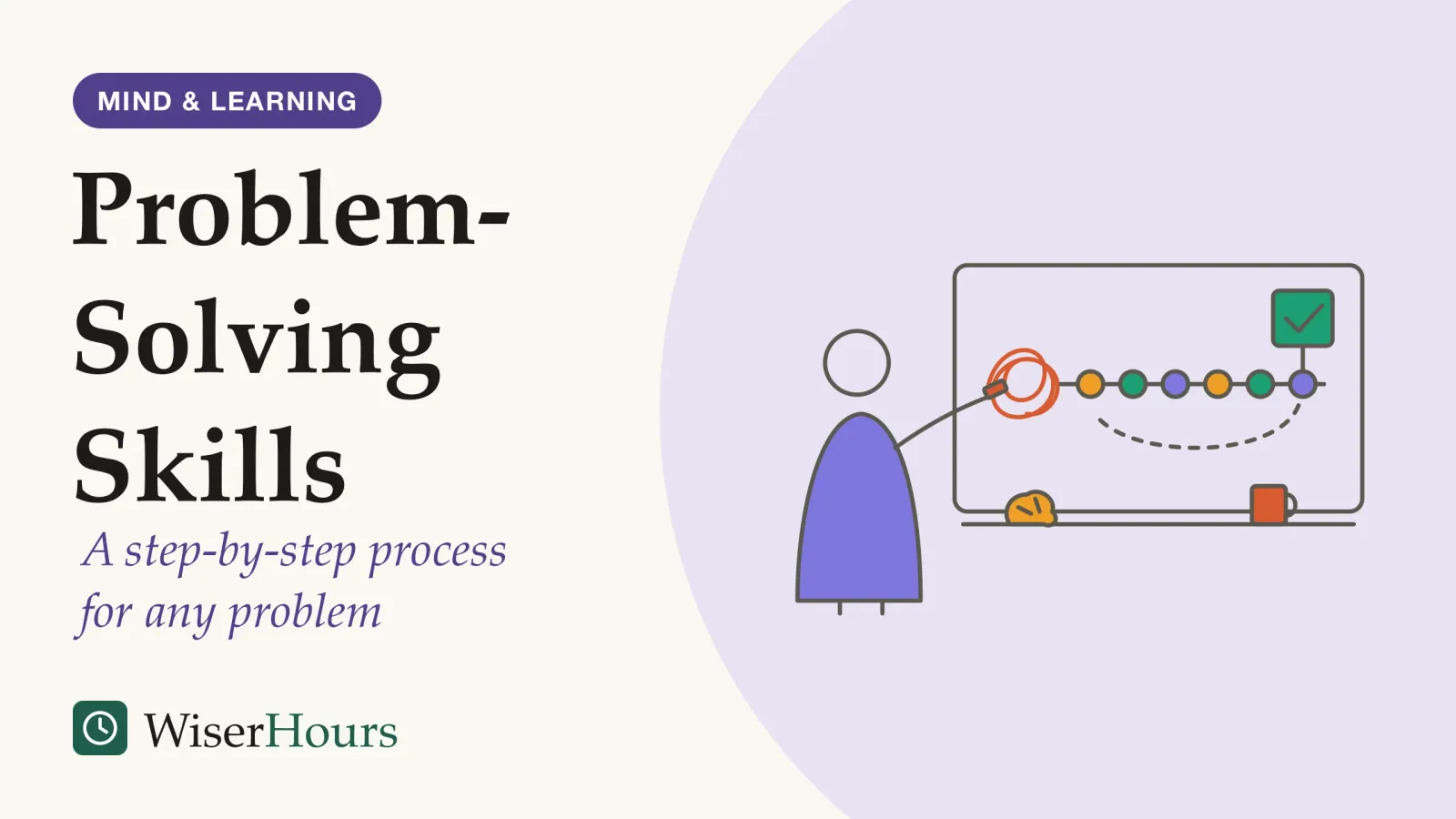
Most people who struggle with a problem are not short of answers. They reach for one too early. Good problem solving skills are the habits that slow that moment down: a repeatable way to work out what is wrong before choosing what to do about it, and to check afterwards whether the fix worked. The same six steps handle a late report at work and a chaotic morning at home:
- Define the problem
- Find the causes
- Generate options
- Choose against criteria
- Test on a small scale
- Review what happened
The first and the last are easy to skip.
Prefer to watch? The video covers the same ground as this article.
What employers mean by problem solving skills
When employers ask for problem solving, they mean a bundle of thinking skills rather than one talent. Analytical thinking is the core skill employers name most often, with about 7 in 10 of the more than 1,000 companies surveyed for the World Economic Forum’s Future of Jobs Report 2025 calling it essential.1 Creative thinking came fourth, and what psychologists count as creative is narrower than the everyday label suggests. These are employers’ views of what their workforce needs, not measurements of what makes people succeed.
O*NET, the US Department of Labor’s occupational database, defines complex problem solving as identifying complex problems and reviewing related information to develop and evaluate options and implement solutions.2 In the US National Association of Colleges and Employers’ Job Outlook 2025 survey, nearly 9 in 10 employers said they look for evidence of problem-solving ability on students’ résumés.3 Both are US sources, so check the skills framework used where you work or study.
It is a bundle because a problem can go wrong at several points: you can spot it but misread it, or find the cause and never follow up. Read side by side, the definitions share five sub-skills (our grouping), each matching a step here:
- Diagnosis: spotting that something is wrong and stating it precisely.
- Analysis: separating causes from symptoms.
- Creative thinking: producing more than one possible answer.
- Judgment: weighing options against what matters.
- Follow-through: putting a fix in place, checking it and adjusting.
Compare two illustrative CV lines. “Strong problem-solver” proves nothing. “Traced late weekly reports to a sign-off queue, tried a deputy approver for a month and checked the result” shows diagnosis, options, a test and follow-through in one sentence. In an interview, tell one real problem in that order, ending with how you checked that the fix worked. The STAR method for structuring interview answers gives that story a shape interviewers recognize.
Why a process beats a flash of insight
The OECD treats problem solving as a set of processes that can be learned and measured. Its framework for the 2012 PISA test of 15-year-olds names four: exploring and understanding the problem, representing and formulating it, planning and executing a solution, and monitoring and reflecting on progress.
Those four echo the mathematician George Pólya’s 1945 book How to Solve It, which split the work into understanding, planning, carrying out and looking back; Pólya also held that the skill is learned by imitation and practice. The framework makes no assumption that the processes run in order, and real solvers may not move through them in a straight line.4
- Myth
- Good problem solvers simply see the answer.
- Fact
- The OECD assesses problem solving as processes, such as exploring a problem and monitoring progress, and its framework calls it a learnable skill, gained through imitation and practice.
The OECD’s 2023 Survey of Adult Skills, run in 31 countries and economies, measured adaptive problem solving: reaching a goal in a changing situation where no method of solution is obvious.5 On average across the participating OECD countries and economies, 29 percent of working-age adults scored at Level 1 or below, so roughly 3 in 10 are low performers on problems with no ready-made method. The survey’s description of its top level is about how people work through a problem: they define the nature of a messy problem, set aside irrelevant information and adapt when the situation shifts.6
A process makes room for the unglamorous moves, describing and checking, that are easy to skip when an answer feels obvious. The six steps work as a checklist: when a small test fails, going back to the causes is the method doing its job. One work example runs through the next three sections: a team’s weekly sales report keeps reaching managers late on Monday.
- Define the problem: what is happening, where, when it occurs, and why it matters
- Find the causes: check each hunch against evidence that could prove it wrong
- Generate options: several before judging any of them
- Choose: against criteria written down before the options
- Test small: on one unit or team first, with a written prediction
- Review: what worked, what did not, what to change next time
Steps 1 and 2: define the problem and find its causes first
Defining and diagnosing are easy to rush. In surveys of 106 senior executives from companies in 17 countries, reported in Harvard Business Review in 2017, the author Thomas Wedell-Wedellsborg found that 85 percent agreed their organizations were bad at diagnosing problems.7 That is opinion rather than a measured result, yet it matches the pattern he describes: managers jump to solutions before checking that they understand the problem.
1. Define the problem
Write one or two sentences that describe what is happening, not what should be done about it. ASQ, a professional body for quality management, suggests answering plain questions: what happened, where it was noticed, when it occurs, how much of it there is and why it matters, while keeping facts apart from opinions.8
Take the running example. “We need a better reporting tool” is a solution in disguise. “The weekly sales report has reached managers after its Monday deadline most weeks this quarter, so pricing decisions wait a day” is a problem. The second version says what good looks like and what the delay costs. If your definition names a tool, a solution or a person to blame, rewrite it.
2. Find the causes
A cause is something that, removed, would stop the problem coming back; a symptom is what you see. The trap at this step is checking your favorite explanation only in ways that could confirm it. In a classic 1960 experiment, the psychologist Peter Wason asked 29 young adults to work out a simple rule about numbers, and only about 1 in 5 reached the right rule without first announcing a wrong one.9 In the task, people guessed the rule behind a trio of numbers by proposing new trios, and participants tended to offer trios that fitted their own guess rather than ones that could disprove it.10
Later researchers argued that testing cases that fit your hunch is not always a mistake.10 It misleads in situations like Wason’s task, where many wrong explanations fit the same evidence.9
In the example, the team suspects the data export is slow. A check that could prove this wrong is to compare when the export finishes with when the report leaves. If the export is done early and the report still goes out late, the cause lies elsewhere, perhaps in the queue for finance sign-off. Tools such as the 5 whys and fishbone diagrams give this step structure; how root cause analysis works, and why it often falls short sets them out in detail.
Steps 3 and 4: widen the options, then choose against criteria set first
Picking from a list of one is linked to failed decisions. Studying 358 decisions in medium-sized and large US and Canadian organizations, the management researcher Paul Nutt found that about half failed. He traced the failures to managers who imposed a solution, limited the search for alternatives and used power to push plans through; managers who set objectives and searched widely for solutions were more likely to succeed.11 Because these were observational studies of real decisions, they reveal a pattern rather than proof of cause.
3. Generate options
ASQ’s advice is to hold off choosing until several alternatives are on the table, because groups too often start planning their first idea.8 A useful minimum is three: one cheap option, one that removes the cause entirely and one that sounds slightly odd. For ways to widen the list, see twelve techniques for coming up with ideas; for problems about how people use a product or service, design thinking’s observe-and-prototype approach adds watching real users.
In the example, if the cause is the sign-off queue, the options include moving sign-off to Friday, letting a deputy approve routine weeks, dropping sign-off when figures are within the usual range, or sending the report on time marked “provisional”.
4. Choose against criteria
Write the criteria before you score the options, so your favorite cannot set the rules. ASQ’s page lists the questions to ask of each candidate: how well it will work, whether it can be carried out, whether it creates new problems and whether the people involved will accept it.8 For a choice with many factors, a weighted decision matrix turns those criteria into scores.
Measured against “on time”, “no extra errors” and “finance agrees”, deputy approval wins. The “provisional” report fails the error test, because managers would act on figures that might change.
Steps 5 and 6: test small, then review what happened
The last two steps turn a decision into evidence. ASQ recommends trying a chosen solution first on a typical subset, such as one region or one unit, and building in ways to monitor it once it runs.8
5. Test on a small scale
A small test limits the damage if you are wrong and exposes problems a plan hides. The same logic sits under the plan-do-study-actplan-do-study-act: A four-step loop for testing a change: plan it with a written prediction, try it on a small scale, study what happened against the prediction, then act by adopting, adapting or dropping it. It comes from the quality methods of Walter Shewhart and W. Edwards Deming.Full entry in the glossary cycle used in health-care improvement: test a change against a prediction, start small and track data over time. A 2014 systematic reviewsystematic review: A review that fixes its question and its rules for including studies in advance, then searches out every study that fits and weighs them together. Some systematic reviews pool the results into a meta-analysis; others describe what the studies found without combining the numbers.Full entry in the glossary of peer-reviewed health-care studies that used the cycle found that many did not follow these core features.12 A test without a written prediction is easy to reinterpret afterwards, so write yours down before it starts.
In the example, the team tries deputy approval for a month on one region’s report, predicting it will arrive before the deadline every week.
6. Review what happened
A review, also called a debrief or after-action review, is a structured look back that builds in reflection, discussion and goals for next time.13
The study
Moderate evidence
What 46 samples say about reviewing your work
Across 46 samples of published and unpublished debrief research, 2,136 people in all, Scott Tannenbaum and Christopher Cerasoli found that on average people and teams who debriefed were about 25 percent more effective than controls. The average effect held about equally for teams and for individuals, for simulations and real work, and for medical and non-medical groups.13
A short, structured review is one of the cheapest ways to get better at the next problem, though the pooled studies used different designs and blended simulations with real work. Nathanael Keiser and Winfred Arthur’s later meta-analysismeta-analysis: A study that combines the results of earlier studies on the same question into one overall estimate. Pooling makes the estimate more precise, but it cannot repair the studies it pools: a meta-analysis of surveys is still survey evidence.Full entry in the glossary (2021), which measured training outcomes, also found a sizable benefit, and reviews built on objective records of performance tended to work better.14
In the example, the month-end review shows the report arrived on time in every week but one, when the deputy was on leave, so the change is to name a second deputy. Keep a review like this to about ten minutes, base it on records rather than memory, and end with one named change.
Before you call a problem solved
Download PDF
A worked everyday example: the morning that always runs late
At household size, each step takes minutes rather than a meeting. Take an illustrative family whose problem, defined without a solution in it, is “we leave after the bus time on most school days”. The first hunch is that the children wake late, but a check shows they are up on time; the delay is a hunt for shoes, keys and signed forms in the last ten minutes. The options: an earlier alarm, a fixed spot by the door for things that leave the house, bags packed the night before, a fridge checklist.
The criteria: it costs no sleep, takes a few minutes a day and the children can do it themselves. That rules out the alarm and favors the spot by the door plus bags packed at night. The family tries it for one school week, predicting on-time departures every day. At Friday’s review, the two late days both involved a form needing a signature, so the change is to put forms on the table on Thursday night.

How well tested is each of the six steps?
The six steps come mostly from frameworks and professional practice, not from trials of each step. One reason is that a single step is hard to test on its own. The review has the firmest direct evidence, from meta-analyses of debriefs; the others rest on surveys, observational studies, one classic experiment and expert guidance.
| Step | What the best evidence found | Evidence |
|---|---|---|
| Define the problem | Executives said their organizations diagnose problems badly | Opinion survey of 106 executives in 17 countries, limited7 |
| Find the causes | People tested their guesses with confirming cases and settled on wrong rules | One small lab experiment from 1960, limited9 |
| Generate options | Failed decisions were traced to a limited search for alternatives | Observational studies of 358 decisions in the US and Canada, limited11 |
| Choose against criteria | Weigh effectiveness, feasibility, side effects and acceptance | Professional guidance from a quality body, expert opinion8 |
| Test on a small scale | Many studies using small test cycles did not follow the method’s core features | Systematic review of 73 health-care articles, limited12 |
| Review what happened | Those who debriefed outperformed comparison groups | Meta-analyses of debrief studies, moderate13 |
Treat the early steps as sound practice that is hard to test directly, and the review as the habit with a measured payoff.
The bottom line
Of the six steps, the review has the strongest evidence. After your next attempt at a problem, spend ten minutes comparing what happened with what you predicted, and write down one change for next time.
Frequently asked questions
Can problem-solving skills be learned?
Yes, in the view of the frameworks that measure them. The OECD assesses problem solving as a set of processes, such as exploring a problem and monitoring progress, rather than as a fixed trait, and its framework draws on a classic 1945 mathematics guide whose author held that it is learned by imitation and practice. The practical route is to use the steps on real problems and review each attempt.
What is the difference between problem solving and decision making?
Decision making is one part of problem solving: choosing among options. Problem solving also covers the work before and after the choice. O*NET, the US Department of Labor's occupational database, defines complex problem solving as identifying problems, reviewing related information, developing and evaluating options, and implementing solutions. A good decision about the wrong problem still leaves the problem in place.
How do I show problem-solving skills in a job interview?
Tell one real story in the order of the process: what was wrong, what you found was causing it, which options you considered, why you chose one and how you checked that it worked. US employers surveyed by the National Association of Colleges and Employers said they look for evidence of problem solving, and a story with a checked result counts as evidence.
What should I do when my solution does not work?
Go back to the causes rather than to a blank page. The OECD's problem-solving framework says the processes need not run in order, and a failed test is information: it usually means the cause you acted on was wrong or incomplete. Check the next most likely cause, test again on a small scale, and write down what the failed attempt ruled out.
Sources
- The Future of Jobs Report 2025. World Economic Forum (January 2025). Geneva: WEF; survey of over 1,000 employers in 55 economies
- Complex Problem Solving: Browse by Transferable Skills. O*NET OnLine, sponsored by the US Department of Labor (accessed 2026)
- What Are Employers Looking for When Reviewing College Students’ Resumes? Gray, K. (2024). National Association of Colleges and Employers, Job Outlook 2025
- PISA 2012 Field Trial Problem Solving Framework. OECD (2010). Programme for International Student Assessment, draft framework for the field trial
- Adult problem solving skills. OECD (accessed 2026). Survey of Adult Skills topic page
- Literacy, numeracy and adaptive problem solving among adults in 2023. OECD (2024). Do Adults Have the Skills They Need to Thrive in a Changing World? Survey of Adult Skills 2023, chapter 2
- Are You Solving the Right Problems? Wedell-Wedellsborg, T. (2017). Harvard Business Review, January-February 2017
- What is Problem Solving? Steps, Process & Techniques. ASQ (accessed 2026). Quality Resources
- On the Failure to Eliminate Hypotheses in a Conceptual Task. Wason, P. C. (1960). Quarterly Journal of Experimental Psychology, 12(3)
- Confirmation bias. Wikipedia (accessed September 2026)
- Surprising but true: Half the decisions in organizations fail. Nutt, P. C. (1999). Academy of Management Executive, 13(4)
- Systematic review of the application of the plan–do–study–act method to improve quality in healthcare. Taylor, M. J., McNicholas, C., Nicolay, C., Darzi, A., Bell, D. & Reed, J. E. (2014). BMJ Quality & Safety, 23(4)
- Do Team and Individual Debriefs Enhance Performance? A Meta-Analysis. Tannenbaum, S. I. & Cerasoli, C. P. (2013). Human Factors, 55(1)
- A meta-analysis of the effectiveness of the after-action review (or debrief) and factors that influence its effectiveness. Keiser, N. L. & Arthur, W. (2021). Journal of Applied Psychology, 106(7)
How we researched this
We searched OECD, World Economic Forum, O*NET and professional-body pages, Crossref, OpenAlex and Semantic Scholar in September 2026 for frameworks, employer surveys and meta-analyses on each step of problem solving, preferring international sources. Sources date from 1960 to 2025. Main limitation: most steps rest on frameworks and professional guidance rather than trials, and for six sources only the abstract or an opening summary was readable.
Keep reading
How to Solve It: George Pólya's Four Steps, Still Useful Today
Pólya's How to Solve It in 4 steps: understand, plan, carry out, look back. The key questions, two worked examples and what later research adds.
Functional Fixedness: Why You Can't See the Obvious Solution
Functional fixedness explained: Duncker's candle problem step by step, 4 classic follow-up studies, everyday examples and ways to loosen it.
Six Thinking Hats: How to Look at a Problem From Every Angle
Six thinking hats, Edward de Bono's 1985 method: what each of the 6 colors covers, a sample meeting sequence with timings, and what the studies show.
Intrapreneurship Explained: Can Employees Act Like Founders Inside a Company?
Intrapreneurship means acting like a founder inside a company. Where the 1978 term came from, 2 famous examples checked, and what helps employee ventures.