Expected Value Explained: A Simple Way to Weigh Risky Choices
Expected value is each payoff times its chance, added up. Worked examples with a raffle, a warranty and 2 job offers, and when the math misleads.

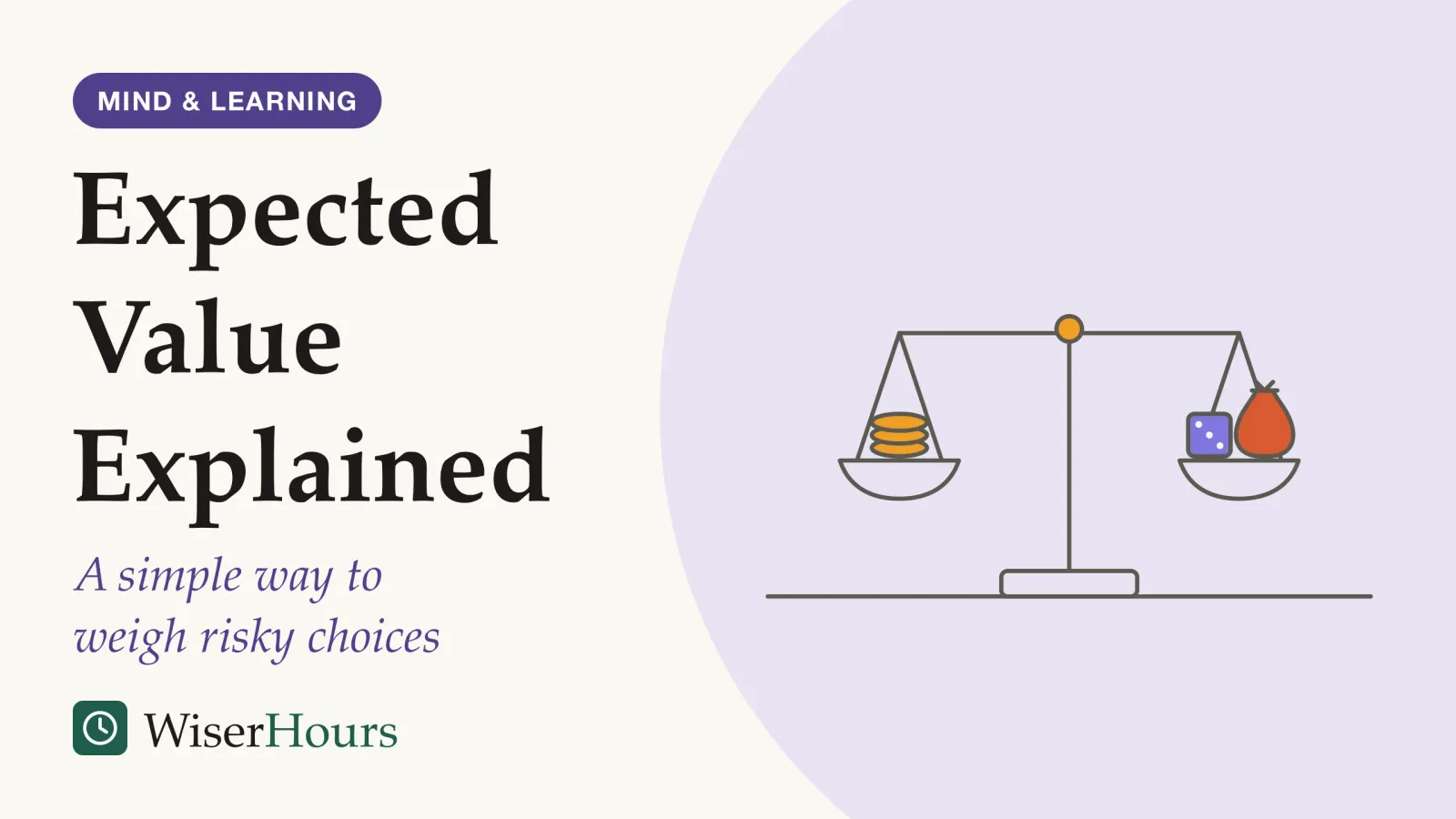
A €20 ticket in Spain’s 2013 Christmas lottery bought, on average, about €14 of prizes, because the lottery set aside 70 percent of ticket sales for prizes.1 That leaves the ticket with an expected value of about minus €6. Expected value is what a risky choice is worth on average: multiply each possible outcome by its probability, add the results, and subtract whatever you pay to take part. A raffle ticket, a warranty offered at the checkout and a job with an uncertain bonus can all be compared this way, on one number, before you commit.
That number describes the long run. If you could repeat the same choice many times, your average result would settle close to its expected value, which is why the idea works so well for anyone who faces the same bet again and again.2 Working it out belongs to the slow, deliberate mode in how human decision making works, and its limits matter as much as its arithmetic.
What expected value means in plain words
Expected value is the average result you would get if you could make the same risky choice over and over. Probability theory defines it as a weighted average of the possible outcomes, with each outcome weighted by its chance of happening, Wikipedia’s overview of the concept explains.2
Definition
Expected value is the probability-weighted average of a choice’s possible outcomes: each payoff multiplied by its chance, then added together.
The weighting is what makes the idea useful. A large payoff with a small chance can be worth less than a modest one that is close to certain. Splitting size and chance forces you to look at each one. A friend’s offer to toss a coin, where heads wins you a lunch and tails costs you two, sounds harmless until you weigh both sides and see that you lose half a lunch per toss on average.
Whenever a choice comes with “a chance of” something, ask for both halves, how much and how likely, before reacting to either.
How do you calculate expected value?
To calculate expected value, list every outcome, multiply each by its probability, add the products and subtract the cost of playing. The probabilities have to cover every possibility and add up to 100 percent, so the most common slip is leaving out the dull outcome where nothing happens.
- List the possible outcomes, including the one where you win nothing.
- Give each outcome a probability, so that together the chances cover every possibility.
- Multiply each payoff by its probability.
- Add the results and subtract what you pay to take part.
A charity raffle shows the steps. In this made-up example, 200 tickets are sold at 5 each (in any currency) and there is one prize worth 500.
| Step | Outcome | Payoff | Chance | Payoff times chance |
|---|---|---|---|---|
| 1-3 | Your ticket wins | 500 | 1 in 200 | 2.50 |
| 1-3 | Your ticket loses | 0 | 199 in 200 | 0 |
| 4 | Expected prize | 2.50 | ||
| 4 | Minus the ticket price | minus 5.00 | ||
| 4 | Expected value | minus 2.50 |
Each ticket buys a chance worth half its price. That can still be a sensible purchase, since the rest goes to the cause, and the expected value tells you what the donation costs.
- List the outcomes: every way the choice can turn out, including winning nothing
- Give each a chance: a thicker branch is a likelier outcome, and the chances add up to 100%
- Multiply: each payoff by its probability, so a big but rare prize shrinks
- Add, then subtract the price: the total is the average result over many tries
Public lotteries work the same way at scale. Because organizers keep part of the money, a ticket costs more than its expected prize, and someone choosing on expected value alone would not buy one; people buy anyway for the thrill or the fantasy of a large win, Wikipedia’s overview of lotteries notes.1 If you do buy tickets, count the expected loss as money spent on entertainment. The more tickets you buy over the years, the closer your average loss per ticket comes to that figure. If betting becomes hard to control, free, confidential help exists, such as the US National Problem Gambling Helpline.3 In the UK, the NHS lists the National Gambling Helpline; elsewhere, a doctor can point you to local support.4
What is an example of expected value? A warranty and two job offers
Two everyday examples of expected value are the extended warranty offered at the checkout and a choice between job offers whose bonuses are uncertain. In both, the arithmetic is quick, and the hard part is finding probabilities you can trust.
Is the extended warranty worth its price?
An extended warranty is a small insurance policy: you pay now, and the seller pays for repairs if the product fails within the cover period. Its expected value to you is the chance of a failure times the repair it would cover, minus the price of the cover.
Data from a large US electronics retailer show how lopsided that can be. Between 1998 and 2004, TV buyers there who took the warranty paid, on average, $90 or more to insure against a repair bill of at most $400, with a chance of failure of about 7 percent, the economists Jose Miguel Abito and Yuval Salant report.5 Multiplied out, the expected repair was at most about $28, under a third of the price.
The study
Moderate evidence
Abito and Salant (2019): shoppers who overrated the risk
Jose Miguel Abito of the Wharton School and Yuval Salant of the Kellogg School of Management modeled purchases by households at one large US electronics retailer from 1998 to 2004. Their model estimated that buyers treated a 5 percent chance of their TV failing as a 13 percent chance, while ordinary dislike of risk played almost no part in their choices. In an online experiment with about 1,000 participants, those who were not told the real failure rate guessed it at about 14 percent on average, and those who were told it was about 5 percent would pay roughly half as much for the warranty, comparing medians.5
The data cover one retailer and one product more than two decades ago, and the experiment used imagined purchases, so the exact gap will differ today. In this study the error sat in the probability, not in the multiplication. The US Federal Trade Commission’s consumer advice makes a related point: cover may not be worth the cost if the product is unlikely to need repairs, and setting money aside for repairs can be the better option.6 Outside the US, a national consumer agency can say what legal guarantees already cover a faulty product.
Before you accept cover at the till, look up a failure rate for the product, from a reliability survey or a review site, and multiply it by the repair cost.
Two job offers with uncertain bonuses
Job offers show expected value away from the shop counter. In this made-up example (in any currency), offer A pays the higher salary and a modest bonus that the company has paid in about half of recent years. Offer B pays less but offers a bonus three times as large, paid in most recent years.
| Offer A | Offer B | |
|---|---|---|
| Salary | 60,000 | 50,000 |
| Bonus and its chance | 10,000 at 50% | 30,000 at 60% |
| Expected bonus | 5,000 | 18,000 |
| Expected pay | 65,000 | 68,000 |
| Pay in a year with no bonus | 60,000 | 50,000 |
On expected value, B wins by 3,000 a year. The last row shows what that average hides: in a year without a bonus, B pays well below A’s salary, and those years come about four times in ten. If your rent and other fixed costs take most of A’s salary, B’s better average comes with the years that hurt.
A bonus history covers only the years you were shown, and a team’s past payouts may not predict your own. Ask how often the bonus was paid to people in your role, then rerun the sum with a lower chance to see whether B still wins. Pay is rarely the only thing that matters, and a decision matrix with weighted criteria can hold expected pay alongside the commute, the work and the people.
Why is expected value important in decision making?
Expected value is important in decision making because it puts uncertain options on one scale, so a likely small gain can be compared directly with an unlikely large one. It is the right guide whenever the same kind of choice comes up many times, because over many independent repetitions the average result settles near the expected value.2
Insurers, lottery operators and casinos rely on it because they make the same bet millions of times. A household can be in a similar position. One warranty is a single bet, but the same offer comes with every phone, laptop and washing machine bought over decades, and across all those purchases the averages decide the total. Paying for your own repairs out of savings, the FTC’s alternative, comes out ahead on average whenever the cover costs more than the expected repair.6 That assumes you could pay a surprise repair bill; if you could not, the cover may be worth more to you than its average.
When a positive expected value is still the wrong bet
A positive expected value is not always a reason to accept. Expected value describes the average over many tries, and a single try, a loss you could not recover from or a stake that is large compared with your savings can turn a favorable bet into a poor one.
The economist Paul Samuelson gave the one-off problem its best-known story in a 1963 essay. He offered colleagues at lunch a coin-toss bet in which they would win $200 or lose $100, which has a clearly positive expected value. One colleague refused, saying he would feel the loss more than the gain, but offered to take 100 such bets. Samuelson replied that a long series also makes a far larger loss possible, and proved that, under standard expected utility theory, someone whose preferences would always make them turn down the single bet should turn down the series too.7 The colleague’s reason, feeling a loss more than a gain twice its size, is the pattern described in the guide to loss aversion.
Stakes change behavior too. In a 2002 experiment, Charles Holt and Susan Laury found that most participants already preferred the safer option at payoffs of several dollars, and became sharply more cautious when payoffs of up to several hundred dollars were paid in real cash rather than imagined (we read only the abstract).8 Matthew Rabin and Richard Thaler argued in 2001 that extra money mattering less is, in most applications, an implausible explanation for caution over moderate stakes, and that loss aversion and mental accounting explain it better (abstract only).9
Ruin is another limit. In a thought experiment from ergodicity economics, a coin toss raises your wealth by 50 percent on heads and cuts it by 40 percent on tails. Each toss has a positive expected value, yet a player who stakes everything on every toss shrinks by about 5 percent a round over time, because heads and tails come up about equally often and a 50 percent gain followed by a 40 percent loss leaves 90 percent of the starting stake.10 The older mathematics of gambler’s ruin makes a related point: a player with limited money, in a fair game against an opponent with unlimited funds, will eventually go broke.11
A freelancer offered either a fixed fee or a share of a project’s revenue faces the same question on a small scale. The revenue share may carry the higher expected value, but if the project flops in the month the rent is due, a good long-run average pays nothing. Before taking a favorable bet, compare its worst outcome with the amount you could lose without changing your plans.
Expected utility: weighing what the money means to you
Expected utility, the standard answer to these limits, weighs what each outcome is worth to you rather than its cash amount. Responding to a betting puzzle Nicolaus Bernoulli described in 1713, Daniel Bernoulli proposed that extra money is worth less to someone who already has more, so a gain and a loss of the same size do not cancel out. Choosing by expected utility multiplies each outcome’s usefulness to you by its probability, which explains why a cautious person can rationally refuse a fair bet. John von Neumann and Oskar Morgenstern later set out four conditions under which a person’s choices can be described this way.12
When to work it out on paper and when to use a rough check
Work expected value out on paper when a choice repeats, when the stakes are small compared with what you can afford to lose, and when the probabilities come from data rather than hope. For a one-off, large or irreversible choice, calculate it as a rough check, then give the worst case at least as much attention as the average.
For the rough check, run the sum twice, once with a hopeful probability and once with a cautious one. If the better option changes between the two, the decision turns on that probability, and finding a better estimate is worth more than more arithmetic. In the warranty experiment, too, a better estimate of one probability, the failure rate, changed what people were willing to pay.5
Before you trust the expected value
The bottom line
Use expected value as a quick test for choices you meet again and again: multiply each outcome by its chance, add, and subtract the price. For a single large choice, calculate it, then look hard at the worst case and decide whether you could live with it. The next time a seller offers cover or an add-on, find the failure rate and multiply before you answer.
This article is general education, not financial advice. For decisions about your own money, speak to a qualified, regulated adviser.
Frequently asked questions
Is the expected value the most likely outcome?
Usually not. Expected value is a weighted average of the possible outcomes, so it often matches none of them. A raffle ticket with an expected value of minus 2.50 never loses exactly 2.50: it either wins the prize or loses its full price. The figure describes what you would average over many tickets, as Wikipedia's overview of the concept explains, and says little about what one ticket will do.
Can expected value be negative?
Yes. A choice has negative expected value whenever its cost is larger than the probability-weighted value of what it can pay out. Lotteries, raffles and casino games are built this way, because the organizer keeps a share of the money. The mathematics of gambler's ruin adds a warning: a persistent player in a game with zero or negative expected value will eventually run out of money, whatever betting system is used.
Who invented expected value?
The idea grew out of letters between Blaise Pascal and Pierre de Fermat in 1654, about how to divide the stakes of a game of chance that had to stop early. Both reached the same answer from the same principle: a chance at a prize is worth the prize in proportion to the chance. The Dutch mathematician Christiaan Huygens published a treatise built on it in 1657, Wikipedia's history of the concept records.
Sources
- Lottery. Wikipedia (accessed 2026-11-07)
- Expected value. Wikipedia (accessed 2026-11-07)
- About the National Problem Gambling Helpline. National Council on Problem Gambling, US (accessed 2026-11-07)
- Help for problems with gambling. NHS, UK (page last reviewed 8 December 2023)
- The Effect of Product Misperception on Economic Outcomes: Evidence from the Extended Warranty Market. Abito, J. M. & Salant, Y. (2019). Review of Economic Studies, 86(6), 2285-2318
- Extended Warranties and Service Contracts. US Federal Trade Commission, consumer advice (March 2023)
- Risk and Uncertainty: A Fallacy of Large Numbers. Samuelson, P. A. (1963). Scientia, 98; reprinted in the Casualty Actuarial Society Forum (1994)
- Risk Aversion and Incentive Effects. Holt, C. A. & Laury, S. K. (2002). American Economic Review, 92(5), 1644-1655
- Anomalies: Risk Aversion. Rabin, M. & Thaler, R. H. (2001). Journal of Economic Perspectives, 15(1), 219-232
- Ergodicity economics. Wikipedia (accessed 2026-11-07)
- Gambler's ruin. Wikipedia (accessed 2026-11-07)
- Expected utility hypothesis. Wikipedia (accessed 2026-11-07)
How we researched this
Sources were found in November 2026 through OpenAlex, Crossref, Wikipedia and web searches, starting from the definition of expected value and moving to research on extended warranty purchases, on risk taking at different stakes and on the limits of expected value. Sources run from 1963 to 2023. Full texts were read for Samuelson's 1963 essay and Abito and Salant's warranty study (the authors' 2018 manuscript); two papers were read only as abstracts. The raffle and job-offer examples use made-up numbers, and direct evidence on how expected value helps personal decisions is thin.
Keep reading

The Delphi Method: Using Anonymous Rounds to Pool Expert Judgment
The Delphi method pools expert judgment in anonymous rounds. Its 4 defining features, how to run one step by step, and what research says it can and can't do.
Loss Aversion: Do Losses Really Loom Larger Than Gains?
Loss aversion makes a loss sting more than an equal gain pleases. Evidence since 1979 says it is real on average, but weak or absent when stakes are small.
Overconfidence Bias: Why We Trust Our Own Judgment More Than We Should
Overconfidence bias has 3 forms. In studies reviewed in 2008, ranges people were 90% sure of held the answer under half the time. What helps.
The Slippery Slope Argument: When It's a Fallacy and When It Isn't
The slippery slope fallacy explained: 3 kinds of slope argument, everyday and work examples, and 3 questions that separate a weak chain from a fair warning.