How to Build an Exercise Habit That Lasts
How to build an exercise habit: the WHO target is 150 minutes a week, but start far below it, make starting automatic and plan how you come back after a miss.

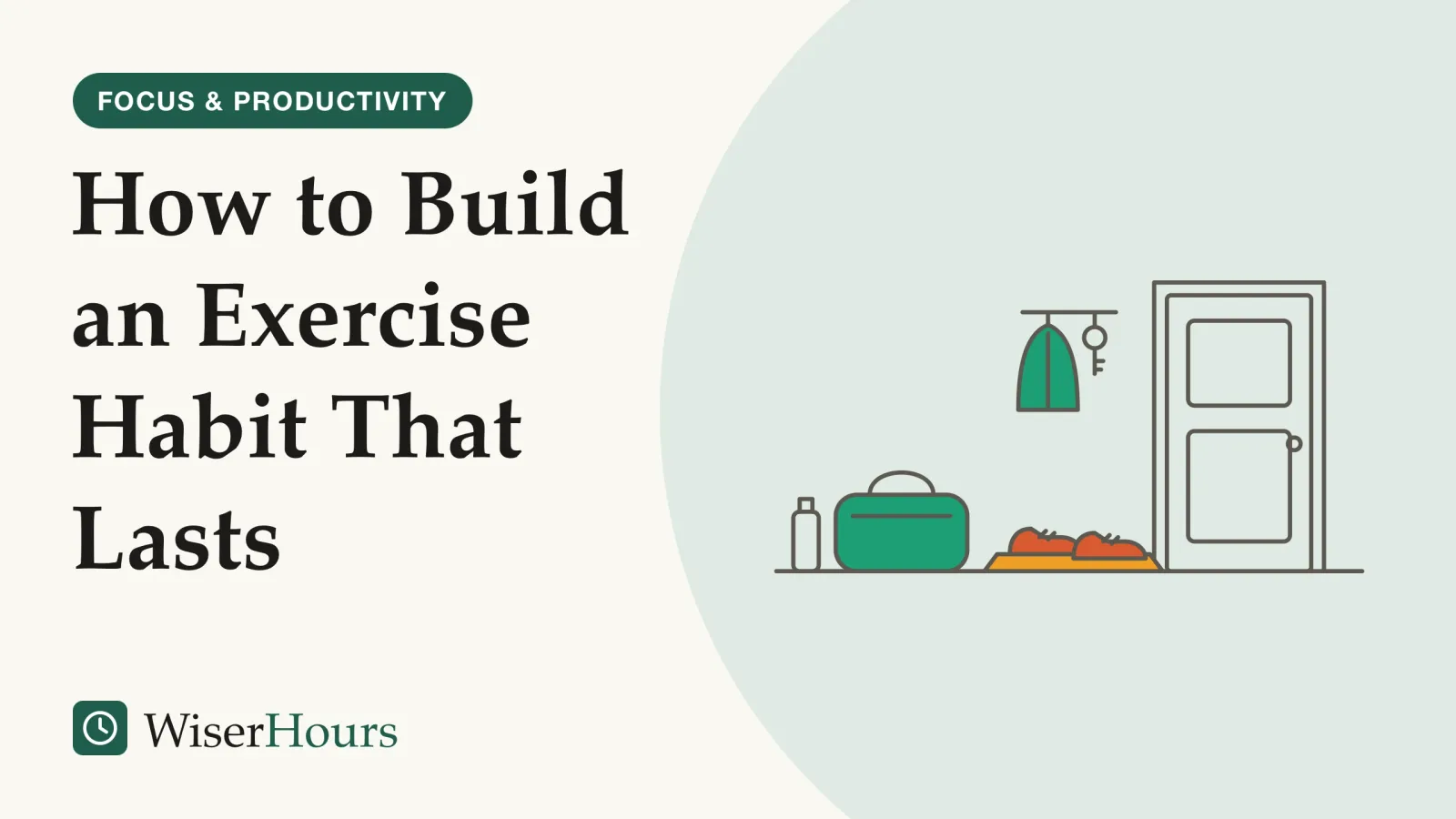
Thirty behavioral scientists, working in separate teams, once designed dozens of four-week programs to get gym members exercising more, and all were tested side by side. Many of the programs worked while they ran, and very few kept working after they stopped. The idea that did best was not a bigger prize: it was a tiny extra reward for coming back after a missed workout.1
That result points to how to build an exercise habit that outlasts the first burst of enthusiasm: start with sessions small enough to repeat, make the start of each one automatic, and plan for the misses instead of hoping they won’t happen. Five steps put that into practice:
- Start with sessions short enough for a bad day
- Plan your comeback before you miss a session
- Fix the days, and the routine each session follows
- Make leaving the house automatic, and let the workout vary
- Save something you enjoy for exercise time only
For someone who barely exercises, a first week might look like this: a 10-minute walk after lunch on Monday, Wednesday and Friday, shoes left by the desk, a rule that a missed walk moves to the next day’s lunchtime, and a podcast kept for those walks alone.
The target is 150 minutes a week, and you can start far below it
In its 2020 guidelines, the World Health Organization asks adults to build up to 150 to 300 minutes of moderate activity a week, with muscle-strengthening work on two or more days, and states plainly that doing some activity is better than doing none. The panel rated these adult recommendations strong, resting on evidence of moderate certainty.2 In the US, the CDC sets the same floor of 150 minutes, which it suggests thinking of as 30 minutes on five days.3 The UK’s NHS offers a simple test for moderate effort, being able to talk but not sing, and lists brisk walking as moderate.4
For a beginner, the fine print matters most. The WHO panel dropped an older rule that activity only counted in bouts of at least 10 minutes, and it advises people who are not yet active to start with small amounts and raise frequency, intensity and duration over time. The adult targets cover ages 18 to 64, including people with chronic conditions or disability; older adults and women during pregnancy and after birth have their own recommendations.2
The first-week walks fall well short of that minimum, which is the point: each is short enough to survive a bad day. Treat the target as a destination, not a starting line. Whether exercise lifts your energy is covered in how exercise affects energy and fatigue; this guide is about making it stick.
Why exercise is a harder habit to build than most
Exercise is probably harder to make habitual than a single daily action, for two reasons habit researchers point to: it is a long chain of steps, and people starting out tend to overestimate how often they will go.
Habits form when an action is repeated in a stable setting, as how habits form through repetition explains. A glass of water is one action; a workout is dozens, from changing and getting there to choosing exercises and finishing. Habit researchers L. Alison Phillips and Benjamin Gardner split exercise into two parts that can each become habitual: instigation, the impulse to start a session, and execution, the run of actions within it.5 The two turn out to behave differently, which shapes step 4.
Overconfidence is the second problem. In a 2018 study at a university-affiliated gym in the US Midwest, almost all new members planned to go more than once a week, about a third were still doing so by their third month, and attendance fell most sharply over the first two months.6
So an early fall-off is the normal pattern, not a personal failing, and a plan that assumes you will never miss rests on the least reliable estimate you have. The first two months, when the drop-off is steepest, are when a plan needs the most support.
Further reading
How to Change: The Science of Getting from Where You Are to Where You Want to Be
Milkman's own account of temptation bundling, the gym audiobook study in step 5, and of her research on making exercise stick.
As an Amazon Associate WiserHours earns from qualifying purchases.
What a megastudy of gym members showed about lasting change
Short programs can get people to exercise more, but most of the effect ends when the program does, according to a 2021 megastudy in Nature led by Katherine Milkman and Angela Duckworth, which tested dozens of four-week programs at once on members of a US gym chain.
The study
Moderate evidence
Fifty-three ways to nudge gym-goers, tested side by side (2021)
Members were randomly assigned to a placebo condition or to one of 53 programs, all built on planning workouts, text reminders and tiny rewards per visit. Compared with the placebo condition, 45% of the programs significantly raised weekly gym visits during the four weeks, by an estimated 9% to 27%. The top performer paid a bonus worth about 9 US cents for returning after a missed workout. In the four weeks after the programs ended, only 8% of the programs showed a significant increase.1
In short, nearly half the programs helped while they ran, the gains mostly faded once they stopped, and even the best added only a fraction of a visit a week. The caveat is scope: one gym chain, people who chose to sign up, and nudges far lighter than a coach; the authors expect in-person coaching or bigger rewards would have had larger effects.1
For your own plan, treat any outside push, such as an app streak, a challenge or a reward, as scaffolding for the early weeks, and aim your planning at the day after a lapse, as the best program did. Gym check-in records point the same way, as the guide to keeping a morning routine through bad weeks describes: for most members, the longer the gap since the last visit, the less likely the next one.
How to build an exercise habit in five steps
The steps run in order of evidence strength: the first rests on the WHO guideline, the second on a large field experiment, the rest on smaller or correlational studies.
1. Start with sessions short enough for a bad day
Begin with a session short enough to do on your worst day, repeat it on several days a week, and lengthen it later, as the WHO guidelines advise for anyone not yet active.2 Frequency seems to matter for the habit, not only the weekly total: each session is another repetition of the start. In a 2015 study that followed new gym members for 12 weeks, Navin Kaushal and Ryan Rhodes concluded that exercising at least four times a week for six weeks was the minimum needed to establish an exercise habit.7 That is the authors’ conclusion from one group of volunteers, and we saw only the abstract, so treat it as a rough marker, not a deadline.
Four 15-minute walks a week give you four chances to practice the start; one long Saturday session gives you one, though both count toward the target. When time is tight, our reading is to keep the number of days and shorten the sessions, not the other way round.
2. Plan your comeback before you miss a session
Settle in advance what you will do the day after a missed session, because the day after a lapse is where an exercise habit is at risk, and it is the moment the megastudy’s best program rewarded. When Haoming Ma’s team pooled habit-building programs for physical activity (a 2023 meta-analysismeta-analysis: A study that combines the results of earlier studies on the same question into one overall estimate. Pooling makes the estimate more precise, but it cannot repair the studies it pools: a meta-analysis of surveys is still survey evidence.Full entry in the glossary), programs teaching problem solving, meaning planning ahead for obstacles, were linked to larger gains in habit strength, though fewer than half of the pooled studies used it.8
A comeback plan in one line
If I miss Tuesday’s walk, I walk for 10 minutes on Wednesday at the same time, whatever the weather. Keeping the restart smaller than a normal session, so it is easy to agree to, is our idea; no study has tested it.
Write the plan on a good day, so the decision is already made on a bad one.
3. Fix the days, and the routine each session follows
Exercise on set days, at the same point in your week, rather than whenever there is time. Pooled studies in a 2026 systematic reviewsystematic review: A review that fixes its question and its rules for including studies in advance, then searches out every study that fits and weighs them together. Some systematic reviews pool the results into a meta-analysis; others describe what the studies found without combining the numbers.Full entry in the glossary showed that people whose activity came at consistent times, or after consistent routines, tended to be more active and to have stronger exercise habits. The associations were small correlations, which cannot show that consistency builds the habit, and consistency went with how often people exercised more than with how long; only its abstract could be read.9
A plan such as “after the school drop-off on Monday, Wednesday and Friday, I walk the long way back” names a time and a routine at once. Choose days your week reliably keeps: a slot that moves every week gives the habit nothing stable to attach to.
4. Make leaving the house automatic, and let the workout vary
Aim the habit at the start of the session, the moment you put your shoes on or leave for the gym, and feel free to vary what you do once you are there. In Phillips and Gardner’s 2016 study of university students and staff, both kinds of habit went with more frequent exercise, but weighed together, only the habit of starting predicted how often people exercised over the following month. Doing the same exercises every session did not predict it, the authors report.5
- The start: leaving at the same point in your routine, shoes on and bag ready; in a small 2016 study, a habit of starting exercise was the stronger predictor of how often people exercised over the next month
- The session: a walk, a ride or weights, chosen on the day; in that study, a habit for the workout itself did not clearly add to the prediction once the starting habit was counted, and doing the same exercises every time did not predict how often people exercised
The caveats are real: one small sample, mostly women, followed for a month, with habits and exercise self-reportedself-report: A measure in which people describe their own behavior, feelings or circumstances, usually by answering a questionnaire. When the same person supplies both of the things being compared, shared habits of answering can make the link between them look stronger than it is.Full entry in the glossary, and the authors call their practical advice tentative. They also expect the split to matter less for simple actions, such as a glass of water, where starting and doing are one act.5 A 2021 systematic review led by Katharina Feil, which includes that study, found the same pattern across the studies that measured both kinds of habit.10
Fix the ritual that gets you out of the door, and choose the workout on the day. The fixed part might be shoes by the door, a bag packed the night before and leaving at a set moment in the evening; what follows can be a run one day and a class the next.
5. Save something you enjoy for exercise time only
Link exercise to something you enjoy and keep that treat for exercise time. In a 2014 randomized experiment at a US university gym, Katherine Milkman and colleagues gave students and staff audiobooks they could listen to only at the gym; they went more often at first, but the effect faded over the weeks, especially after a Thanksgiving break when the gym closed.11 In the new-gym-member study, how positively people felt about exercise was also among the predictors of a strengthening habit.7
Use enjoyment to carry you through the early weeks, and expect the novelty to wear off: a podcast saved for the walk works alongside a fixed start and a comeback plan, not instead of them.
Your exercise habit, set up
Which steps have the firmest support
The WHO’s advice to start small and build up is the best-supported step; the strongest trial evidence concerns what happens after a miss.
| What it is | What the best evidence found | Evidence |
|---|---|---|
| Begin small and build toward the target | Some activity is better than none; bouts of any length count; increase gradually | Guideline, strong recommendation, moderate-certainty evidence2 |
| Go often at first | About four sessions a week for six weeks suggested as a minimum for new gym members | Observational, limited; abstract only7 |
| Plan the comeback | The best-performing nudge rewarded returning after a missed workout; most effects faded once programs ended | Randomized field experiment, moderate1 |
| Same days, same routine | Consistent timing and routines went with more activity and stronger habits; small correlations | Meta-analysis of correlations, limited; abstract only9 |
| Make starting automatic | A starting habit predicted exercise frequency better than a workout habit; repeating the same exercises did not predict it | Observational, limited5 |
| Pair it with a treat | Gym-only audiobooks raised visits at first; the effect faded | Randomized trial, limited11 |
Most rows rest on limited evidence, and none shows that a habit lasts for years: the steps are sensible bets, not guarantees.
When to check with a doctor before or during exercise
The NHS suggests talking to a GP before you start after a long break from exercise or with a medical condition, and both the NHS and MedlinePlus treat sudden chest pain or pressure as an emergency. Their advice, sorted by urgency:
- Now: chest pain, pressure or tightness that starts suddenly and will not ease could be a heart attack, and so could chest pain that spreads into an arm, the jaw, neck, back or stomach, or arrives together with sweating, nausea, breathlessness or light-headedness. The NHS’s instruction for the UK is to phone 999.12 In the US, MedlinePlus advises 911, and in other countries the local emergency number.13
- Soon: chest pain that comes on and off, or that fades fast but leaves you worried, calls for a GP appointment, in the NHS’s advice.12 Feeling far worse a day or two after ordinary activity is worth raising too: for people with ME/CFS, the UK’s NICE advises against general exercise programs in its 2021 guideline, as when exercise makes fatigue worse explains.14
- Routine: after a long inactive spell or with a medical condition, talk your plans through with a GP first and pick an intensity that suits your fitness, the NHS advises.4 The WHO guideline is less cautious: without a medical reason to hold back, it says medical clearance is generally unnecessary before activity no harder than brisk walking.2
The bottom line
An exercise habit is built at the start of each session more than in the workout itself. Begin with something short on the same days each week, decide in advance how you will come back after a miss, and let the minutes grow toward the WHO’s 150 a week once showing up has become the easy part.
This article is general information, not medical advice. If you're worried about your health, talk to a doctor or another qualified professional.
Frequently asked questions
Does being paid to exercise help the habit stick?
Not much, on current evidence. In a 2018 randomized trial with 690 new members of a US gym, rewards of 30 or 60 US dollars, or an item worth 30 dollars, for nine visits in the first six weeks had only small effects on attendance and none after the reward period ended. The authors point to overconfidence: new members expected to hit the target far more often than they did.
Does exercising with a friend or a group help?
Perhaps, though the evidence so far is only correlational. A 2026 systematic review found that people whose social cues, such as who they exercised with, stayed consistent tended to have stronger exercise habits, which does not show that a partner builds the habit. Read that way, a regular partner or class works like any other fixed cue: it marks the same day and time each week.
Does walking or cycling to work count toward the target?
Yes, if the pace is at least moderate. The WHO's 2020 physical activity guidelines include walking and cycling to get from place to place as physical activity, and count bouts of any length. A commute also makes a ready-made cue, because it happens on set days at a set time: a brisker walk to the station fits in without a new decision.
Sources
- Megastudies improve the impact of applied behavioural science. Milkman, K. L., Gromet, D., Ho, H., Kay, J. S., Lee, T. W., Pandiloski, P., ... Duckworth, A. L. (2021). Nature, 600(7889), 478-483
- World Health Organization 2020 guidelines on physical activity and sedentary behaviour. Bull, F. C., Al-Ansari, S. S., Biddle, S., Borodulin, K., Buman, M. P., Cardon, G., ... Willumsen, J. F. (2020). British Journal of Sports Medicine, 54(24), 1451-1462
- Adult Activity: An Overview. US Centers for Disease Control and Prevention, page dated 20 December 2023
- Physical activity guidelines for adults aged 19 to 64. NHS (UK), page last reviewed 22 May 2024
- Habitual exercise instigation (vs. execution) predicts healthy adults' exercise frequency. Phillips, L. A. & Gardner, B. (2016). Health Psychology, 35(1), 69-77
- Can financial incentives help people trying to establish new habits? Experimental evidence with new gym members. Carrera, M., Royer, H., Stehr, M. & Sydnor, J. (2018). Journal of Health Economics, 58, 202-214
- Exercise habit formation in new gym members: a longitudinal study. Kaushal, N. & Rhodes, R. E. (2015). Journal of Behavioral Medicine, 38(4), 652-663
- Effects of habit formation interventions on physical activity habit strength: meta-analysis and meta-regression. Ma, H., Wang, A., Pei, R. & Piao, M. (2023). International Journal of Behavioral Nutrition and Physical Activity, 20, 109
- Not all cues are equal: A systematic review and three-level meta-analysis of context consistency, physical activity and habit strength. Zhu, L., Tao, Y., Zhou, B., Ma, H., Kaushal, N., Ma, X., ... Zhang, L. (2026). Applied Psychology: Health and Well-Being, 18(4), e70204
- A Systematic Review Examining the Relationship Between Habit and Physical Activity Behavior in Longitudinal Studies. Feil, K., Allion, S., Weyland, S. & Jekauc, D. (2021). Frontiers in Psychology, 12, 626750
- Holding the Hunger Games Hostage at the Gym: An Evaluation of Temptation Bundling. Milkman, K. L., Minson, J. A. & Volpp, K. G. M. (2014). Management Science, 60(2), 283-299
- Chest pain. NHS (UK), page last reviewed 8 August 2023
- Chest pain. MedlinePlus Medical Encyclopedia, US National Library of Medicine (review date 28 April 2026)
- Myalgic encephalomyelitis (or encephalopathy)/chronic fatigue syndrome: diagnosis and management (NG206). National Institute for Health and Care Excellence (UK), published 29 October 2021; last reviewed 24 January 2025, no new evidence affecting the recommendations
How we researched this
Europe PMC, Crossref and PubMed searches (September 2026) covered exercise-habit trials, field experiments, systematic reviews and guidelines, and WHO, CDC and NHS guidance was checked for currency. Details come from full texts, except for one study and one review that were available only as abstracts; only what those abstracts state is used. Sources date from 2014 to 2026. Main limitation: habit strength is usually self-reported, samples are often students or gym members, and few studies follow people for more than a few months.
Keep reading
How to Build a Reading Habit: 20 Pages a Day
How to build a reading habit: 20 pages a day takes about 20 to 25 minutes. Tie it to a fixed moment, keep the phone away, and read hard books on paper.
Habit Trackers: Do They Work, and Which Kind Should You Use?
A habit tracker helps you repeat an action, yet use fades: in one French study, 16% still used a tracker after 320 days. What works, and which kind to pick.
How to Build a Morning Routine You'll Actually Keep
How to build a morning routine you'll keep: 5 steps from habit research, and why the kind of cue you pick matters less than meeting it every day.
How to Build a New Habit: A Step-by-Step Guide
How to build a new habit in 6 steps from habit trials: one wanted action, a daily cue, a small start, a written record, loose timing and a restart plan.