Habit Stacking: How to Attach New Habits to Old Ones
Habit stacking ties a new habit to one you already do. A 5-step method, 14 examples for work and home, and what the if-then research behind it shows.

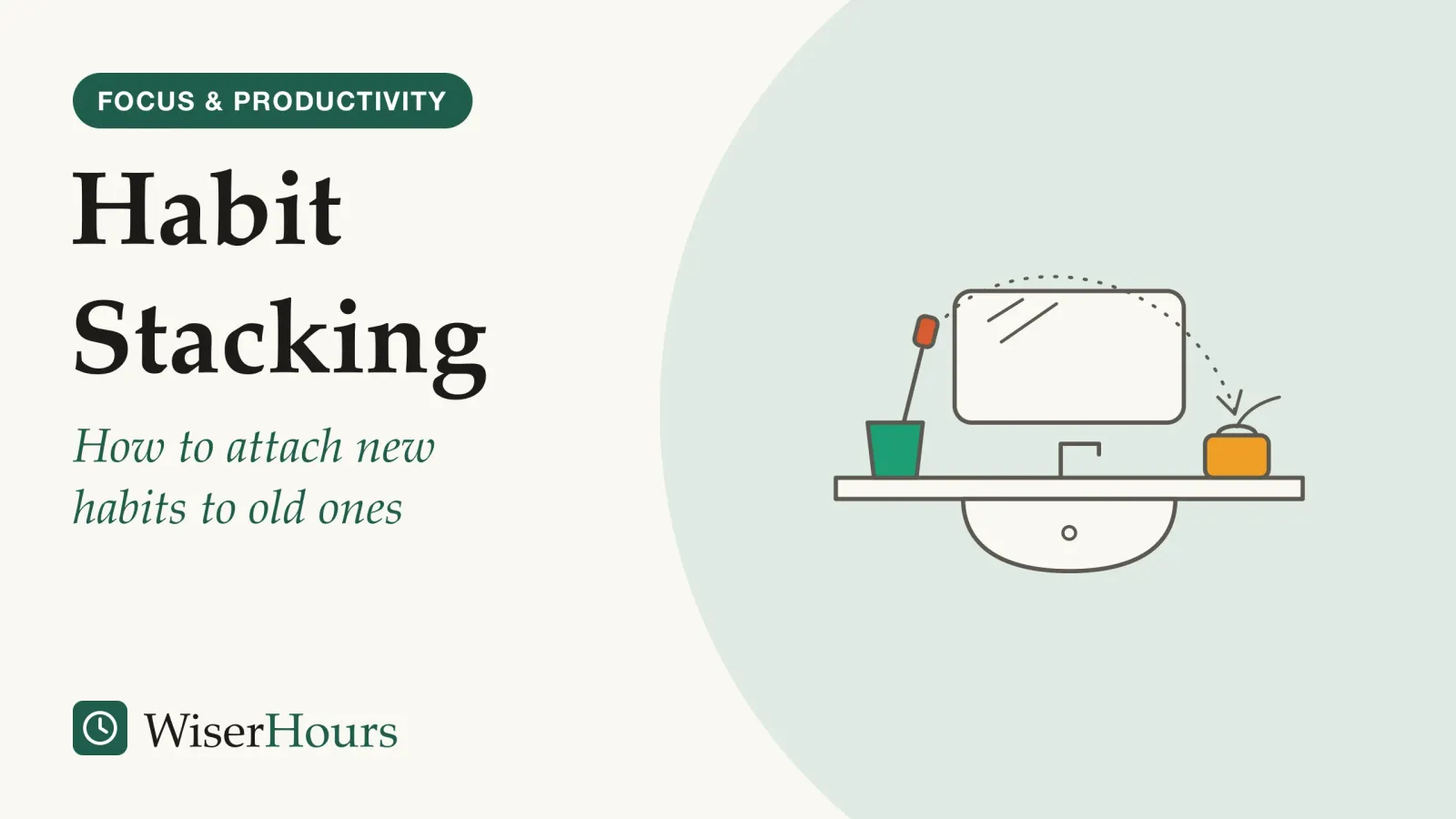
Habit stacking ties a new habit to a routine you already perform every day, so that finishing the old one reminds you to start the new one. The whole plan fits in a sentence: after I plug in my phone at night, I will set out tomorrow’s work clothes. Habit stacking is a type of if-then plan, which psychologists have tested for decades, though the stacking label itself has barely been tested.1
To build a habit stack:
- List the routines you already do without fail
- Pick an anchor that happens at the same time and place every day
- Write the “After I [current habit], I will [new habit]” sentence
- Start with a tiny version of the new habit
- Repair weak or irregular anchors
The steps expand the anchor part of our general method for building a new habit.
What is habit stacking, and who came up with it?
Habit stacking has two parents. The term comes from S.J. Scott’s book Habit Stacking, first released in April 2014, which groups several small changes into one daily routine.2 James Clear popularized the one-line formula in Atomic Habits (2018), crediting the method to BJ Fogg and calling it a special form of if-then plan.3
Clear writes the formula as “After/Before [current habit], I will [new habit]”. He says the method comes from Fogg’s Tiny Habits program, where it is called anchoring, and thanks Scott for the name.3 In Fogg’s version, the recipe reads “After I [existing routine], I will [new tiny behavior]”, and the existing routine is the anchor: something you always do, which then reminds you to do the new thing.4
An anchor shifts the work of remembering onto an event that happens anyway. A product manager who wants to review her calendar each morning needs no reminder app if the review always follows the moment she opens her laptop.
So the phrase covers two ideas. Scott’s stack is a chain: a short block of small actions done in the same order every day. Fogg’s and Clear’s version hooks one new habit onto one old one. A chain is several hooks in a row, each action cueing the next, so start with a single hook and add links once it holds.
Does habit stacking work? The evidence is borrowed
We found no published trial of habit stacking under that name. In an April 2026 Washington Post piece, Wharton professor Katy Milkman, who studies behavior change, said there is hardly any research on it, and the article reported no large, well-designed studies showing that it works.5 The evidence comes from its parent technique, the implementation intentionimplementation intention: A plan in if-then form that ties a specific action to a specific situation, such as 'if it is nine o'clock, then I open the report.' It hands the decision about when and where to act to the situation itself.Full entry in the glossary, a plan that pairs a specific moment with a specific response in if-then form.
The study
Moderate evidence
Gollwitzer and Sheeran pooled 94 tests of if-then plans in 2006
The 2006 review by Peter Gollwitzer and Paschal Sheeran combined results from 94 independent tests in which people settled in advance on when, where and how to act. People who made such plans did better at reaching their goals, a medium-to-large effect by psychology’s usual yardsticks. The plans helped people get started, stay on track despite distractions and drop courses of action that were failing.1
The same paper tested why: forming the plan made the chosen moment stand out when it arrived and made the response begin more automatically.1 A good anchor does both jobs. A 2025 update by Sheeran, Gollwitzer and a colleague, covering 642 tests, found larger effects for plans worded in strict if-then form, for people strongly motivated to reach the goal and for plans people rehearsed (abstract only).6 A habit-stacking sentence supplies the wording; motivation and rehearsal are up to you. Our Atomic Habits summary scores the book’s other tactics against the same research.
The 2025 review also tested different kinds of cue, such as a time and place or the point where one task ends, but its abstract, the only part open to us, does not say how plans cued by an existing habit fared.6
- Myth
- Habit stacking makes you two to three times more likely to stick with a habit.
- Fact
- That figure appears to come from James Clear's account of a two-week exercise study whose plan named a day, time and place. No published study has measured habit stacking's effect.
The popular “two to three times” figure seems to rest on one study. In a 2002 UK study by Sarah Milne, Sheina Orbell and Paschal Sheeran, 248 people were randomly assigned to groups, and adding an if-then plan to a motivational message had a large effect on exercise over the following two weeks.7 James Clear, whose article on if-then plans says they can double or even triple your chances of success, tells that study’s story: in his retelling, 91 percent of the planning group exercised at least once a week, against 35 to 38 percent in the other groups, and the sentence they completed named the day, time and place for exercise, with no existing habit involved.8
Why an old habit makes a good cue
An existing habit makes a strong cue because, as research on how habits work shows, habits are triggered by context, and a context includes what you just did. Wendy Wood and David Neal’s 2007 model of habit describes how people learn links between an action and the features of the setting it happens in, including physical settings and preceding actions (abstract only).9
Finishing one action is itself a signal: rinsing a mug at the sink comes with the same sights and movements every time, and repetition needs that sameness to build a link. In a 2012 paper for family doctors, the University College London habit researchers Gardner, Lally and Wardle advise picking a cue that turns up often and reliably, and call a cue that sits inside a daily routine a convenient and stable starting point.10
A clock time can do the same job. Jan Keller’s team in Germany ran a 2021 randomized controlled trialrandomized controlled trial: A study that assigns participants to the treatment or the comparison group at random, so the groups start out alike and a difference in what happens next can be put down to the treatment. Random assignment makes the two groups comparable; it does not make the people in the trial representative of anyone else.Full entry in the glossary with 192 adults, each of whom picked something new to eat or drink daily and planned it either after an existing routine or at a set time. Automaticity grew under both plans with no difference between them, and people who acted on the plan at its cue more often were more likely to feel the habit grow automatic.11
The position of the new habit is an open question. In a small exploratory study, Gaby Judah and colleagues asked 50 people to start flossing, half before brushing their teeth and half after. The after-brushing group tended to build the stronger flossing habit and, at eight months, still flossed more often (abstract only).12 A larger follow-up in Judah’s 2015 PhD thesis at the London School of Hygiene & Tropical Medicine randomly advised 118 people to floss before or after brushing and found that the order made no difference to flossing or its automaticity (abstract read).13 With one result each way, the order is yours to choose; Fogg’s method puts the new habit after the anchor.4
- 1The anchor endsthe same moment, every day
- 2The new habit startsright there, in the same place
- 3Repeat at every anchor
- 4The anchor alone starts it
Building your first stack in five steps
Five steps turn an existing routine into a cue for a new habit. The first three draw on if-then planning and habit research; the last two rest more on practical reasoning.
1. List the routines you already do without fail
Write down what you do every day without thinking, from waking to sleep: switch off the alarm, put the kettle on, pick up your phone, sit down at your desk, close the last browser tab, lock the front door, plug in the phone at night.
Aim for 10 or more items, and mark the ones that happen on weekends too. A teacher might find that “open the classroom” happens five days a week, while “put the kettle on” happens every day.
2. Pick an anchor that happens at the same time and place every day
Choose an anchor that happens daily, ends at a precise moment and takes place where the new habit can happen. Clear advises matching the anchor’s frequency to the new habit’s: a daily habit needs a daily anchor.3 The Stanford version of Fogg’s method warns against fuzzy moments. “After I finish dinner” has no clear end; “after I take my plate into the kitchen” does.4
Location matters as much. Stretching after you shut the car door fails if you are already late for a meeting, and Clear warns against anchors at moments when you are likely to be busy with something else.3 In the Lally study at University College London, participants chose a daily behavior tied to a context such as “after breakfast”, and those who performed it more consistently showed a clearer habit-forming curve.14
3. Write the “After I [current habit], I will [new habit]” sentence
Write the plan as one sentence in strict if-then form, naming the exact anchor and the exact action: “After I hang up my coat at work, I will write the one task that would make today a success.” Rehearse it by saying it aloud a few times, since the 2025 review found larger effects for rehearsed plans, then put it where the anchor happens, on a sticky note on the kettle or a line on the bathroom mirror.6
“I’ll read more after work” is too loose to work as a plan. A vague plan leaves the decision for later, which is the problem the sentence is meant to remove.
4. Start with a tiny version of the new habit
Make the first version small enough to manage on a terrible day. Fogg’s method asks for a tiny behavior, such as noticing the feel of the water for a moment after you step into the shower.4 One page, one stretch or one line in a journal is enough to keep the link between anchor and action alive while it strengthens.
5. Repair weak or irregular anchors
Repair a failing stack by changing the anchor before you blame yourself. Look for three faults: an anchor that skips days, one with no clear end, and one that falls at a busy moment.
- An anchor you meet every day: the time can move, but the new habit gets its cue on all seven days
- An anchor you meet on some days: on the days it does not happen, nothing reminds you of the new habit
If you keep forgetting, the anchor is probably too fuzzy or too far from where the new habit happens; move the habit to the precise end of the routine, or put the tools for it right there. If the anchor only happens some days, choose another, or use two sentences, one for workdays and one for days off. A wandering anchor time is less of a problem: in Keller’s trial, routine cues did as well as clock times, and when your routines themselves keep changing, a fixed alarm is a fair alternative.11
Shift work, caring and changing weeks
None of the studies above looked specifically at shift workers, carers or anyone with an unpredictable week, so they are in an evidence gap. Choose anchors that come with every version of your day, such as waking up or arriving home, even when the hour changes.
Add one new habit at a time and stack the next only when the first runs without thought. We found no study on how many habits a single anchor can carry, and each extra link is another place for a chain to break.
Your first habit stack
Habit stacking examples for work and home
These 14 examples are illustrations, not tested recipes. Each pairs a common daily anchor with a tiny version of a new habit.
| At work: after I… | I will… |
|---|---|
| open the laptop at my desk | close every tab left over from yesterday |
| finish a meeting | write the next action and its owner in my notes |
| pour my first coffee at work | check my calendar for the next two days |
| send my last email of the day | write tomorrow’s first task on a sticky note |
| close the video call app after a call | stand up and stretch my shoulders |
| get back to my desk after lunch | do 10 minutes on my hardest task before opening email |
| shut down the laptop | clear my desk to one notebook |
| At home: after I… | I will… |
|---|---|
| switch off my alarm | open the curtains and drink a glass of water |
| brush my teeth at night | floss one tooth |
| put the kettle on | write one line in a journal |
| hang up my keys | put my phone in the charging spot for an hour |
| sit down for dinner | ask each person one question about their day |
| load the dishwasher | wipe the counter |
| get into bed | read one page of a book |
Several work because the new habit belongs in the same place as the anchor, as flossing does at the sink. When you write your own, copy that pattern: an anchor that ends cleanly, then a new action that fits the same spot. Reading more is a common goal, and our guide to making reading a daily habit builds a whole routine on the same idea.
Which parts of habit stacking have been tested
The general idea, if-then planning, has the most support; the details of habit stacking rest on small studies, expert advice and one honest gap.
| Part of the method | What the research found | Evidence |
|---|---|---|
| If-then plans | People who made plans linking a situation to an action did better at reaching their goals | Meta-analysis, moderate1 |
| Strict if-then wording and rehearsal | Plans in if-then form and rehearsed plans had larger effects, across 642 tests | Meta-analysis (abstract read), moderate6 |
| Routine cue or clock time | A daily routine and a set time built automaticity equally well | Randomized trial, limited11 |
| New habit after the anchor | One study found a stronger flossing habit when flossing followed brushing; a larger one found no difference | Mixed: exploratory study of 50 people and a randomized thesis study of 118, limited1213 |
| A consistent daily context | More consistent repetition went with a clearer habit-forming curve | Observational study, limited14 |
| Habit stacking by name | No large, well-designed study has tested it | Gap5 |
The bottom line
The if-then research behind habit stacking is solid, and the part you control is the anchor. Tonight, list 10 things you do every day, choose one that ends at a precise moment where the new habit belongs, and write your after-I sentence on a note at that spot.
Frequently asked questions
Should the new habit go before or after the old one?
The evidence is split, so either order can work. In a small 2013 exploratory study of 50 people led by Gaby Judah, those asked to floss after brushing tended to build the stronger flossing habit, but a 2015 study of 118 people in Judah's PhD thesis found no difference by order. Clear's formula allows either, and Fogg's method puts the new habit after.
Does missing a day undo a habit stack?
One miss is unlikely to. In a UK study of 96 volunteers forming a daily habit, published in 2010 by Phillippa Lally's team, a single missed opportunity had no material effect on the habit-forming process. Pick up with the tiny version the next time the anchor comes round, and skip making up the missed one.
When does a stacked habit start to feel automatic?
Usually after weeks to months. In a 2021 German trial led by Jan Keller, the 27 of 117 analyzed participants who formed their new eating or drinking habit took a median of 59 days to reach peak automaticity, and Lally's 2010 UK study found anywhere from 18 to 254 days. Count progress in how little thought the habit needs; the calendar is a poor guide.
Sources
- Implementation intentions and goal achievement: A meta-analysis of effects and processes. Gollwitzer, P. M. & Sheeran, P. (2006). Advances in Experimental Social Psychology, 38, 69-119
- Habit Stacking: 127 Small Changes to Improve Your Health, Wealth, and Happiness (about the book). Scott, S. J. Develop Good Habits; first edition published 2014; page accessed October 2026
- How to Build New Habits by Taking Advantage of Old Ones. Clear, J. jamesclear.com, adapted from Atomic Habits (2018); accessed October 2026
- Tiny Habits for Self Compassion: Getting Started. The ASCEND Project, Stanford Medicine. Based on Tiny Habits by BJ Fogg and Linda Fogg Phillips (2014); revised by N. Morioka-Douglas (2022)
- How to Use Habit-Stacking to Reach Your Health and Wellness Goals (Members in the Media). Association for Psychological Science, excerpt from The Washington Post, April 27, 2026
- The when and how of planning: Meta-analysis of the scope and components of implementation intentions in 642 tests. Sheeran, P., Listrom, O. & Gollwitzer, P. M. (2025). European Review of Social Psychology, 36(1), 162-194
- Combining motivational and volitional interventions to promote exercise participation: Protection motivation theory and implementation intentions. Milne, S., Orbell, S. & Sheeran, P. (2002). British Journal of Health Psychology, 7(2), 163-184
- How to Stick With Good Habits Every Day by Using the Implementation Intentions. Clear, J. jamesclear.com; accessed October 2026
- A new look at habits and the habit-goal interface. Wood, W. & Neal, D. T. (2007). Psychological Review, 114(4), 843-863
- Making health habitual: the psychology of 'habit-formation' and general practice. Gardner, B., Lally, P. & Wardle, J. (2012). British Journal of General Practice, 62(605), 664-666
- Habit formation following routine-based versus time-based cue planning: A randomized controlled trial. Keller, J., Kwasnicka, D., Klaiber, P., Sichert, L., Lally, P. & Fleig, L. (2021). British Journal of Health Psychology, 26(3), 807-824
- Forming a flossing habit: an exploratory study of the psychological determinants of habit formation. Judah, G., Gardner, B. & Aunger, R. (2013). British Journal of Health Psychology, 18(2), 338-353
- An Investigation into the Psychological Determinants of Health Habit Formation (PhD thesis). Judah, G. (2015). London School of Hygiene & Tropical Medicine
- How are habits formed: Modelling habit formation in the real world. Lally, P., van Jaarsveld, C. H. M., Potts, H. W. W. & Wardle, J. (2010). European Journal of Social Psychology, 40(6), 998-1009
How we researched this
We searched Crossref, OpenAlex, Europe PMC and the web in October 2026 for experiments, meta-analyses and reviews on implementation intentions, routine-based cues and habit formation, plus the books and pages that named and popularized habit stacking. We read full texts where open and say where we relied on an abstract. Sources run from 2002 to 2026; the main limit is that we found no published trial of habit stacking under that name.
Keep reading
How to Build a New Habit: A Step-by-Step Guide
How to build a new habit in 6 steps from habit trials: one wanted action, a daily cue, a small start, a written record, loose timing and a restart plan.
Urge Surfing: Riding Out Cravings Without Giving In
Urge surfing in 5 steps: notice a craving, feel it in your body and let it pass. What the evidence shows, how long urges last, and when to get help.
How Long Does It Really Take to Form a Habit? (It's Not 21 Days)
Two studies that timed habit formation found medians of about two months, with individuals taking 4 to 335 days. Where 21 days came from, and what helps.
How to Build a Reading Habit: 20 Pages a Day
How to build a reading habit: 20 pages a day takes about 20 to 25 minutes. Tie it to a fixed moment, keep the phone away, and read hard books on paper.