How to Become a Morning Person (Even If You've Never Been One)
How to become a morning person in 6 steps: one wake time, morning light, dim evenings and a reason to get up. What genes, age and light allow.

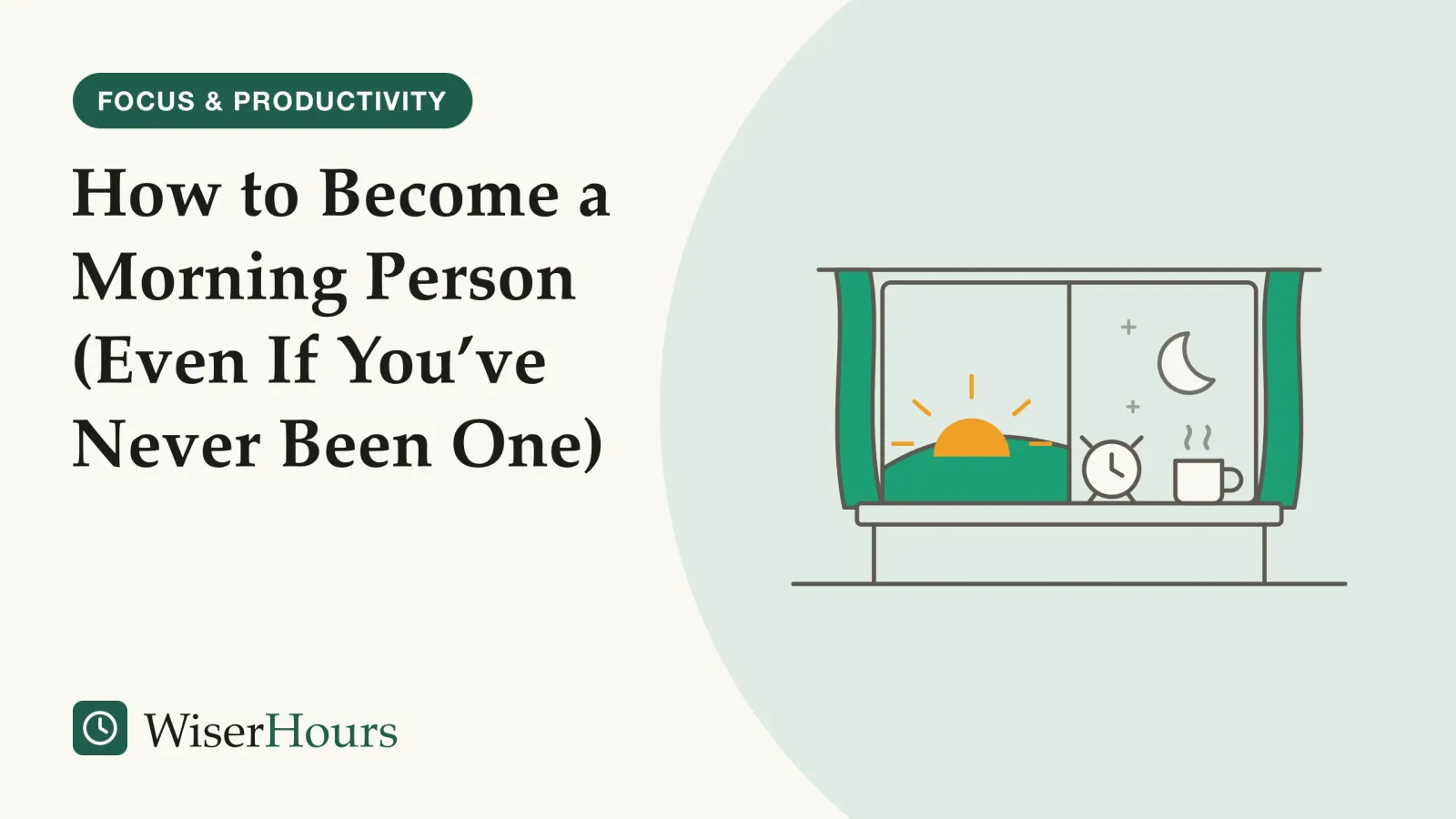
An owl who wants easier mornings has more room to move than the label suggests, though rarely all the way to dawn. Genes and age give everyone a leaning, but the internal clock behind your sleepy hours is reset each day by the light that reaches your eyes, according to Australia’s Sleep Health Foundation.1 Becoming a morning person therefore starts with when you get up and what you see in the first and last hours of the day. Bedtime comes last, once the clock has shifted.
How to become a morning person, in six habits:
- Choose one wake time and keep it all week.
- Bring the alarm forward 15 to 30 minutes every few days.
- Step into outdoor light soon after waking.
- Turn lights and screens down in the evening.
- Count bedtime back from the alarm.
- Tie getting up to something you look forward to.
It suits healthy adults who work days; shift workers and anyone with a diagnosed sleep disorder need other advice. If your hours slid late after a holiday or a run of late nights, resetting a sleep schedule that slipped is the shorter route. The last habit draws on the cue-and-repetition loop behind habits, and the rest work on a clock somewhere on the lark-to-owl spread of chronotypes.
Can a night owl become a morning person?
A night owl can often become an earlier riser, within limits. The body clock is set partly by genes and partly by the light it gets, and the light part can change: in a 2013 US study in Colorado led by Kenneth Wright, the body clocks of eight adults ran about 2 hours earlier after a week of camping with only natural light, and the latest types shifted the most.2
Without outside cues, the clock would run a little longer than 24 hours each cycle, and the Sleep Health Foundation calls light the most important signal that keeps it lined up with day and night.1 Modern indoor life gives that signal weakly. During the ordinary week in Wright’s study, people got far less sunlight by day and more electric light after dark than they did while camping, and their clocks sat later.2
A designer who works under office lighting, scrolls in bed past midnight and keeps the blinds down until nine is giving her clock every reason to stay late. On a camping weekend, with sunrise as the alarm and no lamps after dark, the same clock gets pulled the other way.
The study was tiny and ran in a Rocky Mountain summer, but the direction of the shift carries over. If you have always called yourself an owl, some of that lateness may come from the light you live in, and that share is yours to change.
- 1Morning light pulls the clock earlier: daylight soon after waking, outdoors or by a bright window, is the main outside signal that resets the body clock
- 2Evening light pushes it later: bright lamps and screens late in the evening work in the opposite direction, which is why owls tend to drift later under modern lighting
- 3Repeat both ends, every day: the clock resets every day, so keep the same mornings and evenings, weekends included
How long the move to earlier mornings takes
Expect weeks of steady habits before mornings feel different. The clearest test comes from a 2019 randomized trialrandomized controlled trial: A study that assigns participants to the treatment or the comparison group at random, so the groups start out alike and a difference in what happens next can be put down to the treatment. Random assignment makes the two groups comparable; it does not make the people in the trial representative of anyone else.Full entry in the glossary in Birmingham, UK, led by Elise Facer-Childs, in which young night owls followed a set of everyday sleep, light, meal and caffeine habits at home.3
The study
Limited evidence
Birmingham's three-week reset for night owls (UK, 2019)
Twelve night owls followed a three-week plan: wake 2 to 3 hours earlier, get as much outdoor light as possible in the morning, keep the same sleep times on workdays and free days, limit evening light, eat breakfast soon after waking and have no caffeine after 3 p.m. Ten others were told only to eat lunch at a fixed time every day. The plan group fell asleep and woke about 2 hours earlier, with no significant change in how long they slept, and did better on reaction-time and grip-strength tests in the morning.3
Treat the mood findings with care. Depression and stress scores fell in the plan group, but on the combined mood score the difference from the control group was not clear-cut, and the authors call their samples relatively small.3 The volunteers were healthy university-age adults in an English spring, and they made the change in one big jump, which suits a motivated student better than a parent of a toddler.
The clock moves a little with each day’s light, so give consistent mornings a few weeks and expect some groggy days on the way. Note how hard the alarm felt each morning; by the end of the third week, comparing with the first few days tells you more than any single bad Tuesday.
How to become a morning person, step by step
The habits come from public-health advice and the Birmingham trial, in the order to begin them.
1. Choose one wake time and keep it all week
Set the alarm for the time you need on your earliest regular day, and use it on the other six too. In advice updated in 2022 the US National Heart, Lung, and Blood Institute (NHLBI) suggests a fixed sleep and wake schedule every day and says to limit the weekend difference to roughly an hour, because late nights and lie-ins at weekends can throw off the body clock’s rhythm.4
A small 2017 follow-up from Wright’s lab shows what a lazy weekend costs. Volunteers who spent an ordinary weekend at home under electric light had body clocks about an hour later by the end of it, while those who chose to go camping moved earlier.5 The groups were tiny and picked their own weekend, but the direction matches the advice. After a short week, catch up by turning in earlier on Friday night and leave the Saturday alarm where it is.
2. Bring the alarm forward 15 to 30 minutes every few days
Move the alarm earlier in small steps and hold each one until getting up feels manageable, usually a few days. A 2024 fact sheet from Australia’s Sleep Health Foundation says people with mild symptoms of a late clock may be able to move their sleep earlier gradually.6 No study has compared step sizes, and the Birmingham plan moved people in one go, so the small step is this article’s suggestion for a gentler start.
From 8:30 to 7:00
Someone who wakes at 8:30 and needs 7:00 could move 15 minutes every three days: six steps over about 18 days. Steps of 30 minutes halve that, at the price of more heavy mornings.
If you lie awake long after lights-out or feel drowsy in the day, hold the current step for a few more days.
3. Step into outdoor light soon after waking
Daylight early in the day is what pulls the clock earlier; the Birmingham researchers note that light in the early morning advances it, while light during the body’s night delays it.3 The Sleep Health Foundation’s advice is to get plenty of good light in the morning, for example by opening the curtains and having breakfast near a bright window.6
A walk to the station, coffee on a balcony or the first call of the day taken next to a window all count. Winter mornings far from the equator offer less, so sit by whichever window gets the most daylight. Bright light therapy, from morning sun or a purpose-made light box, is something a sleep specialist may offer for a diagnosed late clock, so ask a doctor before buying one.6
4. Turn lights and screens down in the evening
Evening light works against you. The NHLBI treats the final hour before bed as a quiet wind-down and lists bright screen light, from a TV or computer for example, among the things to avoid, since the brain may read it as a sign to stay alert.4
After dinner, swap the ceiling light for a low lamp, lower screen brightness and plug the phone in somewhere other than the bedroom.
5. Count bedtime back from the alarm
An earlier alarm only helps if sleep moves with it. The UK’s NHS (guidance reviewed in 2024) says most adults need 7 to 9 hours, and its insomniainsomnia: Trouble falling asleep, staying asleep or waking too early despite having the chance to sleep, with effects on how you feel or function during the day. It is called chronic when it lasts for months; short spells after stress are common.Full entry in the glossary advice includes heading to bed only once you are sleepy, rising at a fixed time each morning and resisting a lie-in after a poor night.7
Count back from the alarm
A 7:00 wake time and 8 hours of sleep put lights out near 11 p.m.
On the first nights you may not feel sleepy at that time. Keep the alarm fixed and let bedtime come earlier as sleepiness arrives. If you keep running short of sleep, slow the alarm steps until bedtime catches up.
6. Tie getting up to something you look forward to
Make getting up the cue for something pleasant. Wood and Rünger’s 2016 paper in the Annual Review of Psychology describes habits forming as people repeat the same response in the same setting, so a small treat tied to waking should come more easily with repetition.8
Pick a step that also brings light: coffee outdoors, a short walk to buy bread, breakfast by the window, which the Birmingham plan asked for soon after waking. Keep it to one small thing at first. Once it holds, a morning routine you’ll actually keep can grow around it.
Your first two weeks
| What it is | What the best evidence found | Evidence |
|---|---|---|
| Same wake time every day | Keep weekend times within about an hour of weekdays | Public-health advice, US4 |
| Weekend at home versus camping | Body clock about an hour later after an ordinary weekend at home | Small field study, self-selected groups, US, limited5 |
| Natural light only | Body clock about 2 hours earlier after a week outdoors without electric light | Small field study, 8 adults, US, limited2 |
| Combined plan for night owls | Earlier sleep and waking, no clear loss of sleep length | Small randomized trial, UK, limited3 |
| Genes | About 25 minutes’ difference in sleep timing between the top and bottom 5% of genetic scores | Genetic association study of European-ancestry adults, moderate9 |
| Small steps every few days | Not compared with larger steps in any study we found | Gap; this article’s suggestion |
Is being a morning person genetic?
Being a morning person is partly inherited, though each gene variant nudges timing by minutes, and age shifts it more. A 2019 genetic study led by Samuel Jones, drawing on UK Biobank volunteers and customers of the genetics company 23andMe, found hundreds of genome regions tied to morningness. Even so, people at the very top of that genetic scale slept only around 25 minutes earlier than people at the very bottom. Everyone in the analysis had European ancestry, and 23andMe, which provided customer data, employed two of the authors.9
With effects that small, your genes set a tendency rather than a fixed bedtime. Age leaves a bigger mark. Analysing US time-use diaries in 2017, Dorothee Fischer’s team found that chronotype grows later through the teenage years, is latest at about 19 and then gradually moves earlier.10 Australia’s Sleep Health Foundation adds that delayed sleep-wake phase disorder, an extreme and persistent late clock, is most common in teenagers.6
- Myth
- Night owls are just lazy.
- Fact
- A late body clock is partly inherited and shifts with age. Australia's Sleep Health Foundation notes that people with an extremely late clock are often wrongly seen as lazy or unmotivated.
A 20-year-old owl is working against both biology and age, and may find mornings get easier over the following decade without trying. A strong owl at any age may never enjoy dawn. A realistic aim is earlier than now, perhaps by an hour or so, with mornings that feel less punishing. That target is this article’s reading; no study has measured what most people can reach.
When to stop forcing mornings and get checked
See a doctor if poor sleep goes on for months even with steady habits, or if a late clock keeps getting in the way of work, school or safety. Sleepiness while driving and any thoughts of self-harm are reasons to act at once. The three urgency levels are this article’s arrangement; the advice belongs to the organizations named.
- Now. If sleepiness hits while you are driving, the US National Institute for Occupational Safety and Health (page reviewed 2020) advises getting off the road at the nearest exit or rest area and ending the drive.11 Anyone whose sleep problems come with thoughts of suicide or self-harm should call the local emergency number or a crisis line; for US readers, the National Institute of Mental Health gives the 988 Suicide and Crisis Lifeline.12
- Soon. The NHS gives three reasons to see a GP: new sleep habits have not helped, the problem has gone on for months, or it is making daily life hard.7 The Sleep Health Foundation recommends seeking help once sleep timing is hurting your quality of life or safety; a doctor can look into whether delayed sleep-wake phase disorder is the cause and pass you on to a sleep specialist.6 The US National Center for Complementary and Integrative Health (2024) says melatonin may help that disorder, though it is unclear whether benefits outweigh harms; it is a supplement in the US but prescription-only in several other countries, so ask a doctor or pharmacist first.13
- Routine. Raise a late schedule that keeps colliding with work at your next routine appointment. A sleep log of a week or two, with bedtimes and wake times, gives the doctor real data to work from.6
The bottom line
The alarm and the light around it do most of the work, and bedtime follows. Choose one wake time tonight, set it for all seven days, and get outside within the first hour tomorrow. Give it a few weeks of steady mornings before judging, and see a doctor if months of effort leave your sleep stuck late.
This article is general information, not medical advice. If you're worried about your health, talk to a doctor or another qualified professional.
Frequently asked questions
Does melatonin help you become a morning person?
It is a treatment question. In 2024 guidance, the US National Center for Complementary and Integrative Health says melatonin may help some conditions, including delayed sleep-wake phase disorder, and adds that it is uncertain whether the benefits outweigh possible harms. It is a dietary supplement in the US but prescription-only in several other countries, and people on other medicines should consult a health care provider first. Ask a doctor or pharmacist what applies where you live.
Can teenagers become morning people?
It is harder at that age. In a 2017 US diary study, Dorothee Fischer and colleagues found that sleep timing drifts later through adolescence and is latest at about 19, then moves earlier. Australia's Sleep Health Foundation says an extremely late clock is most common in teenagers. A teenager who cannot get up for school despite steady habits should see a doctor.
Does this plan work for shift workers?
No, because it assumes a daytime schedule with a morning wake-up. For shift work, the US National Heart, Lung, and Blood Institute suggests keeping lights bright at work, making as few shift changes as possible so the body clock can adjust, limiting caffeine to the start of the shift and blocking light and sound during daytime sleep. If sleep still fails, it advises talking with a doctor.
Sources
- Body Clock. Sleep Health Foundation (Australia), fact sheet dated 12 January 2024
- Entrainment of the human circadian clock to the natural light-dark cycle. Wright, K. P., Jr., McHill, A. W., Birks, B. R., Griffin, B. R., Rusterholz, T. & Chinoy, E. D. (2013). Current Biology, 23(16), 1554-1558
- Resetting the late timing of 'night owls' has a positive impact on mental health and performance. Facer-Childs, E. R., Middleton, B., Skene, D. J. & Bagshaw, A. P. (2019). Sleep Medicine, 60, 236-247
- Healthy Sleep Habits. National Heart, Lung, and Blood Institute (US), last updated 24 March 2022
- Circadian Entrainment to the Natural Light-Dark Cycle across Seasons and the Weekend. Stothard, E. R., McHill, A. W., Depner, C. M., et al. (2017). Current Biology, 27(4), 508-513
- Delayed Sleep Phase Syndrome (DSPS). Sleep Health Foundation (Australia), fact sheet dated 2 February 2024
- Insomnia. NHS (UK), page last reviewed 19 March 2024
- Psychology of Habit. Wood, W. & Rünger, D. (2016). Annual Review of Psychology, 67, 289-314
- Genome-wide association analyses of chronotype in 697,828 individuals provides insights into circadian rhythms. Jones, S. E., Lane, J. M., Wood, A. R., et al. (2019). Nature Communications, 10, 343
- Chronotypes in the US: Influence of age and sex. Fischer, D., Lombardi, D. A., Marucci-Wellman, H. & Roenneberg, T. (2017). PLOS ONE, 12(6), e0178782
- Preventing Crashes. National Institute for Occupational Safety and Health, CDC (US), page last reviewed 31 March 2020
- Suicide Prevention. National Institute of Mental Health, National Institutes of Health (US), page last reviewed August 2026
- Melatonin: What You Need To Know. National Center for Complementary and Integrative Health (US), last updated May 2024
How we researched this
We read official pages from Australia's Sleep Health Foundation, the UK's NHS and the US NHLBI, NIOSH, NIMH and NCCIH, plus two camping field studies, a randomized trial, a genetic study and a US diary study on body-clock timing, dated 2013 to 2024, in November 2026. All were read in full except a 2016 habit review (abstract only). Main limitation: the studies that moved people earlier were small, in healthy young adults in the US and UK, and none compared step sizes.
Keep reading
How to Build a Morning Routine You'll Actually Keep
How to build a morning routine you'll keep: 5 steps from habit research, and why the kind of cue you pick matters less than meeting it every day.
30-Day Challenges: Do They Create Lasting Habits?
A 30-day challenge can start a habit, but a 2024 review says new health habits take two to five months. What fades after day 30, and how to plan day 31.
Habit Stacking: How to Attach New Habits to Old Ones
Habit stacking ties a new habit to one you already do. A 5-step method, 14 examples for work and home, and what the if-then research behind it shows.
Urge Surfing: Riding Out Cravings Without Giving In
Urge surfing in 5 steps: notice a craving, feel it in your body and let it pass. What the evidence shows, how long urges last, and when to get help.