How to Build a Morning Routine You'll Actually Keep
How to build a morning routine you'll keep: 5 steps from habit research, and why the kind of cue you pick matters less than meeting it every day.

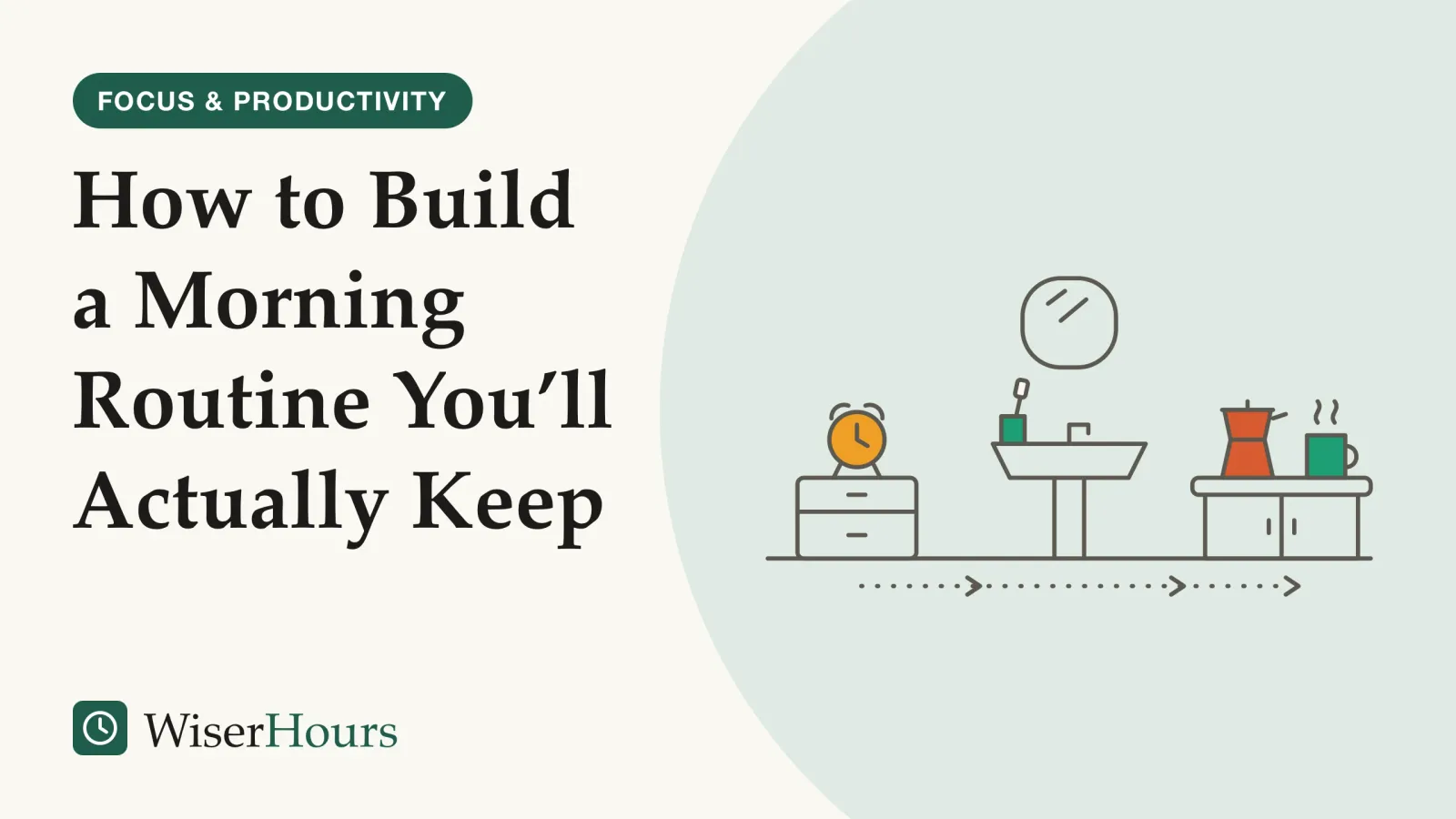
A familiar kind of plan gets written on a Sunday evening: up an hour earlier, then stretching, journaling, reading, a run, a cold shower and a proper breakfast. It lasts until the first late night. A week later only the coffee is left, and the coffee was there before the plan.
The coffee is the model for a morning routine you’ll actually keep: a few actions you value, each set off by something you already do, repeated until they run without a decision. In a 2021 randomized trial in Germany, tying a new daily eating or drinking action to an existing routine worked no better than tying it to a clock time; what went with stronger habits was doing the action at the chosen moment, day after day.1 Put into practice, that gives five steps:
- Hang each new step on something you already do
- Keep it to two or three steps you would miss
- Do the steps in the same order and place
- Write a short version for bad mornings
- Give it months before you judge it
A routine of many new habits runs on motivation
A morning routine made of many new actions runs on motivation until each one becomes a habit, and motivation fades. Writing for family doctors in 2012, Benjamin Gardner and his University College London colleagues Phillippa Lally and Jane Wardle boiled habit advice down to one instruction: repeat a chosen action in the same context until it becomes automatic. Once that link forms, the action depends less on attention and motivation.2
Seen that way, the Sunday plan asks for six or seven new habits at once, each still running on willpower. Every item needs a decision each morning, so one late night knocks out the whole list, while the coffee, needing no decision, survives. The mechanics are laid out in how habits work, from repeated action to automatic response; if your morning problem is something to stop, such as reaching for the phone in bed, begin with changing the cues that trigger a bad habit.
Complexity may matter as well as number, though the evidence is mixed. A 2024 systematic reviewsystematic review: A review that fixes its question and its rules for including studies in advance, then searches out every study that fits and weighs them together. Some systematic reviews pool the results into a meta-analysis; others describe what the studies found without combining the numbers.Full entry in the glossary of 20 habit-formation studies, led by Ben Singh at the University of South Australia, noted a pattern across studies: habit scores rose more in flossing programs than in exercise or healthy-eating ones, though the authors caution this may reflect how well the programs worked rather than the behaviors.3 Compared within one study, the picture is less clear: in Phillippa Lally’s 2010 study at University College London, eating, drinking and exercise habits showed no clear difference in how long they took to feel automatic, in groups the authors say were too small to settle it.4 On a real morning, starting with a glass of water or a short stretch and adding the full workout later is still a sensible order, for the reason Gardner and colleagues give for aiming small: failure can be discouraging.2
Count only the new steps
The coffee you already make costs nothing. Keep the genuinely new parts to two or three small actions at first; that number is our suggestion, not a tested one.
The cue matters less than meeting it every day
A 2021 randomized trial led by Jan Keller at Freie Universität Berlin, the most direct test we found of how to anchor a new daily action, found no difference between tying it to a clock time or to something you already do; what went with stronger habits was acting at that cue, day after day.
The study
Limited evidence
Breakfast cue or clock time: no difference, but showing up went with stronger habits
Participants picked a new eating or drinking action, most often a glass of water or a piece of fruit, and were randomly assigned to plan it after a daily routine, such as breakfast, or at a set clock time. Automaticity rose in both groups, with no difference between them. People who carried out their plan at its cue more often reported higher automaticity, and in a post hoc analysis, those who found the action rewarding in itself were more likely to form a habit.1
In practice, the choice of cue matters less than it is often made to sound; the working part is showing up at it. The caveats: participants were mostly young women, everything was self-reportedself-report: A measure in which people describe their own behavior, feelings or circumstances, usually by answering a questionnaire. When the same person supplies both of the things being compared, shared habits of answering can make the link between them look stronger than it is.Full entry in the glossary, the link between keeping the plan and automaticity is a correlation rather than a randomized comparison, and the authors suggest people in the clock-time group may have picked times when they were already doing something routine.
On an ordinary morning, say the new step is a glass of water. “At quarter past seven” works if you are reliably in the kitchen by then; “after I switch the kettle on” works if the kettle goes on every day. What decides the outcome is whether the glass gets filled at that moment on most mornings for months, and whether drinking it feels like something you want.
- A clock time: such as quarter past seven; it works when you are reliably up and in the kitchen by then
- Something you already do: such as switching the kettle on; it comes around whenever the morning starts
- Acting at the cue, most mornings: in a 2021 randomized trial of a new eating or drinking step, routine cues and clock times built habit strength about equally; carrying out the plan at the cue went with stronger habits
Most participants had still not formed a stable habit by the end of the trial, which is why the later steps are about keeping going rather than starting well. Pick the cue you will meet most reliably, then meet it.
Further reading
Good Habits, Bad Habits: The Science of Making Positive Changes That Stick
Wood's research on how repeating an action in the same setting makes it automatic, the idea behind each step of this routine.
As an Amazon Associate WiserHours earns from qualifying purchases.
Five steps to a morning routine that survives bad weeks
A morning routine that lasts comes down to five steps from habit research: anchor each new step, keep new steps few and wanted, fix their order and place, plan a short version, and allow months. The first has the most direct trial evidence; the rest are good bets rather than guarantees.
1. Hang each new step on something you already do
Write each new step as a sentence that starts with a moment you meet every morning: after I switch the kettle on, I drink a glass of water. Gardner and colleagues describe a cue that sits within a routine you already have as a convenient and stable place to start.2 A clock time works as well if your mornings keep to one, as Keller’s trial found, though the authors note earlier observational work suggesting routine cues need less monitoring: you notice that breakfast is finished without watching the clock.1
Where you can, put the new step after the old one. In a small exploratory study of 50 people published in 2013, Gaby Judah’s team reported that people asked to floss after brushing tended to form stronger flossing habits than those asked to floss before, and still flossed more often eight months later.5 We read only the abstract. The practical version: write the routine as a chain of “after X, I do Y” sentences and keep the list where the first X happens.
2. Keep it to two or three steps you would miss
Choose steps you want, not steps you feel you should want. Gardner and colleagues note evidence that a change picked for its personal value is an easier habit target.2 One study in Singh’s review found that habits people chose for themselves formed more strongly than assigned ones.3 A chapter of a novel with the first coffee, if you would miss it, is a better candidate than journaling adopted because someone else swears by it.
3. Do the steps in the same order and place
Do the steps in the same order and spot every morning, at least until they run on their own. Gardner and colleagues point out that the usual advice to vary a new behavior to keep it interesting works against automaticity, which grows from repeating one specific action in one context.2 So stretch on the same patch of floor before the coffee, not sometimes after it, and leave the book on the chair where you read it.
4. Write a short version for bad mornings
Decide in advance what the routine shrinks to when the morning goes wrong: one stretch instead of ten minutes, a page instead of a chapter. A single missed day is not the danger: in the habit study Gardner and colleagues summarize, missing an occasional day did not seriously set back the process.2
Gaps that grow are another matter. In years of check-in records from more than 30,000 members of a North American gym chain, analyzed by Anastasia Buyalskaya and colleagues in 2023, the strongest predictor of a visit on any day was the time since the last one: for most members, the longer the gap, the less likely a visit.6 Those data are observational and about gyms, but the lesson carries over: the short version exists to stop gaps forming.
After a lapse, the next morning is the restart; coming back from longer breaks, and the popular rule about never missing twice, are topics for their own guides.
5. Give it months before you judge it
Expect the routine to feel effortful for weeks and to ease slowly. Singh’s review, drawing on the four of its studies that timed habit formation, concluded that new health habits typically take months rather than weeks to become automatic, varying widely between people, and that 21-day challenges are unlikely to be enough.3
Judge the routine by how automatic each step feels, not by whether it survived three weeks; Gardner and colleagues suggest rating that once a week.2 A step that still feels like a fight after a couple of months is a candidate to swap, a rule of thumb that is ours rather than tested.
Set up a morning routine for the long run
Mornings may help, depending on your body clock
The case that mornings suit new habits is thin: a small 2017 experiment favored the morning, and a 2024 experiment in the US found that, for self-reported exercise, the answer depended on whether a person leans toward mornings or evenings.78 Treat the morning as a convenient slot, not a magic one.
In the 2017 study, Marion Fournier and colleagues randomly assigned 48 students to stretch either on waking or before bed and tracked for 90 days how automatic it felt. Projected forward, the morning group reached automaticity several weeks sooner, which the authors link to cortisol, a hormone that is high on waking and low at bedtime.7 We read only the abstract. Singh’s review based its conclusion that morning practice helps on this study alone, and rated it low in quality.3
L. Alison Phillips and colleagues at Iowa State University cite some evidence that behaviors and settings are steadier in the morning, and habits need steady settings to form. In their own 2024 experiment with young women students at a US university, exercise planned before noon or after 3 p.m. held up best over four weeks, by self-report, when its timing matched whether a person leaned toward mornings or evenings; evening types given a morning slot did worst. Step counters did not confirm the difference, and no cue plan beat a comparison group that set goals without one.8
The practical reading: use the morning for its predictability, not for heroics. Someone who gets up at one fixed hour has a steady cue handed to them; someone whose mornings start whenever the first meeting allows can still use getting up as the cue. If you are firmly an evening person, our reading of the Iowa State experiment is to keep the morning steps light and put demanding ones later. And if a routine only fits by waking earlier, check first what that does to your nights against practical sleep habits for busy adults.
How much weight each piece of advice can bear
The firmest evidence behind morning-routine advice is a single randomized trial on cues, Keller’s 2021 study; the rest comes from smaller or observational studies, expert advice and a 2024 systematic review whose studies were mostly rated low in quality.
| What it is | What the best evidence found | Evidence |
|---|---|---|
| Tie steps to a routine or a clock time | Both built habit strength about equally; acting at the cue went with stronger habits | Randomized trial, limited1 |
| Start with simple steps | Habit scores rose more in flossing programs than in exercise or eating ones, perhaps because of the programs; one direct comparison found no clear difference in time | Systematic review and field study, limited34 |
| Put the new step after an existing one | Flossing after brushing tended to form a stronger habit than flossing before | Small exploratory study, limited; abstract only5 |
| Choose steps you value | Self-chosen habits formed more strongly than assigned ones | One study in a systematic review, limited3 |
| Keep the order and place fixed | Varying a new behavior works against automaticity | Expert summary, limited2 |
| Keep going on bad mornings | Longer gaps predicted a lower chance of a gym visit | Observational, limited6 |
| Expect months, not weeks | New health habits typically took months to become automatic | Systematic review, limited3 |
| Do new steps in the morning | A stretch on waking was projected to become automatic sooner than one at bedtime | Small trial, limited; abstract only7 |
| Match timing to your body clock | Exercise held up best over four weeks when timing fit morning or evening preference; step counts did not confirm it | Randomized trial, limited8 |
If you act on only one row, make it the first: pick a cue you meet every morning and act at it, most mornings, for months.
The bottom line
A morning routine lasts when it asks for few new decisions: two or three steps you value, each hung on something you already do, in the same order and place, with a short version for bad days. The kind of cue matters less than meeting it, so pick the one you will meet most reliably and give the routine a few months before you judge it.
Frequently asked questions
What if my mornings are unpredictable, with shift work or young children?
Anchor the steps to events rather than clock times. Gardner, Lally and Wardle recommend a cue that comes around every day of the week, and in Keller's 2021 trial a routine cue, such as after breakfast, built habits as well as a set time did. Getting up, or pouring the first coffee, still happens daily whatever the hour. Keep the short version ready for the mornings that belong to someone else.
Do morning routines make you more productive?
Our searches turned up no study testing whether having a morning routine makes people more productive. The research behind this guide measures something narrower: how quickly single actions, such as drinking water, eating fruit or stretching, come to feel automatic. What a routine does for your day depends on what you put in it; habit research only speaks to how to make the chosen steps stick.
How long should a morning routine take?
We found no study of an ideal length. The research behind this guide concerns how many new steps to add and how simple they are, not minutes. Gardner, Lally and Wardle advise small, manageable changes, because failure can be discouraging, so a routine that fits inside the time you already have is a safer start than one that needs an earlier alarm.
Sources
- Habit formation following routine-based versus time-based cue planning: A randomized controlled trial. Keller, J., Kwasnicka, D., Klaiber, P., Sichert, L., Lally, P. & Fleig, L. (2021). British Journal of Health Psychology, 26(3), 807-824
- Making health habitual: the psychology of 'habit-formation' and general practice. Gardner, B., Lally, P. & Wardle, J. (2012). British Journal of General Practice, 62(605), 664-666
- Time to Form a Habit: A Systematic Review and Meta-Analysis of Health Behaviour Habit Formation and Its Determinants. Singh, B., Murphy, A., Maher, C. & Smith, A. E. (2024). Healthcare, 12(23), 2488
- How are habits formed: Modelling habit formation in the real world. Lally, P., van Jaarsveld, C. H. M., Potts, H. W. W. & Wardle, J. (2010). European Journal of Social Psychology, 40(6), 998-1009
- Forming a flossing habit: An exploratory study of the psychological determinants of habit formation. Judah, G., Gardner, B. & Aunger, R. (2013). British Journal of Health Psychology, 18(2), 338-353
- What can machine learning teach us about habit formation? Evidence from exercise and hygiene. Buyalskaya, A., Ho, H., Milkman, K. L., Li, X., Duckworth, A. L. & Camerer, C. (2023). Proceedings of the National Academy of Sciences, 120(17), e2216115120; correction published 2023
- Effects of circadian cortisol on the development of a health habit. Fournier, M., d'Arripe-Longueville, F., Rovere, C., Easthope, C. S., Schwabe, L., El Methni, J. & Radel, R. (2017). Health Psychology, 36(11), 1059-1064
- Evaluating the impact of individuals' morningness-eveningness on the effectiveness of a habit-formation intervention for a simple and a complex behavior. Phillips, L. A., More, K. R., Russell, D. & Kim, H. S. (2024). Journal of Behavioral Medicine, 47(5), 804-818
How we researched this
Searches of OpenAlex, Crossref and PubMed in September 2026 looked for trials, field studies and systematic reviews on forming daily habits, choosing cues and the time of day, preferring randomized and pooled evidence. Six of the eight sources were read in full; for the other two only the abstract was available, and the article uses nothing beyond it. Sources date from 2010 to 2024. The main limitation: we found no test of a whole morning routine; most studies track single actions in small samples, often students, with self-reported habit strength.
Keep reading
How to Build a Reading Habit: 20 Pages a Day
How to build a reading habit: 20 pages a day takes about 20 to 25 minutes. Tie it to a fixed moment, keep the phone away, and read hard books on paper.
Habit Trackers: Do They Work, and Which Kind Should You Use?
A habit tracker helps you repeat an action, yet use fades: in one French study, 16% still used a tracker after 320 days. What works, and which kind to pick.
How to Build a New Habit: A Step-by-Step Guide
How to build a new habit in 6 steps from habit trials: one wanted action, a daily cue, a small start, a written record, loose timing and a restart plan.
How to Build an Exercise Habit That Lasts
How to build an exercise habit: the WHO target is 150 minutes a week, but start far below it, make starting automatic and plan how you come back after a miss.