How Long Does It Really Take to Form a Habit? (It's Not 21 Days)
Two studies that timed habit formation found medians of about two months, with individuals taking 4 to 335 days. Where 21 days came from, and what helps.

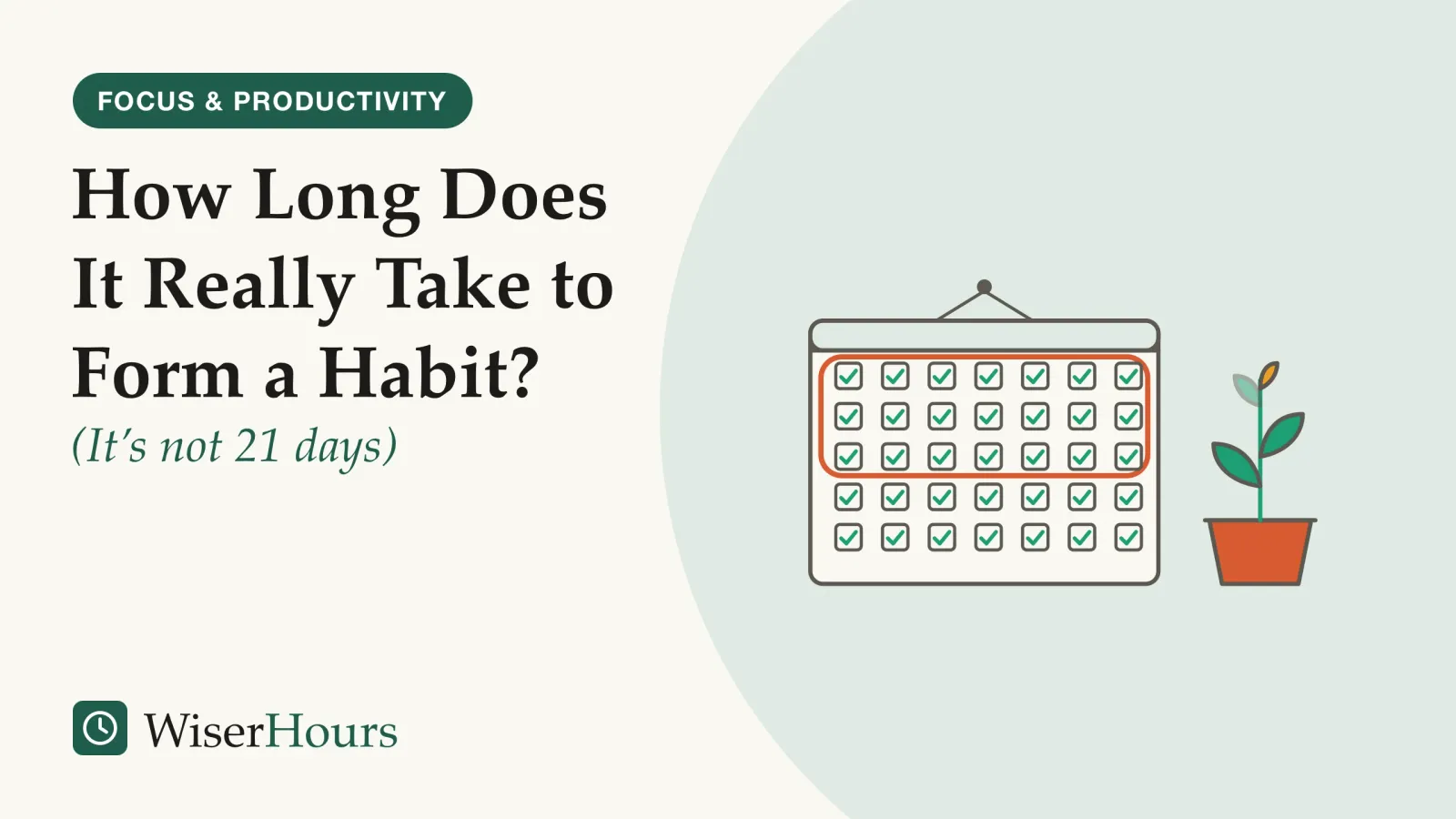
The 21-day rule for habits started as a plastic surgeon’s remark about patients getting used to a new face, and the studies that have timed habit formation do not back it. When researchers at University College London tracked new habits day by day, one volunteer got there in under three weeks and another was projected to need most of a year.1
So how long does it take to form a habit? For a simple daily action, plan on two to three months of repetition, and expect your own number to differ. A 2024 systematic review by University of South Australia researchers found only four studies that timed habit formation: the two that reported medians put them at about two months, the other two reported averages of about three to five months, and individuals took anywhere from 4 to 335 days.2 The 66-day median that how habits work explains is one of those four.
That points to three decisions worth making on day one. Choose an action simple enough to repeat every day, link it to something that happens every day, and put a review in your calendar about ten weeks out, the span Gardner, Lally and Wardle suggest people expect for a daily action.3 And if you miss a day along the way, carry on the next time the cue comes round: when a UK research team checked, a single miss barely registered.4
The 21-day rule began as a remark about new faces
The 21 days comes from the preface of Psycho-Cybernetics, a 1960 self-help book by the American cosmetic surgeon Maxwell Maltz, and his examples were about adjusting to change, not about forming habits.1 The book became a long-running bestseller that influenced many later self-help teachers.5
It usually requires a minimum of about 21 days to effect any perceptible change in a mental image.
His evidence was everyday observation: surgery patients getting used to a new face, the feeling of a “phantom limb” fading after an amputation, and a new house starting to feel like home. None of that involves doing something automatically in response to a cue, which is what psychologists mean by a habit. In 2012, Benjamin Gardner and Susanne Meisel of University College London traced the rule to this passage and offered two possible explanations for how it drifted. One is a mix-up between habituation, which means getting used to something, and habit formation. The other is Maltz’s claim elsewhere in the book that self-image and habits change together, which readers may have stretched into a timeline for habits.1 Somewhere along the way, “a minimum of about” dropped out.
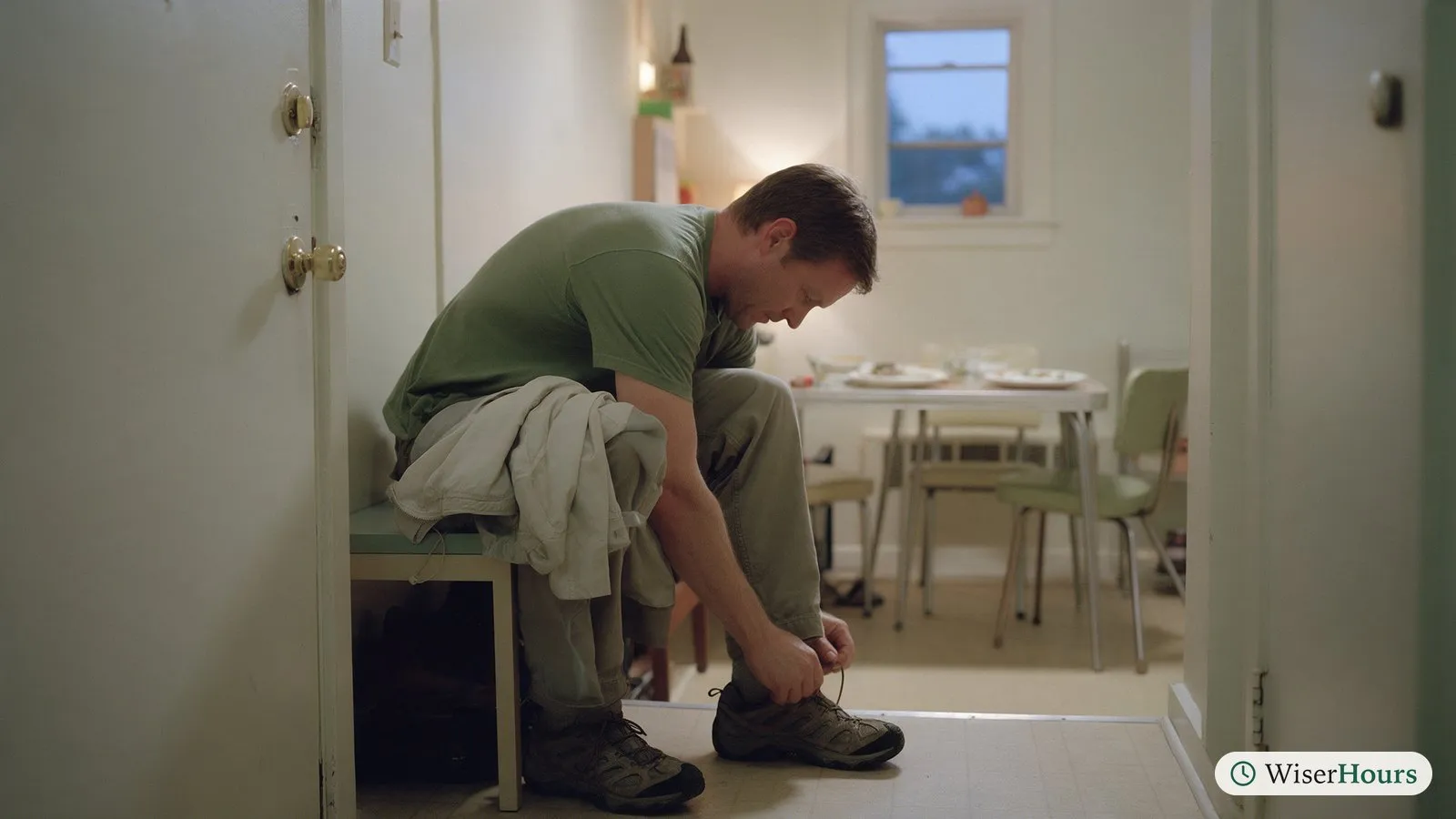
The difference shows up in ordinary life. Three weeks into a new routine of evening walks, the walks may stop feeling strange: that is getting used to them. A habit is something else: dinner ends, and your shoes are on before you have given it a thought. At three weeks, expect a new action to feel familiar rather than automatic, and don’t read the missing autopilot as failure.
How long does it take to form a habit? Months, and it varies
The studies that timed habit formation agree that it typically takes months rather than weeks, and on large differences between people. The two most detailed, a 2010 UK study led by Phillippa Lally and a 2021 randomized trial run in Germany by Jan Keller’s team, used the same method: volunteers repeated one daily action after a cue and, every day for 12 weeks, rated how automaticautomaticity: How far a behavior runs by itself, triggered by a familiar context with little thought or effort. Habit researchers use it to measure how strong a habit has become, usually by asking people to rate it.Full entry in the glossary it felt.46
Each person’s ratings were fitted to a curve that climbs fast and then flattens, and the habit counted as formed when the curve reached 95 percent of its plateau, a cut-off Lally’s team chose because the curves looked flat by then.4 So “66 days” is not the day a switch flips. It is roughly when more repetition stops making the action feel much easier.
Keller’s trial adds a sobering detail. Just 27 of the 117 volunteers analyzed, under a quarter, showed a clear habit forming, and they took a medianmedian: The middle value when numbers are put in order, so half fall below it and half above. Unlike the average (mean), it is not pulled up or down by a few very large or very small values, which is why it is often used for incomes and wealth.Full entry in the glossary of 59 days, with a range stretching to most of a year.6 In Lally’s study, about half the volunteers did not perform the behavior consistently enough to count as having formed a habit.4 Both long upper limits are forecasts drawn from each person’s curve, since nobody was followed for a year.
The review, led by Ben Singh, found 20 studies of new health habits, with 11 judged at high risk of bias, but just four that timed habit formation. Its authors conclude that a 21-day challenge probably won’t suffice and that people should allow at least two to five months for a new health habit.2
| Study | What people were forming | What it found | Evidence |
|---|---|---|---|
| Lally and colleagues, 2010 (UK) | One daily eating, drinking or exercise action | 66 days at the median; individuals from 18 to 254, among 39 people whose data fitted the model | Observational, self-reported; limited4 |
| Keller and colleagues, 2021 (Germany) | One daily nutrition action | Median 59 days among the 27 of 117 analyzed volunteers who formed a habit | Randomized trial of two cue types; limited6 |
| Kaushal and Rhodes, 2015 (Canada) | Exercise, among 111 new gym members | At least four workouts a week for six weeks to establish the habit | Observational, 12 weeks; limited (abstract only)7 |
Picture two colleagues who both start drinking a glass of water after lunch on the same Monday. One may find her hand reaching for the glass within a few weeks; the other may still be reminding himself in month four. Both sit inside the ranges these studies found. Use two to three months as a planning figure, and if week eight arrives and the action still takes effort, you are within the normal range.
Why hand-washing took weeks and the gym took months
Frequent, simple actions seem to turn habitual sooner, and the strongest evidence for that is a 2023 observational study in the Proceedings of the National Academy of Sciences that applied machine learning to years of gym check-ins and hospital hand-washing records.
The study
Limited evidence
Two habits, two speeds: gym check-ins and hospital hand-washing, 2023
Anastasia Buyalskaya and colleagues, including behavioral scientists Katherine Milkman and Angela Duckworth, tracked roughly 30,000 people from their first day at a North American gym chain, and about 3,000 hospital care workers whose hand-washing was logged by sensors. Rather than asking people how automatic an action felt, they measured how predictable each person’s behavior became from context, such as the day of the week or their last shift. Hand-washing became predictable after about 9 to 10 shifts; gym-going took about 2 to 3 months, a figure the authors revised downward in a published correction.8
The authors offer frequency and complexity as one possible explanation. A care worker faces dozens of chances to wash their hands in a single shift, each a short chain of movements. The average gym member in the study visited once every four to six days, and gym-going is, in the authors’ words, a less frequent and more complex behavior.8 Predictable is not the same as automatic, since a fixed work schedule can make someone predictable too, and many of the care workers had probably built part of the habit before the sensors went in.
Smaller studies point the same way. In the Canadian study of new gym members in the table, consistency, low complexity and enjoying exercise were among the factors that predicted how much the habit grew.7 In Lally’s study, exercise took about one and a half times as long as eating or drinking habits, though the difference was not statistically significant in a study too small to test it.4 Gardner, Lally and Wardle’s 2012 advice for family doctors sums it up: simpler actions become habitual more quickly.3
The chart below shows the pattern in outline: both kinds of action climb quickly at first and then level off, but the frequent, simple one levels off much sooner.
- A frequent, simple action: such as hand-washing on hospital shifts, with many chances a day: it became habitual within weeks
- A less frequent, more complex action: such as going to the gym: it took months
- One missed day: a very small dip, and the climb carries on when you resume
What speeds a habit up, and what slows it down
Habits tended to be stronger when the action was repeated often, kept simple, done in a stable setting and enjoyed, according to the Singh review of the studies so far. Its authors also suggest that actions with clear cues and immediate rewards, such as flossing or drinking water, are easier to automate than healthy eating or exercise, while noting that differences between the programs tested may explain part of that gap.2
Acting when the cue arrived seemed to matter more than which cue it was. In Keller’s trial, volunteers randomly assigned to a time-of-day cue or to a cue from their daily routine ended up no different, while repeatedly carrying out the plan at the cue was a key predictor of how automatic the action became.6 Sameness matters too. Gardner, Lally and Wardle warn that varying an action to keep it interesting, such as a different fruit at a different meal each day, may stave off boredom but works against automaticity.3
Take someone who wants a strength habit. Three gym sessions a week give them only a handful of repetitions, each a long sequence of choices. Ten squats every morning after brushing their teeth give them one short, identical repetition a day at a fixed cue. The research suggests the second will feel automatic sooner, and it can sit alongside the gym rather than replace it. How small to start, and how to write the plan down, are set out in our step-by-step plan for building a new habit.
What a missed day does to a forming habit
A single missed day barely registers. In Lally’s study, automaticity dipped by a very small amount after a missed day, and the authors concluded that a single miss did not materially affect habit formation; a miss early in the process was no worse than one later on, though they had few cases to test that.4
Say a client dinner on Thursday wipes out your after-dinner walk. On that finding, Friday’s walk should feel almost as automatic as Wednesday’s, and the climb carries on from there. The loss is one repetition, and the weeks of practice behind it stay.
Longer gaps behave differently. Lally’s team cite an earlier exercise study where skipping a full week was linked to less exercise afterwards, and they suggest such gaps hinder the habit. Overall consistency also mattered: in Lally’s study, the people who performed the behavior less often tended to end with weaker habits or no clear habit at all.4 In the gym records, nothing predicted whether a member would show up on a given day better than how long it had been since their previous visit.8
Treat a missed day as a pause and keep counting. The gap to watch is the one that stretches toward a week. A simple record makes that stretch visible, and how a habit tracker can help or backfire explains which kinds are worth using.
When the ten-week review arrives
Treat it as a check on how the habit is going. If the action still takes effort, you are within the ranges the timing studies found. Gardner, Lally and Wardle point out that the action gets progressively easier with repetition, so staying motivated matters only until the habit has formed.3
What nobody has measured yet
The evidence on habit timing is thin, and three gaps limit what any number can tell you. The volunteers were young: Lally’s were mostly postgraduate students, average age 27.4 Almost every study in the Singh review measured habits by people rating their own automaticityself-report: A measure in which people describe their own behavior, feelings or circumstances, usually by answering a questionnaire. When the same person supplies both of the things being compared, shared habits of answering can make the link between them look stronger than it is.Full entry in the glossary on a questionnaire, and it excluded studies of stopping behaviors.2
Breaking a habit has barely been timed either. In the one daily-life study of it we found, a 2025 Swiss study of 194 adults trying to cut back an unhealthy habit, self-rated habit strength usually fell fastest at first and then leveled off, anywhere from 1 to 65 days in among those whose curves could be timed.9
We could find no study timing weekly habits. For a weekly habit such as a Friday review, the repetition logic above suggests expecting a much longer stretch of calendar time than for a daily one, because each week brings only one chance to practice. That is an inference from the daily studies, not a measured result. Until someone times weekly habits directly, all that can be said is a range and a set of conditions.
The bottom line
Forget the 21 days: it came from a surgeon’s observations about getting used to change. In the two timing studies that reported medians, the middle person took about two months, and individuals ranged from days to most of a year. Choose a simple action you can repeat daily at a fixed cue, expect around ten weeks, and after a missed day just do it again the next time the cue appears.
Frequently asked questions
When does a new habit start to feel easier?
Usually early. In the 2010 University College London study led by Phillippa Lally, the first repetitions produced the largest jumps in how automatic a new action felt, and each later one added less until the curve leveled off. Gardner, Lally and Wardle, advising family doctors in 2012, note that the behavior gets progressively easier, so people only need to stay motivated until the habit forms.
Do older people take longer to form habits?
There is little evidence either way. The studies that timed habit formation mostly followed young adults. In the 2023 gym study by Anastasia Buyalskaya and colleagues, older members living in less densely populated areas had somewhat more predictable, habit-like attendance, but the authors describe most of these demographic effects as small, and its main report does not compare how fast habits formed by age.
Is there a timeline for quitting an old habit?
Only a rough one, from a single study. In a 2025 Swiss study of 194 adults trying to cut back an unhealthy habit, self-rated habit strength usually fell fastest at first and leveled off anywhere from 1 to 65 days in, varying widely between people. The 2024 Singh review left out quitting studies, so its timings apply only to new habits. Gardner, Lally and Wardle add that breaking a habit calls for different, more effortful strategies.
Sources
- Busting the 21 days habit formation myth. Gardner, B. & Meisel, S. (2012). Health Chatter blog, Research Department of Behavioural Science and Health, University College London
- Time to Form a Habit: A Systematic Review and Meta-Analysis of Health Behaviour Habit Formation and Its Determinants. Singh, B., Murphy, A., Maher, C. & Smith, A. E. (2024). Healthcare, 12(23), 2488
- Making health habitual: the psychology of 'habit-formation' and general practice. Gardner, B., Lally, P. & Wardle, J. (2012). British Journal of General Practice, 62(605), 664-666
- How are habits formed: Modelling habit formation in the real world. Lally, P., van Jaarsveld, C. H. M., Potts, H. W. W. & Wardle, J. (2010). European Journal of Social Psychology, 40(6), 998-1009
- Maxwell Maltz. Wikipedia (accessed 2026-09-28)
- Habit formation following routine-based versus time-based cue planning: A randomized controlled trial. Keller, J., Kwasnicka, D., Klaiber, P., Sichert, L., Lally, P. & Fleig, L. (2021). British Journal of Health Psychology, 26(3), 807-824
- Exercise habit formation in new gym members: a longitudinal study. Kaushal, N. & Rhodes, R. E. (2015). Journal of Behavioral Medicine, 38(4), 652-663
- What can machine learning teach us about habit formation? Evidence from exercise and hygiene. Buyalskaya, A., Ho, H., Milkman, K. L., Li, X., Duckworth, A. L. & Camerer, C. (2023). Proceedings of the National Academy of Sciences, 120(17), e2216115120; correction published 2023, doi 10.1073/pnas.2312763120
- The temporal trajectories of habit decay in daily life: An intensive longitudinal study on four health-risk behaviors. Edgren, R., Baretta, D. & Inauen, J. (2025). Applied Psychology: Health and Well-Being, 17(1), e12612
How we researched this
Studies that timed how long new habits take to form were sought in September 2026 in three databases (Crossref, PubMed and Europe PMC), and we followed the 21-day claim to where it began. Each source whose details appear here was read in full, apart from one Canadian gym study that we could see only as an abstract. The evidence runs from 2010 to 2025, plus a 1960 book quoted by researchers. Main limitation: few studies have timed habit formation, and most relied on young volunteers rating their own automaticity.
Keep reading
How Habits Work: The Cue–Routine–Reward Loop Explained
How habits work: repetition links a setting to an action until the setting starts it. Why the reward matters less than the loop says, and what 66 days means.
Habit Stacking: How to Attach New Habits to Old Ones
Habit stacking ties a new habit to one you already do. A 5-step method, 14 examples for work and home, and what the if-then research behind it shows.
Urge Surfing: Riding Out Cravings Without Giving In
Urge surfing in 5 steps: notice a craving, feel it in your body and let it pass. What the evidence shows, how long urges last, and when to get help.
How to Build a Reading Habit: 20 Pages a Day
How to build a reading habit: 20 pages a day takes about 20 to 25 minutes. Tie it to a fixed moment, keep the phone away, and read hard books on paper.