How to Build a New Habit: A Step-by-Step Guide
How to build a new habit in 6 steps from habit trials: one wanted action, a daily cue, a small start, a written record, loose timing and a restart plan.

A strict schedule is not the surest way to make a new behavior stick. Google employees at several US offices were once offered a small payment for each weekday workout at the company gym, some of them only if they started inside a time slot they had picked in advance. In that 2015 randomized trial, employees paid only for workouts in their fixed slot went to the gym less often than those paid for workouts at any time, both while the payments ran and after they stopped.1
The evidence on how to build a new habit favors a plan with some give in it: one small action you want, tied to something you do every day, repeated at that moment until the moment itself starts the action. Step by step:
- Choose one action you would do for its own sake
- Tie it to a moment you meet every day
- Start with a version short enough for your worst day
- Do it at the cue, and mark it down
- Reward the doing, not the time slot
- After a missed day, carry on at the next cue
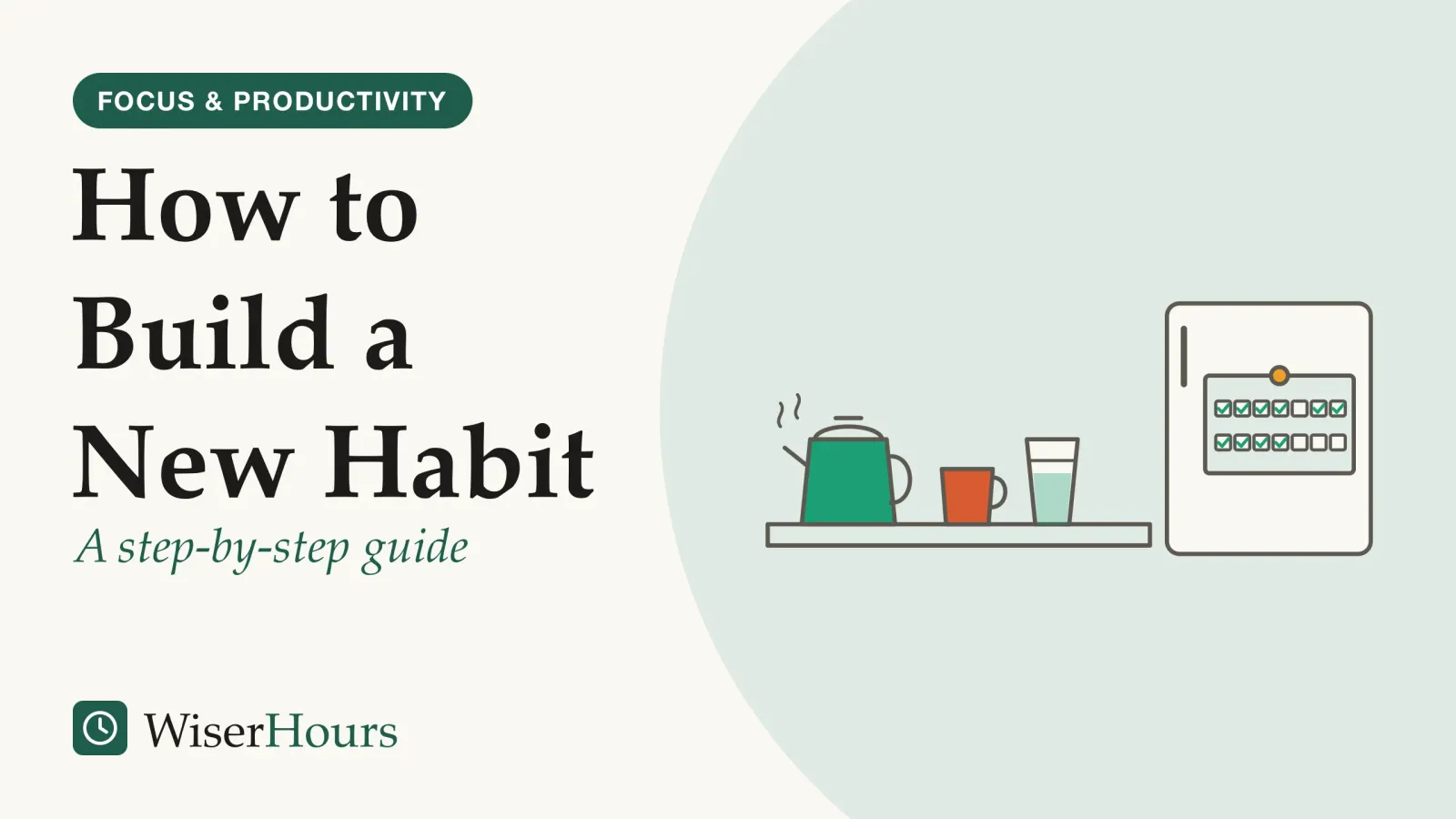
On paper, the whole plan can fit on one line stuck to the fridge: after I switch on the kettle in the morning, I fill a glass of water, finish it and tick the day’s box, and if I miss a morning, I pick it up at the next kettle.
Motivation starts a habit; repetition finishes it
A new habit forms in three phases, according to a 2012 paper in the British Journal of General Practice by UCL’s Benjamin Gardner, with Phillippa Lally and Jane Wardle: you choose an action and a cue, you repeat the action at that cue until the link between them strengthens, and then the habit runs with little effort or thought. Motivation matters most at the start, and the authors argue it only has to hold until the habit forms, because the action gets easier with every repeat.2
That is the core of how habits work: repetition in a stable setting links a cue to an action until the cue alone sets it off.
The middle phase is where many attempts stall. In a 2021 randomized controlled trialrandomized controlled trial: A study that assigns participants to the treatment or the comparison group at random, so the groups start out alike and a difference in what happens next can be put down to the treatment. Random assignment makes the two groups comparable; it does not make the people in the trial representative of anyone else.Full entry in the glossary in Germany led by Jan Keller, adults chose one new daily food or drink habit, most often drinking water, and filled in a short report every evening for 12 weeks. Of those who stuck to the study’s instructions, only about one in four showed rising automaticityautomaticity: How far a behavior runs by itself, triggered by a familiar context with little thought or effort. Habit researchers use it to measure how strong a habit has become, usually by asking people to rate it.Full entry in the glossary that then leveled off, the pattern of a habit taking hold. Participants who most often did the action right at their planned cue were the likeliest to feel it becoming automatic.3
Picture a plan to stretch for five minutes after brushing your teeth at night. The first week runs on novelty. By the fourth, it competes with tiredness most evenings, and every evening it is a fresh decision. The steps below are built for those middle weeks. A good plan is one that still works on a tired Thursday, not one that looks impressive on day one.
Flexible plans outlasted rigid ones in a trial at Google
The strongest test we found of how strict a new-habit plan should be is a 2021 paper by John Beshears, Katherine Milkman and colleagues on that Google trial: rewarding workouts at any time built more gym-going than rewarding workouts in a fixed time slot, while the rewards ran and after they ended.1
The study
Moderate evidence
Google's gym trial paid some staff for timing and others for turning up
Employees chose a two-hour weekday window for their workouts. Those paid only for workouts started inside it made more visits in the window but fewer visits overall than those paid for a workout at any time of day. In the four weeks after payments stopped, the any-time group was about 6 percentage points more likely to visit the gym in a given week. Even employees not paid for timing started only about half of their weekday workouts inside the window they had picked.1
The fixed slot did build something: afterward, people who had been paid for it kept a larger share of their workouts inside their window, a sign, in the authors’ view, of a routine forming. The price was every workout that could not fit. A meeting that runs late turns a fixed-slot plan into no workout and a flexible plan into a later one. The caveats: one company’s volunteers, gym visits rather than fitness, and small differences once the payments ended.1
Payments alone did little for lasting habits in another trial. In a 2018 study led by Mariana Carrera, paying new members of a gym in a Midwestern US city for regular visits during their first six weeks barely changed how often they went, and made no difference to their visits once the money stopped.4 The same pattern, strong while rewards last and faint afterward, runs through the research on building an exercise habit.
- Paid only inside a fixed time slot: more workouts fell in the slot, but there were fewer workouts overall
- Paid for a workout at any time of day: times varied, and there were more workouts overall, while the payments ran and after they stopped
“After my first coffee, whenever that is” survives a late start; “at seven sharp” does not.
How to build a new habit that survives week four
Six steps, drawn from habit trials and field data, turn the idea into a plan: choose an action you want, tie it to a daily cue, start small, act at the cue and record it, reward the doing, and resume after misses. Steps 4 and 5 have the strongest evidence behind them.
1. Choose one action you would do for its own sake
Pick the new action yourself, for its value to you. Gardner and colleagues cite evidence that a change chosen for its personal value, rather than to satisfy someone else, is an easier habit target.2 In Keller’s trial, people who found their chosen action rewarding in itself were likelier to end up with a stable habit, though that came from an analysis run after the trial, so it cannot show cause and effect.3
A walk after lunch because you like the air is a better candidate than a run because a colleague swears by it. Choose one action and let the others wait; how many to take on at once deserves its own guide.
2. Tie it to a moment you meet every day
Attach the action to a cue you meet daily, and write it as one sentence: after I sit down at my desk, I write the day’s first task on a card. Gardner and colleagues describe a good cue as an event or a time of day that you notice often and consistently, ideally every day of the week.2
Whether the cue is a clock time or an existing routine matters less than you might expect. Keller’s trial compared the two directly and found no difference in how automatic the new action became.3 A 2026 meta-analysismeta-analysis: A study that combines the results of earlier studies on the same question into one overall estimate. Pooling makes the estimate more precise, but it cannot repair the studies it pools: a meta-analysis of surveys is still survey evidence.Full entry in the glossary of 14 studies on physical activity, led by Lianghao Zhu, found that keeping timing, place, routine, company and mood consistent was linked to stronger exercise habits, though the associations were small (abstract only).5
The lesson is to pick the cue you are surest to meet on your worst day and put the new action straight after it. A cue that only exists on good days, such as “when I get a quiet moment”, will not do the job.
3. Start with a version short enough for your worst day
Start with the smallest version that still counts as doing it. Gardner and colleagues recommend small, manageable changes, since failing at a big one can put people off, and suggest walking one or two extra bus stops rather than the whole route.2 In a 2019 US online survey of 459 adults, behaviors people rated as more complex were less automatic, a cross-sectionalcross-sectional: Describes a study that measures everyone in its sample at a single point in time. Because the possible cause and the outcome are recorded together, it can show that two things occur together but not which of them came first.Full entry in the glossary link that fits the advice without proving it.6
The popular version, start absurdly small and let momentum carry you, has barely been tested. The only direct trial we found is an unpublished 2022 honours thesis from MacEwan University in Canada: 44 students tried to floss daily for four weeks, and half were told to floss just one tooth whenever they didn’t feel like it. The tactic added no measurable benefit, although students who used it felt it helped.7
So treat the tiny version as insurance for bad days rather than a shortcut: one page, one stretch, one line. Grow the action once it runs at its cue without a debate.
4. Do it at the cue, and mark it down
Do the action every time you meet the cue, and record that you did. Benjamin Harkin and colleagues combined the results of 138 randomized studies in 2016: asking people to monitor their own progress helped them attain their goals, and more so when the monitoring was written down or shared with others.8
The simplest record is the tick-sheet Gardner and colleagues designed: a box for each day and, once a week, a score from 1 to 10 for how automatic the action feels.2 If you prefer an app or a wearable, what the research says about habit trackers compares the kinds.
Watch the rating rather than the calendar. A 2024 systematic reviewsystematic review: A review that fixes its question and its rules for including studies in advance, then searches out every study that fits and weighs them together. Some systematic reviews pool the results into a meta-analysis; others describe what the studies found without combining the numbers.Full entry in the glossary led by Ben Singh concluded that new health habits can start forming within about two months, with wide variation between people, so a low rating in week three is no reason to quit.9
5. Reward the doing, not the time slot
Use rewards to get through the middle weeks, and tie them to doing the action at all rather than doing it at a set hour, as the Google trial suggests. The reward can be small: the tick itself, or a coffee you have only after the walk.
Expect rewards to matter less once the habit forms. Anastasia Buyalskaya and colleagues analyzed years of check-in data covering more than 30,000 people at a large gym chain in North America in 2023, and the members whose visits were easiest to predict, a sign of habit, were the least moved by a program designed to raise attendance.10 A formed habit keeps going without the prize, which is the point of building one.
6. After a missed day, carry on at the next cue
A missed day is a gap to step over, not a reason to start again. In a 2010 study by Phillippa Lally’s team at University College London, the first formal test of the question, one missed day lowered how automatic the new behavior felt by a very small amount, and progress carried on once people resumed. A longer break may be different: the team cite older exercise research in which a lapse of a whole week predicted less exercise afterward.11
In Buyalskaya’s gym records, the time since the last visit was the strongest predictor of whether a member went on a given day, and for most members the chance of a visit fell as the gap grew.10
- Myth
- Miss one day and you are back to square one.
- Fact
- In a 2010 UK study of new daily habits, one missed day barely dented how automatic the action felt, and progress resumed the next day. Longer lapses may matter more.
So settle the restart ahead of time: the short version from step 3, at the next cue, with no make-up session. The never-miss-twice rule, and coming back after weeks away, each need a separate guide.
The plan on one page
How much testing sits behind each step
Recording progress and keeping timing flexible have the strongest evidence behind them, while the advice to start small rests mostly on reasoning. The table lists each step, the firmest evidence we found on it and how solid that evidence is.
| Step | What the best evidence found | Evidence |
|---|---|---|
| Choose an action you value | People who found their action rewarding in itself were likelier to form a habit | Analysis run after one trial, limited3 |
| Tie it to a daily cue | Clock times and existing routines worked equally well as cues | Randomized trial, limited3 |
| Start small | The one direct test found a “floss one tooth” rule added nothing for 44 students; the rest is reasoning | Unpublished thesis, limited7 |
| Act at the cue and record it | Keeping track of progress helped people reach goals, and a written record helped more | Meta-analysis of randomized studies, moderate8 |
| Reward the doing, not the slot | Rewards for any-time workouts built more gym visits than rewards for a fixed slot | Randomized field experiment, moderate1 |
| Resume after a miss | One missed day barely slowed progress; a week-long lapse predicted less exercise | Field study, limited11 |
In practice, put most of your effort into the record and the loose timing, and treat the other steps as sensible starting points you can adjust.
When your days have no fixed shape
The studies behind these steps mostly followed students, office employees and gym members with fairly regular days, so people on rotating shifts, carers and anyone whose week keeps changing are close to an evidence gap. Nobody we found has measured how habits form around rotating schedules.
The steps still point somewhere useful. Gardner and colleagues count events as cues, not only clock times, so “when I get home from a shift” can work as well as a set hour.2 A nurse on rotating shifts might tie a short stretch to taking off her work shoes, whatever time that happens, which also keeps the timing loose. If your week has no fixed shape, anchor the habit to something that happens on every kind of day, not to the clock.
The bottom line
Plan for week four, not day one: one action you value, one cue you meet every day, a version small enough for a bad day, a record, and a restart after misses. Keep the cue fixed and the clock loose; in the strongest trial we found, flexible timing led to more gym visits than a fixed slot did, during the rewards and after.
Frequently asked questions
Does it matter what time of day you start a new habit?
Too little evidence exists to say. Ben Singh's 2024 systematic review, from the University of South Australia, reported that morning practice generally went with greater habit strength, but that rests on one stretching study the reviewers rated at high risk of bias. A moment you reliably meet every day is better supported than any particular hour.
Does telling other people about a new habit help?
It may. Benjamin Harkin's 2016 review of randomized studies, from the University of Sheffield, found that tracking progress did more for goal attainment when people reported their results to someone or published them than when they kept them private. Those studies tested goals in general, not habit strength.
Can a habit form if you only do it on weekdays?
We found no study comparing weekday-only habits with daily ones. Most habit-formation studies asked for a daily action, and the University College London team behind the habit tick-sheet advise choosing a cue you meet every day of the week. If your weekends look different, pick a cue that happens on them too.
Sources
- Creating Exercise Habits Using Incentives: The Trade-off Between Flexibility and Routinization. Beshears, J., Lee, H. N., Milkman, K. L., Mislavsky, R. & Wisdom, J. (2021). Management Science, 67(7), 4139-4171
- Making health habitual: the psychology of 'habit-formation' and general practice. Gardner, B., Lally, P. & Wardle, J. (2012). British Journal of General Practice, 62(605), 664-666
- Habit formation following routine-based versus time-based cue planning: A randomized controlled trial. Keller, J., Kwasnicka, D., Klaiber, P., Sichert, L., Lally, P. & Fleig, L. (2021). British Journal of Health Psychology, 26(3), 807-824
- Can financial incentives help people trying to establish new habits? Experimental evidence with new gym members. Carrera, M., Royer, H., Stehr, M. & Sydnor, J. (2018). Journal of Health Economics, 58, 202-214
- Not all cues are equal: A systematic review and three-level meta-analysis of context consistency, physical activity and habit strength. Zhu, L., Tao, Y., Zhou, B., Ma, H., Kaushal, N., Ma, X., Guo, Y., Zhao, R., Oguntuase, S. B., Li, H. & Zhang, L. (2026). Applied Psychology: Health and Well-Being, 18(4), e70204
- Habits, Quick and Easy: Perceived Complexity Moderates the Associations of Contextual Stability and Rewards With Behavioral Automaticity. McCloskey, K. & Johnson, B. T. (2019). Frontiers in Psychology, 10, 1556
- Is "Just-Get-Started" an Effective Self-Management Tactic to Improve Flossing? Touznik, J. (2022). Unpublished honours thesis, Department of Psychology, MacEwan University, Canada
- Does monitoring goal progress promote goal attainment? A meta-analysis of the experimental evidence. Harkin, B., Webb, T. L., Chang, B. P. I., Prestwich, A., Conner, M., Kellar, I., Benn, Y. & Sheeran, P. (2016). Psychological Bulletin, 142(2), 198-229
- Time to Form a Habit: A Systematic Review and Meta-Analysis of Health Behaviour Habit Formation and Its Determinants. Singh, B., Murphy, A., Maher, C. & Smith, A. E. (2024). Healthcare, 12(23), 2488
- What can machine learning teach us about habit formation? Evidence from exercise and hygiene. Buyalskaya, A., Ho, H., Milkman, K. L., Li, X., Duckworth, A. L. & Camerer, C. (2023). Proceedings of the National Academy of Sciences, 120(17), e2216115120; correction published 2023
- How are habits formed: Modelling habit formation in the real world. Lally, P., van Jaarsveld, C. H. M., Potts, H. W. W. & Wardle, J. (2010). European Journal of Social Psychology, 40(6), 998-1009
How we researched this
Starting from a research dossier the site owner commissioned, we searched Europe PMC and Crossref in September 2026 for trials, field experiments and reviews on forming new habits. Each source behind a reported detail was read in full, except one 2026 meta-analysis we could access only in abstract. The sources span 2010 to 2026; their main weakness is that habit strength was mostly self-reported, over weeks rather than years, by students, office staff or gym members.
Keep reading
How to Build a Reading Habit: 20 Pages a Day
How to build a reading habit: 20 pages a day takes about 20 to 25 minutes. Tie it to a fixed moment, keep the phone away, and read hard books on paper.
Habit Trackers: Do They Work, and Which Kind Should You Use?
A habit tracker helps you repeat an action, yet use fades: in one French study, 16% still used a tracker after 320 days. What works, and which kind to pick.
How to Build a Morning Routine You'll Actually Keep
How to build a morning routine you'll keep: 5 steps from habit research, and why the kind of cue you pick matters less than meeting it every day.
How to Build an Exercise Habit That Lasts
How to build an exercise habit: the WHO target is 150 minutes a week, but start far below it, make starting automatic and plan how you come back after a miss.