Urge Surfing: Riding Out Cravings Without Giving In
Urge surfing in 5 steps: notice a craving, feel it in your body and let it pass. What the evidence shows, how long urges last, and when to get help.

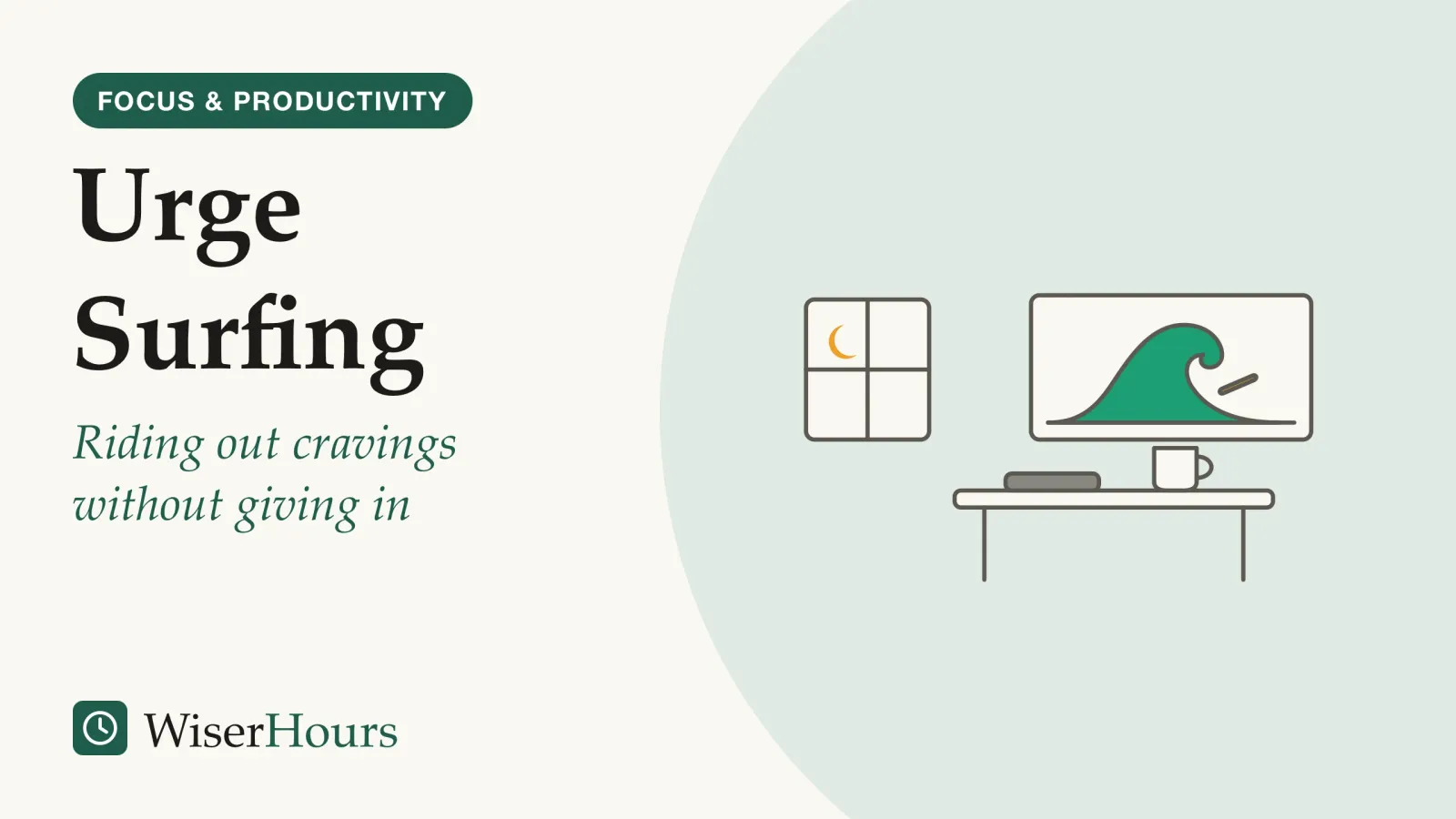
A craving is easier to outlast than to argue with. That is the idea behind urge surfing, a technique popularized by G. Alan Marlatt, a University of Washington addiction psychologist: you picture the urge as a wave that builds, peaks and then subsides, and you ride it out instead of obeying it or fighting it.1
Urge surfing is meant to change what you do with a craving, not to make the craving disappear. It is a coping skill with modest evidence. A 2017 RAND Corporation review of 9 randomized trials found that the group program that teaches urge surfing had a small effect on craving and withdrawal symptoms and no clear effect on relapse, and it rated that evidence low quality.2 To practice it when a craving hits, work through five steps:
- Pause and name the urge
- Find where it sits in your body
- Breathe and watch it rise and fall
- Treat the thoughts as thoughts
- When it eases, choose your next move
What is urge surfing?
Urge surfing is a mindfulnessmindfulness: Paying attention to what is happening in the present moment, including thoughts and sensations, on purpose and without judging it. The word covers both a state of mind and the courses that train it, and most research tests the courses.Full entry in the glossary technique for cravings: you observe an urge as a passing mix of body sensations and thoughts and let it crest and fade without acting on it. Bowen and Marlatt’s 2009 paper credits the technique to Marlatt and Gordon’s 1985 work on relapse prevention, an approach to addiction.3
Relapse prevention is a cognitive-behavioral treatment that teaches people to spot the situations that lead back to drinking or drug use and to cope with them. Urge surfing now sits inside mindfulness-based relapse prevention, an eight-week group program that pairs meditation with those skills. The authors of a 2014 trial of that program suggest why it might help: watching a craving may work like exposure, so the discomfort grows more tolerable and the rush to relieve it eases.4 That is their explanation, not something the trial measured.
An urge feels like an instruction, and most of us treat it as one: we either obey or brace against it. Urge surfing adds a third option, which is to watch. Say it is 9:40 at night and your thumb drifts toward a delivery app. Instead of ordering, or lecturing yourself, you notice the pull, get curious about it, and let it pass on its own schedule.
Urge surfing is for the moment after a cue has already fired. Removing the cue in the first place is separate work, covered in how to break a bad habit by changing what sets it off.
How to practice urge surfing, step by step
The steps below are an everyday version for ordinary cravings, such as snacks, the phone or online shopping, drawn from how relapse-prevention and dialectical behavior therapy programs describe it. They are a habit skill, not a treatment: if the craving is for alcohol or a drug you depend on, or the urge is to self-harm, binge or purge, read the help section near the end first.
- Notice and name it: say to yourself what the urge is for, as soon as you catch it
- Find it in the body: tight chest, restless hands, a watering mouth: describe it instead of obeying it
- Breathe through the crest: the strongest moment is a feeling, not an order; the dashed route to acting on it stays optional
- It eases, then choose: how long this takes varies; when it softens, decide what to do next
1. Pause and name the urge
Say to yourself, plainly, what is happening: “This is an urge to check my phone.” Naming it turns an automatic reach into something you can look at, and gives you a second or two before your hand moves.
2. Find where it sits in your body
Cravings are physical as well as mental. Look for the sensations: a tight chest, restless hands, a watering mouth, a pull in the stomach. Describe them to yourself as an observer would, and notice whether they stay put or shift. In the Hong Kong version of the program, the session that teaches urge surfing asks people to observe the thoughts, emotions, sensations and impulses a trigger brings and to notice that they pass.5
3. Breathe and watch it rise and fall
Use your breath as the board you stand on. Breathe normally and keep checking the strength of the urge, perhaps on a rough scale of 0 to 10. Watch whether it climbs, wobbles or starts to soften. You are not trying to push it down; you are watching what it does when you leave it alone.
A script for the moment
There it is: an urge to snack. Where is it? A tight jaw, a pull in the stomach. Breathe in, breathe out. It is a feeling. Rate it again in a minute and see what it does.
4. Treat the thoughts as thoughts
Cravings come with arguments: “just one,” “you deserve it,” “it doesn’t matter today.” Notice them as thoughts the craving produces, not as facts you have to act on. In a 2014 study at McGill University in Canada, people trained for two weeks in a skill the researchers call disidentification (roughly, stepping back from craving thoughts instead of identifying with them) reported less intense chocolate cravings after a craving test than people trained in distraction.6 Our account rests on that study’s abstract alone, and chocolate is not cigarettes.
5. When it eases, choose your next move
Once the wave has dropped, decide what to do next, ideally something that uses your hands or takes you elsewhere. The UK’s NHS advises people quitting smoking to keep a distraction ready, because cravings usually last only a few minutes.7 In a published case report from a US clinic, a therapist teaching the skill asked a client to allow 15 minutes to tolerate the urge and then to do something else.8
Riding one urge
How long does an urge or craving last?
We found no study that supports a single figure for how long cravings last, and the length likely varies with the substance, the habit and the person. The NHS says smoking cravings usually last only a few minutes and are hardest in the first 28 days after quitting, when the body is adjusting to being without nicotine.7
A figure often repeated online is that an urge peaks within 20 to 30 minutes. We could not trace that figure to a study, so it is better seen as a guess than as data. The useful part of the wave picture is its shape rather than its timing.
- Myth
- If you don't give in, a craving keeps building until you can't stand it.
- Fact
- Cravings rise and fall. The NHS says smoking cravings usually last only a few minutes, and urge surfing is built on watching that happen.
Collect your own number. The next few times you ride an urge, glance at the clock when it starts and when it has clearly softened. Knowing that your evening snack urge usually fades in about ten minutes, say, makes the next one easier to sit through.
How urge surfing differs from white-knuckling
Urge surfing is the opposite of gritting your teeth. White-knuckling treats the craving as an enemy to be pushed out of mind; urge surfing lets it be there and watches it. The difference matters, because trying not to think about a craving can backfire.
In a 2008 lab experiment by a University of Hertfordshire researcher in the UK, people who spent five minutes suppressing thoughts of chocolate then ate more of it in a taste test than people who had simply talked aloud with no instructions.9 That account comes from the abstract alone. Ordering yourself not to think about the snack may backfire, and noticing it is the alternative.
The best-known test of urge surfing itself also points at the response rather than the feeling.
The study
Limited evidence
Same urges, fewer cigarettes: a 2009 lab study of student smokers
In a study run by University of Washington researchers, 123 undergraduate smokers who wanted to change their smoking but were not in a quit program took part in a cue-exposure task designed to set off urges. They were randomly assigned to brief mindfulness instructions based on urge surfing or to no instructions. The two groups’ urges did not differ. Over the next seven days, though, the mindfulness group smoked significantly fewer cigarettes.3
That pattern is the heart of the technique: the urge arrived just as strongly, and people did less about it. The study had a small sample of students, one week of follow-up, and only the abstract to go on.
Urge surfing also turns up in the original dopamine detox, where it is one of two techniques borrowed from therapy for cutting back an impulsive behavior.
Does urge surfing work for addiction?
For people in addiction treatment, most of the evidence on urge surfing comes from mindfulness-based relapse prevention, a therapist-led group program used as aftercare once initial treatment ends. The results are encouraging in some trials and flat in others, and on its own, urge surfing is not a treatment for dependence.
The program’s 12-month test, published in JAMA Psychiatry in 2014, followed 286 adults for a year after they finished treatment at a US nonprofit agency. They were randomly assigned to the mindfulness program, to standard cognitive-behavioral relapse prevention, or to the agency’s usual 12-step-based aftercare. At six months, both skills programs had lowered the risk of relapse to drug use and heavy drinking compared with usual care; at a year, the mindfulness group reported less heavy drinking than both other groups and, among those who used drugs, fewer days of drug use.4 Outcomes were mostly self-reported, and some authors are paid to train therapists in the program.
Smaller trials pull in both directions. A 2009 pilot by the same team found lower substance use over four months than usual care.10 A 2026 pilot in Hong Kong found no statistically significant differences between groups on any outcome, including craving.5 Pooled together, as in the RAND review above, the picture is uncertain. A 2026 umbrella review of 11 earlier reviews (we read its abstract only) was more upbeat about relapse and craving but flagged uneven study quality.11
Outside formal treatment, a 2017 study from the University of Alaska Anchorage gave 28 adults with an alcohol use disorder a phone app offering an urge-surfing audio track among other coping tools. Cravings met with urge surfing were followed by drinking less often than those met with strategies outside the app.12 People chose their own strategy, so this shows an association, not proof.
For anyone in treatment, urge surfing is one tool inside a program, used alongside the rest of your care, not a replacement for it.
| Approach | What the best evidence found | Evidence |
|---|---|---|
| Brief urge-surfing instructions, student smokers | Urges unchanged; fewer cigarettes over the next week | Randomized lab study, limited (abstract only)3 |
| Disidentification training, chocolate cravings | Less intense chocolate cravings than distraction training | Two-week training study, limited (abstract only)6 |
| Mindfulness-based relapse prevention, 12 months | Fewer drug-use days and less heavy drinking than two other aftercare programs | Randomized trial, moderate4 |
| Pooled trials of the same program | Small effect on craving and withdrawal; no clear effect on relapse | Meta-analysis, low-quality evidence2 |
Is urge surfing a DBT skill?
Urge surfing did not start in dialectical behavior therapy (DBT); it comes from Marlatt’s relapse prevention. DBT therapists do teach it, though. A 2025 US case report described teaching “riding the wave,” or urge surfing, as a DBT skill to two women with post-traumatic stress disorder and eating disorders.8 A 2026 trial protocol from the All India Institute of Medical Sciences, Bhopal, lists urge surfing in a DBT distress-tolerance session for people with obsessive-compulsive disorder.13
We could not check Marsha Linehan’s DBT skills manual, so we make no claim about it. If you are in DBT, ask your therapist how urge surfing fits with the distraction and self-soothing skills you are learning.
Alcohol, drugs and dependence: get help before you stop
Urge surfing is a way to sit through a craving, not a way to come off a substance your body depends on. If you drink heavily or use drugs regularly, stopping suddenly can be dangerous, and the safe route starts with a doctor.
Before you stop drinking or using
For anyone dependent on alcohol, the UK’s NHS (2026) says that suddenly giving up drinking can be very dangerous, and that people who get withdrawal symptoms should get medical help before they try to stop.14 The US National Institute on Drug Abuse (2020) warns that after a break from some drugs, using the old amount can easily cause an overdose, because the body is no longer used to it.15
- Now: if someone may have overdosed, or seizures, severe confusion, hallucinations or fever follow stopping alcohol, phone your local emergency number; MedlinePlus gives 911 as the US example.16 Across the EU, 112 reaches all emergency services.17 In the US, the 988 line answers calls and texts from anyone in suicidal crisis or emotional distress.18 NHS guidance for the UK points to 999 when a life is at risk, such as after an overdose, and the Samaritans line, 116 123, for talking about anything troubling you.19 If you live elsewhere, note the emergency and crisis numbers for your country before you need them.
- Soon: if you drink heavily or use drugs regularly, see a doctor or an addiction service before you try to stop, for the reasons in the box above. NIDA notes that medicines exist to help with alcohol, nicotine and opioid addiction, and urge surfing is no substitute for them.15 If urges to self-harm, binge or purge keep returning, see a doctor or mental health service too.
- Routine: mention it to your doctor at a regular visit if a habit keeps winning despite your efforts, or is costing you sleep, money or relationships.
The bottom line
Urge surfing asks you to treat a craving as a wave you can watch, not an order you must follow. Its best support is modest: it seems to change what people do with an urge more than how strong the urge feels, and the program built around it has a small, uncertain effect on craving and withdrawal. For everyday urges, try the five steps and judge them by what you did. For alcohol or drugs you depend on, get a doctor’s help with stopping.
This article is general information, not medical advice. If you're worried about your health, talk to a doctor or another qualified professional.
Frequently asked questions
Can urge surfing help with phone, snacking or shopping urges?
Possibly, but that is mostly untested. The studies behind urge surfing involve smoking, alcohol, other drugs and chocolate, and we found no trial of urge surfing for phone checking or shopping. The technique costs nothing and carries little risk for everyday urges, so it is reasonable to try, as long as you judge it by what you end up doing rather than by whether the urge shows up.
Is urge surfing the same as meditation?
No, though it grows out of mindfulness meditation. In the eight-week mindfulness-based relapse prevention groups described in the 2026 Hong Kong trial, urge surfing is one practice alongside others such as the body scan and a mountain meditation. Meditation is the regular training; urge surfing is the brief version you use at the moment a craving arrives.
What if I give in halfway through?
Then you have learned where your wave was steepest, which is useful for next time. For addiction, the US National Institute on Drug Abuse says a return to use does not mean treatment has failed; it is a sign to resume, change or try another treatment. For everyday habits, the same attitude applies: note what happened and try again.
Is distraction better than urge surfing?
They do different jobs, and you can use both. The NHS advises keeping a distraction ready for smoking cravings because they usually pass in minutes. A 2014 study at McGill University in Canada found that people trained to step back from craving thoughts reported less intense chocolate cravings than people trained in distraction. Surf the peak, then move on to something else.
Sources
- G. Alan Marlatt. Wikipedia (accessed 2026-10-11)
- Mindfulness-based Relapse Prevention for Substance Use Disorders: A Systematic Review and Meta-analysis. Grant, S., Colaiaco, B., Motala, A., et al. (2017). Journal of Addiction Medicine, 11(5)
- Surfing the urge: brief mindfulness-based intervention for college student smokers. Bowen, S. & Marlatt, A. (2009). Psychology of Addictive Behaviors, 23(4)
- Relative efficacy of mindfulness-based relapse prevention, standard relapse prevention, and treatment as usual for substance use disorders: a randomized clinical trial. Bowen, S., Witkiewitz, K., Clifasefi, S. L., et al. (2014). JAMA Psychiatry, 71(5)
- The feasibility of mindfulness-based relapse prevention for adults with substance use disorders (illicit drugs) in a Chinese population: A pilot randomized controlled trial. Ting, K. T., Leung, I. C. H., Chan, D. C. C., et al. (2026). Addiction, 121(9)
- The effects of three mindfulness skills on chocolate cravings. Lacaille, J., Ly, J., Zacchia, N., et al. (2014). Appetite, 76
- Understand your smoking triggers and cravings. NHS Better Health (UK), accessed 2026-10-11
- Written Exposure Therapy and Dialectical Behavior Therapy Skills Training as a Novel Integrated Intervention for Women With Co-Occurring PTSD and Eating Disorders: Two Case Studies. Tilstra-Ferrell, E. L., Salim, S. R., López, C., Foster, A. & Hahn, C. K. (2025). Cognitive and Behavioral Practice, 32(3)
- Resistance can be futile: investigating behavioural rebound. Erskine, J. A. (2008). Appetite, 50(2-3)
- Mindfulness-based relapse prevention for substance use disorders: a pilot efficacy trial. Bowen, S., Chawla, N., Collins, S. E., et al. (2009). Substance Abuse, 30(4)
- How Effective Are Mindfulness-Based Interventions (MBIs) for the Treatment of Substance Use Disorders (SUDs), Relapse Prevention, and Craving: An Umbrella Review Article. Ajami Bakhtiarvand, P. & Abedi, M. R. (2026). Substance Use & Misuse, online ahead of print
- Smartphone-based, momentary intervention for alcohol cravings amongst individuals with an alcohol use disorder. Dulin, P. L. & Gonzalez, V. M. (2017). Psychology of Addictive Behaviors, 31(5)
- Efficacy of distress tolerance techniques of dialectical behavior therapy in persons with obsessive-compulsive disorder: a study protocol for a randomized controlled trial. Kumar, M., Singh, V., Kumar, R., et al. (2026). Trials, 27
- Alcohol-use disorder. NHS (UK), page last reviewed 24 April 2026
- Treatment and Recovery (Drugs, Brains, and Behavior: The Science of Addiction). National Institute on Drug Abuse, US National Institutes of Health (July 2020)
- Alcohol withdrawal. MedlinePlus Medical Encyclopedia, US National Library of Medicine (review date 1 January 2025)
- 112: Europe's emergency number. European Commission, Shaping Europe's digital future
- Help for Mental Illnesses. National Institute of Mental Health, US (last reviewed April 2026)
- Where to get urgent help for mental health. NHS (UK), page last reviewed 26 April 2023
How we researched this
We searched PubMed, Europe PMC and the web in October 2026 for trials and reviews of urge surfing and of mindfulness-based relapse prevention, and read NHS, NIDA, NIMH and MedlinePlus pages for the safety points. We read the full text of the 2009 and 2014 relapse prevention trials, the 2026 Hong Kong trial, the 2017 RAND review and the 2017 app study. The 2009 smoking study, the chocolate studies and a 2026 umbrella review were read in abstract only. Main limitation: few trials test urge surfing on its own.
Keep reading
How to Break a Bad Habit: What Science Recommends
A 2005 study of 115 transferring students found habits survived a move only when their setting did. How to break a bad habit: change the cue, plan a swap.
Habit Stacking: How to Attach New Habits to Old Ones
Habit stacking ties a new habit to one you already do. A 5-step method, 14 examples for work and home, and what the if-then research behind it shows.
How Long Does It Really Take to Form a Habit? (It's Not 21 Days)
Two studies that timed habit formation found medians of about two months, with individuals taking 4 to 335 days. Where 21 days came from, and what helps.
How to Build a Reading Habit: 20 Pages a Day
How to build a reading habit: 20 pages a day takes about 20 to 25 minutes. Tie it to a fixed moment, keep the phone away, and read hard books on paper.