Matrix Management: How to Lead When People Report to Two Bosses
Matrix management gives people two bosses. A 2015 US Gallup survey linked it to weaker role clarity; 5 practices help the two managers agree who decides what.

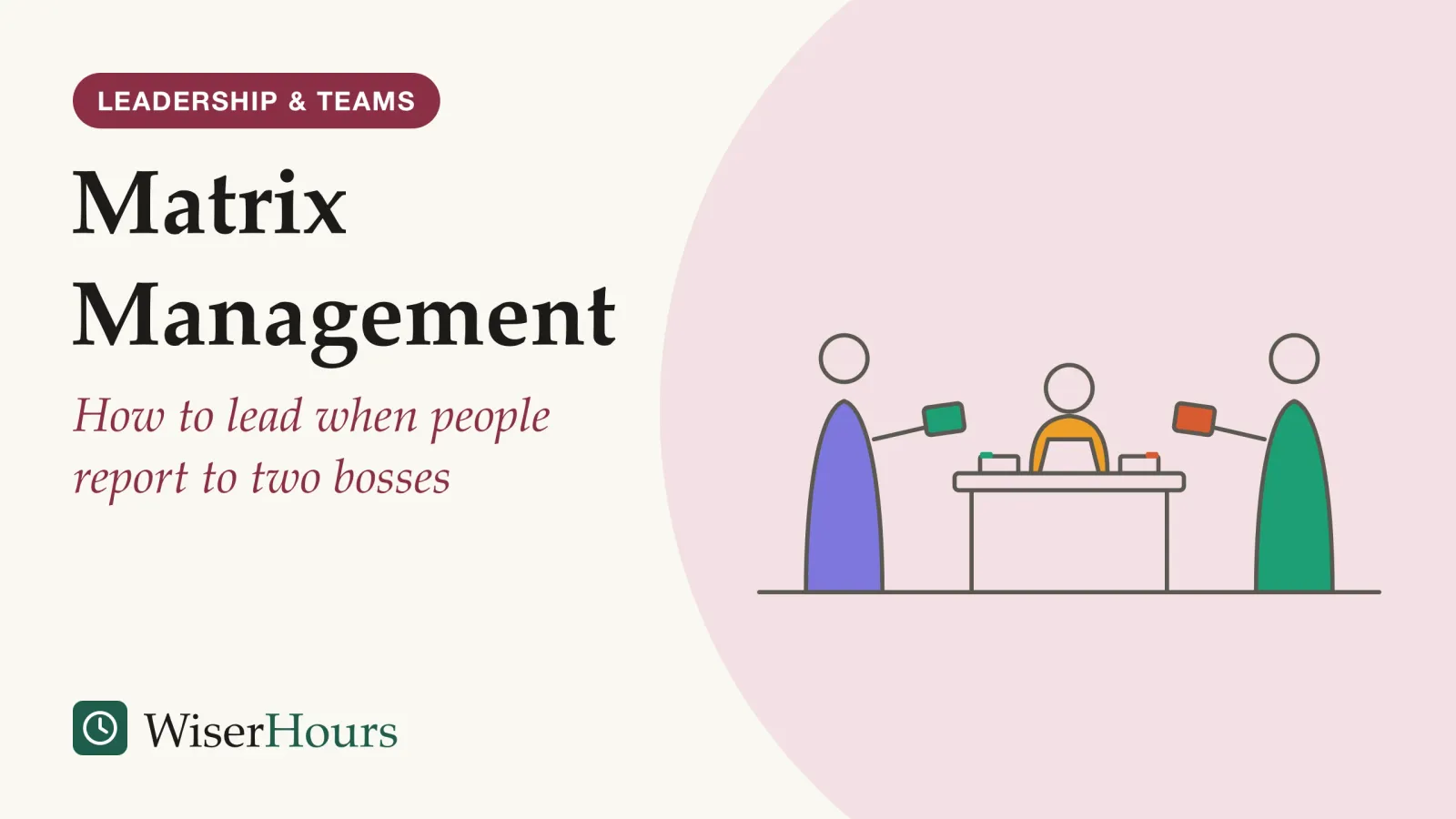
Matrix management puts some people under two managers at once: a functional line manager, such as the head of engineering or finance, and a project, product or regional manager who directs part of their day.1 Companies use it to share scarce specialists across teams without moving them, and the usual cost is confusion about who decides what. In a 2015 Gallup survey of nearly 4,000 US employees, analyzed with McKinsey, people who worked for different managers across teams were more likely to say their organization helped them collaborate, but fewer felt clear about what was expected of them.2
A tidier organization chart rarely settles that confusion. The remedy the classic sources keep returning to is a set of explicit agreements between the two managers.3 This guide, part of our guides to leading and managing people, sets out five of them for managers on either side of the matrix:
- Write down who decides what.
- Hold a regular three-way check-in.
- Agree the escalation route before a clash.
- Count the person’s total workload.
- Share the performance review on purpose.
What is matrix management?
Matrix management is a dual chain of command: in Stanley Davis and Paul Lawrence’s 1978 Harvard Business Review definition, its identifying feature is that some managers report to two bosses rather than one. One chain usually runs through functions such as marketing or engineering, which own skills and resources; the other runs through products, projects, customers or regions, which own results. Davis and Lawrence named three roles: the senior manager who heads both chains and keeps them in balance, the two matrix bosses who share people, and the person who reports to both.3 This guide is mostly for the second and third.
The form grew up in US aerospace in the 1950s and spread more widely in the 1970s.1 A satellite program needs structural engineers, software engineers and test specialists at the same time, but no single program can keep a full team of each busy for years. A matrix lets the engineering department keep its people, train them and move them between programs, while each program manager directs the work that matters to the program.
- Functional line manager: how the work is done and who does it
- Project, product or regional manager: what gets done and when
- The two managers settle most questions between themselves
- Senior management, only for clashes the two cannot settle
A 1979 Project Management Institute paper by Linn Stuckenbruck, building on an earlier analysis by David Cleland and William King, offers a rough split. The project side answers what is to be done, when, and with how much money; the functional side answers how the work is done, where, and by whom.4 Stuckenbruck himself called the split highly simplistic, since each manager inevitably cares about the other’s questions. It is still a good opening question for anyone managing in a matrix: which of these decisions are mine, and which only feel like mine?
Weak, balanced and strong matrix: where the power sits
The difference between a weak, balanced and strong matrix is how much authority the project or product manager holds compared with the functional line manager. Stuckenbruck, drawing on Jay Galbraith, placed the matrix on a continuum: in a weak matrix the balance of power tilts decisively toward the functional managers, in a strong matrix it sits clearly with project management, and a true balance probably seldom occurs in practice.4
| Type | Who holds most authority | What the project or product manager does | What the shared employee experiences |
|---|---|---|---|
| Weak matrix | The functional line manager | Plays only a coordinating role, sometimes as a part-time coordinator | Most decisions about the person’s work and future sit with the line manager 4 |
| Balanced matrix | Shared, at least on paper | Directs the work’s goals and timing while the line manager directs method | Two real bosses, so conflicts surface often and need a settled route 4 |
| Strong matrix | The project or product manager | Directs the work and, in effect, much of the person’s time | The function stays home base, where the person returns after the project 4 |
Stuckenbruck also noted that employees usually see the functional manager as the real boss, because that manager represents home base and normally carries the most weight in performance reviews and promotions.4 That one detail explains a lot of everyday friction: the project manager sets the deadline, but the person knows whose opinion decides the next pay rise.
So name the matrix you are actually in, not the one on the chart. A project manager in a weak matrix who behaves like the boss is likely to meet quiet resistance, and a line manager in a strong matrix who keeps pulling people back for departmental work is likely to lose that argument.
How to manage someone who reports to two bosses
To manage someone who reports to two bosses, the two managers agree the rules between themselves first, then review them with the person in a regular three-way conversation. Davis and Lawrence’s central lesson was that relationships between functional and product managers should be explicit, so that people roughly agree who does what in different situations.3
1. Write down who decides what
Agree, in writing, who sets weekly priorities, who approves leave and training, who writes the performance review, who has a say in pay and promotion, and who settles a clash. Stuckenbruck recommended a responsibility chart filled in at a meeting of all the managers concerned, because it surfaces conflicts before specific problems arise.4 A starting split, drawn from his division of questions and from Davis and Lawrence’s escalation route, might look like this; adjust it to the matrix you are in.
| Decision | Starting owner | Who has a say |
|---|---|---|
| What gets done, and by when | Project or product manager | Line manager, on capacity 4 |
| How the work is done, and by whom | Functional line manager | Project manager, on fit 4 |
| The performance review | Usually the line manager | Project manager, in writing before it is drafted 4 |
| A clash neither manager can settle | Both managers together, then their superiors | The employee, who raised it 3 |
Leave approval sounds trivial until both managers say yes to different weeks, or one approves a holiday the other planned a launch around. A one-page agreement makes that much less likely. Keep it short, date it, and reopen it whenever the project changes phase. Teams that already use a RACI chart to show who is accountable and who is consulted can reuse that format.
2. Hold a regular three-way check-in
Meet as three on a regular rhythm, every few weeks for example, in addition to each manager’s own conversations. The point is to look at the person’s priorities together, so that neither manager hears about the other’s demands second-hand. The Gallup and McKinsey authors recommended frequent conversations about each person’s role and regular reclarifying of expectations as work changes, which matters more in a matrix than elsewhere.2
The regular one-on-one meeting whose agenda the employee sets stays with each manager. The three-way meeting is narrower: what is on the list, what comes first, and what is about to collide.
3. Agree the escalation route before a clash
Davis and Lawrence spelled out a sound route. When the person gets conflicting instructions, they ask for one meeting with both bosses. If that fails, each boss takes it to their own superior, and those superiors first ask whether it reflects a wider policy question; if not, they send it back down and insist on a prompt answer.3
That last step matters. Pushing every clash up both chains overloads senior managers, and it skips the lesson Davis and Lawrence wanted the superiors to teach: that the two bosses can settle most problems themselves. Name the two superiors and a time limit in your written agreement.
4. Count the person’s total workload
It is easy for each manager to plan as if they owned the person’s whole week. Before adding work, compare notes on the full load: how many projects, which meetings, which deadlines fall in the same fortnight. When the two demands exceed one job, the managers renegotiate between themselves. Davis and Lawrence also warned against turning every decision into a meeting, which wastes people’s time and slows the response.3
5. Share the performance review on purpose
Decide in advance who writes the review and how the other manager’s view is gathered. Stuckenbruck observed that the functional manager usually carries the most weight in evaluations, which can leave project work invisible at review time.4 A written note from the project manager each quarter, read before the review is drafted, is one simple way to narrow that gap. The wider process is covered in how to run performance reviews.
Your matrix agreement
What are the disadvantages of a matrix structure?
The main disadvantages of a matrix structure are unclear accountability, power struggles between the two sides and slow decisions. Davis and Lawrence listed nine pathologies to watch for, from anarchy and power struggles to “groupitis” and “decision strangulation”, and Christopher Bartlett and Sumantra Ghoshal wrote in 1990 that in practice dual reporting led to conflict and confusion, especially in international companies.35
The mechanism is ordinary. Two people with different goals share a third person’s time. One side is pushing for the date, the other for the standard of the work. Each request is reasonable on its own; together they add up to more than one job. In one company Davis and Lawrence describe, a product manager worked across functions with no explicit agreement with the functional managers, and when sales slipped, each functional head grabbed for control.3
- Myth
- In a matrix, every decision should be made together by everyone involved.
- Fact
- Davis and Lawrence called this groupitis. Decisions belong with the people who hold the relevant information; teamwork as often as needed and as little as possible.
The best numbers on what this feels like come from a single survey.
The study
Limited evidence
Two bosses in a 2015 US survey: more collaboration, hazier expectations
Gallup surveyed 3,956 full-time US employees in April 2015. About 17% reported to different managers across teams, which the authors called “supermatrixed”. Only a minority of them strongly agreed with Gallup’s item “I know what is expected of me at work”, against 60% of people with no matrix at all. Yet, compared with the lightly matrixed, roughly double the share said their organization helped them collaborate more effectively with coworkers.2
The authors were McKinsey’s head of organizational science and Gallup’s chief scientist for workplace management, so the study is company research that no journal peer-reviewed, and a one-time survey cannot show that the matrix caused the gap. Still, the pattern fits what Davis and Lawrence saw decades earlier. In the same survey, matrixed staff were also more likely to say they spent their days answering colleagues’ requests and sitting in internal meetings, and that they needed clear direction from project leaders and communication between their managers to prioritize well.2 Unclear rolesrole ambiguity: Not knowing clearly what is expected of you at work: your duties, your authority or how your work will be judged. Its opposite, role clarity, is linked in workplace surveys to better satisfaction and performance, though most of that evidence is cross-sectional.Full entry in the glossary are the price; the five practices above are how you pay less of it.
The matrix of the mind: what the case evidence says
The research behind matrix management is mostly case-based: practitioner books and articles built from company examples, with very little controlled study. Davis and Lawrence wrote from their studies of companies and their own experience, and Robert Ford and Alan Randolph’s 1992 literature review, published in the Journal of Management, stressed the great need for empirical research to resolve its open questions.36
Within that limit, the two best-known lines of thinking agree. Bartlett and Ghoshal argued that companies fell into a trap by treating the matrix as a structure to install. The most successful companies, they wrote, worked the other way round: managers’ attitudes and working relationships first, formal structure last. Their examples include Unilever, Philips and NEC.5
The challenge is not so much to build a matrix structure as it is to create a matrix in the minds of our managers.
Jay Galbraith’s 2009 book Designing Matrix Organizations That Actually Work makes a similar point in organization-design terms, as its publisher summarizes it: structures do not fail, management fails at implementing them. Its table of contents shows how much of the book is about what has to change around the chart, from communication and planning processes to ways of settling disputes and human resources policies.7
For a manager, both points come down to behavior. A matrix depends less on formal authority and more on influence, which is where the difference between leading and managing stops being abstract. You will often need someone’s time without being able to order it.
Which companies use matrix management?
Matrix management is most common in large companies with several product lines, countries or customer groups. Davis and Lawrence listed General Electric, Bechtel, Citibank, Dow Chemical, Shell Oil, Texas Instruments and TRW as users in 1978.3 Galbraith’s publisher sums up the book’s premise: companies with many product lines, countries and customer segments can hardly avoid some form of matrix. The book draws on IBM and Procter & Gamble.7
Outside the US, Wikipedia records ABB, formed from a 1988 merger, organizing local operations within a two-dimensional matrix, and Nokia trying a form of it in 2004. It also notes that Digital Equipment Corporation, an early pioneer, abandoned its matrix in 1994, and that companies using matrices tend to keep quiet about it.1 If your employer has project leads, regional heads and functional heads who all claim your time, you are probably in one, whatever the chart says.
The bottom line
Two bosses are workable once the managers have agreed who decides what. Before the next clash, write down who owns priorities, leave, the review and escalation, put a three-way check-in on the calendar, and settle disagreements between the managers rather than through the person they share.
Frequently asked questions
Is a dotted-line manager the same as matrix management?
Not quite. Wikipedia's entry notes that people in a matrix may report through a solid or a dotted line. Davis and Lawrence wrote in 1978 that, as companies grow confident with a matrix, they bring the dotted line into the open and give it legitimacy. They also warned against relying too much on an informal or latent matrix for critical work.
What should an employee do when two bosses give conflicting instructions?
Do not quietly pick one. Davis and Lawrence describe the sound route in their 1978 HBR article: tell both managers about the clash and ask for one meeting with the two of them together. If they cannot settle it, it goes to their own superiors, who should send it back for a prompt answer unless it raises a wider policy question.
Can a small company use a matrix?
It can, in a light form, for example when one specialist serves several clients or products. Davis and Lawrence reported in 1978, from their own experience, that a matrix seemed to work better when no more than 500 managers were in matrix relationships. That is an observation, not a tested limit.
Did matrix management fail?
It has a mixed record rather than a verdict. Digital Equipment Corporation, an early adopter, dropped it in 1994, Wikipedia records, and Bartlett and Ghoshal wrote in 1990 that in practice the matrix proved all but unmanageable, especially across countries. Jay Galbraith's 2009 book, as its publisher summarizes it, argues that structures do not fail; management fails at implementing them.
Sources
- Matrix management. Wikipedia (accessed 11 October 2026)
- Revisiting the matrix organization. Bazigos, M. & Harter, J. (January 2016). McKinsey Quarterly; Gallup panel survey of US employees, 2015. Company research, not peer-reviewed
- Problems of Matrix Organizations. Davis, S. M. & Lawrence, P. R. (1978). Harvard Business Review, 56(3), May 1978
- The Matrix Organization. Stuckenbruck, L. C. (1979). Project Management Quarterly, 10(3), 21-33. Project Management Institute
- Matrix Management: Not a Structure, a Frame of Mind. Bartlett, C. A. & Ghoshal, S. (1990). Harvard Business Review, 68(4), 138-145, July-August 1990
- Cross-Functional Structures: A Review and Integration of Matrix Organization and Project Management. Ford, R. C. & Randolph, W. A. (1992). Journal of Management, 18(2), 267-294
- Designing Matrix Organizations That Actually Work. Galbraith, J. R. (2009). Jossey-Bass (Wiley), San Francisco; publisher's description
How we researched this
Searches in October 2026 covered Wikipedia, Harvard Business Review, the PMI learning library, McKinsey, OpenAlex and Crossref; the sources date from 1978 to 2016. Both HBR articles and the PMI paper were read in full through archived copies. Main limitation: research on matrix management is mostly case-based, the one large survey is company research from the US, and the Ford and Randolph review was read as an abstract only.
Keep reading
How to Manage Managers: What Changes When You Lead Leaders
How to manage managers: 5 changes for skip-level leaders, from delegating problems to judging yourself by your managers' teams. Practitioner evidence.
The Change Curve Explained: How People React to Workplace Change
The change curve turns Kübler-Ross's 1969 stages of dying into 4 or 5 workplace stages. What research found, and what managers can do at each point.
Theory X and Theory Y: What McGregor's Idea Still Teaches Managers
Theory X and Theory Y are a manager's assumptions about people, not two styles. What McGregor argued in 1960, the thin evidence and how to spot X habits.
The GROW Model Explained: A Simple Coaching Framework for Managers
The GROW model runs a coaching talk in 4 stages: Goal, Reality, Options, Will. Questions for each stage, a worked one-on-one and the evidence behind it.