How to Run an Effective Meeting: A Step-by-Step Guide
How to run an effective meeting in 7 steps: a one-line purpose, a short invite list, a timed agenda with owners, fair facilitation and a next-day follow-up.

Two invitations arrive for Thursday afternoon. One reads “Q3 budget.” The other reads “Decide which two of the four proposed projects get funding next quarter.” Only the second tells people what to read and when the discussion is finished. Settling that before anyone joins is most of how to run an effective meeting: decide what it must produce, invite only the people that outcome needs, share a timed agenda, run the room so every voice counts, and close the loop in writing. MIT’s human resources guide (US) gives planning beforehand and follow-up afterwards as much weight as the hour itself.1 Inside the hour, short steering remarks such as “back to the topic” or a quick summary were followed less often by complaining and criticism in videotaped team meetings at German companies, according to a 2013 study by Nale Lehmann-Willenbrock, Joseph Allen and Simone Kauffeld.2 The seven steps:
- Write the purpose and the outcome in one sentence
- Keep the invite list to the people the outcome needs
- Send an agenda with an owner and a time for each item
- Start on time, and open the room a few minutes early
- Facilitate so everyone contributes, including people on a screen
- Read back decisions and action items before anyone leaves
- Send the follow-up within one working day
Prefer to watch? The video covers the same ground as this article.
For the research behind each failure, see what meeting research has found about why meetings fail; this guide stays with the doing.
Before anyone joins: a purpose, the right people and a timed agenda
A meeting works best when everyone knows what it has to produce. A 2026 narrative reviewnarrative review: A review in which an expert summarizes a body of research in prose, choosing which studies to discuss. It can be a good map of a field, but without a stated search and pooling method it is easier for selection and opinion to shape the conclusions than in a systematic review.Full entry in the glossary by Steven Rogelberg and colleagues, covering three decades of meeting research, puts clarity of purpose first in its advice to leaders, noting that research links clear meeting goals with meetings rated as more effective.3
The reason is practical. A goal tells people what to prepare, what counts as on topic and when to stop. Without one, each person brings their own idea of why they are there, and the talk drifts toward whatever the loudest person cares about.
The clearest study of this looked at leaders. Researchers at the University of Oslo (Norway) observed eight top management groups working through their agenda items and found that clearer goals went with more focused discussion, and both went with better task performance, working relationships and member satisfaction.4 One detail is useful in practice: speaking up when a goal was unclear went with more focused talk and better task performance, while speaking up once the talk had wandered off track showed no link with task performance and went with poorer relationships.4 Eight groups make a small, observational sample; the paper itself was unavailable to us, so this summary stays within its abstract.
So spend your effort on the goal at the start, when a question costs nothing.
1. Write the purpose and the outcome in one sentence
The two invitations at the top show the test: “Q3 budget” names a topic, while the funding question names an outcome. MIT’s guide frames it as a question to ask yourself: what do you want to walk out of the meeting with?1
When that sentence will not come, hold the invite until it does. Deciding whether a topic needs a meeting at all deserves its own guide; the review’s quick check is to ask whether an email or a short chat would do instead.3
2. Keep the invite list to the people the outcome needs
Invite the people who will decide, do the work or hold information nobody else has, and keep everyone else informed another way. Leaders tend to invite too many people, the 2026 review notes.3 A 2011 survey of 367 working adults by a US team led by Melissa Cohen found that larger staff and team meetings were rated as lower in quality, although the link was small.5 A survey cannot separate cause from correlation, so read it as a nudge toward a shorter list rather than proof.
Leaving people out has a cost too, because an invitation can signal who matters. The review suggests asking relevant people who are not invited for their input beforehand and sending them the notes afterwards.3 GitLab’s public handbook adds a simple tool: mark people who are not essential as optional.6
Take a design review with twelve names on the draft invite. Five people decide or build; three more need the outcome but not the debate. Invite the five, ask the three for comments by the day before, and send all eight the notes. Every extra person adds hours, and how to calculate what a meeting costs walks through that arithmetic.
3. Send an agenda with an owner and a time for each item
An agenda earns its place when each item says what the group should leave with, who leads it and how long it gets. MIT’s agenda guide (US) lists those parts for every item, and it warns that people underestimate time: its authors suggest adding about a third to your estimates until you get better at it.7
A. Purpose
One sentence on what the meeting must produce
B. Outcome per item
What the group should leave each item with
C. Owner
The person who leads the item
D. Time
Minutes for the item, with a margin
Send it early. In the same 2011 survey, people who could see a formal agenda before the meeting rated it higher, while an agenda that appeared only at the meeting scored no better than having none.5 For teams spread across time zones, GitLab’s handbook recommends linking the agenda in the invitation about three days ahead, and at least one day ahead, so people can prepare or add comments in writing.6 A ready-made template and the idea of wording items as questions each get their own guide later.
A single line might read: “Which two projects get funding? Lead: Priya. 20 minutes.” Anyone can see what to prepare, and the chair can see when that item is out of time. A recurring team check-in is a special case with its own format, set out in how to run a daily stand-up.
Before any invite goes out, check that it answers three questions: what will we leave with, who has to be there, and how long each part gets.
In the room: a punctual start and shared steering
Inside the hour, two habits stand out: starting at the stated time, and a steady stream of small steering remarks from whoever notices the talk drifting. Both cost almost nothing, and neither has to be left to the chair.
4. Start on time, and open the room a few minutes early
Start at the stated time, and let people gather a little before it. In a 2014 online survey of 252 working adults in the US, a team led by Joseph Allen found that small talk just before a meeting was linked to rating the meeting as more effective, even after accounting for good meeting procedures; the link was stronger for less extraverted people.8 Because it is a single-moment snapshotcross-sectional: Describes a study that measures everyone in its sample at a single point in time. Because the possible cause and the outcome are recorded together, it can show that two things occur together but not which of them came first.Full entry in the glossary, the survey cannot tell us whether the chat itself makes meetings better.
In practice, open the video link or the room a few minutes early and say hello to whoever arrives. That buys the social warm-up without making punctual people wait.
What counts as on time differs across cultures. According to studies the review summarizes, staff in Germany, China, the Netherlands, Italy and the US mostly regard late arrivals as disruptive, whereas in cultures that run on event time, such as Pakistan, being punctual means arriving with the group rather than by the clock.3 In a mixed team, say the norm out loud once: “We start at the hour, whoever is here.”
5. Facilitate so everyone contributes, including people on a screen
Facilitation is mostly small, steering remarks: naming the goal, summarizing, noting the time left, asking who will do what. The strongest evidence for this comes from recordings of real meetings.
The study
Moderate evidence
Does a quick 'back to the topic' change what comes next?
Researchers videotaped 59 regular team meetings in 19 German companies and coded every statement. Procedural remarks such as leading back to the topic, clarifying, summarizing and noting the time were followed more often by proactive talk about who will do what and when, and less often by complaining, criticizing or losing the thread. Teams whose procedural remarks were spread more evenly across members were more satisfied with the discussion and its outcome.2
The pattern is a sequence observed in the recordings, not an experiment, and the satisfaction ratings were self-reported. The authors note the sample was all German and mostly male.2 Still, facilitation looks like a set of sentences anyone can say.
The review’s advice for inclusion follows the same line: rotate who speaks, invite quieter people in, and use silent reflection or breakout rooms when talk is uneven.3 Colleagues who hold back need more than an open floor, and ways to draw quieter colleagues into the discussion goes further.
The review reports that in virtual meetings women used the chat more than men, who spoke more.3 A facilitator who ignores the chat may therefore miss part of the discussion. In practice, read the chat aloud at each item and turn to remote attendees first on key decisions, so their input is not an afterthought. For hybrid meetings, which GitLab’s handbook would rather avoid, it suggests that everyone use their own camera and headset, even people sitting in the same room, so nobody is a face at the end of a table.6 When a team spans time zones, the handbook suggests checking everyone’s time zone, choosing slots where regions overlap and asking a volunteer whose working hours fit to host.6
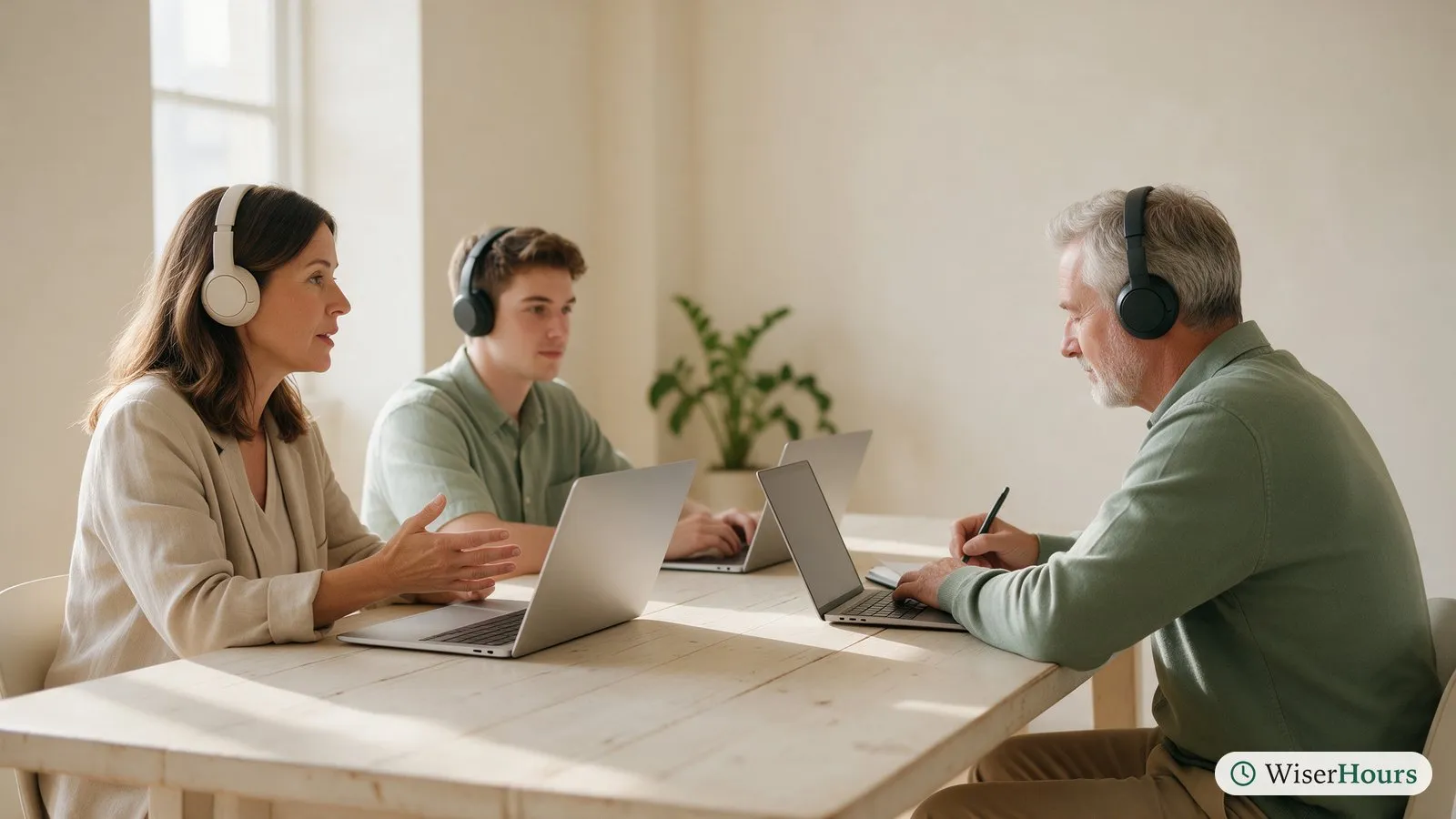
Whatever the setup, say out loud at the start that anyone may call time or pull the talk back to the goal; in the German recordings, teams that shared the steering were the more satisfied ones.
Afterwards: write down what was decided, and send it
A meeting’s value leaves the room in writing. MIT’s guide advises listing the tasks at the end, assigning a person to each, and sending that list to everyone with the key decisions.1
6. Read back decisions and action items before anyone leaves
Save the last five minutes. Read each decision aloud, then each action with its owner and date, and ask whether anyone heard it differently. The 2026 review lists summarizing key points and being clear on action items among the habits of an active facilitator.3
A read-back catches a familiar gap: two people who each think the other owns a task. Wording each item so it gets finished, with one owner and a date, has its own guide on writing meeting action items people complete.
7. Send the follow-up within one working day
Send the notes while the discussion is fresh: decisions, actions with owners and dates, and open questions. For people in other time zones, GitLab’s handbook suggests leaving decisions open for comment for a day or two when the meeting fell outside their hours, and posting any recording within 12 hours.6 The review adds sending the notes to people who were not invited and asking for their feedback.3
The evidence here is thin. No study of a one-day deadline turned up in our searches; it is a practitioner habit, chosen because notes sent a week later arrive after the work has already started or stalled. Treat it as a default, and adjust it to your team’s rhythm.
Finish the notes before the meeting ends
Write the follow-up during the read-back, in the shared agenda document, so it is finished when the meeting ends. Then send the link before you open your next task.
How to run an effective meeting: a one-page checklist
Seen on a clock, the routine is mostly work done away from the table: a few days ahead, a few minutes either side of the start, and the day after.
- A few days beforeOutcome sentence, short invite list, agenda with owners and times
- A few minutes beforeRoom or link open for early arrivals
- On the hourStart, whoever is here
- Last five minutesRead back decisions, owners and dates
- Within a working dayNotes to attendees and to those left off the invite
Copy the checklist below into your own agenda template, or tick it here before your next meeting.
Before, during and after your next meeting
Download PDF
Not every step rests on the same kind of evidence. Some come from recordings or surveys of real meetings; others are practice that guides recommend without a study behind the specific advice.
| Step | What the best evidence found | Evidence |
|---|---|---|
| Clear purpose | Clearer goals went with more focused talk and more effective management meetings | Observation of 8 top management groups by University of Oslo researchers (observational, abstract only)4 |
| Small invite list | Larger meetings were rated slightly lower in quality | Survey of 367 working adults, US team (observational)5 |
| Timed agenda with owners | Recommended practice: an outcome, an owner and a time for each item | Practitioner guide (expert opinion)7 |
| Pre-meeting talk, then a punctual start | Small talk before the start linked to higher effectiveness ratings | Survey of 252 US working adults (observational)8 |
| Shared steering remarks | Followed by more action talk and less complaining; evenly shared remarks went with satisfaction | Videotaped team meetings in German companies (observational)2 |
| Read-back and next-day notes | Recommended practice; no study of the timing found | Practitioner guides (expert opinion)1 |
Where a step rests on practice alone, treat it as a sensible default and adjust it to how your team works.
The bottom line
Run a meeting by designing it before anyone joins: one sentence of purpose, the few people that outcome needs and an agenda where every item has an owner and a time. In the room, keep making small steering remarks and invite others to make them too. Close by reading back what was decided, and send it in writing within a working day. For your next meeting, start with step 1 and write the outcome as one sentence before you send the invite.
Frequently asked questions
Does the manager have to be the one who runs the meeting?
No. In a 2013 study of videotaped team meetings at German companies, run without a supervisor in the room, teams whose steering remarks were spread more evenly across members were more satisfied with the discussion. The authors suggest members share the job of keeping a meeting on course, so anyone can summarize, name the time left or bring the talk back.
Is small talk at the start of a meeting a waste of time?
Not necessarily. In a 2014 online survey of 252 working adults in the US, Joseph Allen and colleagues found that small talk just before a meeting was linked to rating the meeting as more effective, even after accounting for good meeting procedures. One survey cannot prove the chat helps, so keep it short and before the official start.
Do these steps change for a fully virtual meeting?
The steps stay the same; the timing and tools change. GitLab's public handbook, written for a company spread across many time zones, advises checking every attendee's time zone, linking the agenda in the invite and recording the meeting so people can catch up later. Use the chat and a shared agenda document so people can add points in writing.
What if a meeting ends with nothing to write in the follow-up?
Treat it as a sign the meeting may not have needed to happen. Steven Rogelberg and colleagues' 2026 review notes that many meetings could be replaced by an email or a quick chat, and suggests shared documents and recordings for status updates. Next time, ask whether a written update would do.
Sources
- The Basics of Designing & Facilitating Meetings. MIT Human Resources (undated web guide; accessed 28 September 2026)
- A Sequential Analysis of Procedural Meeting Communication: How Teams Facilitate Their Meetings. Lehmann-Willenbrock, N., Allen, J. A. & Kauffeld, S. (2013). Journal of Applied Communication Research, 41(4), 365-388
- Thirty Years of Meeting Science: Lessons Learned and the Road Ahead. Rogelberg, S., Kreamer, L. M. & Gray, J. (2026). Annual Review of Organizational Psychology and Organizational Behavior, 13, 415-442
- Effectiveness in top management group meetings: The role of goal clarity, focused communication, and learning behavior. Bang, H., Fuglesang, S. L., Ovesen, M. R. & Eilertsen, D. E. (2010). Scandinavian Journal of Psychology, 51(3), 253-261
- Meeting design characteristics and attendee perceptions of staff/team meeting quality. Cohen, M. A., Rogelberg, S. G., Allen, J. A. & Luong, A. (2011). Group Dynamics: Theory, Research, and Practice, 15(1), 90-104
- All-Remote Meetings. GitLab (company handbook web page; accessed 28 September 2026)
- How and Why to Use a Meeting Agenda. MIT Human Resources (undated web guide; accessed 28 September 2026)
- Linking pre-meeting communication to meeting effectiveness. Allen, J. A., Lehmann-Willenbrock, N. & Landowski, N. (2014). Journal of Managerial Psychology, 29(8), 1064-1081
How we researched this
OpenAlex, Crossref and publisher sites were checked during September 2026 for meeting-science studies of goal clarity, attendee numbers, agendas, pre-meeting talk and facilitation, favouring Rogelberg's and Allen and Lehmann-Willenbrock's work; two practitioner guides (MIT Human Resources, GitLab) were added for practice. The oldest source is from 2010 and the newest from 2026. The chief limitation: nearly all studies are surveys or observations rather than trials, and one of the studies could be judged from its abstract alone.
Keep reading
How Much Do Meetings Really Cost? A Simple Way to Calculate It
Cost of meetings, step by step: attendees times hourly pay plus benefits times hours, plus prep and recovery. Six people for an hour: about $400 (US, 2026).
Why Meetings Fail: What the Research on Meeting Science Shows
Why meetings fail: in 92 videotaped team meetings, complaining was more strongly linked to poor outcomes than problem-solving talk was to good ones.
Virtual Meeting Etiquette: Cameras, Mute, Chat, and Other Norms
Virtual meeting etiquette in 7 norms: 4 courtesies every attendee owes and 3 team choices on cameras, turn-taking and recording, plus a template to paste.
How to Write Action Items That Actually Get Done
Meeting action items are more likely to get done with 5 parts: one owner, a verb, a date, a shared record and a check at the next meeting.