Mnemonics for Beginners: The Memory Techniques Worth Learning
4 mnemonics worth learning as a beginner, why they work, and where the evidence behind each one is solid, thin or surprisingly weak.

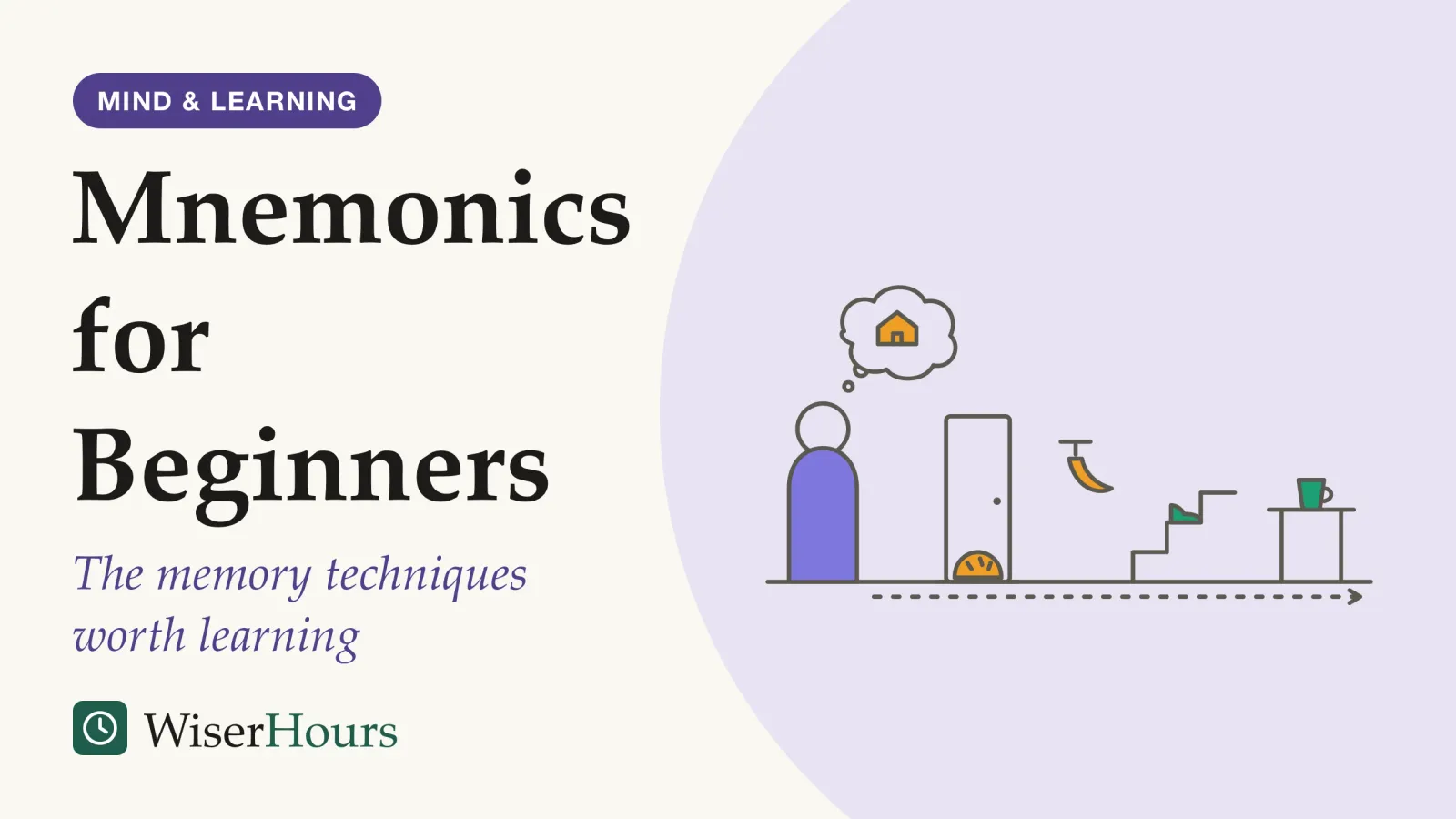
You have five points to make in Monday’s update and no slides to lean on. You run through them twice on the way in, and halfway through the meeting the fourth one is gone. The list gave your memory nothing to grip: no picture to hold each point, and nothing to lead from one point to the next.
Mnemonics supply both. They are memory techniques that turn information that is hard to hold, such as a list, a sequence or a foreign word, into vivid images hung on cues you already know. The most recent systematic reviewsystematic review: A review that fixes its question and its rules for including studies in advance, then searches out every study that fits and weighs them together. Some systematic reviews pool the results into a meta-analysis; others describe what the studies found without combining the numbers.Full entry in the glossary of the best-known technique, published in 2025 by Jan Ondřej of Masaryk University, found that placing items along an imagined route beat rote repetition for recalling lists in order right after learning, but rated the evidence very low in certainty.1 For beginners, four techniques are worth learning, each suited to a different job, plus one habit that makes any of them last:
- Place items along a familiar route
- Hang items on a rhyming peg list
- Link a foreign word to a sound-alike image
- Turn a fixed sequence into an acronym
- Practice recalling what you encoded
How mnemonics work: an odd image plus a cue you already own
Every mnemonic does two jobs, according to Kathleen McDermott and Henry Roediger, the memory researchers who wrote the chapter on encoding, storage and retrieval in the open Noba psychology textbook. It makes information distinctive while you learn it, and it gives you a set of cues you know perfectly for when you need that information back. All mnemonic systems, they write, rest on those two principles.2
Ordinary lists fail for a dull reason. Nothing about “bread, peanut butter, bananas, lettuce” leads from one item to the next, and nothing in the supermarket points back to the list. The first half of the fix is what McDermott and Roediger call recoding: converting information into a form that is easier to remember, the way the colors of the rainbow become the name ROY G BIV. The second half is the cue. In the peg-word version they describe, you first learn a rhyming list (one is a gun, two is a shoe, three is a tree), then picture each new item interacting with its peg: a gun shooting a loaf of bread, a jar of peanut butter inside a shoe. At recall you run through the pegs, which you know cold, and look at what hangs on each one.2
That is the logic of how memory works through encoding, storage and retrieval, applied on purpose: an odd image gets the item in, and a dependable cue gets it out. It also explains why a mnemonic can fail. A striking image tied to a cue you will not think of at the right moment is as useless as a forgettable image tied to a good cue.
Recoding has one cost worth knowing. McDermott and Roediger note that it can introduce errors, because details you add while making the image can later be remembered as part of the original.2 A doctor’s appointment pictured as a dentist’s chair on your doorstep may come back as a dental appointment. Keep images tied to the actual item, and check anything that matters against the source.
Exceptional memory is a skill people build
People with remarkable memories mostly trained for them, which matters to a beginner: the tools they use are the ones in this guide. In a 2003 study, a University College London team tested and scanned people renowned for memory feats at events such as the World Memory Championships. Their superior memory was not driven by exceptional intellect or by differences in brain structure; they used a spatial learning strategy that drew on brain regions, such as the hippocampus, that are critical for memory and especially for memory of places.3
Training studies agree. In a 2017 study led by Martin Dresler, the memory athletes tested all credited their skill to deliberate training in mnemonic strategies. The team then studied 51 young men with no mnemonic experience: some practiced the method of loci for half an hour a day over six weeks, others did working-memory training or no training. The loci group gained more on a word-list test than either comparison group and was still ahead four months later.4 The sample was small and all male, and the groups were balanced on baseline scores rather than randomized, so it shows what practice can do, not how much the average reader will gain.
In a 1980 study at Carnegie Mellon University, one participant practiced for more than 230 hours in the lab and raised the number of digits he could repeat back from 7 to 79.5 One person proves that the ceiling can move, not that everyone’s will.
Why does practice matter so much? A mnemonic adds a step to learning: each item has to be turned into an image and attached to a cue. McDermott and Roediger warn that items need to come relatively slowly at first, until pairing each one with its cue becomes practiced, and that systems beyond a basic peg list take a great deal of time and concentration to build. People get faster with time, they add.2
What this means for you: expect the first attempts to feel clumsy and slower than simply reading the list. A realistic first goal is a short list you can still walk through the next morning, such as tomorrow’s five errands, not a deck of cards. Speed comes with repetition.
Further reading
Moonwalking with Einstein: The Art and Science of Remembering Everything
A journalist's year of training for a memory contest, with the memory palace explained and the research on how champions do it.
As an Amazon Associate WiserHours earns from qualifying purchases.
A memory route helps recall, by an amount nobody can pin down
Placing an image of each item at a stop along a route you know well, then walking the route in your mind, is the method of loci, often called a memory palace, and Dresler’s team calls it the most prominent mnemonic technique.4 Ondřej’s 2025 review traces its benefit to familiar principles working together: words paired with pictures, new items tied to personal places, and a fixed path for retrieval.1
Take the Monday update from the start of this guide. The budget becomes a pile of coins on your doormat, the hiring plan a stranger sitting on the hall stairs, the delayed launch a rocket stuck in the kitchen sink, and so on. In the meeting, you walk from the front door inward and read off each scene. The images are silly on purpose; the route is familiar on purpose, so the next stop always tells you where to look.
The study
Limited evidence
A large effect that shrinks under a bias check
Jan Ondřej pooled experiments that compared the method of loci with rote repetition. Across 3,006 adults aged 17 to 88 (weighted mean age about 61), people using the method recalled lists in order much better when tested right away, a large effect (d = 0.88). In young adults alone, the effect was small (d = 0.42). Both analyses found strong evidence of publication bias and small-study effects; in the pooled one, one correction method shrank the effect to almost nothing while the other gave an implausibly large estimate. The review rates certainty very low.1
In plain terms, the method probably helps, but nobody can yet say by how much. Studies with striking results seem to have reached print more often than quieter ones, which is what publication biaspublication bias: The tendency for studies with striking or statistically significant results to be published, while quieter ones stay in the drawer. Since the missing studies are mostly the unimpressive ones, a pooled result tends to overstate the effect until it is corrected.Full entry in the glossary means. An earlier 2021 meta-analysis by Conal Twomey and Meike Kroneisen found a medium effect across 13 randomized trials, mostly at universities, that held up after its own checks for publication bias, although the great majority of those trials did not describe how they randomized participants.6 The direction is consistent; the size is contested.
The review also lists practical limits. It cites a recommended limit of about two items per stop, routes take time to build, fast use takes considerable practice, and reusing a route for a new list can interfere with the old one. The method mainly helps you recall items, especially in order; a 1985 study found little advantage for simply recognizing them.1 So a route earns its keep when you must produce the items yourself, in sequence, with nothing in front of you.
Which mnemonic to use for which job
Start with the one technique that fits what you actually need to remember, because each suits a different job. The evidence behind them also differs: the memory route has a recent systematic review, the keyword method a large body of trials with mixed long-term results, and peg lists and acronyms mainly a textbook account and a few small experiments.
1. Place items along a familiar route
Use a route for anything that must come back in order: the points of a talk, the stages of an argument, the errands for a Saturday. Keep to about two items per stop, the limit the 2025 review cites, and give each list its own route, since reusing one can blur the old list.1
2. Hang items on a rhyming peg list
A peg list suits items you may need by position (“what was the fourth step?”). McDermott and Roediger write that the method works quite well even with little training, that a 20-item rhyming list would probably take less than 10 minutes to learn, and that you can recall items backward as easily as forward, because each peg leads straight to its item.2 Systems that turn every number into a stored image exist too, but they take far longer to build.
3. Link a foreign word to a sound-alike image
The keyword method pairs a new word with a familiar one that sounds like it, then joins the two in one image. John Dunlosky and colleagues give the example of the French la dent (tooth): think of “dentist,” then picture a dentist holding a large molar with pliers. The method has helped learners from second graders to college students with foreign vocabulary, science terms and people’s names.7
Its limits are real. It works best for concrete, “keyword-friendly” words, and in most studies the researchers supplied the keywords. In one set of experiments, the keyword advantage vanished for students tested only after a week, and once a rote-repetition group was given enough practice to match the keyword group on an immediate test, it recalled more a week later. Dunlosky’s 2013 review rated the method low utility, partly for that reason.7 Save it for a handful of stubborn, concrete words, and test yourself on them.
4. Turn a fixed sequence into an acronym
An acronym, a word built from first letters, holds the order of things you already know, not the things themselves. In a 2019 experiment at Technische Universität Berlin, university students given an acronym learned an eight-step procedure faster than students without one, but they were no quicker or more accurate at carrying it out. The authors note that earlier studies found acronyms helped memory for order but usually not memory for which items were on the list.8 Use one for the steps of a routine you understand, such as a pre-meeting checklist.
5. Practice recalling what you encoded
A mnemonic gets information in; recalling it helps keep it there. In one head-to-head comparison cited in Dunlosky’s review, plain self-testing helped foreign vocabulary last as well as keyword images did, or better a week later, and it is easier to use.7 For the full method, with timings for each review, read the guide to self-testing and spaced review for any subject.
Seven days, one technique
Where mnemonics fall short
Mnemonics help most with arbitrary material that must come back exactly, such as lists, orders, names and foreign words. Most of the loci experiments in the 2025 review’s tables are short lab tests of word lists, many of them with students. That review rated its evidence very low in certainty, and found that older learners often stopped using the technique or changed it, which reduced their long-term gains.1
In our search we found few studies that follow people using mnemonics in their own work over months. The honest summary is that the techniques work in the lab, especially for ordered lists tested soon after learning, and that how well they carry into daily life is mostly untested.
If it is an idea, a mnemonic is the wrong tool, and self-testing and spacing will serve you better. If it is a list, a route or a peg list is worth the effort.
| Technique | What the best evidence found | Evidence |
|---|---|---|
| Memory route (method of loci) | Beat rote repetition for immediate recall in order; true size uncertain because of publication bias | Meta-analysis, limited1 |
| Six weeks of route training | Word-list recall improved more than with working-memory training, still ahead four months later | Non-randomized trial with 51 young men, limited4 |
| Rhyming peg list | Works quite well with little training; recall runs forward or backward | Textbook chapter by memory researchers, limited2 |
| Keyword images | Help with concrete words at first; faster forgetting in one experiment; rated low utility | Expert review of trials, limited7 |
| Acronyms | Faster learning of a step order; no faster or more accurate performance | Trial with students, limited8 |
The bottom line
A beginner needs one mnemonic matched to one real job: a memory route for points that must come in order, a peg list for items you need by position, a sound-alike image for a stubborn foreign word, an acronym for a routine you already understand. Expect it to feel slow at first, and recall the images the next day instead of rereading the list. Even the route, the best-reviewed of the four, rests on evidence of very low certainty, so judge any technique by what you can still recall a week later.
Frequently asked questions
Is a mnemonic quick to pick up, or does it need weeks of practice?
It depends on the system. Kathleen McDermott and Henry Roediger write that a 20-word rhyming peg list would probably take less than 10 minutes to learn and practice, while larger systems take a great deal of time and concentration. In Martin Dresler's 2017 training study, beginners practiced memory routes for 30 minutes a day over six weeks.
Can you reuse the same memory route for a new list?
You can, with care. Jan Ondřej's 2025 review notes that reusing the same stops for a new list can cause interference between the old and new material. In Martin Dresler's 2017 training study, beginners built four routes and followed a plan that rotated them, partly to reduce interference between lists learned on consecutive days.
Do mnemonics work for older adults?
Yes, with more support. Jan Ondřej's 2025 review found the method of loci linked to better recall in healthy older adults, but they often stopped using or changed the technique, used it inconsistently without explicit reminders, and typically did not reach younger adults' levels even with extended practice. The review rated this evidence very low in certainty.
Sources
- The method of loci in the context of psychological research: A systematic review and meta-analysis. Ondřej, J. (2025). British Journal of Psychology, 116(4)
- Memory (Encoding, Storage, Retrieval). McDermott, K. B. & Roediger, H. L., III (2026). In R. Biswas-Diener & E. Diener (Eds), Noba textbook series: Psychology. DEF Publishers
- Routes to remembering: the brains behind superior memory. Maguire, E. A., Valentine, E. R., Wilding, J. M. & Kapur, N. (2003). Nature Neuroscience, 6(1)
- Mnemonic Training Reshapes Brain Networks to Support Superior Memory. Dresler, M., Shirer, W. R., Konrad, B. N., Müller, N. C. J., Wagner, I. C., Fernández, G., Czisch, M. & Greicius, M. D. (2017). Neuron, 93(5)
- Acquisition of a Memory Skill. Ericsson, K. A., Chase, W. G. & Faloon, S. (1980). Science, 208(4448)
- The effectiveness of the loci method as a mnemonic device: Meta-analysis. Twomey, C. & Kroneisen, M. (2021). Quarterly Journal of Experimental Psychology, 74(8)
- Improving Students' Learning With Effective Learning Techniques: Promising Directions From Cognitive and Educational Psychology. Dunlosky, J., Rawson, K. A., Marsh, E. J., Nathan, M. J. & Willingham, D. T. (2013). Psychological Science in the Public Interest, 14(1)
- The Impact of a Mnemonic Acronym on Learning and Performing a Procedural Task and Its Resilience Toward Interruptions. Radović, T. & Manzey, D. (2019). Frontiers in Psychology, 10, 2522
How we researched this
Sources were found through PubMed, PMC, Crossref and web searches in September 2026, starting from the newest systematic review of the method of loci. Five were read in full and three, marked in the editor's notes, as abstracts only. They span 1980 to 2026. Main limitation: nearly all the experiments are short lab sessions with word lists, mostly with students or healthy older adults.
Keep reading

Do Brain-Training Games Work? What Large Studies Found
Do brain-training games work? From a 2010 BBC trial to 20 years of US data, large studies find they train the game, not everyday memory.
How to Remember Names: A Method That Works at Parties and Meetings
4 steps for remembering names, built on the best-tested one: recall a new name to yourself soon after you hear it, then again after longer gaps.
Dementia Risk Factors You Can Change: What Major Reviews Conclude
A 2024 Lancet Commission links 14 changeable dementia risk factors to about 45% of cases. What WHO's 2026 guideline and trials like FINGER add.
Working Memory Explained: Your Brain's Mental Scratchpad
Working memory is the mind's small scratchpad. A 2017 review counted 9 definitions; here are the main models, how it is tested and what lowers it.