How to Create a Weekly Cleaning Schedule
How to make a weekly cleaning schedule in 5 steps that fit your free time and household, with 3 ready-made versions to copy and adapt.

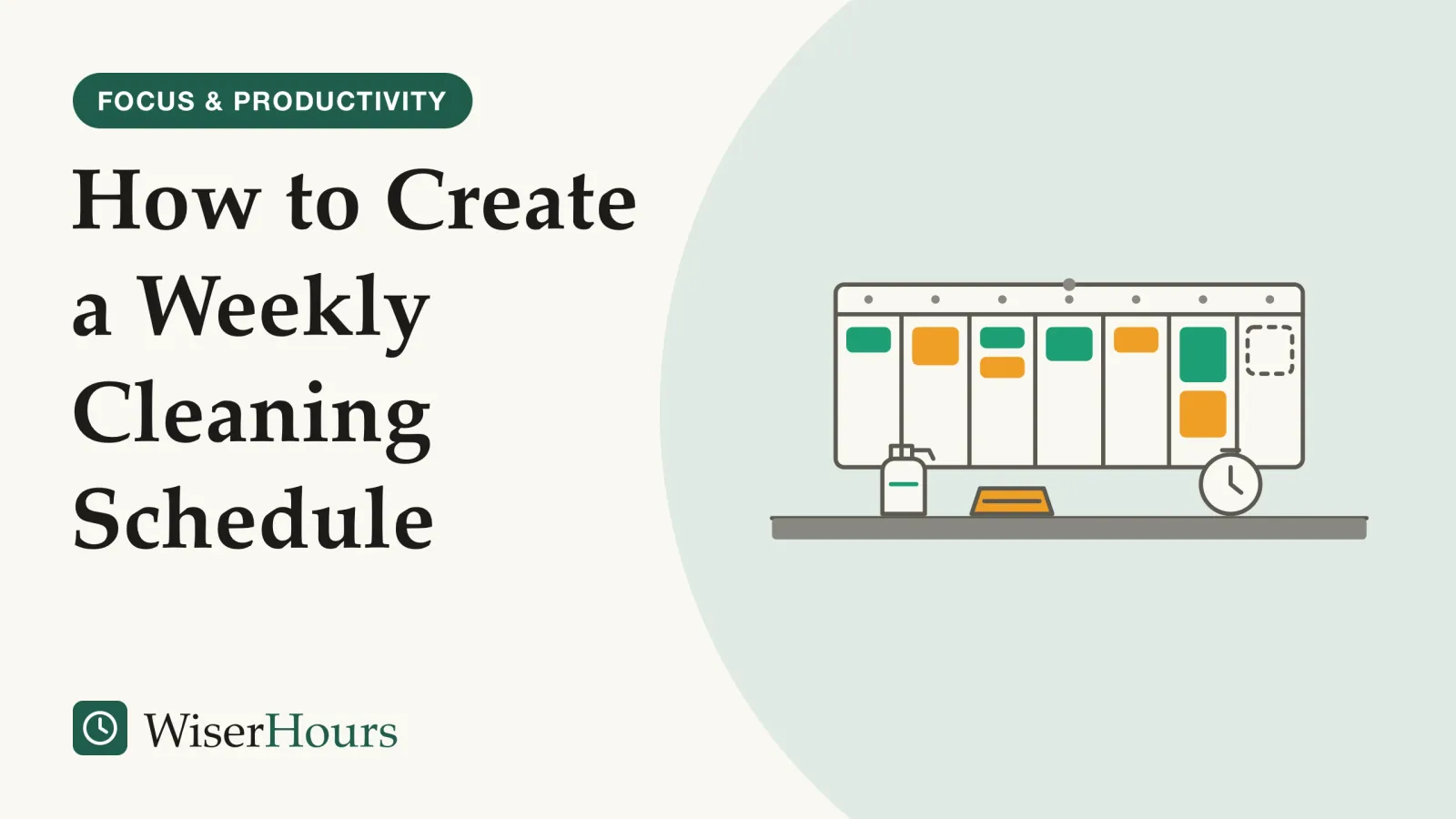
Bathroom on Monday, kitchen on Tuesday, bedrooms on Wednesday: the usual printable chart gives each room its own day and assumes you are free every evening and live alone. A weekly cleaning schedule that lasts starts from the other end: the jobs your home needs, the hours you have free and who shares the work. It takes five steps:
- List every cleaning job in your home
- Sort each job by how often it needs doing
- Time the jobs and fit them into your free time
- Give every job one owner
- Keep a catch-up slot for missed days
This guide from the organization section covers the upkeep that follows a full plan to put your home and days in order. If the problem is too much stuff, decluttering your home room by room comes first: fewer things on surfaces make every job shorter.
Prefer to watch? The video covers the same ground as this article.
What should be on a weekly cleaning schedule?
A weekly cleaning schedule should hold the jobs that come back within about a week: wiping kitchen surfaces and the hob, cleaning the toilet, sink and shower, changing bedding, vacuuming or mopping floors, dusting, emptying bins and clearing the fridge. Daily jobs and monthly ones sit on separate, shorter lists.
Two kinds of job end up on that list. Some protect health. The International Scientific Forum on Home Hygiene (IFH), an educational charity whose core work is funded by the cleaning-product makers Unilever, SC Johnson and Reckitt, calls its approach targeted hygiene and names nine moments when harmful germs are most likely to spread, among them food handling, using the toilet or changing a nappy, touching surfaces other people often touch, handling dirty laundry and linen, and handling rubbish.1 The rest keep the home pleasant: dust, smears on glass, crumbs under the sofa. Those can wait a few days when the week is full.
That split tells you what to protect when the week goes wrong. A home with a toddler, a pet or someone ill will have more jobs in the first group. Wiping the chopping board after raw chicken belongs with the cooking itself, whatever day the schedule says.
- Myth
- A good cleaning schedule gives every room its own day.
- Fact
- Rooms take very different amounts of time. Plan by job, its length and your free days, and let busy days carry nothing.
How often to clean each part of your home
How often to clean each area depends on what the job prevents. Hygiene guidance ties some jobs to events, such as preparing raw food or someone being ill, rather than to a calendar.1 For most other jobs, the usual frequencies are habit and convention: watch how fast the mess returns in your home and adjust.
| Job | Typical frequency | Basis |
|---|---|---|
| Wipe and clean food-preparation surfaces | After cooking, and straight after raw meat or poultry | Food handling is one of the IFH’s hygiene moments1 |
| Toilet, bathroom sink and taps | Weekly, and more often when someone is ill | Toilet use and caring for an ill family member are IFH moments; the weekly interval is convention1 |
| Bins and the area around them | Empty when full; wash when they smell or leak | Handling rubbish is an IFH moment; the interval is convention1 |
| Bedding and towels | Weekly to fortnightly | Convention; no official schedule found |
| Floors, dusting, mirrors | Weekly, or less in a lightly used room | Convention; no official schedule found |
| Fridge clear-out | Weekly, before the shopping | Convention; no official schedule found |
| Oven, windows, inside cupboards | Monthly to a few times a year | Convention; no official schedule found |
Treat the convention rows as starting points. A flat with two cats and a muddy garden door may need the floors done twice a week; a quiet spare room can drop to once a month. The hygiene rows stay tied to their moments however busy the week is.
Five steps to a weekly cleaning schedule that fits your week
No study has tested cleaning schedules as such, so the five steps draw on planning and habit research instead.
- List: every cleaning job in the home on one list, before deciding anything
- Sort by how often: daily, weekly, or monthly and less, judged by hygiene where it matters and by how fast the mess returns elsewhere
- Fit, assign, leave a gap: place jobs only in time you really have, give each one an owner (two colours here), and keep one empty slot for whatever slips
1. List every cleaning job in your home
Walk through each room and write down every job you do or wish you did, from wiping the hob to washing the shower curtain. Include the small ones people forget to count, such as refilling soap and taking out recycling, so the plan does not look lighter than the week is.
2. Sort each job by how often it needs doing
Mark each job daily, weekly, or monthly and less, starting from the table above: if the bathroom mirror is spotted again within two days, it is a twice-weekly job for you. Daily jobs, such as dishes, stay off the weekly plan and belong with your evening routine.
3. Time the jobs and fit them into your free time
Before you plan, time each weekly job once with a phone timer, the next time you do it. A set of 1994 studies by the psychologists Roger Buehler, Dale Griffin and Michael Ross found that people expect their own tasks to take less time than they do, because they picture the plan rather than recall how long similar tasks took before.2 The bias is known as the planning fallacyplanning fallacy: The tendency to underestimate how long your own tasks will take, even when you know similar tasks ran late before. Estimating from your track record on past tasks, rather than from the plan, tends to correct it.Full entry in the glossary. Their fourth study found the bias vanished once participants were told to connect their estimate with relevant past experiences, which is what a timed first run gives you.2 The studies used academic and everyday tasks rather than housework, and we read only the paper’s abstract.
Then mark your free time on a week plan. A parent who gets home late on Mondays and Wednesdays has no cleaning time on those evenings, and the plan should show it. Place each timed job into a free slot, and name the slot as a when and where: “Thursday after dinner, bathroom.” A meta-analysis of 642 tests, published in 2025 by Paschal Sheeran, Olivia Listrom and Peter Gollwitzer, concluded that plans like this, known as implementation intentionsimplementation intention: A plan in if-then form that ties a specific action to a specific situation, such as 'if it is nine o'clock, then I open the report.' It hands the decision about when and where to act to the situation itself.Full entry in the glossary, helped people follow through on what they meant to do, with small to moderate effects across outcomes, and worked better when written as if-then.3
4. Give every job one owner
In a shared home, write one name next to every job. “We’ll all do the bathroom” usually means the person who minds the dirt most does it. Owning a job also means noticing when it is due and getting the supplies, the unseen planning described in how the household mental load builds up. Hand over whole jobs, including the noticing.
5. Keep a catch-up slot for missed days
Leave one short slot each week empty on purpose, ideally on the day you are most often free. A missed job moves there instead of waiting a whole week or piling onto the next evening. In a 2012 article for GPs, the habit researchers Benjamin Gardner, Phillippa Lally and Jane Wardle report that skipping the odd chance to repeat a new behaviour did not seriously set back habit formation.4
Set up your schedule
How long should weekly cleaning take?
No official guideline says how long weekly cleaning should take; it takes as long as your own timed jobs add up to. Time-use surveys show what people do instead. The American Time Use Survey, run by the US Bureau of Labor Statistics, counts housework separately from cooking and garden work.
The study
Strong evidence
Who did housework on an average US day in 2025
On an average day in 2025, about 36% of people in the US aged 15 or older did some housework, and those who did spent about an hour and a half on it.5
These are US averages across very different homes; they describe what people do, and other countries’ surveys give other numbers. If your timed list adds up to far more than your free time, cut or share jobs before you start.
Three ready-made schedules to copy
Pick the version closest to your week, then swap in your own jobs and free days.
Version 1: 15 minutes a day
Pick this one if most evenings have a short gap and the weekend has no long block. Each day carries one job of about a quarter of an hour.
| Day | Job |
|---|---|
| Monday | Kitchen: wipe cupboard fronts, hob and appliance handles |
| Tuesday | Bathroom: toilet, sink, taps and mirror |
| Wednesday | Dust surfaces and wipe light switches and door handles |
| Thursday | Vacuum or mop the main floors |
| Friday | Clear the fridge and empty all bins |
| Saturday | Change bedding and start the wash |
| Sunday | Catch-up slot, or rest |
Version 2: the weekend block
Long weekday hours point to this version. Daily jobs carry on during the week, and the weekly jobs run as one block of about 90 minutes at the weekend: bedding into the wash first, then dusting, bathroom and kitchen, with floors last so dust falls onto floors you have not yet cleaned. In the US survey, slightly more people did housework on weekend days than on weekdays.6 Keep a short weekday evening as the catch-up slot, for the weekend you are away.
Version 3: a shared-household rotation
Housemates and families with older children can share the work this way. Group the weekly jobs into zones of similar length and rotate them each week, so nobody keeps the bathroom for good.
| Zone | Jobs | Week 1 | Week 2 | Week 3 |
|---|---|---|---|---|
| Kitchen | Surfaces, hob, fridge clear-out, bins | Person A | Person B | Person C |
| Bathroom | Toilet, sink, shower, mirror, towels | Person B | Person C | Person A |
| Floors and dust | Vacuum, mop, dust shared rooms | Person C | Person A | Person B |
Each person picks their own day, as long as the zone is done by the agreed evening; bedrooms stay with whoever sleeps in them.
How to split a cleaning schedule in a shared home
Split a shared cleaning schedule by time and by whole jobs: add up each person’s timed jobs so the totals are close, and let each person own their jobs outright. Unequal splits are common. In the same 2025 US survey, 48 percent of women did some housework on an average day, double the 24 percent of men.5 Worldwide, the International Labour Organization’s 2018 report on care work found that women perform more than three-quarters of all hours of unpaid care work.7
In a 2016 Pew Research Center report on US married adults, 56 percent said sharing household chores is very important for a successful marriage, ranking it above having children or an adequate income.8 The survey measured what people value, and it cannot show what uneven sharing does to a relationship.
A couple where one partner works nights might split by availability, then compare totals in minutes; children can own small whole jobs, such as dusting or folding towels. Review the split together after a month.
How to stick to a cleaning schedule
A cleaning schedule sticks when each job is tied to a fixed cue, is short enough to finish, and has a planned way back after a missed day. Gardner, Lally and Wardle’s advice is to pick a time and place that turn up daily; in the research they summarize, a simple action such as drinking water became automatic sooner than a longer routine.4 That work tracked daily habits, so a weekly job will probably need more repeats before it runs on its own.
Hang the schedule where everyone sees it, such as the fridge door or a shared calendar, and tick jobs off. A job that keeps landing in the catch-up slot is usually too long for its slot, sits on a day that is not free after all, or belongs to someone who never agreed to it; change that one thing.
Cleaning products: mixing, fresh air and children
Cleaning safely comes down to three points from public-health bodies: never mix bleach with other cleaners, let fresh air in while you work, and store products where children cannot reach them. The US Centers for Disease Control and Prevention (CDC), in guidance reviewed in 2026, says never to mix bleach with ammonia or any other cleaner.9 A 2020 CDC report explains why: bleach mixed with vinegar or ammonia can release chlorine and chloramine gases, which might cause severe lung damage if breathed in.10 Read the labels before using two products in the same room on the same day.
Using cleaning products safely
The CDC advises opening windows and doors when using cleaning products indoors and trying not to breathe in the fumes.9 The UK’s NHS poisoning page, reviewed in 2025, lists household cleaning products such as bleach among common causes of poisoning, and advises keeping liquid cleaners in their original containers and chemicals out of children’s reach, ideally in a locked cupboard.11
If someone may have swallowed, breathed in or splashed a cleaning product, the right route depends on how they are:
- Now: if the person is unconscious, has stopped breathing, has severe trouble breathing or has a seizure, call your local emergency number immediately. These are the signs the NHS gives for the UK, with 999 or A&E as its route, and it warns against trying to make the person sick.11
- Soon: if you are unsure whether a product is harmful, call a poison centre where your country has one. The World Health Organization noted in 2021 that fewer than half of its member states have a poisons centre, so in many places the emergency number or a doctor is the route.12 In the US, the Poison Help line, 1-800-222-1222, is staffed around the clock by America’s Poison Centers members at no cost.13 The NHS sends unsure callers in the UK to 111.11
The bottom line
A weekly cleaning schedule works when it is built from your own week: every job listed, timed once, placed only in free time, owned by one person and backed by a catch-up slot. This week, time each job the next time you do it, then draft the plan on one sheet and put it where the whole household will see it.
This article is general information, not medical advice. If you're worried about your health, talk to a doctor or another qualified professional.
Frequently asked questions
Should I clean one room a day?
A room-a-day plan suits a home where every room takes about the same time and you are free every day. Most homes are uneven: a bathroom takes far less time than a kitchen, and some days have no spare time at all. Group jobs by how long they take and by the days you are free, so a busy Tuesday gets nothing and a quiet Thursday gets two jobs.
What if my working hours change every week?
Plan by job rather than by weekday. Keep a short list of the week's jobs with their timed length, and when the rota for the week is out, slot them into the free gaps it leaves. The catch-up slot matters more on a shifting schedule, so put it on the day you are most often free.
Is a cleaning app better than a paper chart?
No study comparing cleaning apps with paper charts turned up in our searches. What matters is that everyone who shares the work can see the plan without looking for it and knows which jobs are theirs. A sheet on the fridge works for that; so does a shared calendar or list app, if everyone already opens it daily.
Sources
- Nine moments for hygiene. International Scientific Forum on Home Hygiene (IFH), press release, 20 November 2019
- Exploring the 'planning fallacy': Why people underestimate their task completion times. Buehler, R., Griffin, D. & Ross, M. (1994). Journal of Personality and Social Psychology, 67(3), 366-381
- The when and how of planning: Meta-analysis of the scope and components of implementation intentions in 642 tests. Sheeran, P., Listrom, O. & Gollwitzer, P. M. (2025). European Review of Social Psychology, 36(1), 162-194
- Making health habitual: the psychology of 'habit-formation' and general practice. Gardner, B., Lally, P. & Wardle, J. (2012). British Journal of General Practice, 62(605), 664-666
- Table 1. Time spent in primary activities and percent of the civilian population engaging in each activity, averages per day by sex, 2025 annual averages. US Bureau of Labor Statistics, American Time Use Survey, released 25 June 2026
- American Time Use Survey: 2025 Results. US Bureau of Labor Statistics, news release, 25 June 2026
- ILO calls for urgent action to prevent looming global care crisis. International Labour Organization, press release on the report Care Work and Care Jobs for the Future of Decent Work, 28 June 2018
- Sharing chores a key to good marriage, say majority of married adults. Pew Research Center (US), 30 November 2016
- How to Safely Clean and Sanitize with Bleach. Centers for Disease Control and Prevention (US), last reviewed 26 August 2026
- Knowledge and Practices Regarding Safe Household Cleaning and Disinfection for COVID-19 Prevention — United States, May 2020. Gharpure, R. et al. (2020). CDC Morbidity and Mortality Weekly Report, 69(23), 705-709
- Poisoning. NHS (UK), page last reviewed 12 June 2025
- Why the world needs more poisons centres. World Health Organization, feature story, 18 February 2021
- America's Poison Centers. America's Poison Centers (US), home page, checked 2026-10-17
How we researched this
We searched official time-use surveys (the US Bureau of Labor Statistics, the ILO), hygiene and poisoning guidance (CDC, NHS, WHO, the International Scientific Forum on Home Hygiene) and psychology research on planning and habits in October 2026. Sources date from 1994 to 2026. Main limitation: no study has tested cleaning schedules themselves, so the method applies planning and habit research to housework, and two papers were read as abstracts only.
Keep reading

How to Build a Capsule Wardrobe
How to build a capsule wardrobe in 5 steps: log what you wear for two weeks, pick a palette, size it to your climate and life, buy slowly, review each season.

Desk Organization Ideas That Actually Help You Work
6 desk organization ideas that make work easier, from zoning by reach to a short end-of-day reset, and what research says about messy desks.
How to Organize Your Closet
How to organize your closet in 6 steps and one afternoon: empty it, edit by fit and use, zone by how often you wear things, and store the off-season safely.
Cable Management: A Simple Guide
Cable management in 6 steps with cheap parts: one power strip under the desk, heavy cables first, loose ties, slack, and the fire rules for cords and rugs.