How to Get Organized When You Don't Know Where to Start
How to get organized in 4 steps: list what's in your head, plan the tasks that nag, clear one small area, then hold a weekly reset. Why that order works.

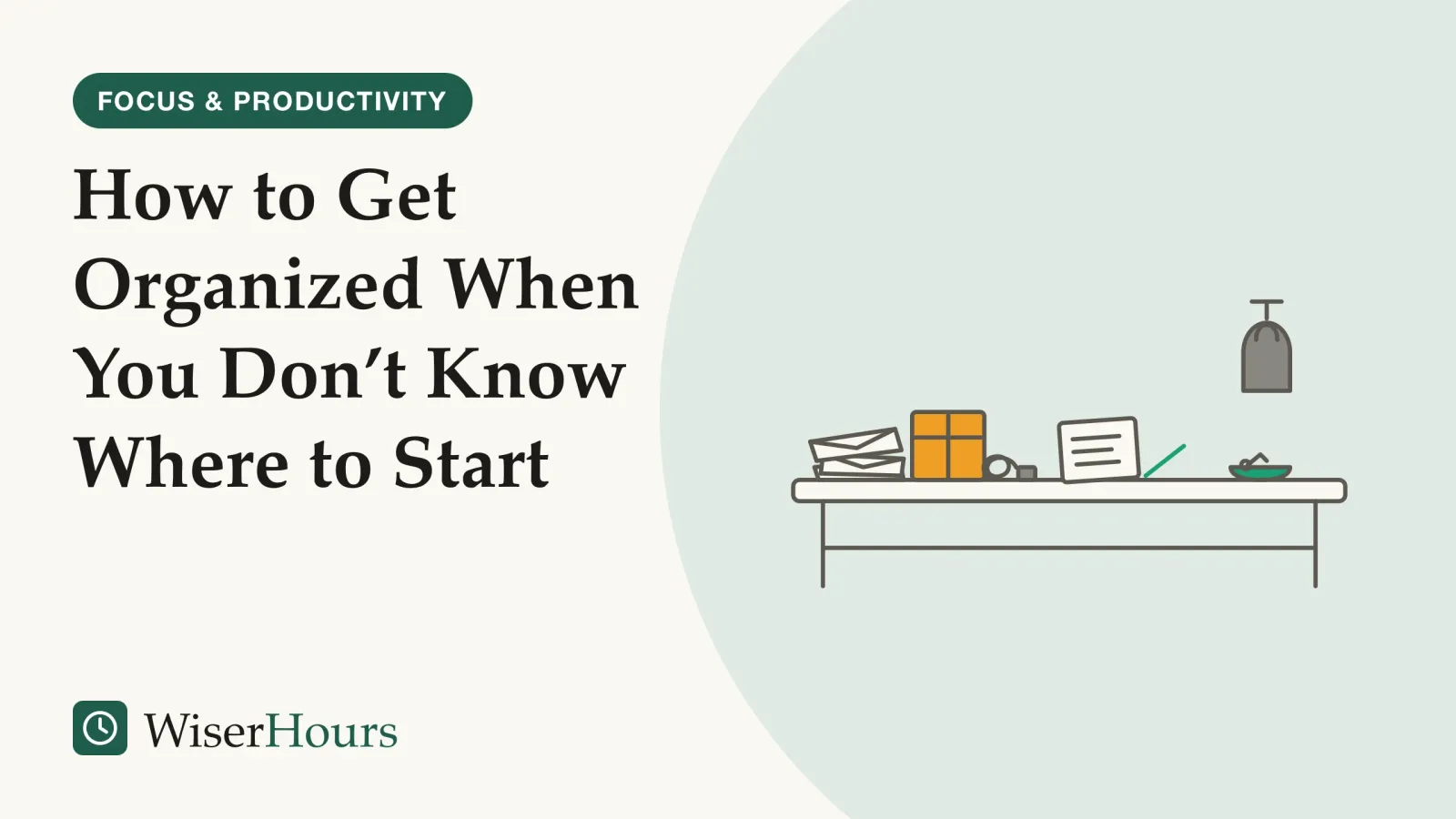
The pile on the hall table has been there since spring: unopened letters, a parcel to return, two chargers, a form for the dentist. Every time you walk past, it reminds you of half a dozen things you haven’t done.
Start with your head, not your house. That is how to get organized when you don’t know where to start: the problem is less the stuff than the decisions it stands for, so the first job is to get those decisions out where you can see them, then finish one small area, then protect it with a short routine. In a series of experiments published in 2011, mostly with university students, psychologists E. J. Masicampo and Roy Baumeister found that making a specific plan for an unfinished task stopped it from intruding on people’s thoughts, even though the task itself was still undone.1 In practice, that gives four steps:
- Empty your head onto one list
- Make a specific plan for the three tasks that nag most
- Clear one small area you use every day
- Hold a short weekly reset
A mess is a pile of postponed decisions
A disorganized home or desk is hard to start on because each item is a small decision you have put off, and together they are too many to rank. In an online survey of 290 US office workers published in 2019, Catherine Roster and Joseph Ferrari found a pattern consistent with a chain: heavy, fast-paced workloads went with exhaustion, exhaustion with putting off decisions, and indecision with more clutter in people’s workspaces.2 Survey data like these cannot show which came first, and we read only the study’s abstract.
The idea explains why a pile grows. Putting something down “for now” postpones three questions at once: do I keep it, where does it live, and when will I deal with it? The dentist form on the hall table is not really a piece of paper. It is an unmade appointment, an unanswered question about insurance and a vague promise to yourself. That is why stacking the pile neatly feels useless: every decision is still waiting.
- Myth
- Your brain holds on to unfinished tasks, so you won't forget them.
- Fact
- A 2025 meta-analysis by Romain Ghibellini and Beat Meier found no general memory advantage for unfinished tasks. What held up was a pull to go back to them.
That pull may be part of the nagging you feel, and it is not a reliable record. Ghibellini and Meier, of the University of Bern, pooled experiments on interrupted tasks and found that people did not generally remember unfinished tasks better than finished ones, but did tend to resume them when given the chance.3 The lesson is to treat the nag as a signal, not a filing system: if a task matters, it belongs on paper.
Writing a plan quiets unfinished tasks before you do them
The best-tested first move happens on paper rather than on shelves. In Masicampo and Baumeister’s experiments, unfinished tasks kept pulling at people’s attention until they wrote a specific plan for when, where and how they would do them, and then the pull stopped.1
- No plan yet: each unfinished task keeps a thread to your attention and can intrude while you do something else
- A specific plan: the tasks are still undone, but each has a when, where and how on the page; in the 2011 experiments, that stopped the intrusions
The experiments asked a question most people never do: does an unfinished task stop nagging only once it is done?
The study
Limited evidence
Masicampo and Baumeister: plans for unfinished tasks (2011)
In most of the studies, people were asked to think of important tasks or goals they had not yet finished, then some of them wrote down exactly how, when and where they would do each one. Those who only thought about their unfinished tasks reported more intrusive thoughts about them during an unrelated reading task, and in another study did worse on anagram puzzles. Those who made a plan showed none of these effects, although they had done none of the work.1
The authors’ explanation is that once a plan exists, the mind stops pushing and waits for the time you named. Two details matter in practice. In one study, listing several possible ways to get a task done without committing to one left people with more intrusive thoughts than making a specific plan did. In the two studies that measured feelings, that one included, planning did not make people feel less anxious about their tasks; it changed what occupied their minds, not how they felt.1 So expect a plan to clear your head, not to make a dreaded task feel lighter. The studies were short, mostly with students, and have not been repeated by another team that we could find.
Here is what that looks like on the hall table. “Sort out the dentist form” keeps nagging. “Thursday at 12:30, at my desk, fill in the form and post it on the way back from lunch” gives the task a place to wait. Nothing is done yet, but you can walk past the table without it asking you anything new.
What this means for you
A to-do list quiets your mind only when its items become commitments. For the few tasks that keep coming back to you, write the next action and exactly when and where you will do it. A list of options, or a note that just says “deal with it,” leaves the loop open.
How to get organized in four steps
Each step makes the next one easier: the list shows you where the pressure is, the plans quiet the loudest items, the cleared area gives you a visible result, and the weekly reset keeps it. The first two steps rest on experiments; the last two rest mainly on habit research and our reasoning.
- 1Empty your headone list, no sorting yet
- 2Plan the nagging fewa when and a where for each
- 3Clear one small areafinish it in one session
- 4Weekly resetrestore the area, update the list, pick the next area
Then repeat from “Empty your head”
1. Empty your head onto one list
Set aside half an hour and write down everything that has your attention: home, work, errands, admin and the things you have been meaning to fix. Don’t sort, rank or solve anything yet. The aim is one list in one place rather than notes scattered across sticky pads and message drafts.
This is the capture step that productivity systems such as Getting Things Done begin with. A long list can feel worse at first. That is normal: you are seeing how much you have been carrying.
2. Make a specific plan for the three tasks that nag most
Read the list and mark the three items that bother you most. For each, write the next physical action and when and where you will do it, as in the dentist example. This is the step Masicampo and Baumeister tested, and the specific plan, not the list itself, is what made the difference in their studies.1 Three is our choice, not a tested number.
Wording the plan as “if it is Thursday at 12:30 and I am at my desk, then I fill in the form” may help you follow through. A 2025 meta-analysis of 642 experimental tests by Paschal Sheeran, Olivia Listrom and Peter Gollwitzer found that plans naming when and where to act helped people act on their goals, with larger effects when plans took the if-then form and were rehearsed; the authors judge the average benefit small once publication bias is allowed for. One caution from the same analysis, in comparisons across studies: plans that people kept and could reread had smaller effects, which the authors suggest may be because rethinking a plan weakens it.4 There are more worked examples in if-then plans for starting your most important task.
3. Clear one small area you use every day
Choose one surface you see daily, such as the hall table, the desk or one kitchen counter, and finish it in a single session. Everything on it goes into one of three places: out of the house, to where it belongs (take it there now), or onto your list with a next action. No study has tested where to start decluttering, so this reasoning is ours: a finished area closes loops, while half-emptied cupboards in four rooms open new ones.
Small matters because it is finishable. A counter can look better within the hour, and a visible result may make the next session easier to begin. A first step you are sure you can finish is also one of the fixes in why we procrastinate. If parting with things causes you real distress, not just reluctance, skip this step and read the hoarding pointer near the end; that caution is ours.
Try it
Tonight, set a timer for 20 minutes and clear one surface completely. Anything that needs more than two minutes of thought goes on your list with a next step, not back on the surface.
4. Hold a short weekly reset
Once a week, restore your cleared area, go through the list, cross off what is done, give the week’s most nagging items a when and a where, and pick the next small area. Tie the reset to something you already do each week, such as the Saturday coffee after the shopping, so the cue arrives on its own.
Habit research supports keeping it short and tied to a stable cue. In a 2012 article for family doctors, Benjamin Gardner, Phillippa Lally and Jane Wardle advise attaching a new action to a time and place you meet every day, and note that simple actions became automatic faster than elaborate routines.5 That research is about daily actions, so our inference is that a weekly routine may take longer to feel automatic. The cue side is explained in how habits form around cues, and the list side in a weekly review that moves what did not fit.
Your first week
Clutter and stress tend to arrive together
Clutter goes with stress and lower well-being in observational studies of homes and offices, and the link may run both ways, but no study we found shows that clearing clutter lowers stress. That shapes two things: what you can expect from tidying, and how you judge yourself when the piles grow.
Further reading
Getting Things Done: The Art of Stress-Free Productivity
The system this guide's capture step comes from, set out in full by the person who created it.

As an Amazon Associate WiserHours earns from qualifying purchases.
One often-cited study is small. In 2010, Darby Saxbe and Rena Repetti analyzed tours that 60 dual-income spouses gave of their own homes. Wives who used more words about clutter and about the home feeling unfinished had a flatter daily rhythm of the stress hormone cortisol, a pattern the authors link to poorer health, and their mood grew more depressed as the day went on. The study counted words, not objects, so, on our reading, a stressed person may simply describe the same room more harshly, and we read only its abstract.6
A 2025 one-off survey of 501 adults, run by Francis Quinn during the COVID pandemic, likewise linked more home clutter with more negative feelings, without showing which came first.7
Both directions fit the idea of clutter as postponed decisions. A pile can remind you of every choice you have not made. And the office-worker survey fits the reverse route: exhaustion may make decisions harder to take, so the parcel and the cable get put down “for now” and stay there.2 Think of someone who comes home from a hard week to a spare room full of half-finished projects: the room may add to the strain, and the strain may make the room harder to face.
What to expect from tidying
Don’t count on a clear counter to fix stress from elsewhere, such as a heavy workload: it gives you a visible result, not a lighter week. If clutter builds up during an overloaded stretch, read it as a sign of overload, not a personal failing; keep the next reset small and ease the load where you can.
If stress is the bigger problem, start with what stress is and how the stress response works.
What the evidence supports, step by step
The strongest evidence here is on planning; the evidence on clutter is observational, and the order of the steps is our reasoning. Keep the planning steps, and adjust the rest to suit your home.
| What it is | What the best evidence found | Evidence |
|---|---|---|
| A specific plan for an unfinished task | Stopped intrusive thoughts in short experiments, without reducing anxiety | Trial, limited: mostly undergraduates1 |
| If-then wording for plans | Helped people act on goals, more so in if-then form; small after correcting for publication bias | Meta-analysis, moderate4 |
| The nag of unfinished tasks | No general memory advantage; a tendency to resume them | Meta-analysis, moderate3 |
| Clutter and stress | Clutter words linked to flatter cortisol and worsening mood in wives; clutter linked to more negative feelings | Observational, limited67 |
| Stress and clutter | Workload, exhaustion and indecision linked to office clutter | Observational, limited: one survey2 |
| Starting with one small area | No study found | Gap: our reasoning |
| A weekly reset on a stable cue | Simple daily actions became automatic faster than elaborate ones; weekly routines not studied | Expert summary of one field study, limited5 |
Signs that organizing is not the whole answer
A steady struggle with clutter or with keeping track of things is sometimes part of a health condition, such as hoarding disorder or ADHD, rather than a lack of effort, and tidying is not a treatment for either condition or for low mood. Each line names its source; the order of urgency is ours.
- Urgently: for thoughts of suicide or self-harm, seek help at once. In the US, call or text 988 for the Suicide and Crisis Lifeline, and call 911 if a life is in danger, as the National Institute of Mental Health advises.8 In the UK, the NHS says to call 999 or go to A&E if a life is at risk or you cannot keep yourself safe, and to use 111 online or call 111 for urgent mental health help.9 Elsewhere, call your local emergency number.
- In the next few weeks: if you find it very hard to get rid of things even when rooms can no longer be used, or your belongings cause conflict at home, see a doctor. In the UK, the NHS describes hoarding disorder as a mental health condition and advises seeing a GP if you think you might have it.10 In the US, the American Psychiatric Association advises contacting your doctor or a mental health professional.11
- At a routine appointment: if disorganization has followed you since childhood, along with losing things, being easily distracted and struggling to finish tasks, mention it. In the UK, the NHS lists these among the signs of ADHD in adults and suggests seeing a GP (outside the UK, a family doctor) when they affect work, study or relationships.12
The bottom line
Getting organized starts with the decisions your stuff stands for, not the stuff. Write everything down, give the few tasks that nag most a specific time and place, finish one small area you see every day, and protect it with a short weekly reset. The planning step has the best evidence behind it, so if you do only one thing today, make it that.
This article is general information, not medical advice. If you're worried about your health, talk to a doctor or another qualified professional.
Frequently asked questions
Do I need storage boxes or an app to get organized?
No study we found shows that buying containers or a particular app helps people get organized. The planning experiments behind this guide asked people to write down their tasks and a specific plan, nothing more. Buy storage once you know what needs a home, after you have cleared an area and seen what is left, and use whatever list tool you will actually open every day.
How long does it take to get organized?
No study has timed it. The first list and one small area can fit into an afternoon; making the upkeep automatic takes longer. For daily habits, habit researchers Benjamin Gardner, Phillippa Lally and Jane Wardle suggest expecting about 10 weeks of repetition before an action feels automatic, and a weekly routine repeats less often, so give it time.
What if I get organized and it falls apart again?
Slipping back is normal and does not mean starting over. In the habit research that Gardner, Lally and Wardle summarize, missing an occasional day of a new daily routine did not seriously set back how automatic it became. If a week goes badly, run the next weekly reset as usual: restore your cleared area first, then update the list.
Sources
- Consider it done! Plan making can eliminate the cognitive effects of unfulfilled goals. Masicampo, E. J. & Baumeister, R. F. (2011). Journal of Personality and Social Psychology, 101(4), 667-683
- Does Work Stress Lead to Office Clutter, and How? Mediating Influences of Emotional Exhaustion and Indecision. Roster, C. A. & Ferrari, J. R. (2019; print issue 2020). Environment and Behavior, 52(9), 923-944
- Interruption, recall and resumption: a meta-analysis of the Zeigarnik and Ovsiankina effects. Ghibellini, R. & Meier, B. (2025). Humanities and Social Sciences Communications, 12, 962
- The when and how of planning: Meta-analysis of the scope and components of implementation intentions in 642 tests. Sheeran, P., Listrom, O. & Gollwitzer, P. M. (2025). European Review of Social Psychology, 36(1), 162-194
- Making health habitual: the psychology of 'habit-formation' and general practice. Gardner, B., Lally, P. & Wardle, J. (2012). British Journal of General Practice, 62(605), 664-666
- No Place Like Home: Home Tours Correlate With Daily Patterns of Mood and Cortisol. Saxbe, D. E. & Repetti, R. (2010). Personality and Social Psychology Bulletin, 36(1), 71-81
- Home clutter and mental well-being: Exploring moderators and the mediating role of home beauty. Quinn, F. (2025). Journal of Environmental Psychology, 105, 102672
- Suicide Prevention. National Institute of Mental Health (US), last reviewed August 2026
- Where to get urgent help for mental health. NHS (UK), page last reviewed 26 April 2023; content checked 2026-09-22
- Hoarding disorder. NHS (UK), page last reviewed 12 January 2026
- What is Hoarding Disorder? American Psychiatric Association (US), physician review September 2024
- ADHD in adults. NHS (UK), page last reviewed 19 March 2025
How we researched this
We searched PubMed, Crossref, OpenAlex and publisher sites in September 2026 for experiments and reviews on unfinished tasks and planning, and for studies linking clutter to stress and well-being, and checked NHS, NIMH and American Psychiatric Association pages for health details and help routes. Sources date from 2010 to 2026. Main limitation: no trial has tested a way of getting organized as a whole, the clutter studies are observational, and three papers were read as abstracts only.
Keep reading
How to Get Organized With ADHD
How to get organized with ADHD in 5 steps that put reminders in the room, not your head, and what 2010 trials of skills therapy for adults found.
Ergonomic Desk Setup: The Basics
An ergonomic desk setup in 6 steps from US and UK safety guidance, and what trials show: the setup has not been proven to prevent pain.
How to Organize Computer Files: A Folder Structure That Lasts
How to organize computer files in 6 steps, based on studies of how people really find their files: shallow folders, one per project, and an archive.
How to Let Go of Sentimental Items
How to let go of sentimental items in 4 steps: photograph the memory, box the hard cases, choose who gets each, keep a few in view.