The KonMari Method Explained
The KonMari method sorts 5 categories in a set order and keeps what sparks joy. How each rule works, its fair critics, and a plan for weekends.

The KonMari method is Marie Kondo’s way of tidying a whole home in one thorough pass: you sort belongings by category rather than by room, in a fixed order, keep only what “sparks joy”, thank the rest as it leaves, and then give everything you kept a home.1
It is less a storage system than a way of deciding, and its research base is thin. In a 2021 survey and interview study of KonMari fans in Sweden, the UK and Ireland, participants said the method changed their attitude to buying new things, but the authors say they found nothing showing it tidies a home better than other decluttering methods.2 Several of its rules work on their own, and one category per weekend is enough to try them.
Prefer to watch? The video covers the same ground as this article.
Where KonMari comes from, and what sets it apart
The KonMari method comes from Marie Kondo, who started an organizing consultancy as a university student in Tokyo, and it carries her nickname, Konmari. Her first book on it came out in Japan in 2011 and in the US in 2014 as The Life-Changing Magic of Tidying Up, and her Netflix series, Tidying Up with Marie Kondo, followed in 2019.3 A follow-up, Spark Joy, added illustrated folding and category guides.4
Two ideas set it apart from everyday decluttering. It is meant as a one-time event, which Kondo’s company calls a tidying festival. And it asks what to keep, not what to throw away.5
That second idea changes the job. Instead of hunting for shirts to throw out, you pick the ones you would gladly wear tomorrow, and the rest goes. The publisher’s page claims that none of Kondo’s clients have lapsed, a marketing line no independent study has checked.6
Nor is it minimalism, in Kondo’s telling: a home full of loved books and art counts as a success if those things bring joy.7
So treat KonMari as a big reset. If you want a first step you can finish tonight, getting organized with one small first step starts smaller.
Why the KonMari method sorts by category
Kondo tidies by category because people store the same kind of thing in several places, so sorting one room at a time hides how much of it they own. Her official site gives the example of paperclips: you keep the ones in your office because you have forgotten the stockpile in the attic. It is also why she says to finish discarding before you think about storage: only then do you know how much needs a home.1
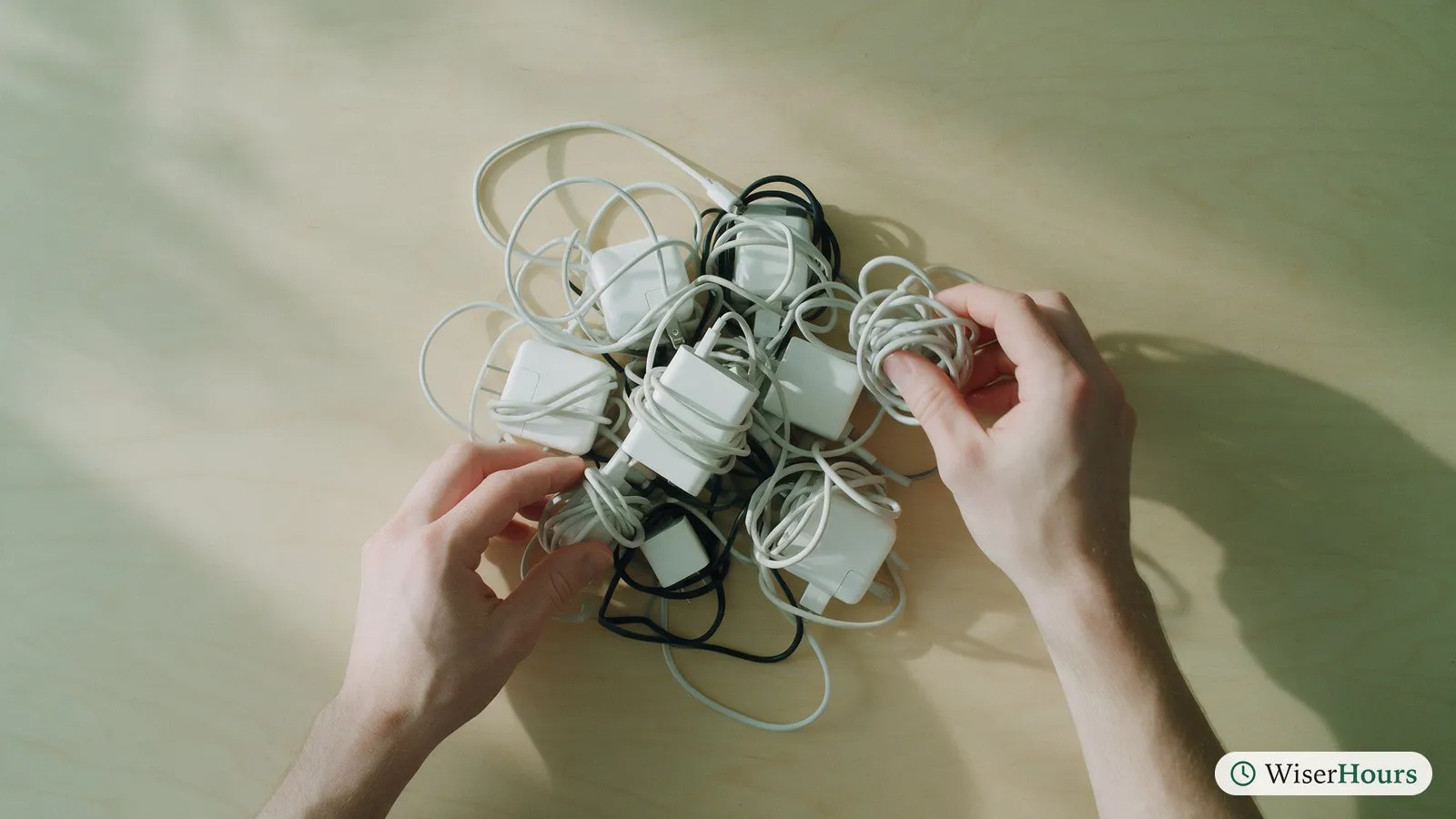
Gathering a whole category into one pile makes the total visible at once. Take phone chargers: one in the kitchen drawer, two by the bed, a tangle in the hall cupboard. Room by room, each drawer looks reasonable. On one table, six chargers for two phones make the decision for you. Even if you adopt nothing else, bring every one of a type of thing into one place before you decide about it.
The room-by-room decluttering guide takes the opposite route and starts where verdicts are quickest. No study has pitted one order against the other, so choose the one that fits your home and your time.
Clothes first, keepsakes last: the five categories
Kondo’s order is clothes, books, papers, komono, and sentimental items last; komono is a Japanese word her site translates as miscellaneous items. The official KonMari site says the order runs from relatively easy to challenging, so that by the time you reach keepsakes, choosing what to keep seems simple, and that a tidied wardrobe gives early proof of progress.1
- Clothes: gathered from every room into one pile; relatively easy, and a tidy wardrobe shows progress early
- Books: all of them, from every shelf and bag
- Papers: check your own country’s rules on which records to keep before you shred
- Komono (miscellaneous items): a wide mix of sub-categories, so take them one at a time
- Sentimental items: the most challenging choices, so they come last
Quick calls on T-shirts and paperbacks are rehearsal for slow ones, such as a box of old letters. Each category is gathered from the whole home: for clothes, the hall cupboard, storage boxes and under-bed bags as well as the wardrobe, all in one heap.5 Papers are where local rules matter: how long to keep tax, legal and medical records depends on your country, so check the official rules where you live before shredding.
Komono is the slowest category to finish because it is not one thing. Kondo’s company describes it as tough to tidy precisely because it spans so many sub-categories, from kitchen appliances to cleaning supplies, cables and toiletries.8 Treat each sub-category as a small category of its own.
Does it spark joy? The test and its weak spot
Kondo’s test is to hold each item in turn and quietly ask whether it sparks joy, noticing how your body responds. Her site contrasts this with rules such as discarding anything unused for two years: joy is personal, so the same test works in a crowded family flat and a sparse studio.1
a little thrill, as if the cells in your body are slowly rising.
Things that fail the test are thanked for their service and let go. In the official account, the thanks is also a lesson: something you never used teaches you that you have no purpose for anything like it, which should shape what you buy next.5 The dress bought for one wedding and never worn again is a pattern to notice.
The test struggles with practical things. A tin opener, a tax file or a plunger rarely produces a thrill, yet you would miss each one within the month. Kondo’s own company softens the rule here: its guide to komono says to keep only the items that spark joy or are truly needed.8
So for practical items, change the question. Ask whether you use it, and whether you would have to buy it again if it left. If yes, it stays, joy or not. That question is ours, not Kondo’s.
Folding and storage: upright, visible, and last
Kondo’s storage rules begin once discarding is finished: every item gets a designated spot, and similar things are stored together. Boxes turn a drawer into a grid where everything shows at once; for years Kondo used saved confectionery boxes before her company launched its own line.9
Clothes are folded into small rectangles that stand upright in a drawer instead of lying in stacks, which her site says prevents wrinkles and saves space.10
The everyday gain is visibility. In a stack of T-shirts, you wear the top one while the rest wait for months. Filed upright like folders, every shirt shows its edge when you open the drawer. Fold one drawer this way before deciding whether the rest of the wardrobe deserves the effort.
Buy storage last
Don’t buy containers first. Finish a category, then use shoeboxes and whatever you already own to see what size of home each group of things needs.
Trying KonMari over five or six weekends
You do not need one marathon. Kondo’s company says a full tidying festival can take several weeks, though it need not.5 Five or six weekends keep her order and category rule while fitting around work and family; the schedule is our suggestion, not hers.
1. Before you start, picture the home you want and find your exits
Kondo’s second rule is to imagine your ideal lifestyle, in a sketch, a few written lines or magazine pictures, so you know why you are tidying.1 Then find out where things can go. What charities and recycling collections accept varies by country and even by town, so check with local charity shops and your local authority before you fill bags.
2. Weekend one: clothes
Pile every item of clothing on the bed and hold each piece. If the pile is too big for a day, split it into tops, bottoms and outerwear, finishing one group before the next. Put the keepers back loosely for now; their final home comes later.
3. Weekend two: books and papers
Books go quickly once every one of them is on the floor. Papers need a slower pass against your country’s record-keeping rules.
4. Weekends three and four: komono, one sub-category at a time
Work through the kitchen, bathroom, cleaning supplies, cables and tools as separate piles. Electronics, cables, cleaning products and old medicines need their own routes, such as electronics recyclers and pharmacy take-back schemes where they exist.8
5. Weekend five: sentimental items, then storage
Leave keepsakes until last, as Kondo does, and allow extra time; the sixth weekend is there if you need it. Only then give every category its final home.
For each KonMari weekend
Download PDF
Does KonMari work? Only its fans have been asked
Nobody has measured how well KonMari works for an ordinary household: our searches turned up no randomized trial, and the fullest study of its practitioners we found, published in 2021 by Lucy Chamberlin and Åsa Callmer of the Norwegian University of Science and Technology, relied on what committed fans in Sweden, the UK and Ireland reported about themselves.
The study
Limited evidence
What KonMari fans said changed: a 2021 study in Sweden, the UK and Ireland
The researchers surveyed members of KonMari Facebook groups in 2018, about 300 in each region, and interviewed 23 of them, all women. Almost all respondents said the method had changed their attitude to buying new things, and about half chose the statement “I shop on impulse” to describe their habits before it, against about 2 percent afterwards. The authors add that they found no evidence KonMari tidies a home better than other methods, and that the first wave of discarding may not be offset by buying less later.2
Treat that as a hint. Fan-group members are the people most likely to report success, a problem called self-selectionself-selection: When the people in a study chose to take part, or chose the thing being studied, rather than being picked or assigned. Volunteers and choosers can differ from everyone else, so the result may not apply more widely or may reflect who chose rather than what they chose.Full entry in the glossary; the “before” was reported afterwards; and nobody measured real spending, as the authors acknowledge.2
The idea that tidying calms you rests on even less. In a 2010 paper, UCLA researchers Darby Saxbe and Rena Repetti had 60 dual-income spouses each lead a tour of their home, then used software to count the words they chose. Wives who talked more about clutter and a home that felt unfinished showed a flatter daily curve of the stress hormone cortisolcortisol: A hormone made by the adrenal glands that helps regulate energy, blood pressure and the body's response to stress. Its level follows a daily rhythm, high on waking and low at night, so a single reading says little on its own.Full entry in the glossary, and their depressed mood increased over the day.11 It measured language, not possessions, and tested no tidying; everything said of it here comes from the published summary at the top of the paper.
So expect a KonMari weekend to leave you with a clearer wardrobe and a sharper sense of what you like, not a cure for stress that starts somewhere else.
Fair criticisms of the KonMari method
The fairest criticisms of the KonMari method are that a fast, feeling-led clear-out can create waste and invite replacement buying, and that a perfectly tidy home is hard to keep up in a busy household, as Kondo herself has said.
When Netflix released her series on New Year’s Day 2019, US thrift stores told local media they were swamped with donations, although NPR noted there was no proof the show was the main cause.12 In Slate, the journalist Elizabeth Cline reported that much donated clothing is never resold, and that the head of a US resale trade association believed the show added to the glut.13 The European Environment Agency said in 2023 that reuse and recycling capacity in Europe is limited, so a large share of the used textiles collected in the EU is exported, and its fate there is highly uncertain.14
A discard led by feeling can also backfire when a useful thing that sparked nothing has to be bought again. A 2022 paper by Viola Muster and colleagues, drawing on a citizen-science project on decluttering in Germany, warns that it is unclear whether decluttering changes shopping for long, since newly won space may itself motivate filling it again.15 Step 1 of the plan is the practical answer: know where things go before they leave.
Kondo has also softened her own standard. At a 2023 media event, reported by The Washington Post and then CNN, she said her home is messy; on her website she has written that with three children she accepts she cannot tidy every day.16 In a 2025 post there, she describes a home that will stay messier for the foreseeable future, and, some evenings, a quick tidy once the children are asleep that usually takes about 10 minutes because everything already has a designated home.17
Who the KonMari method suits
KonMari suits people who want a single thorough reset, have room to pile up a whole category and a few free weekends, and find a feeling easier to trust than a rule. It suits a household less well when the things are not all yours to judge, when young children undo the tidy daily, as Kondo has found, or when parting with things causes real distress rather than tedium.
Shared homes are the common snag: a partner’s books are not yours to hold up for a joy test. The fair version, in our view, is to run the method on your own things and invite others to do the same.
If you would rather have a rule, other decluttering methods offer one. If keepsakes are what stops you, start with a gentler way to part with sentimental items.
The bottom line
Borrow the parts of KonMari with the clearest logic: gather each category into one pile, keep what you love or need, and give everything a home before buying storage. Its evidence is limited to what enthusiasts report, and critics fairly point to waste, so spread the work over weekends and send what leaves where it is most likely to be used again.
Frequently asked questions
Do I need special boxes or organizers for the KonMari method?
No. The method's storage rules call for a designated place for everything and similar things kept together, not particular products. Kondo's official site says that for years she used confectionery boxes she had saved before her company launched its own line. Finish discarding a category first, then use shoeboxes and containers you already own to see what each group of things needs.
Is the KonMari method connected to Japanese religion?
Partly, by Kondo's own account. Wikipedia's article on her reports that she says her method is partly inspired by Shinto, in which treating objects as valuable rather than disposable is part of living well, and that she spent five years as an attendant at a Shinto shrine. The method's rituals, such as thanking items, reflect that background, but you can use its rules without them.
Can children take part in the KonMari method?
Yes, in a simpler form. On her official site in 2025, Kondo suggests explaining to children what you are doing as you tidy, encouraging them to put belongings away after play from about the age they start walking, and giving toys a set location they know. She says a fixed home for everything keeps the evening tidy short.
Sources
- About the KonMari Method. KonMari Media, Inc. (official Marie Kondo website), accessed 2026-09-28
- Spark Joy and Slow Consumption: An Empirical Study of the Impact of the KonMari Method on Acquisition and Wellbeing. Chamberlin, L. & Callmer, Å. (2021). Journal of Sustainability Research, 3(1), e210007
- Marie Kondo. Wikipedia, accessed 2026-09-28
- Spark Joy by Marie Kondo. Penguin Random House (Ten Speed Press), book page, accessed 2026-09-28
- What Is the KonMari Method? KonMari Media, Inc. (official Marie Kondo website), accessed 2026-09-28
- The Life-Changing Magic of Tidying Up by Marie Kondo. Penguin Random House (Ten Speed Press), book page, accessed 2026-09-28
- KonMari Is Not Minimalism. Kondo, M. KonMari Media, Inc. (official Marie Kondo website), accessed 2026-09-28
- KonMari's Guide for Mindful Discarding: Komono Category. KonMari Media, Inc. (official Marie Kondo website), accessed 2026-09-28
- Simple Storage Solutions: Hikidashi Boxes. KonMari Media, Inc. (official Marie Kondo website), accessed 2026-09-28
- How to Fold Clothes with the KonMari Method. KonMari Media, Inc. (official Marie Kondo website), accessed 2026-09-28
- No Place Like Home: Home Tours Correlate With Daily Patterns of Mood and Cortisol. Saxbe, D. E. & Repetti, R. (2010). Personality and Social Psychology Bulletin, 36(1), 71-81
- Thrift Stores Say They're Swamped With Donations After 'Tidying Up with Marie Kondo'. NPR, All Things Considered (US), 21 January 2019
- Tidying Up With Marie Kondo Has Created a Flood of Clothing Donations No One Wants. Cline, E. L. (2019). Slate, 13 May 2019
- EU exports of used textiles in Europe's circular economy. European Environment Agency (2023). Briefing 01/2023, published 27 February 2023
- The cultural practice of decluttering as household work and its potentials for sustainable consumption. Muster, V., Iran, S. & Münsch, M. (2022). Frontiers in Sustainability, 3, 958538
- Marie Kondo is focusing on what’s important – and that means letting the tidying slide. CNN, 30 January 2023
- Marie's Tips for Tidying with Kids — Most of the Time. Kondo, M. (2025). KonMari Media, Inc. (official Marie Kondo website), 14 May 2025
How we researched this
Research for this piece was collected in September 2026 from Marie Kondo's official KonMari site and her publisher's book pages for how the method works, news reports from 2019 and 2023 on its effects and on Kondo's later views, a European Environment Agency briefing on used textiles, and studies of KonMari and of clutter and stress dated 2010 to 2025. Main limitation: the method has apparently never been put to a trial, the main study of its practitioners relied on self-selected fans' reports, and for the 2010 clutter-and-mood paper, only the published abstract could be consulted.
Keep reading
How to Declutter Your Home: A Room-by-Room Guide
How to declutter your home in 6 steps: set up exits, start where choices are easy, leave keepsakes for last, and get rid of batteries and medicines safely.

How to Build a Capsule Wardrobe
How to build a capsule wardrobe in 5 steps: log what you wear for two weeks, pick a palette, size it to your climate and life, buy slowly, review each season.
Desk Organization Ideas That Actually Help You Work
6 desk organization ideas that make work easier, from zoning by reach to a short end-of-day reset, and what research says about messy desks.
How to Create a Weekly Cleaning Schedule
How to make a weekly cleaning schedule in 5 steps that fit your free time and household, with 3 ready-made versions to copy and adapt.