How to Let Go of Sentimental Items
How to let go of sentimental items in 4 steps: photograph the memory, box the hard cases, choose who gets each, keep a few in view.

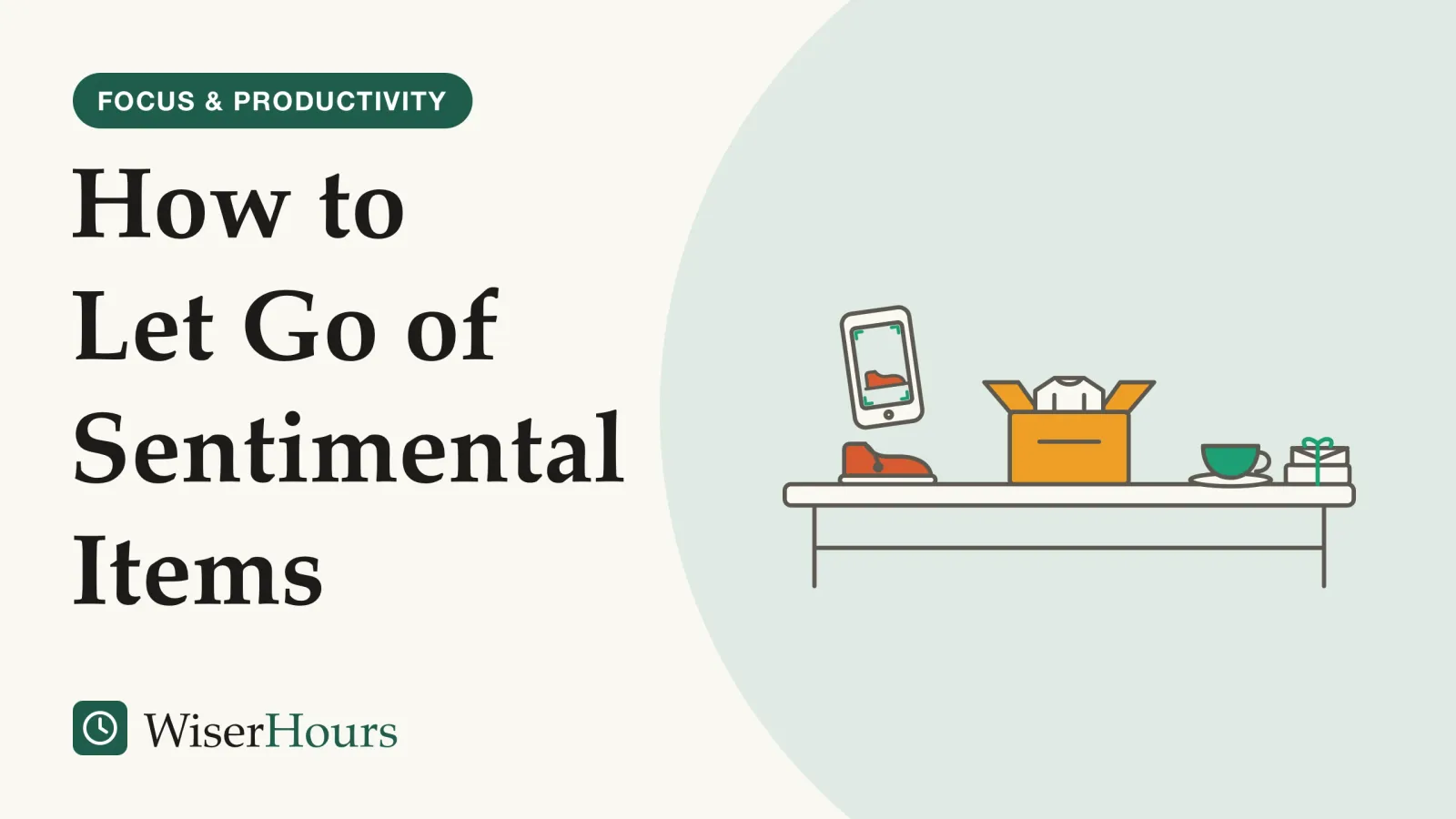
What makes a keepsake hard to give away is rarely the object. It is the memory the object brings back and the version of you it stands for: the team you played on, the grandmother who poured tea from that cup. That changes how to let go of sentimental items. Instead of asking whether you still need the thing, find another way to keep what it holds, then let the object go to someone who will use it. Dorms whose residents were nudged to photograph sentimental possessions before a donation drive collected more donations in 2017 studies by marketing researchers Karen Page Winterich, Rebecca Walker Reczek and Julie Irwin, and the team’s five lab experiments traced the effect to a smaller sense of losing part of themselves.1 Turned into a routine, the idea has four steps:
- Photograph it, and write down what it holds
- Give the hardest items a waiting place and a date
- Choose who gets it
- Keep the few that carry the memory best, where you will see them
If your keepsakes are one pile among many, start with a first pass at getting organized and come back to them.
Why sentimental items are hard to part with
Sentimental items are hard to part with because they carry memories and a sense of identity that the object only stands for. A 2021 review of research on possessions and memory, by Elise van den Hoven, Daniel Orth and Annemarie Zijlema, reports that linking an object with personal memories is a primary reason people grow attached to it. Objects work as memory cues: the review’s illustration is a chair, given by a grandparent, that brings back years of card games at their table whenever you sit in it. Once the chair is gone, the memories it used to bring back may remain.2
Recall starts from a cue, as how memory rebuilds the past from cues explains, and a keepsake is a cue you can hold. Some keepsakes also stand for a person you used to be. Winterich and her colleagues describe an old team jersey you probably won’t wear again: giving it away can feel like giving up a piece of your own identity.3
That pull also outlasts usefulness. Across seven studies published in 2015, Yang Yang and Jeff Galak found that the value people placed on an item’s features fell with time while its sentimental value typically did not.4 A faded concert T-shirt has been worth little as clothing for years; as a reminder of the night, it has lost almost nothing. That is why “I never wear it” rarely settles the question.
Attachment also runs stronger at some times than others. In studies reported in 2024, Bingyan Hu, Cathy Cole and Jing Wang found lonelier people more attached to used possessions and less willing to let them go; making people feel lonely strengthened attachment but did not directly change willingness.5 If you are sorting during a lonely stretch, such as after a move, it may feel harder than usual, so start with the easier boxes.
The answer tells you what needs keeping. If you would miss the thing itself, because you use it or love looking at it, keep it. A memory or a former self can be kept another way.
A photo can keep the memory when the object goes
A record of an item’s memory, most often a photo, was linked to more donations of sentimental possessions in the 2017 studies by Winterich, Reczek and Irwin, and people said they would lose less of themselves by donating a cherished item they had photographed.3
- Myth
- Give away the keepsake and the memory goes with it.
- Fact
- A keepsake is a cue, not a container. A 2021 review notes that memories an object once brought back may remain after the object has gone.
That changes what you are deciding. You are not choosing between the memory and the shelf space; you are choosing which cue to keep. Take the old team jersey: a photo of it, with a line naming the season and the friends on that team, holds what it stood for, and the jersey itself can go to someone who will wear it.
- The item as a cue: it brings back a memory and a sense of who you were, so giving it away can feel like losing part of yourself
- The memory kept another way: a photo or a note keeps a cue within reach; in 2017 studies, a photo eased that sense of loss, and dorms where students were prompted to take one collected more donations
The researchers tested this with donation drives in student dorms at the end of two semesters.
The study
Limited evidence
A photo prompt at a dorm donation drive (Winterich, Reczek and Irwin, 2017)
At spring move-out, the researchers put donation-drive signs in eight dorms. In four, the signs suggested photographing sentimental items before donating them; in the rest, the same appeal left out the photo. The photo-prompt dorms collected about a third more items. A drive in six all-female dorms before the winter break found 15 percent more. At a local thrift store, donors handed an instant photo of a meaningful item they were giving away reported feeling they had lost less of themselves.1
In the researchers’ reading, a photo keeps the memory safe, so people stop fearing they will lose it and feel freer to let the object go. The caveats are real: the paper does not say dorms were assigned at random, only three or four dorms got each appeal, the lab studies asked about imagined donations, the sense of loss was self-reportedself-report: A measure in which people describe their own behavior, feelings or circumstances, usually by answering a questionnaire. When the same person supplies both of the things being compared, shared habits of answering can make the link between them look stronger than it is.Full entry in the glossary, and nobody measured how people felt months later.1 We found no independent replicationreplication: Running a study again with fresh data and the same method, to see whether the original result comes back. A finding that fails to replicate is not automatically wrong, but it stops being something you can lean on.Full entry in the glossary of the dorm studies.
The authors also report where a photo did not help. It made no difference when people were asked to sell sentimental items, possibly, the authors suggest, because people are reluctant to put a price on cherished things. Nor did it help people part with things that held no memories. They did not test throwing keepsakes away, and suspect a photo would not help there.3
Where a photo helps
Use a photo for the keepsakes you plan to give away. Do not expect it to loosen your grip on things you would rather sell or throw out.
How to let go of sentimental items, step by step
How to let go of sentimental items comes down to four steps, ordered from best tested to least: record the memory, give the hardest items a waiting place, choose each one’s next owner, and keep the best few in view.
1. Photograph it, and write down what it holds
Before an item leaves, take its picture and add a line on what it holds: who gave it to you, where you wore it, what it marked. When Winterich and her colleagues asked online participants how they would preserve an item’s memory, most chose a photo; fewer chose a note or something else.1 The written line is our addition: the picture shows the object, and the line names the memory.
In other words, people don’t want these things – they just want to keep the memories they represent intact.
A child’s first pair of shoes becomes one photo and one sentence: the kitchen floor, the first wobbly steps, who was there to see them. The shoes can then go to a family with a toddler.
2. Give the hardest items a waiting place and a date
For items you cannot decide on yet, a box on a high shelf can do some of the work. In three studies published in 2023, Mathew Isaac and Poornima Vinoo found that moving possessions into a temporary holding place, which they call a product purgatory, helped owners brace for parting with them by leading them to picture the disposal ahead of time, without necessarily weakening their attachment.6 Their summary describes possessions in general, not keepsakes.
In practice, box the prom dress or the birthday cards, write a date a few months ahead on the lid, and decide again when it comes. The date is our suggestion; the studies did not test one.
3. Choose who gets it
The people most attached to a possession care most about how it will be used next, so choosing the next owner is part of letting go. In four studies published in 2012, Aaron Brough and Mathew Isaac found evidence that strongly attached sellers may be more willing than weakly attached ones to offer a discount to a buyer whose plans for the item they approve of.7
In interviews with 80 older consumers, published in 2000, Linda Price, Eric Arnould and Carolyn Folkman Curasi found that people passing on cherished possessions sought a good home for them and tried to pass on personal and family legacies with them.8
A grandfather’s toolbox might go to a niece who is learning carpentry, with a note about who used it and what he built. Tell the next owner the story if you can, so part of the meaning travels with the object.
4. Keep the few that carry the memory best, where you will see them
Letting go of most keepsakes does not mean letting go of all of them. The van den Hoven review notes that displaying or using possessions that cue memories lets people connect with the past, while storing them away can give people permission to forget.2 So keep the item that brings the memory back most strongly where you will meet it: one teacup from the set, used on Sunday mornings, rather than the whole set wrapped in newspaper in the attic.
The belongings of someone who has died, and a parent’s home being downsized, raise their own questions about timing, family and grief. If grief is part of what you feel, the last section lists where to get help.
Before a keepsake leaves
How much of this is tested
Only the photo step has been tested on sentimental items directly, by one research team. The other steps rest on small experiments, interviews and reviews, and no study we found followed people to see whether letting go of keepsakes left them better off or regretful.
Most of this research comes from marketing, and a donation drive can count bags of clothes, not how their owners feel a year later. So treat the steps as small tests. Photograph and donate three of the ten souvenir mugs in the cupboard, then check a month later whether you miss them or the photos are enough, and adjust from there.
| What it is | What the best evidence found | Evidence |
|---|---|---|
| A photo before donating | People donated more and felt they lost less of themselves | Trial, limited: one team, dorm drives and lab studies1 |
| A photo before selling, or of things with no memories attached | No more willingness to sell or part with them | Trial, limited: authors’ summary3 |
| A temporary holding place | Helped people brace for parting by picturing it, without necessarily weakening attachment | Trial, limited: three studies, possessions in general6 |
| Choosing who gets it | Strongly attached sellers may be more willing to discount for buyers with fitting plans; older people sought a good home for cherished things | Four studies and interviews, limited78 |
| Keeping a few where you see them | Displaying or using objects that cue memories keeps the link with the past active | Narrative review, expert2 |
| A set number of keepsakes, sorting order, regret after letting go | No study found | Gap |
When holding on is more than sentiment
Strong attachment to keepsakes is not the same as hoarding disorder. In the NHS’s UK description, hoarding disorder is a mental health condition in which someone collects a great many things and finds parting with them very difficult, even when their life suffers for it. One practical difference is what the keeping costs you: a shoebox of a child’s drawings on a shelf costs little, while rooms too full to use are one of several signs the NHS lists. No single sign settles it: in the UK, a GP usually refers people to a mental health specialist for a diagnosis.9
Psychological therapy can help. In a 2025 systematic reviewsystematic review: A review that fixes its question and its rules for including studies in advance, then searches out every study that fits and weighs them together. Some systematic reviews pool the results into a meta-analysis; others describe what the studies found without combining the numbers.Full entry in the glossary of therapies for hoarding disorder, Emily O’Brien and Keith Laws found that symptoms fell during therapy and that, in the few randomized trials, all at high risk of bias, therapy groups improved more than comparison groups; symptoms often stayed above the clinical cut-off for the diagnosis.10
Each tier below names its source, and the sorting by urgency is ours. If you live outside the UK and US, take GP to mean your family doctor.
- Now: anyone having thoughts of suicide or self-harm should get help straight away. In the US, the 988 Suicide & Crisis Lifeline answers calls and texts on 988, and 911 is the number for a life in danger, according to the National Institute of Mental Health.11 In the UK, the NHS’s advice is to dial 999 or head to A&E when a life is at risk or someone cannot keep themselves safe and, in England, to contact NHS 111, by phone or online, for urgent mental health help.12 In any other country, phone your local emergency number.
- Soon: if you, or someone close to you, think you might have hoarding disorder, the NHS recommends a GP appointment.9 For the US, the American Psychiatric Association’s advice is to contact a doctor or mental health professional.13 The NHS also suggests a GP visit if clearing a loved one’s belongings comes with a low mood lasting more than 2 weeks, or if coping has become a struggle.14
- At your next check-up: raise grief after a death that is not easing as the months pass. The NHS calls this prolonged grief disorder and suggests seeing a GP about it.14
The bottom line
Most of what you keep when you keep a keepsake is a memory and a sense of who you were, and those can be kept another way. Photograph the item and write down what it holds before it goes, give the hard cases a dated waiting box, and choose who gets each one. Then keep the few that bring the memory back best, where you will see them.
This article is general information, not medical advice. If you're worried about your health, talk to a doctor or another qualified professional.
Frequently asked questions
Will I regret getting rid of sentimental items?
No study we found has measured regret after people let go of keepsakes. The 2017 photo studies by Karen Page Winterich, Rebecca Walker Reczek and Julie Irwin measured donations and people's sense of losing part of themselves, not how they felt months later. If you fear regret, the lower-risk route is to photograph the item, write down what it holds, and keep the hardest cases in a dated box before deciding.
Is a digital photo as good as keeping the object?
Not quite, and it does not need to be. A 2021 review by Elise van den Hoven and colleagues notes that research has found digital possessions generally less valued than physical ones. In the 2017 studies, a photo did not replace the object; it eased the sense of losing part of oneself, and people donated more. Keeping one physical item and photographing the rest is a middle path.
Should I sort sentimental items first or last?
No study we found has compared the two orders, so choose the one you will actually finish. The research points to something more useful than order: in the 2017 studies, what people feared losing was the memory and the identity tied to an item. Whichever order you choose, record the memory with a photo and a line of writing before the item goes.
Sources
- Keeping the Memory but Not the Possession: Memory Preservation Mitigates Identity Loss from Product Disposition. Winterich, K. P., Reczek, R. W. & Irwin, J. R. (2017). Journal of Marketing, 81(5), 104-120
- Possessions and memories. van den Hoven, E., Orth, D. & Zijlema, A. (2021). Current Opinion in Psychology, 39, 94-99
- Cherishing stuff with a photo can help you let go of it. Winterich, K. P., Irwin, J. R. & Reczek, R. W. (2017). The Conversation (US), the study authors' own summary of their Journal of Marketing research
- Sentimental value and its influence on hedonic adaptation. Yang, Y. & Galak, J. (2015). Journal of Personality and Social Psychology, 109(5), 767-790
- How loneliness affects consumers' reluctance to let go of used possessions. Hu, B., Cole, C. & Wang, J. (2024; print issue 2025). Psychology & Marketing, 42(1), 127-141
- Bracing for the sting of disposal: Product purgatories encourage mental simulation of the disposal process. Isaac, M. S. & Vinoo, P. (2023). Journal of Consumer Psychology, 33(3), 575-582
- Finding a Home for Products We Love: How Buyer Usage Intent Affects the Pricing of Used Goods. Brough, A. R. & Isaac, M. S. (2012). Journal of Marketing, 76(4), 78-91
- Older Consumers' Disposition of Special Possessions. Price, L. L., Arnould, E. J. & Folkman Curasi, C. (2000). Journal of Consumer Research, 27(2), 179-201
- Hoarding disorder. NHS (UK), page last reviewed 12 January 2026
- Decluttering Minds: Psychological interventions for hoarding disorder - A systematic review and meta-analysis. O'Brien, E. & Laws, K. R. (2025). Journal of Psychiatric Research, 181, 738-751
- Suicide Prevention. National Institute of Mental Health (US), last reviewed August 2026
- Where to get urgent help for mental health. NHS (UK), page last reviewed 26 April 2023; content checked 2026-09-24
- What is Hoarding Disorder? American Psychiatric Association (US), physician review September 2024
- Get help with grief after bereavement or loss. NHS (UK), page last reviewed 14 July 2026
How we researched this
We searched Crossref, OpenAlex, PubMed and publisher sites in September 2026 for experiments, interview studies and reviews on attachment to possessions and how people part with them, and read NHS, American Psychiatric Association and NIMH pages for help routes. Sources date from 2000 to 2026. Main limitation: most studies come from marketing research, often with students, none measured regret or well-being after letting go, and four papers were read as abstracts only.
Keep reading
Ergonomic Desk Setup: The Basics
An ergonomic desk setup in 6 steps from US and UK safety guidance, and what trials show: the setup has not been proven to prevent pain.
How to Get Organized With ADHD
How to get organized with ADHD in 5 steps that put reminders in the room, not your head, and what 2010 trials of skills therapy for adults found.
How to Organize Computer Files: A Folder Structure That Lasts
How to organize computer files in 6 steps, based on studies of how people really find their files: shallow folders, one per project, and an archive.
How to Declutter Your Home: A Room-by-Room Guide
How to declutter your home in 6 steps: set up exits, start where choices are easy, leave keepsakes for last, and get rid of batteries and medicines safely.