Generational Wealth: What It Means and How Families Actually Pass It On
Generational wealth is more than an inheritance: 6 ways families pass it on, why the richest fifth report about 50 times more, and why inheritances can fade.

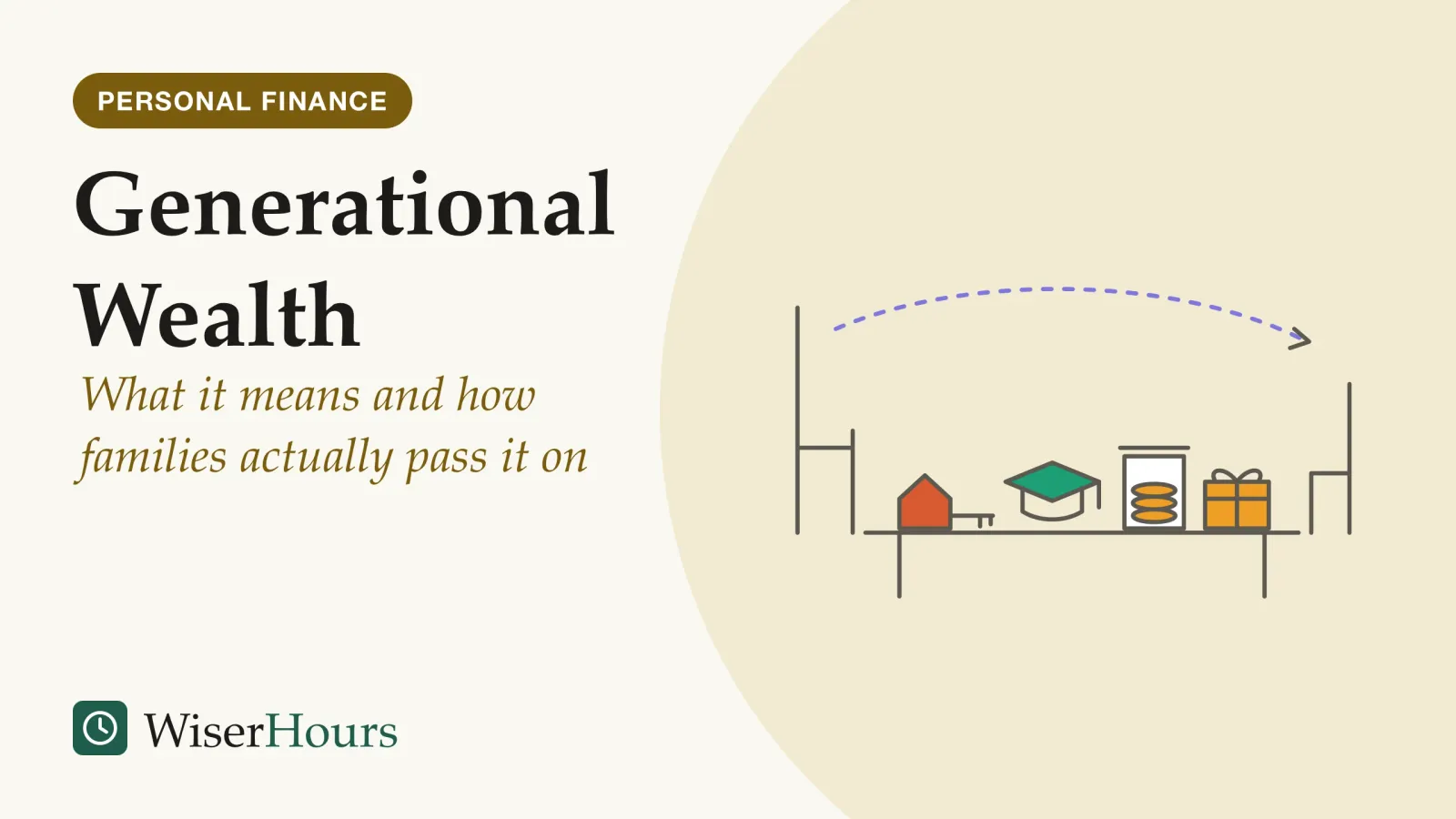
A parent who helps with a first deposit, an uncle who brings a nephew into the family firm and a will that leaves a house are all passing on generational wealth: money, property or advantage that outlasts the person who built it and gives the next generation a head start. Its routes are open to far more families than the phrase suggests, but they carry very different amounts. In 16 OECD countries with data, mostly in Europe, the wealthiest fifth of households report receiving inheritances and gifts close to 50 times larger than those the poorest fifth report, according to the OECD’s 2021 review of inheritance taxation.1
Like passive income, honestly defined, it is money that keeps working after the effort that created it.
What counts as generational wealth?
Generational wealth is anything of lasting value one generation passes to the next, during life or at death. A 2018 Federal Reserve analysis counts direct transfers of cash and assets and also indirect routes, such as paying for education or bringing children into a profitable family business.2
Definition
Generational wealth is money, property or advantages, such as a home, savings, a business or an education, that pass from one generation to the next and give the receiver a better starting position than they would have had alone.
The wide definition matters because much family help never looks like a will. A Federal Reserve note on 2019 US survey data gives examples such as help with a down payment on a home, a substantial wedding gift, or paying for college or private school.3 A grandmother who covers a granddaughter’s tuition, so she starts work without a student loan, has passed on wealth as surely as one who leaves her a house.
So when you take stock of what your family might pass on, list advantages as well as assets: a paid-off home, a habit of saving, a skill, a network, help with a first deposit.
How much money is considered generational wealth?
There is no official threshold. Generational wealth is measured by the head start it gives, not by a set sum, and most transfers are modest: in US survey data analyzed by the Federal Reserve in 2018, about half of all inheritances were under US$50,000, while a small number of very large ones made up much of the money.2
One family leaves a child enough to clear a car loan; another leaves enough to buy a home outright. Both pass on wealth; the second simply changes the child’s options more.
- Myth
- Generational wealth means a large inheritance from rich relatives.
- Fact
- Most inheritances are modest, and much family help arrives as gifts, tuition or a deposit while the giver is still alive.
A family does not need a fortune to give the next generation a better start. A sum that clears one large debt can shift a young adult’s finances for years.
How do families pass wealth to the next generation?
Families pass wealth through six main channels, and they arrive at different ages. Federal Reserve economists, using the US Survey of Consumer Finances, found that lifetime gifts peak when recipients are in their mid-20s, while inheritances peak at around age 60.2
| Channel | How it moves wealth | What the evidence shows |
|---|---|---|
| Home equity and help with a deposit | A paid-off home is left or sold; parents help children buy their first one | In the US, about two-thirds of families owned their home in 20224 |
| Retirement accounts | Savings left after retirement pass to named heirs | Just over half of US families held a retirement account in 20224 |
| A family business | Heirs inherit a firm, or a job and a stake in it | In US data, people “born to wealth” were far more likely than others to work in an inherited or family-funded business2 |
| Education | Parents pay for school or university, which can help children build wealth later | The Fed lists paying for college or private school as a way families invest in children’s future wealth3 |
| Lifetime gifts | Cash or assets handed over while the giver is alive | Gifts peak when recipients are in their mid-20s; a few very large gifts carry close to half the money2 |
| Inheritance at death | Whatever is left passes under a will or the law | Receipt peaks at around age 60, and is about twice as likely in the top tenth by income as in the bottom half2 |
A seventh, quieter channel is upbringing. A 2021 study of Korean-born children adopted as infants by Norwegian families, whose placement was effectively random, found that family background mattered significantly for how much wealth the children built and how they invested as adults, even without a genetic link.5 It does not say which parts of family life matter most, only that the effect goes beyond genes.
- Lifetime gifts: the chance of receiving one peaks in the mid-20s, when deposits, degrees and first debts are decided
- Inheritances: the chance of receiving one peaks at around age 60 (US Survey of Consumer Finances, Federal Reserve analysis, 2018)
Help at 25 arrives while deposits, degrees and debts are being decided; an inheritance at 60 arrives decades later.
Can you build generational wealth on an average income?
Yes, in modest but real forms, because most channels need no fortune. In the Federal Reserve’s 2022 US survey, about half of families in the bottom half of the income range owned their home, and just over half of all families held a retirement account.4
In practice that means a home that is paid down rather than remortgaged, a retirement account whose named heirs are kept up to date, help with a deposit or a course fee when a child needs it, and open talk about money at home. Timing matters as much as amount. A hypothetical example in US dollars, after inflation, before fees and taxes, and assuming the money is invested rather than spent: the same US$1,000 received at 25 instead of at 60 has 35 more years to grow. These are illustrative rates, not forecasts, and actual returns may be lower or even negative.
| Assumed real yearly return | What US$1,000 given at 25 is worth at 60 |
|---|---|
| 3% | about US$2,800 |
| 5% | about US$5,500 |
| 7% | about US$10,700 |
Those figures are our own arithmetic using compound interestcompound interest: Interest worked out on the original amount plus the interest already added to it, so the total grows faster over time. It works for savers and against borrowers, whose unpaid interest itself starts to attract interest.Full entry in the glossary. They show why some families help earlier rather than waiting for an estate. Early help has a cost too: money given away is no longer there for the giver’s own retirement or care.
Before planning what to pass on, it helps to know what you own and owe today; a walk-through of how to calculate your net worth gives you that starting figure.
How much of family wealth is inherited?
Economists disagree, because the answer depends on how fast inherited money is assumed to have grown since it arrived. The Federal Reserve’s 2018 analysis of US survey data gives a range rather than one number, and earlier studies cited in it range from about a fifth to four-fifths of all wealth.2
The study
Mixed evidence
How much US household wealth came from family? A Federal Reserve estimate, 2018
Using every inheritance and large gift US survey respondents reported receiving over their lives, two Federal Reserve economists estimated that transfers account for about 26% of total household wealth if inherited money earned a 3% real return, and about 51% at 5%. Transfers made up a substantial share of wealth in every group, from the bottom half to the top tenth.2
The swing between those two figures comes from time. Money received decades ago has had time to grow, so a small change in the assumed rate changes how much of today’s wealth counts as “inherited”. The analysis is Fed staff work, not peer-reviewed, and covers only direct transfers, not tuition or a family business.
When you see a confident claim that some exact share of wealth is inherited, ask what return was assumed and whether gifts were counted.
How inheritances shape gaps between families
Inheritances flow mostly to families who already have more, yet they can still narrow some measures of inequality. The OECD’s 2021 review found that between a quarter and a half of households across OECD countries report receiving an inheritance or substantial gift, and that wealthier households are more likely to receive one, and to receive more.1
In the US, the gap also runs along racial lines. A Federal Reserve analysis of 2019 survey data found that nearly 30 percent of White families had received an inheritance or gift, compared with about 10 percent of Black families.3 Its authors note that wealth gaps can reflect a legacy of unequal treatment in housing, education and work.
The surprise comes from a 2018 study of Swedish population registers, which found that inheritances reduced wealth inequality measured in shares, such as the top group’s slice of all wealth, but increased absolute gaps in money.6 The authors explain that richer heirs receive larger sums, but a modest inheritance is large relative to what a less wealthy heir owned before, partly because heirs do not inherit debts. A headline saying inheritances widen or narrow inequality can be right either way, depending on what it measures.
Why inherited wealth can shrink
Inherited wealth can shrink because it is spent, split or taxed, and because heirs adjust how they work and save. The Swedish register study found signs that heirs changed their behavior in ways that weakened the equalizing effect of inheritances, possibly through higher spending by less wealthy heirs, and that the extra movement up and down the wealth ranking that inheritances brought was short-lived.6
The reasons are ordinary rather than moral: an heir with debts or a tight budget has good reasons to use the money now. An estate divided among four siblings becomes four smaller sums; the OECD notes the reverse effect as families shrink, with fewer heirs sharing an estate and so larger shares each.1 The 2018 Fed analysis also notes some evidence for an old idea: some heirs work less after a large inheritance.2
The popular saying that family fortunes vanish within three generations deserves its own look; the studies here support something narrower: inherited money can be spent or split, and the shake-up it brings to the wealth ranking tends to be short-lived. If you expect to inherit one day, deciding in advance what you would clear, keep and spend gives you a plan before any money arrives.
Tax rules for gifts and estates differ by country
How wealth is taxed on its way down the generations depends on where the giver and heir live. The OECD’s 2021 review found that 24 of its member countries tax inheritances or estates, while others, including Australia, Canada and Sweden, have repealed such taxes. Most of the 24 tax the heir on what they receive; four, including the US and UK, tax the estate instead.1
Two national examples, checked in October 2026, show the spread; both change often.
| Country (as of 2026) | Tax on wealth passed at death | Gifts during life |
|---|---|---|
| United States (federal) | Estate tax is charged on the estate, with a basic exclusion of US$15 million for deaths in 20267 | An annual exclusion of US$19,000 per recipient for gifts made in 20267 |
| United Kingdom | Inheritance Tax at 40% above a £325,000 threshold, which can rise to £500,000 when a home goes to children or grandchildren8 | Up to £3,000 a tax year is exempt; larger gifts can be taxed if the giver dies within 7 years9 |
The IRS describes the US estate tax as a tax on the right to transfer property at death, with assets counted at market value.10 That is the federal rule: some US states add their own tax, and Pennsylvania, for example, taxes heirs at rates that depend on their relationship to the person who died.11 In the UK, beneficiaries do not normally pay tax on what they inherit, though income from it, such as rent, can be taxed.8 Elsewhere the rules differ again, so check with your national tax authority before relying on either example.
Who to ask before giving or receiving a large sum
Passing on wealth mixes tax, property and family law, so personal decisions deserve a professional’s eye. GOV.UK, for example, points people to a solicitor or tax adviser for advice on what they can give away tax-free during their lifetime.9
- Soon, within weeks: if a parent has died and you are handling the estate, or you are about to give or receive a large sum, a home or a share of a business. An estate lawyer (a solicitor in the UK) can explain deadlines and tax rules where you live.
- Before a major decision: a fee-only financial adviser, whose income comes from your fee rather than from commission on products, can show how a gift or inheritance fits your own retirement plans. Ask in writing how they are paid.
- Routinely, once a year: review who would receive what, and whether that still fits your family.
According to Investor.gov, run by the US SEC, much US investment fraud involves people without a license or registration, so look up a professional’s background before hiring them.12 UK readers can confirm authorization on the FCA’s Financial Services Register or its Firm Checker tool.13 Elsewhere, use your national financial regulator’s register.
The bottom line
Generational wealth is a set of head starts: a home, savings, an education, a business and help given at the right age. Inheritances flow mostly to families who already have more, and inherited money can shrink once it is spent or split. An ordinary family can still pass on something real, and the earlier help comes, the more time it has to grow if invested; check the tax rules where you live before moving large sums.
This article is general education, not financial advice. For decisions about your own money, speak to a qualified, regulated adviser.
This article is general information, not legal advice. Rules differ by country and change over time; for your own situation, speak to a qualified lawyer or an official advice service where you live.
Frequently asked questions
Is an inheritance the same as a lifetime gift?
No. A lifetime gift passes while the giver is alive, and an inheritance passes at or after death. The Federal Reserve's 2018 analysis of US survey data found gifts peak when recipients are in their mid-20s, while inheritances peak around age 60. Tax rules also treat them differently: in the UK, for example, a gift can count toward the estate if the giver dies within 7 years.
Do you pay tax on money you inherit?
It depends on the country. In the UK, GOV.UK says beneficiaries do not normally pay tax on things they inherit, because Inheritance Tax is paid from the estate, though income from inherited assets, such as rent, can be taxed. The US federal estate tax is also charged on the estate, not the heir, though some US states, such as Pennsylvania, tax heirs too. Many countries tax the heir instead, so check your own tax authority's rules.
Is the family home a good way to pass on wealth?
In the US, about two-thirds of families owned their home in 2022, so for many it is the obvious asset to pass on, and some tax systems treat it gently. The OECD's 2021 review found that donors' main residences commonly get preferential treatment under inheritance and estate taxes. A home also needs upkeep, may need selling to divide between heirs, and pays no income unless it is rented out, so an estate lawyer can help weigh it against other options.
Sources
- Inheritance Taxation in OECD Countries (report and summary brochure). OECD (2021). OECD Tax Policy Studies, No. 28, OECD Publishing, Paris
- How Does Intergenerational Wealth Transmission Affect Wealth Concentration? Feiveson, L. & Sabelhaus, J. (2018). FEDS Notes, Board of Governors of the Federal Reserve System (US), 1 June 2018
- Disparities in Wealth by Race and Ethnicity in the 2019 Survey of Consumer Finances. Bhutta, N., Chang, A. C., Dettling, L. J. & Hsu, J. W. (2020). FEDS Notes, Board of Governors of the Federal Reserve System (US), 28 September 2020
- Changes in U.S. Family Finances from 2019 to 2022: Evidence from the Survey of Consumer Finances. Aladangady, A. et al. (October 2023). Board of Governors of the Federal Reserve System (US)
- Why Do Wealthy Parents Have Wealthy Children? Fagereng, A., Mogstad, M. & Rønning, M. (2021). Journal of Political Economy, 129(3)
- Inheritance and wealth inequality: Evidence from population registers. Elinder, M., Erixson, O. & Waldenström, D. (2018). Journal of Public Economics, 165
- What's new: Estate and gift tax. Internal Revenue Service (US), page last reviewed 23 July 2026; checked current on 11 October 2026
- How Inheritance Tax works: thresholds, rules and allowances. GOV.UK (UK government), checked current on 11 October 2026
- How Inheritance Tax works: rules on giving gifts. GOV.UK (UK government), checked current on 11 October 2026
- Estate tax. Internal Revenue Service (US), page last reviewed 22 December 2025; checked current on 11 October 2026
- Inheritance Tax. Pennsylvania Department of Revenue (US state), checked current on 11 October 2026
- Check Out Your Investment Professional. US Securities and Exchange Commission, Investor.gov, accessed 11 October 2026
- How to check a firm or individual is authorised. Financial Conduct Authority (UK), first published 20 March 2023, last updated 22 September 2026
How we researched this
In October 2026 we read the OECD's 2021 summary of Inheritance Taxation in OECD Countries, two Federal Reserve analyses of the Survey of Consumer Finances (2018 and 2020), the Fed's report on the 2022 survey, abstracts of peer-reviewed studies from Norway and Sweden, and current IRS and GOV.UK tax guidance. The worked example is our own arithmetic. Main limitation: estimates of how much wealth is inherited depend heavily on assumed returns, and most detailed data come from the US and Nordic countries.
Keep reading

Trusts in Plain English: What They Are and Who Uses Them
What is a trust? The 3 roles (settlor, trustee, beneficiary), revocable vs irrevocable, will trusts, trusts for children, and the costs people underrate.

Assets vs. Liabilities: A Plain-English Guide to Your Personal Balance Sheet
Assets vs liabilities explained: where 7 tricky items go, from a mortgaged home to pay-later plans and tax bills, and a one-page balance sheet to fill in.
Dividend Reinvestment Explained: How Payouts Compound Over Time
How dividend reinvestment grows a holding: a hypothetical example where 100 shares become about 219 in 20 years, plus the tax, records and risks to know.

Renting vs. Buying Your Home: The Wealth-Building Case for Each
Renting vs buying: US owners' median net worth is about 43 times renters', yet much of that gap reflects who buys. What decides which builds more wealth.