Trusts in Plain English: What They Are and Who Uses Them
What is a trust? The 3 roles (settlor, trustee, beneficiary), revocable vs irrevocable, will trusts, trusts for children, and the costs people underrate.

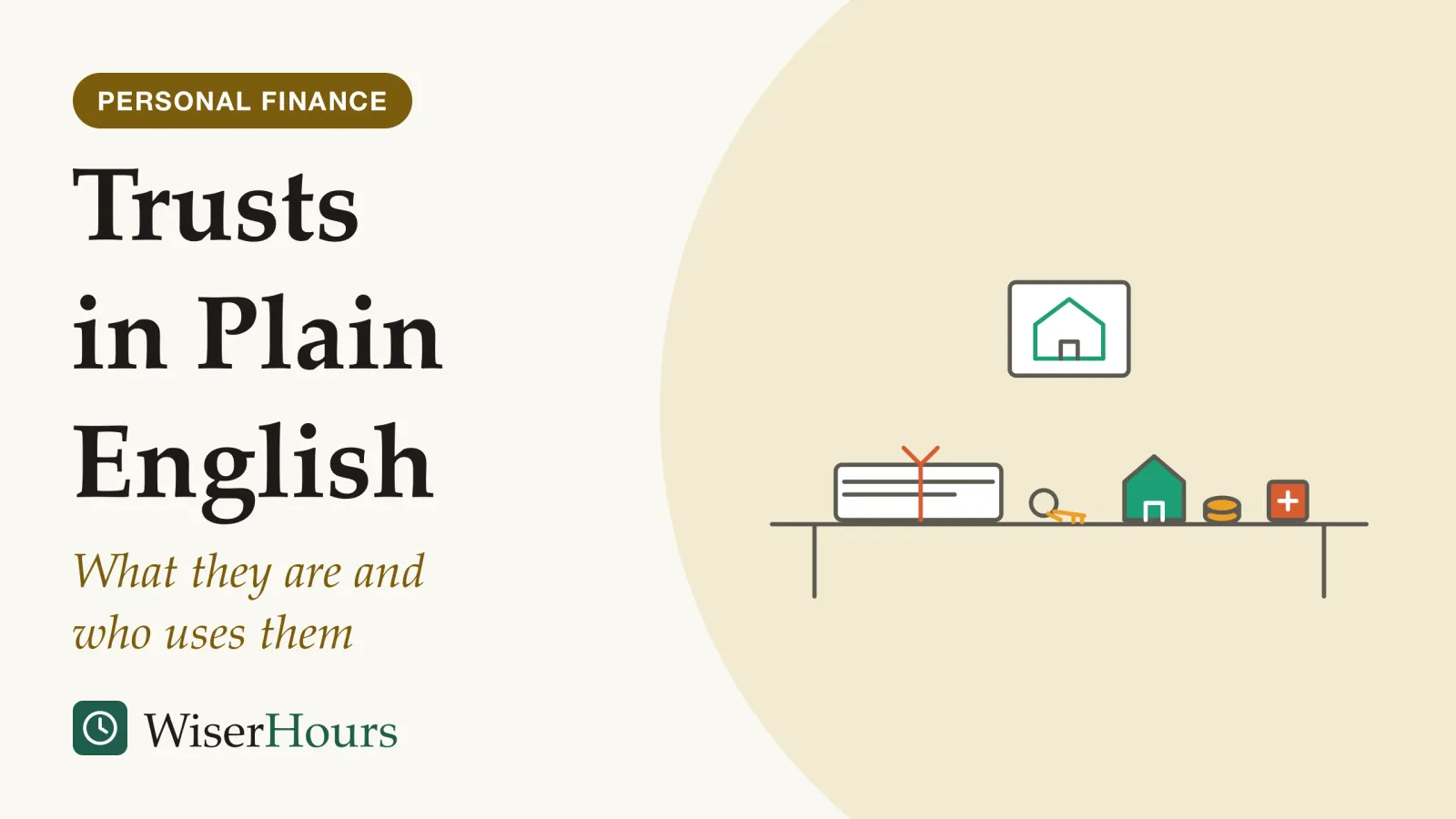
A trust is a legal arrangement in which one person, the settlor, hands money or property to another, the trustee, who becomes its legal owner but must manage it for someone else, the beneficiaries, under written rules. The UK government’s guide puts it in fewer words: a way of managing assets for people.1
The everyday answer to what is a trust is plainer than the sales pages suggest: parents use one to hold an inheritance until a child grows up, and families use one to support a relative who needs help managing money. A revocable living trust brings no tax advantage over a will and no meaningful protection from creditors, according to the Washington State Bar Association’s 2014 consumer guide (US).2 A trust is a tool for control and timing; it does not generate money the way the streams in what counts as passive income do. If you have a modest estate and no will yet, a will usually comes first, and it can set up a trust for children on its own.
Prefer to watch? The video covers the same ground as this article.
What is a trust? Three roles and a separate fund
A trust works by splitting ownership from benefit: the trustee holds legal title and runs the assets, while the beneficiaries gain from them. America’s tax agency, the Internal Revenue Service (IRS), describes it as a fiduciary relationship between a grantor (another word for settlor), a trustee and a beneficiary, set up for a stated purpose.3
Definition
A trust is an arrangement in which a settlor transfers assets to a trustee, who must manage them, separately from their own property, for the beneficiaries named in its terms.
The rules live in a document, the trust deed in the UK or trust instrument in the US. Beneficiaries may receive the income only (rent from a house the trust owns, say), the capital only (shares handed over at a set age), or both.1
The split works because the property is kept apart. The Hague Trust Convention, an international treaty, lists the core features: the assets form a separate fund, not part of the trustee’s own estate, and the trustee is accountable for managing them under the trust’s terms.4 A trustee who spends trust money on themselves breaks that duty.
- Settlor: the person who puts the assets in and sets the rules (US documents also say grantor or trustor)
- Trust deed: the written terms: who benefits, when, and what the trustee may do
- Trustee: the legal owner, who must manage the assets for the beneficiaries, not for themselves, and keep them apart from their own
- Beneficiaries: the people the trust is for; they may get income, capital or both, now or later
Picture a grandmother who wants to leave savings to a five-year-old grandson. Her will names her daughter as trustee to hold the money and pay school costs until he reaches an age the will sets: settlor, trustee, beneficiary. Start with three questions: who would hold the money, for whom, and until when.
Revocable or irrevocable: who keeps control?
A revocable trust can be changed or cancelled by the person who made it; an irrevocable trust, by its terms, generally cannot. That is how the IRS defines the two, adding that state law and the trust document decide which one a trust is. Because the maker of a revocable trust can take the assets back, US tax law treats it as a “grantor trust”, taxing its income to the maker as if the trust did not exist.3 Giving up control is what can change the tax and legal picture, which makes an irrevocable trust a much bigger decision. The best-known revocable trust is the US “living trust”, usually run by its maker as trustee.
A US couple who move their house into a living trust and name themselves trustees still live there, can still sell it, and their creditors can still reach it; the change comes at death, when a successor trustee can pass the house on, possibly without probate.2 Before signing anything irrevocable, ask what control you give up and what that buys.
The study
Moderate evidence
What one US state bar tells consumers about living trusts
The Washington State Bar Association’s consumer guide lists three advantages of a revocable living trust over a will: a private transfer instead of a probate record, possibly no probate if the trust is set up and maintained properly, and easy appointment of someone else to manage your assets. It also says moving assets into one gives no meaningful protection from lawsuits or creditors and no tax advantage over a will.2
The guide comes from one US state and dates from 2014: read it as a careful summary, not as the rule where you live.
UK trusts are sorted differently. GOV.UK lists bare, interest in possession, discretionary and other trusts, each taxed in its own way; in a discretionary trust, the trustees decide what to pay, to whom and how often.5 Outside the US, then, ask what the trustees must pay out and what they may decide.
Trusts that start when someone dies
A testamentary trust, called a will trust in the UK, is created by a will and comes into existence at death, when property moves from the estate into it. The IRS notes that a testamentary trust is irrevocable by definition, since its maker has died; a trust made during life is called an inter vivos or living trust.3
GOV.UK lists passing on assets at death and holding them for someone too young to manage their affairs among the main reasons trusts are set up; in England and Wales, the inheritance rules can also create one when someone dies without a will.1 The appeal is timing: a will trust lets a parent say a child receives money at 25, or in stages, rather than outright at the age the law sets.
Trusts for children and for a disabled relative
Trusts for children and disabled relatives put a responsible adult between the money and someone who is too young to manage it or needs support to do so. GOV.UK says the beneficiary of a simple bare trust can claim everything at 18 in England and Wales, or at 16 in Scotland, so parents who want a later age would look at a different kind of trust.5
For a disabled relative the worry is that a lump sum can upset means-tested support, and each country has its own rules.
- In the UK, GOV.UK describes special tax treatment for “trusts for vulnerable beneficiaries”, covering a disabled person or a child under 18 whose parent has died, if the trust meets conditions on who may benefit.6
- In the US, the federal Social Security Administration does not count, for the means-tested SSI benefit, a trust holding the assets of a disabled person under 65 if it meets set conditions, including repaying the state’s Medicaid costs from what is left at the person’s death.7
Both rules are narrow, and a trust that misses a condition can cost the benefits it was meant to protect. Elsewhere, ask a lawyer who knows your country’s disability benefits.
Is a trust better than a will?
For most people a trust is an extra to a will, used for a particular job. Citizens Advice in England says it is important to make a will however much or little you own, partly because without one, the law of England and Wales decides who gets what, and unmarried partners cannot inherit from each other.8
In the US a living trust can stand in for a will. The Washington State Bar Association says a person usually has one or the other as their main document, with a simple “pour-over” will catching assets left outside the trust, and that probate varies greatly between states in cost and length.2 A trust that saves real money in one state may save little in another.
- Myth
- Everyone with a house should set up a trust instead of making a will.
- Fact
- A will is the starting point. A trust is worth its cost when it solves a specific problem: young or vulnerable heirs, privacy, property in several places, or a probate process that is slow where you live.
If you have no will yet, start there.
What are the disadvantages of putting assets in a trust?
The main disadvantages of a trust are cost, paperwork, loss of control and tax rules that can work against you. The Washington State Bar Association notes that a living trust usually costs more to set up than a will, because each asset has to be moved into it, and needs ongoing upkeep so new assets go in too.2
Then come the running duties. In the UK, HM Revenue and Customs (HMRC) guidance updated in July 2026 says many trusts must be registered, generally within 90 days of being created or becoming liable for tax, with a penalty for failing to register.9 In the US, a trust that is not a grantor trust generally files its own federal tax return in years its income reaches a small threshold.3
Tax can cut both ways. In the UK, Inheritance Tax can apply when assets go into many trusts, at each 10-year anniversary and when assets leave, with lighter rules for some trusts for children and disabled people.10 In the US, federal estate tax applies only to large estates: a return is required only when the estate, plus certain lifetime gifts, exceeds US$15 million for people who die in 2026, a threshold that changes over time.11 If your estate is far below that figure, federal estate tax is no reason for a trust, whatever an advertisement says.
Some people hold a life insurance policy in an irrevocable trust; in the US the usual aim is to keep a large estate’s payout outside it for estate tax.12 The policies themselves are explained in term versus whole life insurance, and a net worth calculation gives you the list of assets an adviser will ask for first.
Who should have a trust?
People who use trusts usually have a specific problem a will alone handles badly. Each row pairs one with a question for an adviser.
| Situation | Kind of trust often discussed | Question to ask |
|---|---|---|
| Young children who may inherit | A will trust that sets the age or stages | Who manages the money, and until what age?1 |
| A relative with a disability on means-tested benefits | A trust for a vulnerable beneficiary (UK) or a special needs trust (US) | Will the trust affect their benefits?67 |
| A home in a US state with slow or costly probate | A revocable living trust with a pour-over will | Will every asset be moved into it?2 |
| An heir who may not manage a lump sum well | A discretionary trust (UK) where trustees decide what to pay | Who are the trustees, and what guidance will they get?5 |
If no row fits you, a well-drafted will may be all you need for now.
Trusts outside common-law countries
Trusts grew out of English law and are at home in common-law countries, the systems descended from it, which include the US, Canada outside Quebec, Australia, New Zealand, Ireland and India.13 Most civil-law countries, including much of continental Europe, do not have the trust in their own law; France has a similar device, the fiducie, which is a contract rather than a trust.14
That matters for families with homes or heirs in more than one country. The 1985 Hague Trust Convention sets rules on which law governs a trust and how it is recognized abroad; it has 14 contracting parties, including Australia, Canada, the UK, Italy, the Netherlands and Switzerland, while the US and France have signed but not ratified it.15 Even where it applies, the Convention keeps local rules that cannot be set aside by choice, such as the fixed shares of an estate some countries reserve for a spouse and close relatives.4
A trust drafted in one country may not work as expected for a house in another. Outside the common-law world, ask a local notary or lawyer how your country reaches the same goals, such as provision for a child or a disabled relative, without a trust.
When to get professional advice
Setting up any trust is a legal act with tax effects, so it calls for a qualified professional: a solicitor in the UK, an attorney in the US, or a lawyer or notary elsewhere. GOV.UK suggests a legal or tax adviser and points to the Society of Trust and Estate Practitioners, a professional body for this field.1 Elsewhere, ask your bar association, law society or chamber of notaries for a referral and about free legal help.
- Before you sign: get advice if you want to provide for a dependant who cannot care for themselves, or if there is a home shared with a partner you are not married to, property abroad, a business, or children from more than one relationship. Citizens Advice in England names these as cases where a solicitor is particularly advisable, suggests comparing what several charge, and points to a check for free or affordable legal help.8
- If you are made a trustee: ask soon what the deed requires and whether the trust must be registered or file tax returns, since in the UK the registration deadline can run from the day the trust is created.9
- Routinely: review a will or trust after marriage, divorce, a death or a birth.
Be wary of anyone who sells a trust mainly as a tax-saving product. On its page about abusive trust tax evasion schemes, the IRS says income you earn cannot be assigned to a trust to avoid tax, and it suggests checking a doubtful promotion with a tax professional who has no part in it.3
The bottom line
A trust earns its cost when someone cannot or should not receive money outright, when privacy or probate matters, or when a family crosses borders. For most people the first step is a will; anything beyond that is worth a conversation with a local lawyer.
This article is general education, not financial advice. For decisions about your own money, speak to a qualified, regulated adviser.
This article is general information, not legal advice. Rules differ by country and change over time; for your own situation, speak to a qualified lawyer or an official advice service where you live.
Frequently asked questions
Can you be the trustee of your own trust?
Often, yes, for a revocable living trust in the US. The Washington State Bar Association says the person who creates such a trust typically acts as trustee for life and should name at least one successor trustee to take over on incapacity or death. For irrevocable trusts and in other countries the rules and tax effects differ, so check with a local lawyer.
Does a trust have to file a tax return?
The answer turns on the country and the type of trust. The IRS says that, as of 2026, a US trust must file Form 1041 for any year it has at least US$600 of income, unless it is a grantor trust whose maker reports the income on their own return. In the UK, trustees manage the trust and pay any tax due, and many trusts must also be registered with HMRC.
Who can be a trustee?
Usually a relative, friend or colleague, or a professional fiduciary such as a trust company, according to the Washington State Bar Association's guide (US). GOV.UK says a trust can carry on when trustees change, but there must always be at least one. The IRS notes that a trustee is a fiduciary, someone with a legal duty to act for the benefit of others, so the choice matters.
Sources
- Trusts and taxes: Overview. GOV.UK (UK government), accessed 11 October 2026
- Revocable Living Trusts: What you need to know about revocable living trusts. Washington State Bar Association (US), consumer information guide (2014)
- Abusive trust tax evasion schemes: Questions and answers. Internal Revenue Service (US), page last reviewed 21 August 2026
- Convention of 1 July 1985 on the Law Applicable to Trusts and on their Recognition. Hague Conference on Private International Law (HCCH), full text
- Trusts and taxes: Types of trust. GOV.UK (UK government), accessed 11 October 2026
- Trusts and taxes: Trusts for vulnerable people. GOV.UK (UK government), accessed 11 October 2026
- SI 01120.203 Exceptions to Counting Trusts Established on or after January 1, 2000. Social Security Administration (US), Program Operations Manual System, effective 9 June 2022
- Wills. Citizens Advice (England), accessed 11 October 2026
- Check if you need to register a trust. HM Revenue and Customs, GOV.UK (UK government), last updated 13 July 2026, accessed 11 October 2026
- Trusts and taxes: Trusts and Inheritance Tax. GOV.UK (UK government), accessed 11 October 2026
- Estate tax. Internal Revenue Service (US), page last reviewed 22 December 2025
- Life insurance trust. Wikipedia, accessed 11 October 2026
- List of national legal systems. Wikipedia, accessed 11 October 2026
- Trust law. Wikipedia, accessed 11 October 2026
- Status table: Convention of 1 July 1985 on the Law Applicable to Trusts and on their Recognition. Hague Conference on Private International Law (HCCH), last updated 19 September 2017, accessed 11 October 2026
How we researched this
This explainer draws on trust guidance read in October 2026 from the UK government (GOV.UK and HMRC pages), the US Internal Revenue Service and Social Security Administration, the Washington State Bar Association's consumer guide, Citizens Advice in England, and the Hague Conference on Private International Law, plus Wikipedia for legal history and systems. Main limitation: trust law differs by country and by US state, and no source we found counts how many people use each kind of trust.
Keep reading
Generational Wealth: What It Means and How Families Actually Pass It On
Generational wealth is more than an inheritance: 6 ways families pass it on, why the richest fifth report about 50 times more, and why inheritances can fade.
Assets vs. Liabilities: A Plain-English Guide to Your Personal Balance Sheet
Assets vs liabilities explained: where 7 tricky items go, from a mortgaged home to pay-later plans and tax bills, and a one-page balance sheet to fill in.
Dividend Reinvestment Explained: How Payouts Compound Over Time
How dividend reinvestment grows a holding: a hypothetical example where 100 shares become about 219 in 20 years, plus the tax, records and risks to know.
Renting vs. Buying Your Home: The Wealth-Building Case for Each
Renting vs buying: US owners' median net worth is about 43 times renters', yet much of that gap reflects who buys. What decides which builds more wealth.