Toxic Productivity: When Self-Optimization Goes Too Far
Toxic productivity has no clinical definition. What 4 lines of research show, from workaholism to busyness as a status symbol, and when to ease off.

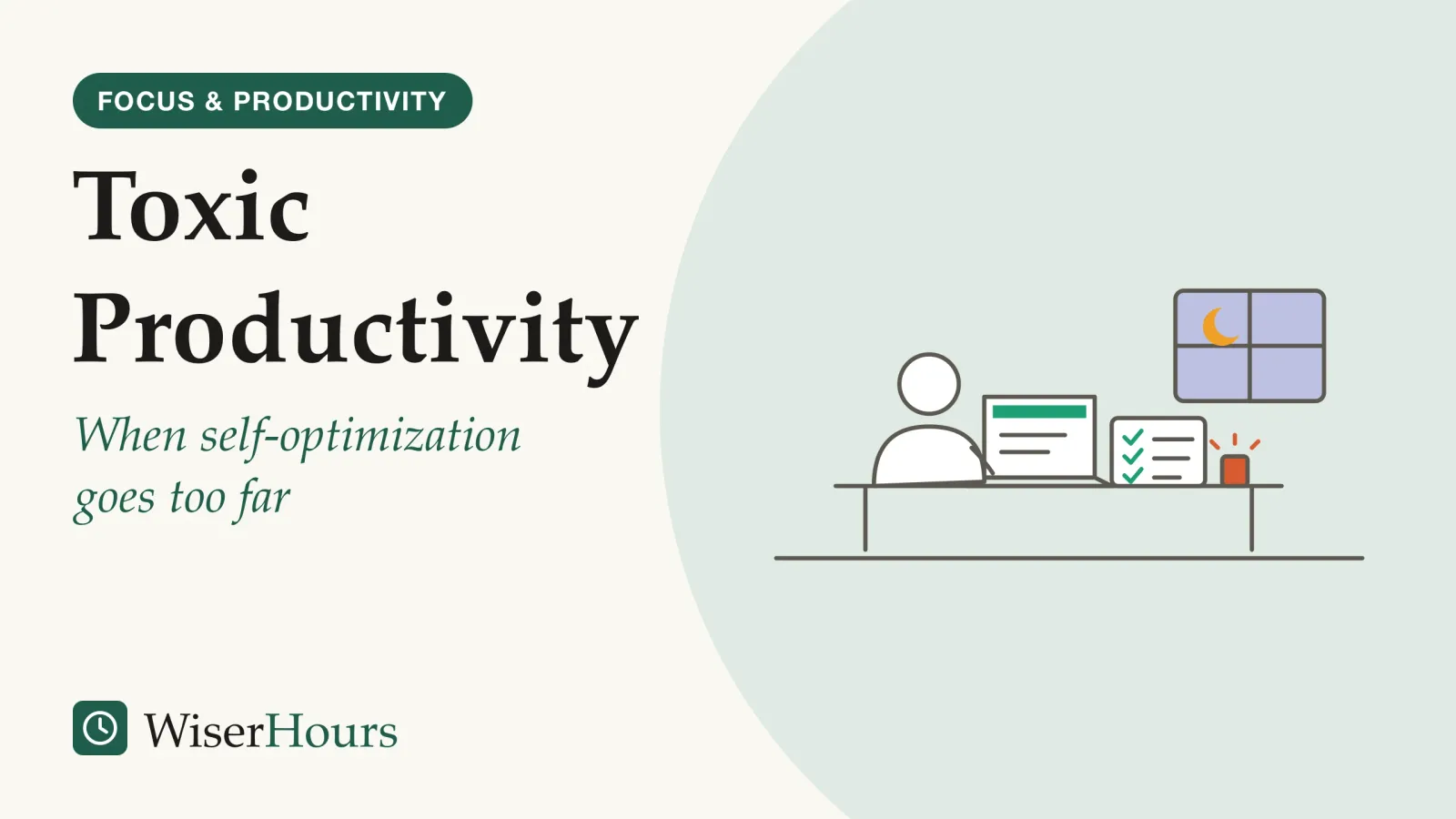
The last task on the list was ticked before dinner. At ten the laptop is still open, the inbox has been cleared twice, and shutting the lid feels like leaving early. That unease, more than the hours, is the heart of what people call toxic productivity.
Toxic productivity, in plain terms, is pursuing output past the point where it helps you, driven by guilt or compulsion rather than by the work itself. No study has measured it under that name: a PubMed search in September 2026 found no research record that uses the phrase. Its measured core is workaholism, and a 2016 meta-analysismeta-analysis: A study that combines the results of earlier studies on the same question into one overall estimate. Pooling makes the estimate more precise, but it cannot repair the studies it pools: a meta-analysis of surveys is still survey evidence.Full entry in the glossary led by Malissa Clark found workaholism linked to more burnout, job stress and work-life conflict, and to poorer physical and mental health.1
A rough self-check follows from that research. Ask whether you could stop if you chose to, and whether stopping brings relief or guilt. Count the hours second.
Toxic productivity is a label, not a diagnosis
People use the phrase for a cluster of habits: filling every free minute with something useful, feeling guilty on a day off, measuring self-worth in tasks completed. None of those has an established questionnaire or cutoff behind it, so the label cannot tell you how common the pattern is or what it does to people. For that you need the research term closest to it, and that term is older than it sounds.
The word “workaholism” goes back to the late 1960s, when the American minister and psychologist Wayne Oates coined it for his own addiction to work, and it caught on in everyday speech long before researchers agreed on a meaning. Wilmar Schaufeli, Akihito Shimazu and Toon Taris proposed a two-part definition, working excessively hard and working compulsively, and tested a short questionnaire built on it with large samples of employees in the Netherlands and Japan.2
- Myth
- The more hours you put in, the more productive you are.
- Fact
- Hours alone do not separate healthy drive from harmful drive; researchers look at whether you work compulsively and can stop.
The two parts matter because either one alone describes plenty of healthy people. A nurse covering a double shift in flu season works excessively hard; a designer who sketches ideas on the train home is absorbed, not compelled. The pattern the popular label describes is the combination: long effort plus an inner pressure that makes stopping feel wrong.
To apply the two parts to yourself, look back over last week and mark each evening you worked. For each one, ask which part applied: was the work needed, or did you keep going because stopping felt wrong? Only the second kind matches the compulsive half of the definition. Choosing a method from the major productivity systems is a separate question; any of them can serve a healthy drive or a compulsive one.
How common workaholism is, and what it is linked to
Workaholism has a research record that toxic productivity lacks, and on health it points one way. Clark and colleagues pooled studies of workaholism’s correlates and outcomes and concluded that it is best understood as an addiction to work, one linked to many negative outcomes for the person, their relationships and their employer.1 The full paper is closed access, so we rely on its abstract and nothing more.
A 2023 review from the University of Bergen in Norway pooled 53 studies from 23 countries and put the prevalenceprevalence: The share of a population who have a given condition at a point in time or across a set period. Every prevalence figure depends on the case definition behind it: loosen or tighten the criteria for counting as a case and the figure moves with them.Full entry in the glossary of workaholism, as measured by questionnaire cutoffs, at about 14 to 15 percent, roughly 1 in 7 people studied, depending on whether a correction for publication bias is applied. Estimates varied widely: representative samples gave lower figures than non-representative ones, and one common questionnaire gave higher figures than another.3
That spread carries the lesson. Different questionnaires draw the line in different places, so a score from an online quiz is a rough guide, not a verdict. Read “about 1 in 7” as a sign that the pattern is common, not as a count of anyone you know.
Two neighbours get one line each. Perfectionism, which Clark’s team found related to workaholism, rose among British, Canadian and American college students between 1989 and 2016 in Curran and Hill’s 2019 meta-analysis, and how striving differs from harsh self-judgment has its own guide.14 The health effects of sheer hours, including the international estimates behind them, are covered in what large studies found on long working hours.
Long hours are not the test: why the motive matters
Hard work and harmful work look identical on a timesheet, and the research that separates them looks at motive. In a 2008 study of 587 managers at a Dutch telecom company, Schaufeli, Taris and Willem van Rhenen found that managers high in employee engagementemployee engagement: A term with two main meanings: in research, a positive state of energy, dedication and absorption in one's work; in workplace surveys such as Gallup's, the conditions thought to produce it. Figures from the two kinds of measure are not interchangeable.Full entry in the glossary also worked long hours, yet they reported good mental health and smooth social lives. Managers high in workaholism worked hard too, but shared many of the negative features of burned-out colleagues, including poorer health and strained relationships.5
The authors explain the difference as motivation. Engaged managers were immersed because the work was enjoyable; workaholic managers were driven to it. Burnout, in the same data, looked like the opposite of engagement, and it was positively correlated with workaholism.5 If exhaustion is already the main feature, the WHO definition of burnout is the better starting point.
- Same hours: both can work long days; the timesheet does not tell them apart
- Engaged: pulled by interest in the work; health and satisfaction held up or improved
- Workaholic: pushed by a compulsion to keep working; ill-health rose, with no gain in performance
That 2008 study was a one-time surveycross-sectional: Describes a study that measures everyone in its sample at a single point in time. Because the possible cause and the outcome are recorded together, it can show that two things occur together but not which of them came first.Full entry in the glossary: it shows what goes together, not what came first. A later study in Japan followed the same employees over time.
The study
Limited evidence
Shimazu, Schaufeli, Kamiyama and Kawakami (2015), International Journal of Behavioral Medicine
Employees who scored higher on workaholism at the start reported rising ill-health and falling life satisfaction two years later, compared with what their starting scores predicted, but showed no clear link with changes in job performance. Employees higher in work engagement reported better health, more life satisfaction and better job performance over the same period.6
Put simply, the compulsive drive in this company came with costs and no measurable payoff in performance. The caveats are real: one company, mostly men, every measure self-reportedself-report: A measure in which people describe their own behavior, feelings or circumstances, usually by answering a questionnaire. When the same person supplies both of the things being compared, shared habits of answering can make the link between them look stronger than it is.Full entry in the glossary, and the authors themselves call for replication with objective measures and in other countries.6 Still, the direction matches the Dutch data and the meta-analysis, and it suggests one plain lesson: if guilt is what keeps you at the desk, do not assume those extra hours are what keeps your results up.
How to ease off and keep your eye on results
The steps below change what you measure, not how much you care about the work. None of them has been tested as a cure for workaholism; they follow from what the studies above found, and they are habits for healthy adults, not treatment. They also assume the extra hours are yours to cut: if long days come from a second job, caregiving or an employer’s demands, the pressure sits outside you and these steps fit less well.
1. Judge the week by results, not hours
Workaholism was not linked to better performance in the two-year Japanese study, while engagement was.6 So on Friday afternoon, list the two or three outcomes that mattered and whether they moved. If a Saturday spent clearing email connects to none of them, it is a candidate to cut.
2. Treat guilt about time off as a signal
One of the items in the Schaufeli team’s workaholism questionnaire asks whether you feel guilty when you take time off work.2 That is a useful self-check because it separates compulsion from ordinary effort: a busy week that ends with relief is different from a quiet evening that feels like failure.
3. Practise switching off in the evening
Detaching from work is a skill that can be trained. A 2021 meta-analysis pooled 30 studies of programs built to teach it and found a modest average benefit, larger for longer and more intensive programs (abstract read only).7 The evening routines behind such programs are laid out in how to switch off from work in the evening.
4. If you lead a team, stop rewarding visible busyness
In the Dutch managers study, workaholism went with less job control and less support from supervisors, a link the authors did not expect and that a one-time survey cannot explain.5 Managers can at least avoid adding a status signal on top: praise finished work in meetings, and let late messages wait until morning.
A weekly check on your drive
For a single experiment, start smaller.
One evening off, on paper
Pick one evening with no work and no catch-up reading. Before it starts, write the one result from the day that mattered. Afterwards, note whether the evening felt like rest or like guilt. After a few weeks, the notes give you a record of your own pattern to judge by.
Why busyness passes for a status symbol
Some of the pressure to look productive comes from outside, because in some cultures a full calendar signals worth. In a 2017 paper, Silvia Bellezza, Neeru Paharia and Anat Keinan found that American participants in online experiments judged a person who described a busy, overworked life as higher in status than one with plenty of leisure. Participants read the busy person as competent, ambitious and in demand.8
The same effect ran the other way in Italy. When the researchers compared Americans with Italians, Italians gave more status to the person with a leisurely life, and in open-ended answers linked long hours to necessity rather than success. The authors tie the difference to belief in social mobility: people who believe hard work moves you up read busyness as a sign of rising.8 These were short online and lab studies with hypothetical people, so they show how people judge others, not how busyness affects the busy.
The lesson is practical. When the urge comes to mention how swamped you are, notice who you expect to impress; the complaint often works as a boast. And if you manage people, ask what your praise rewards. Thanking someone for a late-night email teaches the whole team that visible busyness is the currency, whatever the work achieved.
Which claims about overwork hold up
The strongest evidence here links workaholism to worse health; almost everything else rests on surveys taken once or on short experiments. The table sorts each claim by what was measured.
| Claim | What researchers measured | Evidence |
|---|---|---|
| Toxic productivity harms people | Nothing under that name; no research record found in PubMed | Gap: no measure exists |
| Workaholism goes with burnout, stress and poorer health | Pooled studies of workaholism’s correlates and outcomes | Meta-analysis, abstract read only1 |
| Workaholism is common | Pooled prevalence studies; estimates vary with the questionnaire and the sample | Meta-analysis, moderate3 |
| Long hours with engagement differ from long hours with compulsion | Managers at one Dutch company, surveyed once | Observational, limited5 |
| Workaholism showed no performance payoff | Employees of one Japanese company, surveyed two years apart | Observational, limited6 |
| Busyness signals status in some cultures | Online and lab experiments in the US and Italy | Trials, limited8 |
| People can learn to switch off | 30 studies of detachment programs | Meta-analysis, moderate (abstract read only)7 |
Two gaps stand out. Whether easing workaholism improves health is barely tested: the one controlled trial we found, a 2017 study of 73 full-time workers in England, was small and not randomized, and one of its authors taught the meditation program it tested. Participants who took the program reported less distress than a waiting-list group.9 And apart from the prevalence review, which drew on 23 countries from Brazil and Egypt to South Korea, the studies described here come from the Netherlands, Japan, the US and Italy, so readers elsewhere should treat the findings as a starting point.3
When drive turns into distress
Toxic productivity is not a diagnosis, but a compulsive drive to work can sit alongside exhaustion, low mood and, at worst, thoughts of self-harm. The help routes below are ordered by urgency; the ordering is ours, and each piece of advice names its source.
- Now: if you are having thoughts of harming yourself or ending your life, or you doubt you can stay safe, phone your local emergency number or a crisis line straight away. The WHO gives the same advice to anyone who believes they are in immediate danger of harming themselves, and reminds anyone with thoughts of suicide that they are not alone and that many people have felt the same and found help.10 As a US example, NIMH lists 988, the Suicide & Crisis Lifeline, reachable by phone or text, and 911 whenever someone’s life is threatened.11 As a UK example, the NHS points anyone in an emergency to 999 or A&E, and the charity Samaritans offers a free phone line, 116 123.12 Elsewhere, check which crisis line serves your country.
- Soon: in the WHO’s description, a depressive episode means low mood or lost interest that fills most of the day, almost every day, lasting two weeks or longer, sometimes with poor concentration and excessive guilt; the WHO advises seeing a healthcare provider.10 If that matches your recent weeks, book an appointment within days rather than waiting.
- At your next routine visit: if trouble stopping, guilt about rest or tiredness keeps coming back while you still manage day to day, bring it up with a family doctor or occupational health service. According to the NHS, a UK GP can advise on treatment and help you get access to mental health services.12 Elsewhere, check how your own health system handles referrals.
The bottom line
The hours you log say little about whether your drive has turned harmful; whether you can stop without guilt says more. Toxic productivity is a popular name for what researchers call workaholism, working excessively and compulsively, and the evidence links it to worse health and, in one two-year study, to no better performance. If stopping brings guilt, change what you measure before you change how much you work, and if the pressure has started to affect your mood, talk to a professional.
This article is general information, not medical advice. If you're worried about your health, talk to a doctor or another qualified professional.
Frequently asked questions
Is workaholism a mental disorder?
Researchers have not settled how to classify it. Malissa Clark and colleagues concluded in their 2016 meta-analysis that workaholism is best understood as an addiction to work, and a 2023 review from the University of Bergen calls it a behavioral addiction. Studies still use different questionnaires, which is one reason estimates of how common it is vary.
Is toxic productivity just another word for perfectionism?
No, though the two travel together. Clark and colleagues' 2016 meta-analysis found workaholism related to achievement-oriented traits such as perfectionism and Type A personality, but perfectionism is about the standards you hold, while workaholism is about a compulsive drive to keep working.
Can healthy engagement turn into workaholism?
No study cited here shows one turning into the other, but the two overlap in one respect. In a 2008 study of Dutch telecom managers, Wilmar Schaufeli and colleagues found that feeling absorbed in work belonged mainly to engagement but also, weakly, to workaholism. The difference they describe is motive: engaged people are immersed because the work is enjoyable, while workaholics are driven to it.
Sources
- All Work and No Play? A Meta-Analytic Examination of the Correlates and Outcomes of Workaholism. Clark, M. A., Michel, J. S., Zhdanova, L., Pui, S. Y. & Baltes, B. B. (2016). Journal of Management, 42(7), 1836-1873
- Being Driven to Work Excessively Hard: The Evaluation of a Two-Factor Measure of Workaholism in The Netherlands and Japan. Schaufeli, W. B., Shimazu, A. & Taris, T. W. (2009). Cross-Cultural Research, 43(4), 320-348
- The prevalence of workaholism: a systematic review and meta-analysis. Andersen, F. B., Djugum, M. E. T., Sjåstad, V. S. & Pallesen, S. (2023). Frontiers in Psychology, 14, 1252373
- Perfectionism is increasing over time: A meta-analysis of birth cohort differences from 1989 to 2016. Curran, T. & Hill, A. P. (2019). Psychological Bulletin, 145(4), 410-429
- Workaholism, Burnout, and Work Engagement: Three of a Kind or Three Different Kinds of Employee Well-being? Schaufeli, W. B., Taris, T. W. & van Rhenen, W. (2008). Applied Psychology: An International Review, 57(2), 173-203
- Workaholism vs. Work Engagement: the Two Different Predictors of Future Well-being and Performance. Shimazu, A., Schaufeli, W. B., Kamiyama, K. & Kawakami, N. (2015). International Journal of Behavioral Medicine, 22(1), 18-23
- Interventions for improving psychological detachment from work: A meta-analysis. Karabinski, T., Haun, V. C., Nübold, A., Wendsche, J. & Wegge, J. (2021). Journal of Occupational Health Psychology, 26(3), 224-242
- Conspicuous Consumption of Time: When Busyness and Lack of Leisure Time Become a Status Symbol. Bellezza, S., Paharia, N. & Keinan, A. (2017). Journal of Consumer Research, 44(1), 118-138
- Meditation awareness training for the treatment of workaholism: A controlled trial. Van Gordon, W., Shonin, E., Dunn, T. J., Garcia-Campayo, J., Demarzo, M. M. P. & Griffiths, M. D. (2017). Journal of Behavioral Addictions, 6(2), 212-220
- Depressive disorder (depression). World Health Organization, fact sheet dated 11 September 2026, accessed 26 September 2026
- Suicide Prevention. National Institute of Mental Health, US National Institutes of Health, accessed 26 September 2026
- Where to get urgent help for mental health. NHS (UK), page last reviewed 26 April 2023
How we researched this
We searched PubMed, Crossref and OpenAlex in September 2026 for the phrase toxic productivity (PubMed returned no records using it) and for reviews, trials and longitudinal studies of workaholism, work engagement, busyness and perfectionism. Studies date from 2008 to 2023. Most evidence is self-reported and much of it cross-sectional; two sources were read at abstract level only.
Keep reading
Checklists: The Simple Tool That Prevents Expensive Mistakes
Why checklists work: from a 1935 bomber crash to a 19-item surgical checklist, the evidence suggests real use matters more than having a list.
The 80/20 Principle: A Complete Guide
The 80/20 rule tested against real data on software bugs, grocery sales and health spending: where the pattern holds, where the ratio breaks, how to use it.
Personal Kanban: Visualize Your Work and Limit Work in Progress
Personal kanban's 2 rules, show your work and cap what is in progress, explained with the research on why fewer open tasks finish sooner.
Getting Things Done: A Beginner's Guide to GTD
Getting Things Done for beginners: GTD's 5 steps, a minimal setup and a first-week plan, with each step labelled by what backs it, research or David Allen.