Habit Trackers: Do They Work, and Which Kind Should You Use?
A habit tracker helps you repeat an action, yet use fades: in one French study, 16% still used a tracker after 320 days. What works, and which kind to pick.

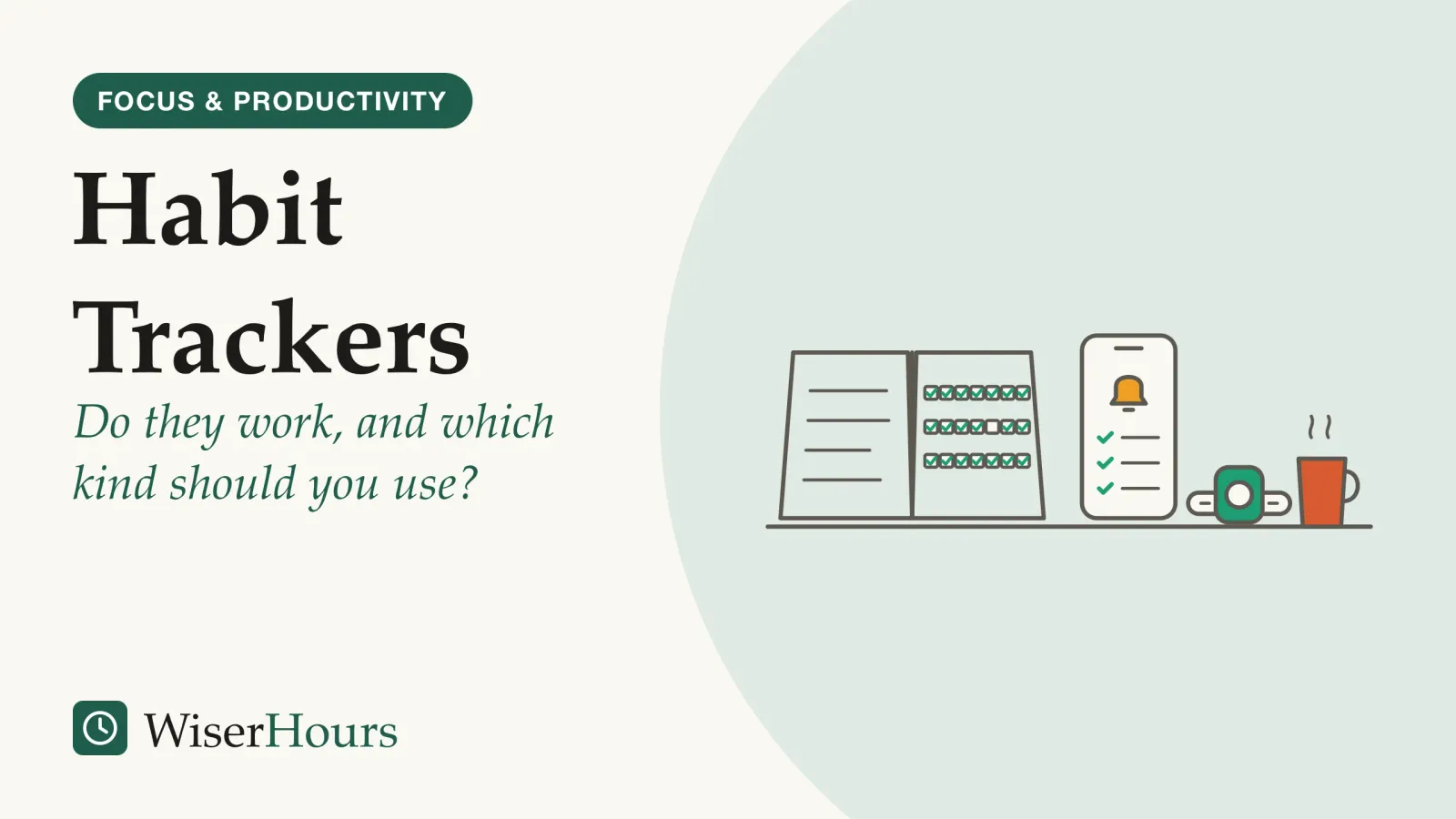
The daily reminder, one of the two features habit apps have long been built around, can keep you doing a new habit without letting it become one. Tracking itself is worth doing: a written record of what you do is one of the better-supported ways to act on a goal. The trouble starts when the tool does the remembering for you, or when the record becomes the thing you are protecting.
A habit tracker works best as temporary scaffolding. It helps you repeat an action and shows you when it slips, but the habit forms when something in your day, not the app, starts the action. In a 2015 four-week study at University College London, people who got a daily text reminder repeated a small task most reliably yet rated it the least automatic, while people who did it right after lunch rated it more automatic.1
The kind to choose follows from the habit. A sheet of paper suits one or two simple habits; an app suits several, provided each reminder names a moment in your day; a wearable suits walking and other movement; and something you do purely for pleasure may be better left uncounted.
Does a habit tracker work?
A habit tracker works for doing something more often, and the evidence for that part is good. A 2016 meta-analysismeta-analysis: A study that combines the results of earlier studies on the same question into one overall estimate. Pooling makes the estimate more precise, but it cannot repair the studies it pools: a meta-analysis of surveys is still survey evidence.Full entry in the glossary of 138 randomized studies, led by Benjamin Harkin, found that getting people to check their progress more often made them likelier to reach their goals, especially when the record was written down or made public.2 The same finding is behind noting each time a bad habit happens before trying to change it.
The reason a record helps is that memory is a generous judge. Without one, a week in which you walked twice feels like a week in which you mostly walked. With one, the gap between what you meant to do and what you did is on the page, and a gap you can see is one you can act on.
Take a month of evening walks logged in a notebook. The ticks matter less than the blanks, and if the blanks keep landing on Tuesdays and Thursdays, the late-meeting days, the tracker has told you something useful: the plan fails on two days for one reason. The fix, walking at lunch on those days, comes from the pattern, not from trying harder.
What a tracker records is not quite the habit, though. In the research sense, a habit is an action that a setting starts with little thought (see how a stable setting comes to start an action for you). A tick shows that you did something, not what made you do it, and that difference decides which tracker helps. Use one to see when the habit happens and when it does not, and to keep count while the action is new; do not expect the ticking itself to make the action automatic.
Reminders keep you repeating but can stall the habit
In a 2015 experiment at University College London, text reminders made people carry out a new daily task more reliably but also left it feeling less automatic than an ordinary daily cue did. Katarzyna Stawarz, Anna Cox and Ann Blandford ran that test alongside a review of the habit apps then on sale.1
The study
Limited evidence
Does a daily text build the habit? Four weeks of lunch reports at UCL
Volunteers texted a description of their lunch every day for four weeks. Some got an afternoon text reminder, some were told to send the report as soon as they finished lunch (an if-then planimplementation intention: A plan in if-then form that ties a specific action to a specific situation, such as 'if it is nine o'clock, then I open the report.' It hands the decision about when and where to act to the situation itself.Full entry in the glossary), and some got no cue. The reminder groups sent about 94% of the expected reports, against about 76% for the lunch groups. Yet they rated the task the least automatic: an average of 15 out of 28, against 20 for the lunch groups and 19 with no cue at all.1
Stawarz’s team reads the result simply: people who were reminded learned to wait for the prompt, so they had no reason to remember on their own. The caveats are real too: one small study lasting four weeks, a task invented for it, and automaticity that participants rated themselves.1
Think of a colleague who reminds you every Friday to send the weekly report. The report goes out, but the remembering lives in the colleague, and the week they are away it slips. Sending it when Friday lunch ends is the version that survives their absence.
The same paper’s review of 115 habit apps, found in the UK app stores in 2014, showed the imbalance built into the products: most offered tick-box tracking and many sent reminders, but only three helped users pick a moment in their day to hang the habit on.1 Apps have changed since, so read that as a picture of how the category began, not a verdict on any app today.
The weak point seems to be handing over the remembering, not the clock. In a 2021 randomized trial by Jan Keller and colleagues, adults who planned an everyday nutrition behavior for a set time of day built automaticity as well as those who tied it to a daily routine; each person picked their own behavior, and carrying out the plan again and again was a key predictor of automaticity.3 It is the same reason a morning routine you’ll keep rests on meeting the cue rather than on picking the perfect one.
- A reminder from the phone: in a small four-week UK study (2015), daily text reminders kept people doing a small task most reliably, but they rated it the least automatic
- Something you already do, such as finishing lunch: people who acted right after lunch did the task less reliably but rated it more automatic
- Reminders that point at the cue, then fade: the design the study’s authors propose, so you learn to rely on the cue rather than the phone
In practice, choose the moment the habit will follow, and set any reminder to point at it (“after lunch: walk”) rather than to stand in for it. Stawarz’s team suggests reminders that arrive before the chosen moment and are phased out over time, so the cue, not the phone, ends up doing the work.1
Further reading
Atomic Habits: An Easy & Proven Way to Build Good Habits & Break Bad Ones
Includes a chapter on habit trackers and the rule never to miss twice, which fits this article's advice to plan the make-up day.
As an Amazon Associate WiserHours earns from qualifying purchases.
A broken streak can cost more than the missed day
A streak counter motivates while the chain holds, and a visible break can make you less likely to carry on than the same miss would without a counter. That is the finding of seven studies by Jackie Silverman of the University of Delaware and Alixandra Barasch of the University of Colorado Boulder, published in 2023.4
Their explanation is that a logged streak becomes a goal in its own right. Once the counter resets, that goal has failed, and the next day’s action has lost part of its point. Picture a 40-day run in a language app that ends on a travel day: your Spanish is no worse than it was the day before, but “keep 40 alive” was a reason to open the app, and “start again at 1” is a much smaller one.
In one experiment, set in a mock language-learning app, people whose streak had just broken chose to continue with the same language less often when the break was shown in a log than when it was not: fewer than half, against about three in five.4 A 2018 step challenge for university employees showed the same direction in daily life, with goals met more often after an intact streak than after a broken one, though that field comparison is only correlational.4
Two details point to fixes. The drop was steeper when people blamed themselves for the break, and shallower when the app let them restore the streak by doing the same activity again. Most of the experiments were short online tasks with paid participants, so they show choices made in the next few minutes, not over months, and the work was partly funded by two research centers at the University of Pennsylvania’s Wharton School.4
- Myth
- Never break the chain: one missed day undoes your progress.
- Fact
- In a 2010 study of how daily habits form, missing a single opportunity did not materially affect habit formation. What a broken streak can damage is motivation.
The miss itself matters less than the counter implies. Phillippa Lally’s 2010 field study, which followed volunteers building a daily habit, found that missing one opportunity to perform the behavior did not materially affect how the habit grew.5 So decide in advance what a miss means. A rule such as “a missed day is repaired by doing it the next morning”, or a weekly target such as most days out of seven, keeps the record honest without turning one bad day into a failed goal. Silverman and Barasch make a similar suggestion to app makers: count streaks more flexibly, and stop alerting people when a streak breaks.4
Why tracking fades, and when stopping is fine
Tracking tends to fade, and so does the extra activity it brings. In a French study of adults given a basic Fitbit activity tracker in 2013, about three in four were still using it after 100 days and fewer than one in five after 320 days.6
The commonest reason for quitting was mundane: flat batteries and broken or lost trackers. The project began as groundwork for a publicity campaign by a health-communication agency, and the data were later handed to university researchers for independent analysis.6
Stawarz’s team, summarizing earlier research, gives two everyday examples of how tracking ends, the tool stops working or people get bored, and warns that behavior can slip back to where it started once tracking stops.1 A step counter that ends up in a drawer in October is not the problem in itself. The question is whether the evening walk went into the drawer with it.
Wearable tracker programs do raise activity, but the gain fades. A 2022 umbrella reviewumbrella review: A review that gathers and compares existing systematic reviews and meta-analyses on a broad question, rather than individual studies. It gives a wide view quickly, but it inherits the limits of the reviews it collects.Full entry in the glossary of 39 reviews, led by Ty Ferguson in Australia, found activity trackers added roughly 1,800 steps a day. One review inside it found the gain years later was less than half its size at four to six months, and the authors judged most of the included reviews to be of low or critically low quality.7 A wearable, in other words, pushes hardest while it is new.
Tracking can also cost something when the activity is one you do for pleasure. In six experiments with US students and online participants, Jordan Etkin of Duke University found that counting steps walked or pages read made people do more but enjoy it less, because the activity started to feel like work; after the count was taken away, people who had seen it read less and were less likely to choose to keep reading.8 These were brief studies, none longer than a day, all by one author, and when readers had the goal of getting through as many pages as possible, Etkin reports only a marginal, not clearly significant sign that the count made reading more enjoyable instead.8
So a pages-per-night count can turn the novel you read to unwind into a quota, while for a textbook you need to finish, enjoyment was never the main point. Stopping a tracker is not failure if the habit has moved to its cue; the risk Stawarz’s team describes applies when nothing but the tracker was starting the action. Before you drop the record, check for a week that the action still starts at its moment without it.
Paper, app or wearable: which kind of habit tracker to use
No trial we found has pitted paper, app and wearable habit trackers against each other for building habits, so the choice rests on indirect evidence and on the habit you are tracking. The closest test compared ways of keeping a food record rather than a habit tracker.
In that 2013 pilot trial at the University of Leeds, overweight UK adults following a weight-management plan were randomly given an app, a website or a paper diary. App users recorded on about three times as many days as paper users over six months, though nearly half the paper group dropped out, against very few app users. Recording fell off in every group. The researchers built the app themselves (the university owns it and has no commercial plans for it), and the trial measured record-keeping, not habits.9
| Kind | What the best evidence found | Evidence |
|---|---|---|
| Paper sheet or notebook | Paper diarists kept records on fewer days than app users in one six-month UK pilot trial; no study we found tests paper habit trackers on their own | Small pilot trial, limited9 |
| Habit app | Apps reviewed in 2014 were built around tick-box tracking and reminders, rarely around cues; reminders kept people repeating a task but not automatic | App review and one small trial, limited1 |
| Wearable | About 1,800 extra steps a day across reviews of trials, with a smaller gain years later; in one French study most users had stopped within a year | Umbrella review of mostly low-rated reviews, moderate; observational study, limited76 |
| Streak counter, in any of them | An intact streak shown in a log made people more likely to continue; a broken one made them less likely | Experiments and one field study, limited4 |
Read the table as a set of fits rather than a ranking. A sheet on the fridge or a page on your desk sits where the cue happens and never runs out of battery, which suits one or two simple habits and anyone tired of notifications. An app handles several habits and early prompts, as long as each reminder names the cue and is switched off once the action runs on its own. A wearable counts movement without effort, fixing the biggest weakness of manual logs, but expect its pull to fade.
Setting up a tracker that builds the habit
The bottom line
Use a tracker to watch a new habit take hold, not to hold it up. In the first weeks it shows when the action happens and when it slips; choose the kind by the habit, make every reminder point at a moment in your day, and settle in advance that a missed day gets made up rather than counted as failure. Once the action starts at its cue without a glance at the record, the tracker can go.
Frequently asked questions
Do I need reminders at all to build a habit?
Not necessarily. In Katarzyna Stawarz's 2015 study at University College London, volunteers given no cue at all rated a daily task about as automatic as those told to do it right after lunch, and some set up their own reminders. Across the study, people leaned on phone alerts, notes or the lunch itself. Reminders mainly helped people repeat the task, not make it automatic.
Do badges, points and encouraging messages in habit apps help?
Probably not much, on the thin evidence available. In the same 2015 UCL study, cheerful automatic thank-you texts after each report did not raise automaticity, and groups without them scored slightly higher. The authors suspect the messages felt annoying or insincere. Their review found game-style points and rewards in a minority of the habit apps they examined.
Is it bad to stop tracking a habit?
For a habit that already starts at its cue, no study we found says so. For activities done for pleasure, there is a caution: in Jordan Etkin's 2016 experiments, people who had seen a page count and then lost it read less afterward. Stawarz's team, summarizing earlier research, also warns that behavior can slip back when tracking stops if no cue has taken over.
Sources
- Beyond Self-Tracking and Reminders: Designing Smartphone Apps That Support Habit Formation. Stawarz, K., Cox, A. L. & Blandford, A. (2015). Proceedings of CHI 2015, ACM, pp. 2653-2662
- Does monitoring goal progress promote goal attainment? A meta-analysis of the experimental evidence. Harkin, B., Webb, T. L., Chang, B. P. I., Prestwich, A., Conner, M., Kellar, I., Benn, Y. & Sheeran, P. (2016). Psychological Bulletin, 142(2)
- Habit formation following routine-based versus time-based cue planning: A randomized controlled trial. Keller, J., Kwasnicka, D., Klaiber, P., Sichert, L., Lally, P. & Fleig, L. (2021). British Journal of Health Psychology, 26(3)
- On or Off Track: How (Broken) Streaks Affect Consumer Decisions. Silverman, J. & Barasch, A. (2023). Journal of Consumer Research, 49(6)
- How are habits formed: Modelling habit formation in the real world. Lally, P., van Jaarsveld, C. H. M., Potts, H. W. W. & Wardle, J. (2010). European Journal of Social Psychology, 40(6)
- Determinants for Sustained Use of an Activity Tracker: Observational Study. Hermsen, S., Moons, J., Kerkhof, P., Wiekens, C. & De Groot, M. (2017). JMIR mHealth and uHealth, 5(10), e164
- Effectiveness of wearable activity trackers to increase physical activity and improve health: a systematic review of systematic reviews and meta-analyses. Ferguson, T., Olds, T., Curtis, R., Blake, H., Crozier, A. J., Dankiw, K., Dumuid, D., Kasai, D., O'Connor, E., Virgara, R. & Maher, C. (2022). The Lancet Digital Health, 4(8)
- The Hidden Cost of Personal Quantification. Etkin, J. (2016). Journal of Consumer Research, 42(6)
- Adherence to a Smartphone Application for Weight Loss Compared to Website and Paper Diary: Pilot Randomized Controlled Trial. Carter, M. C., Burley, V. J., Nykjaer, C. & Cade, J. E. (2013). Journal of Medical Internet Research, 15(4), e32
How we researched this
Sources came from PubMed, Crossref, Google Scholar and publisher websites, searched in September 2026 for experiments, trials, field studies and reviews from 2010 to 2023 on self-monitoring, habit apps, streaks, activity trackers and why people abandon them. The Stawarz, Silverman and Barasch, Etkin, Ferguson, Hermsen and Carter papers were read in full; three sources are used only as far as their abstracts go. Main limitation: no trial compares paper, app and wearable habit trackers directly.
Keep reading
How to Build a Reading Habit: 20 Pages a Day
How to build a reading habit: 20 pages a day takes about 20 to 25 minutes. Tie it to a fixed moment, keep the phone away, and read hard books on paper.
How to Build a Morning Routine You'll Actually Keep
How to build a morning routine you'll keep: 5 steps from habit research, and why the kind of cue you pick matters less than meeting it every day.
How to Build a New Habit: A Step-by-Step Guide
How to build a new habit in 6 steps from habit trials: one wanted action, a daily cue, a small start, a written record, loose timing and a restart plan.
How to Build an Exercise Habit That Lasts
How to build an exercise habit: the WHO target is 150 minutes a week, but start far below it, make starting automatic and plan how you come back after a miss.