Dollar-Cost Averaging vs. Lump Sum: What the Research Says
Dollar-cost averaging vs lump sum: why investing each paycheck is a different question, and what Vanguard and research since 1979 found about windfalls.

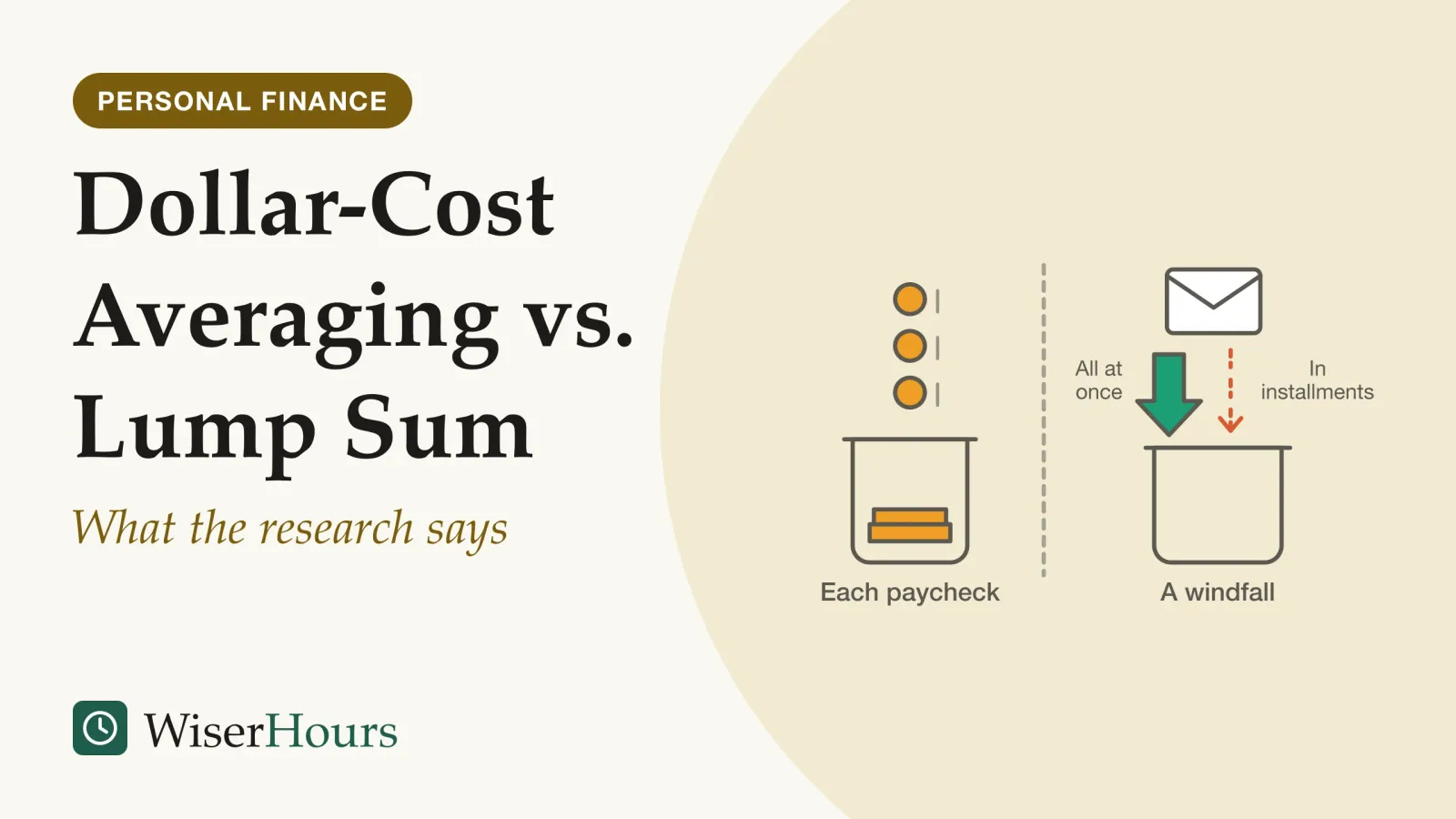
Dollar cost averaging vs lump sum is a real choice only when a large sum of cash is already in your account, such as an inheritance, a bonus or the proceeds of a sale. Vanguard’s company research, published in 2012 and updated in 2023, found that investing such a sum at once usually ended ahead of feeding it in over several months, because stocks and bonds tended to return more than cash.12 Spreading the money out did better when prices dropped soon after the start, and it can make a fall easier to live with.
In practice, the research sorts people into three positions. Someone investing part of each paycheck has no lump to decide about. Someone holding a windfall would, in past markets, usually have come out ahead by investing it at once, by a modest margin. And someone who spread it over a few months on fixed dates gave up some of that edge in return for smaller losses when markets fell soon after.2 None of this says what to do with your own money. The UK’s Financial Conduct Authority (FCA) also puts earlier steps first, such as paying off short-term debt and building an emergency cash fund, which the beginner’s guide to how investing works sets out in order.3
Investing each paycheck and spreading a windfall are different questions
Dollar-cost averaging names two different habits: investing a fixed amount from each paycheck, and splitting a sum you already hold into installments. The SEC, the US securities regulator, defines it as investing equal portions at regular intervals, regardless of the market’s ups and downs.4
How this article uses the term
Here, dollar-cost averaging means splitting a sum you already hold into equal installments invested on set dates. Investing part of each paycheck as it arrives is a separate habit.
The first habit is how payroll investing works, through a workplace retirement plan, for example. Money arrives a slice at a time, so it can only be invested a slice at a time. Vanguard’s 2012 paper calls this a prudent way to invest, and says the only sound alternative would be to let the cash pile up and then try to pick a moment to invest it.1
The second habit is a genuine decision. Picture two colleagues. One has part of every paycheck go into her retirement plan. The other has just inherited a large sum and wonders whether to invest it this week or in monthly installments over the coming year. Only the second faces the question in this article’s title. Vanguard’s 2023 paper draws the same line: it sets paycheck investing aside and studies only a sum that is available immediately.2
So the research below says nothing about investing through payroll. It applies when cash is already sitting in an account, waiting for a decision.
Why buying more shares when prices dip is only half the story
Spreading a purchase does buy more shares when prices dip, as the FCA explains, while investing a windfall in one go gets you fully invested immediately.3 The extra shares help only if prices fall after you start. When prices climb instead, the money still waiting in cash buys fewer shares than it would have bought on the first day.
A worked example makes the mechanism visible. Our own arithmetic, with made-up prices and no fees: 300 dollars goes into a fund, either all at once in the first month or as 100 dollars a month for three months.
| Price in months 1, 2 and 3 | All at once | Three monthly installments |
|---|---|---|
| Dips, then recovers: 10, 5, 10 dollars | 30 shares, worth 300 dollars at the end | 10 + 20 + 10 = 40 shares, worth 400 dollars |
| Keeps rising: 10, 15, 20 dollars | 30 shares, worth 600 dollars at the end | 10 + about 7 + 5 = about 22 shares, worth about 433 dollars |
The installments win the first case because the dip let later money buy cheaply. They lose the second because the waiting money kept paying more. Which path is more likely in any given quarter, nobody knows in advance; the next section shows which one past markets favored.
- Myth
- Dollar-cost averaging lowers your average cost, so it beats investing all at once.
- Fact
- It buys more shares when prices dip, but it comes out ahead only if prices fall after you start. When prices rise, the money still waiting in cash buys less than it would have on day one.
Spreading a sum out, then, is not a free discount. It is, in effect, a wager that prices will fall soon, paid for with time out of the market.
Dollar cost averaging vs lump sum: what Vanguard’s tests found
In Vanguard’s 2023 study of past global stock and bond returns, investing a sum at once beat splitting it over three months in most one-year periods, and splitting it still beat leaving it all in cash. The study is company research by a fund manager, not peer-reviewedpeer review: The checking of a study by independent experts, usually arranged by a journal, before it is accepted for publication. It screens for weak methods and unclear reporting, but reviewers rarely see the raw data, so passing it does not prove a finding is right.Full entry in the glossary, and it reports past index returns, not a forecast.2
The study
Moderate evidence
Lump sum or three monthly installments? (Finlay and Zorn, Vanguard, 2023)
Investing everything at once beat splitting the sum into three equal monthly installments in 68% of rolling one-year periods of a global stock index, with no interest earned on the waiting cash. The installments, in turn, beat staying entirely in cash 69% of the time. In a 60% stock, 40% bond mix, the lump sum ended 1.8% higher on average; in the worst periods, installments lost less.2
Put plainly, the patient investor came out ahead in roughly one year in three, and in a typical year the gap was small. For investors who still prefer installments, the authors suggest keeping the period short, such as three months, to limit the cost of waiting. The main caveats: Vanguard is a fund manager, and the tests use index returns, which leave out fund fees and taxes. Paying interest on the waiting cash also narrows the lump sum’s edge, the authors report.2
Vanguard’s earlier 2012 paper, covering US, UK and Australian markets over ten-year holding periods, found the same pattern and one more: the longer the spread, the worse it did. In the US, investing at once beat a 36-month spread in about 9 of 10 ten-year spans.1
In the past data, then, the length of a spread mattered more than the method. Every extra month is another month in which part of the money sits in the gray area of the drawing above.
Lump sum or installments: what the research found for three situations
In the sources, the case for each approach turns on where the money comes from and how an investor would react to a fall, not on a market forecast. Money that arrives with each paycheck is simply invested as it comes, so the table covers three situations with a windfall; it describes the research, not a recommendation for your money.
| Situation | What the sources found | Evidence |
|---|---|---|
| A windfall, and you are at ease with your planned mix | Investing at once ended ahead in most past periods, by a small margin on average | Company research, historical tests2 |
| A windfall, and a fall soon after would be hard to bear | Short installment plans lost less in the worst periods and suited loss-averse investors in Vanguard’s model | Company research, model2 |
| A windfall, but no plan yet | FINRA, a US self-regulatory body, in 2024 guidance suggests considering holding off on big moves for six to 12 months, with the cash in a relatively safe place such as a savings account | Expert guidance5 |
Two points hold across every row. First, a delay has a cost: Vanguard’s 2012 authors call delaying investment a form of market timing, which few investors succeed at, and an installment plan with dates fixed in advance at least keeps the delay from stretching on.1 Second, the bigger cost is never deciding. Many investors hold too much cash because they keep putting off the decision, Vanguard’s 2023 authors write, and the choice between the two approaches makes only a marginal difference compared with leaving money in cash for good.2
Regret, not return, is the case for spreading out
The strongest argument for feeding a windfall in slowly is emotional, and researchers take it seriously. Vanguard’s 2012 paper found that spreading did better during market downturns, and it called worries about regret after investing just before a fall not unreasonable.1
Meir Statman, a finance professor at Santa Clara University, made the behavioral case in 1995. Brennan and colleagues, in a 2005 study discussed below, quote his argument that the fixed rules of dollar-cost averaging “reduce responsibility and regret”.67 The mechanism is familiar. Invest a whole inheritance on Monday, watch prices fall on Tuesday, and the loss feels like your own mistake. Buy in installments on dates set in advance, and a fall afterward is partly the schedule’s doing, while the next installment buys at the lower price.
Vanguard’s 2023 model points the same way. When its authors added a penalty for losses to a model of investor preferences, a moderately conservative investor switched from preferring the lump sum to preferring installments. The concern is less a small shortfall than abandoning the plan after a severe fall: lowering risk for a while, the authors argue, can limit losses and regret in a downturn and so preserve commitment to the plan.2
An honest answer points to the real decision. Vanguard’s 2012 authors note that discomfort with either route may signal a low willingness to take risk in general, and suggest revisiting the target mix of investments itself.1
What finance research adds: the trade is about risk, not timing
Finance researchers reached a similar verdict decades before Vanguard, with a twist that matters for the reader: once risk is counted, spreading a purchase is not the only way to lower it, and may not be the best. George Constantinides challenged the popular idea that installments protect an investor from buying everything at a bad moment, in a 1979 note on the “suboptimality” of dollar-cost averaging.8
His objection, as Michael Brennan, Feifei Li and Walter Torous summarize it in their 2005 study, is that a fixed schedule makes today’s portfolio depend on where the investor started, while a rational investor would decide using only what is known now.7 Put simply, the plan keeps buying on autopilot, whether or not anything in the investor’s life calls for the mix it happens to hold that month.
Brennan and colleagues then scored strategies on US stock data from 1926 to 2003 by how much a risk-averse investor would value each one, rather than by average wealth. Spreading purchases of a broad stock portfolio over one to six years scored better than a lump sum for all but the most risk-tolerant investors, apparently because it carried less risk. But a plain mix of half stocks and half cash, reset to that balance each month, beat both, so the authors called the support for dollar-cost averaging mixed.7
One recent result adds a condition, and it is the weakest evidence in this article. A single-author study published in September 2026, with no outside funding, used US data since 1941: in high-inflation periods, spreading ended ahead on average after inflation, but the difference was statistically significantstatistical significance: A result that a statistical test says would be unlikely to turn up if there were no real effect. It does not carry the everyday sense of significant: it says nothing about how big the effect is or whether it matters in practice.Full entry in the glossary for 10-year Treasuries and not reliably for stocks, while in low-inflation periods the lump sum came out clearly ahead. The author traces the bond result to Treasuries earning about the same as cash when inflation ran high, so waiting cost little.9 Until others test it, it is a lead, not a finding to act on.
What a spread really buys, on this evidence, is a few months of holding less risk. The research suggests the underlying question is how much risk you want to carry, not only how quickly you get there.
Tax, scams and your own plan: where professional help comes in
A windfall raises questions no study answers for you, such as tax, debts and what the money is for, so FINRA and the FCA point to professional help, most urgently when someone is pushing you to act. The order below, from most to least urgent, is our arrangement of their advice.
If someone is rushing you, the pressure is itself a warning sign. FINRA warns that a windfall, especially one others can find out about, can make you a target for fraudsters, and names promises of quick profits, returns said to be certain and pressure to invest right away as red flags.5 The UK’s FCA says scammers often call out of the blue and press people to act quickly; its online register, the Firm Checker, shows if a firm has FCA authorisation.10 In other countries, look to the national securities regulator to check a firm or report one.
Before a large sum moves, FINRA’s 2024 windfall guidance suggests considering a registered financial professional, plus an accountant who can explain the tax implications, and looking up their background first on its BrokerCheck or the SEC’s adviser database.5 UK readers can use the FCA register above; elsewhere, the local regulator keeps its own. Decisions that turn on your own circumstances need a licensed adviser.
After the money is invested, one of the FCA’s golden rules is to look over your investments from time to time, because choices that suited you two years ago may not suit you now.11
The bottom line
For a windfall, research on past markets favors investing at once on average, while a short installment plan with dates set in advance gives up some expected return for less regret. Money that arrives with each paycheck sits outside the question: it gets invested as it comes. In the sources, the costlier mistake is leaving the money in cash with no plan at all, and a decision about your own sum is one to take with a licensed adviser.
This article is general education, not financial advice. For decisions about your own money, speak to a qualified, regulated adviser.
Frequently asked questions
Does dollar-cost averaging protect you from losses?
No. Vanguard's 2012 paper states that dollar-cost averaging does not guarantee a profit and does not protect against losses when prices are falling. Spreading a purchase lowers risk only while part of the money waits in cash; once it is all invested, the portfolio carries the full risk of whatever it holds, and it can still end up worth less than was put in.
What if the cash earns interest while I spread it out?
Interest narrows the gap but did not close it in Vanguard's 2023 tests. Adding interest at the three-month US Treasury bill rate to the waiting cash, the lump sum still ended ahead in most one-year periods for an all-stock portfolio, and the authors found that the higher the interest rate on cash, the smaller the lump sum's advantage. These are past index returns, before fees and taxes.
Does it matter whether the sum goes into stocks or bonds?
Not to the direction of the result in Vanguard's 2012 study. Investing at once ended ahead more often than a 12-month spread for all-stock, mixed and all-bond portfolios in US, UK and Australian data. The authors link this to stocks and bonds both returning more than cash over those periods, which is history, not a promise about future returns.
Does the same trade-off apply when taking money out in retirement?
Vanguard's 2023 authors suggest a mirror image of it does. Taking out a whole year's money at the start of the year, instead of monthly, might be suboptimal, they write, but having the year's cash ready adds some security if markets fall. The choice, they conclude, again comes down to opportunity cost, risk and the investor's preferences.
Sources
- Dollar-cost averaging just means taking risk later. Shtekhman, A., Tasopoulos, C. & Wimmer, B. (July 2012). Vanguard research, The Vanguard Group (archived copy of Vanguard's PDF)
- Cost averaging: Invest now or temporarily hold your cash? Finlay, M. & Zorn, J. (February 2023). Vanguard research, The Vanguard Group
- Should you invest? Financial Conduct Authority (UK), InvestSmart, last updated 16 May 2025
- Dollar Cost Averaging. U.S. Securities and Exchange Commission, Investor.gov glossary
- Tips for Managing a Financial Windfall. FINRA (US), Investor Insights, 20 June 2024
- A Behavioral Framework for Dollar-Cost Averaging. Statman, M. (1995). The Journal of Portfolio Management, 22(1)
- Dollar Cost Averaging. Brennan, M. J., Li, F. & Torous, W. N. (2005). Review of Finance, 9(4)
- A Note on the Suboptimality of Dollar-Cost Averaging as an Investment Policy. Constantinides, G. M. (1979). Journal of Financial and Quantitative Analysis, 14(2)
- Dollar-Cost Averaging Versus Lump-Sum Investing in High-Inflation Periods. Kaur, D. (2026). Journal of Risk and Financial Management, 19(9), 671
- Protect yourself from scams. Financial Conduct Authority (UK), last updated 19 January 2026
- The golden rules of investing. Financial Conduct Authority (UK), InvestSmart, last updated 19 January 2026
How we researched this
Research for this page ran in September 2026: we read in full Vanguard's 2012 and 2023 research papers, studies by Brennan, Li and Torous (2005) and Kaur (2026), and investor guidance from the US SEC, FINRA and the UK Financial Conduct Authority, with papers found through Crossref and dated 1979 to 2026. Two older academic papers were used only as their publisher's extract or as others describe them. Main limitation: every comparison rests on past or simulated market returns, mostly from the US.
Keep reading
Diversification Explained: Why Spreading Your Money Reduces Risk
Diversification explained: why spreading cuts one company's risk but not the market's, and why one US study found the stocks needed rose from about 20 to 50.
Bear Markets Explained: What They Are and How Long They've Lasted Historically
A bear market is usually a fall of 20% or more, a convention rather than a rule. US bear markets since 1929 fell for 1 month to about 2.5 years.
The Behavior Gap: How Investors End Up Earning Less Than Their Own Funds
Fund investors often earn less than their funds report. How the behavior gap is measured, why estimates range from about 8.5 points to 0.1, and what to do.
What Is an Index Fund? How Tracking a Market Index Works
An index fund copies a market index instead of trying to beat it. How tracking works, why the copy is never exact, and 5 questions to ask before you buy.