The Cornell Note-Taking Method: How It Works and When to Use It
The Cornell note-taking method splits a page into 3 areas and adds 5 steps. Research backs its self-testing step far more than the layout itself.

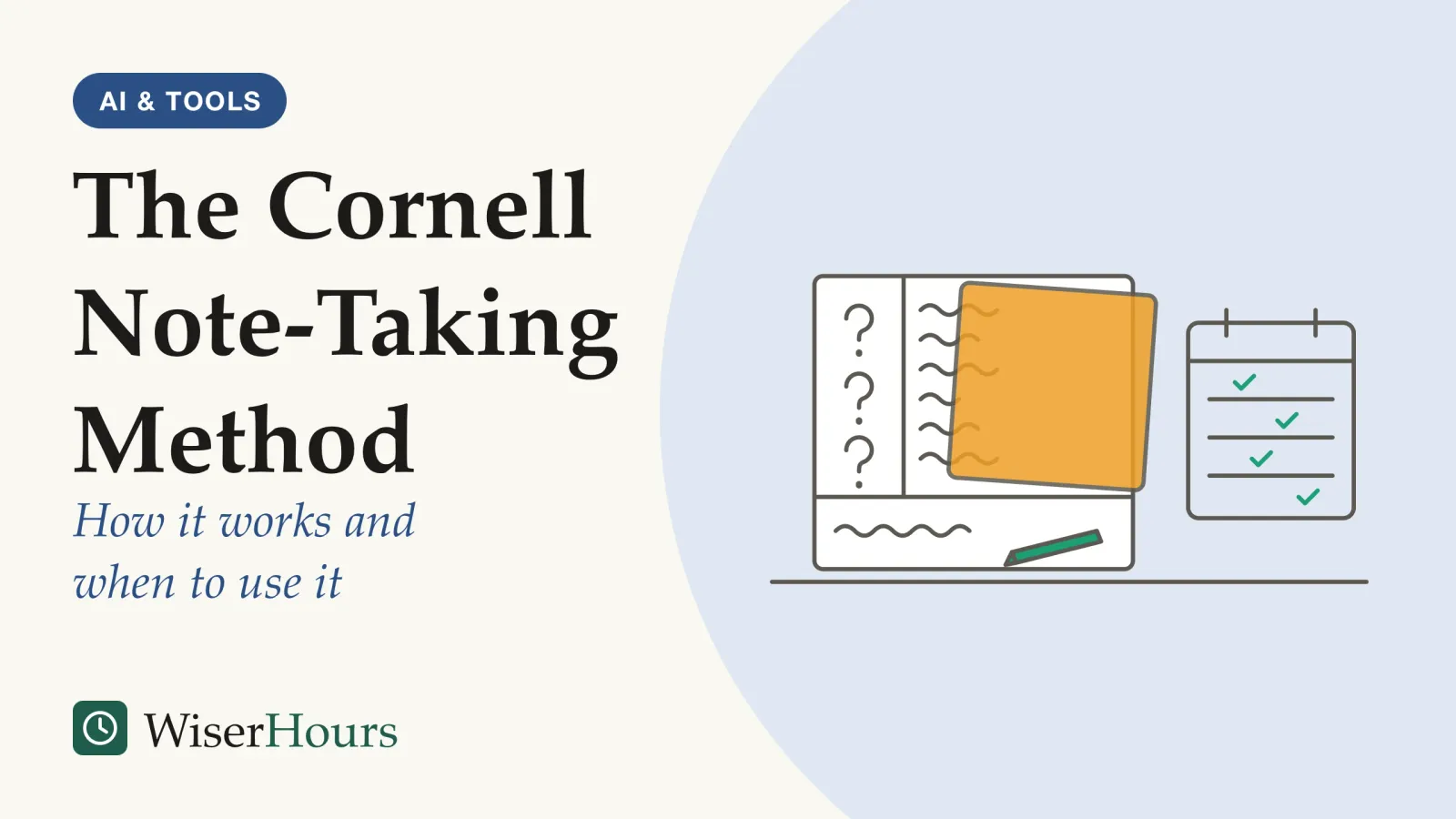
The part of a Cornell page that research backs most firmly is also the easiest part to skip: the narrow column of questions, used later to quiz yourself with the notes covered.1 The ruled layout gets the attention, but the self-testing carries the evidence.
The Cornell note-taking method, devised by Walter Pauk at Cornell University, splits each page into a narrow cue column, a wide notes column and a summary strip, and pairs that layout with a routine of recording, questioning, reciting, reflecting and reviewing.2 To use it:
- Rule the page into three areas before you start.
- Record in the wide column, in short phrases.
- Turn your notes into questions soon afterwards.
- Cover the notes and answer the questions aloud.
- Write the summary from memory, then check it.
- Come back for a short review every week.
How the Cornell note-taking method works, in Pauk’s own terms
Walter Pauk, a longtime Cornell education professor, developed the system in the 1950s while working as a teaching assistant, and it spread after he described it in his 1962 book How to Study in College, which later reached an 11th edition, according to Cornell’s alumni magazine.2
Cornell’s Learning Strategies Center still hands out a one-page version adapted from the 2001 edition of the book. It draws a cue column on the left, a note-taking column on the right and a summary space across the bottom, then lists five steps.3 Other university handouts call the second step “reduce”, boiling the notes down to key words or questions, so that all five steps start with R.4
- 1Recordnotes in the wide column during the class or reading
- 2Questioncue questions in the left column soon after
- 3Recitecover the notes, answer from the cues aloud
- 4Reflectask what the facts mean and connect to
- 5Reviewa short look back at all your notes each week
The design separates jobs by time. During a talk you only capture; later you question, test and connect. In a Monday training session, for example, you fill the right-hand column while the trainer speaks, and that evening you turn each chunk into a question on the left. The split matters because, as our guide to why notes help memory and thinking explains, notes pay off mostly when you go back to them. The Cornell page builds the going back into the paper itself.
The practical lesson is that a Cornell page is unfinished when the lecture ends. If you stop after the first step, you have ordinary notes with a wide empty margin.
Six steps from blank page to weekly quiz
The steps below follow Pauk’s handout, with the self-testing parts, which the research in the next sections supports most, placed where they cannot be skipped.3
1. Rule the page into three areas before you start
The Cornell handout, drawn in inches, sets a 2.5-inch (about 6 cm) cue column on the left and a 2-inch (about 5 cm) summary strip at the bottom. On A4 or any notebook, a margin of roughly a quarter to a third of the width works the same way. In an app, a two-column table with a text box below does the job.
2. Record in the wide column, in short phrases
During the talk or reading, write only in the wide column, in what Pauk calls telegraphic sentences: short phrases that keep the meaning. Leave the cue column empty.
3. Turn your notes into questions soon afterwards
As soon after the session as you can, write a question in the cue column beside each main point. Prefer questions that ask for an answer (“Why did sales fall in the second quarter?”) over labels (“sales”).
4. Cover the notes and answer the questions aloud
Lay a sheet over the wide column and answer each cue from memory before you look. Mark the ones you missed.
5. Write the summary from memory, then check it
With the page covered, write two or three sentences in the strip, then compare them with the notes and fix any gaps.
6. Come back for a short review every week
Repeat step 4 across your recent pages once a week, spending most of the time on the cues you missed.
For each Cornell page
What research says about Cornell notes as a whole
Studies of the complete method are few and small, and they point to a modest advantage at best. The only randomized trial of the full layout we found, a 2026 study from Türkiye, gave Cornell notes an edge over plain sentence notes only on a test taken weeks later, and not over the other structured formats it tested.5
The study
Limited evidence
Four ways of taking notes, compared at a university in Türkiye (Yıldırım, 2026)
Second-year trainee teachers were randomly assigned to take notes in a course for five weeks with the Cornell layout, a two-column format beside the slides, a laptop or tablet, or plain sentences. A week after the course, no method beat another. Four weeks later, the Cornell group’s adjusted score was about 15 out of 20 against about 12 for plain sentence notes, the only difference that held up after correction for multiple comparisons.5
Read that as a small, delayed edge over the least organized option, not proof that the Cornell page beats any other structure. The Cornell group wrote cues, notes and a summary after each lesson, but the paper does not describe the cover-and-recite step, so the trial may have tested the layout more than the routine.5
A classroom project in the US shows the same uncertainty. In a 2012 action-research project in one high school, a class required to use Cornell notes did no better on three unit tests than a parallel class that took notes its own way, and the teachers had no way to tell whether students studied from their notes at all.6
- Myth
- Cornell notes are proven to raise test scores by 10 to 12 percent.
- Fact
- That figure comes from one school's science classes compared with an earlier semester, reported in a 2010 teaching article. Controlled studies are few, small and mixed.
The popular figure traces to a 2010 practitioner article about a literacy coach helping a new teacher bring structured notes into a science class, as a later study cites it.76
Take two colleagues on one course. One rules tidy Cornell pages and files them; the other scribbles notes but quizzes herself from them every Friday. The research in this article gives more support to the second colleague’s habit than to the first colleague’s page. Expect the method to help only as much as you use its later steps.
The cue column works best as questions you answer from memory
The cue column earns its place when it holds questions that you later answer with the notes hidden. Pauk’s instructions, in the Cornell handout, are to write questions soon after class, then cover the note column and answer aloud from the cues alone.3
Writing questions helps clarify meanings, reveal relationships, establish continuity, and strengthen memory.
The recite step is a form of retrieval practiceretrieval practice: Learning by recalling material from memory, for example by quizzing yourself, instead of rereading it. Pulling information out makes it easier to recall later, a result also known as the testing effect.Full entry in the glossary: recalling an answer from memory strengthens it more than looking at it again. The 2013 review of learning techniques by John Dunlosky and four colleagues judged practice testing to be of high utility, its best grade, and rereading of low utility, and named the Cornell system as one easy way to test yourself.1 A 2021 meta-analysis of 222 classroom studies, by a team led by Chunliang Yang at Beijing Normal University in China, found that quizzing raised achievement to a medium extent in real classrooms, not just in the lab.8
Writing the questions may help on its own too. In a 2020 study by psychologists at the University of Kassel in Germany, run during a university lecture, recall a week later benefited from students writing their own questions and from answering questions, but not from restudying, according to the paper’s abstract.9
Here is what the difference looks like. A cue that reads “supplier terms” only reminds you where to look. A cue that reads “What two conditions did the supplier attach to the discount?” makes you produce the answer before you check it, and a blank tells you exactly what to review. So write each cue as a question you could get wrong.
The summary strip helps only when you write it from memory
The summary strip is the weakest-supported part of the page as most people use it. The same 2013 review rated summarization low utility, because doing it well takes a lot of training for many learners, some undergraduates included, and findings were mixed about which tasks it helps. There is a better way to fill the strip: the review describes research in which readers who wrote summaries without the text in front of them got better at judging what they did and did not know.1 Copying the best sentence from the notes column into the strip gives you the look of a summary without the effort that makes it useful.
In practice, cover the whole page and write two or three sentences on what it said. Then uncover it and compare. Whatever you left out or got wrong is your review list for the week.
- Cue column: questions written soon after; covering the notes and answering them is practice testing, the best-supported part of the method
- Notes column: short phrases during the talk; the layout on its own gave small or no gains in the few classroom studies
- Summary strip: most useful written with the notes covered; summarizing on its own was rated low utility
- Weekly review: short, spaced returns to the page; spreading study out was rated high utility
Short weekly reviews do more than one long reread
Pauk kept the last step short and regular. His handout asks for at least ten minutes every week reviewing all previous notes.3 The 2013 review rated spreading study over time, known as distributed practicedistributed practice: Spreading study or practice of the same material across several sessions with gaps between them, rather than cramming it into one. Also called spacing, it tends to give longer-lasting learning than the same time spent in a single block.Full entry in the glossary, high utility.1 Pooling 33 studies in 2006, Keiichi Kobayashi found the combined effect of taking notes and then going back over them to be substantial.10
Each return is another round of the self-testing described above, which is why the weekly review should be a recite session with the notes covered, not a reread. A student might spend ten minutes every Friday quizzing from the cue columns of the week’s pages; a manager might do the same with notes from a training course before the skills are needed.
If a weekly slot feels like too much, the lesson still holds on a smaller scale: a short, covered-notes pass a few days after you take the notes is closer to what the research supports than a long reread the night before you need them. The explainer on how spaced retrieval practice works shows how the two habits fit together.
When to use Cornell notes, and when another format fits better
Cornell notes suit material you must later recall without the page: classes, training courses, briefings and dense reading. They fit less well when someone else can give you the structure, when the material is a set of things to compare, or when it is mostly equations and diagrams.
When the presenter shares slides or an outline, use it. Kobayashi’s 2006 meta-analysis found that providing a framework or notes from the instructor did more to strengthen the payoff of note-taking plus review than pretraining or instructions alone did.10 A 2009 meta-analysis by Moira Konrad and colleagues concluded that guided notes, which teachers provide to keep students actively responding during lectures, are an effective way to increase note-taking accuracy and academic performance, particularly for school-age students.11 You can still add your own cue questions in the margin of a handout.
When you need to compare several items on the same features, a table may do better than a column of notes. In a 2010 US experiment with 72 undergraduates, a matrix that lined up topics against categories helped students learn both facts and relationships better than plain text or an outline. The students studied ready-made displays rather than taking notes, so treat this as a pointer, not a test of note formats.12 Someone weighing three suppliers on price, delivery and support, for example, may spot the gaps faster in a grid than in a column of notes.
For math, lab work and diagrams, the Cornell layout appears untested, and so does its use in workplace meetings: no study of either came up in our searches.
The Cornell method part by part: how strong the evidence is
The self-testing and review steps have far stronger support than the layout, according to the 2013 Dunlosky review and a 2021 classroom meta-analysis; studies of the full method are small.
| Step | What the research found | Evidence |
|---|---|---|
| Whole layout versus plain notes | An edge over plain sentence notes only on a delayed test, in one randomized study | One small trial, limited5 |
| Writing cue questions | Writing your own questions helped recall a week later, as did answering questions | One university experiment, abstract only, limited9 |
| Covering notes and reciting | Quizzing raised classroom achievement to a medium extent across 222 studies | Meta-analysis, strong8 |
| Summary strip | Summarizing rated low utility without training; summaries written without the text helped readers judge what they knew | Expert review, limited1 |
| Weekly review | Spreading study out rated high utility across ages, materials and long delays | Expert review, strong1 |
The bottom line
The Cornell page is a reminder to quiz yourself later, and that later quizzing is the part with the evidence behind it. If you only have time for one habit, skip the neat margins and spend ten minutes a week covering your notes and answering your own questions.
Frequently asked questions
Can you use Cornell notes in a notes app?
Yes. The layout needs only a narrow column, a wide column and a strip below, which a two-column table or a template can give you. We found no study comparing Cornell notes on paper with the same layout on a screen, so pick the version you will reopen and quiz yourself from. The self-testing step is the part the 2013 Dunlosky review links to learning.
Do Cornell notes work for math and science problems?
Not that we could find. No study we came across tested the Cornell layout with equations, worked problems or diagrams, and the notes column can be cramped for long working. The self-testing idea still carries over: write a problem type as the cue and solve it on scrap paper before you look, a form of the practice testing that the 2013 Dunlosky review put in its top tier.
Should a teacher or manager require everyone to use Cornell notes?
The evidence does not support a blanket rule. In a 2012 US classroom project, requiring Cornell notes did no better on unit tests than letting students choose their own method. Keiichi Kobayashi's 2006 meta-analysis found that handing learners a framework, or the instructor's own notes, helped more than training alone. Sharing an outline and building in time for self-testing has more support than mandating a page layout.
Sources
- Improving Students' Learning With Effective Learning Techniques: Promising Directions From Cognitive and Educational Psychology. Dunlosky, J., Rawson, K. A., Marsh, E. J., Nathan, M. J. & Willingham, D. T. (2013). Psychological Science in the Public Interest, 14(1)
- Take Note: Popular Study Method has 'Cornell' Written All Over It. Wilensky, J. (2022). Cornellians, Cornell University
- The Cornell Note-taking System (handout adapted from How to Study in College, 7th ed., by Walter Pauk, 2001). Learning Strategies Center, Cornell University
- The Cornell Note Taking System. University of New England, Student Academic Success Center (2011)
- The effects of note-taking methods on lasting learning: the role of motivation and cognitive load. Yıldırım, M. (2026). Frontiers in Psychology, 16, 1697151
- The Impact of the Cornell Note-Taking Method on Students' Performance in a High School Family and Consumer Sciences Class. Quintus, L., Borr, M., Duffield, S., Napoleon, L. & Welch, A. (2012). Journal of Family & Consumer Sciences Education, 30(1)
- Learning How to Learn: Cornell Notes as an Example. Donohoo, J. (2010). Journal of Adolescent & Adult Literacy, 54(3)
- Testing (quizzing) boosts classroom learning: A systematic and meta-analytic review. Yang, C., Luo, L., Vadillo, M. A., Yu, R. & Shanks, D. R. (2021). Psychological Bulletin, 147(4)
- Comparing the effects of generating questions, testing, and restudying on students' long-term recall in university learning. Ebersbach, M., Feierabend, M. & Nazari, K. B. B. (2020). Applied Cognitive Psychology, 34(3)
- Combined Effects of Note-Taking/-Reviewing on Learning and the Enhancement through Interventions: A meta-analytic review. Kobayashi, K. (2006). Educational Psychology, 26(3)
- A Meta-Analytic Review of Guided Notes. Konrad, M., Joseph, L. M. & Eveleigh, E. (2009). Education and Treatment of Children, 32(3)
- What makes a matrix so effective? An empirical test of the relative benefits of signaling, extraction, and localization. Kauffman, D. F. & Kiewra, K. A. (2010). Instructional Science, 38(6)
How we researched this
We started from a commissioned research dossier, then searched ERIC, Crossref, Europe PMC and PubMed during September 2026 for research on Cornell notes and on its parts (writing questions, self-testing, summarizing, spaced review), and opened every source cited. The cited work spans 2006 to 2026, and for five papers we could reach nothing beyond the abstract. Main limitation: studies of the full method are few, small and set in schools and universities, and none tested it at work.
Keep reading
How to Take Notes From Books So You Remember What You Read
How to take notes from a book: a 2022 review of 36 articles found highlighting did little for understanding. Recall each chapter from memory instead.
Best Note-Taking Apps Compared: How to Choose
The best note taking apps compared as 6 types, from phone notes to Markdown files: choose by how you capture, how you refind and how your notes can leave.
The Zettelkasten Method Explained: A Beginner's Guide
The Zettelkasten method explained: the 4 parts of Niklas Luhmann's slip-box, what note apps changed, and what research does and does not support.
Building a Second Brain: The Core Ideas Explained
Building a second brain rests on 4 steps: capture, organize, distill, express. Here is Tiago Forte's method and what memory research backs.