Building a Second Brain: The Core Ideas Explained
Building a second brain rests on 4 steps: capture, organize, distill, express. Here is Tiago Forte's method and what memory research backs.

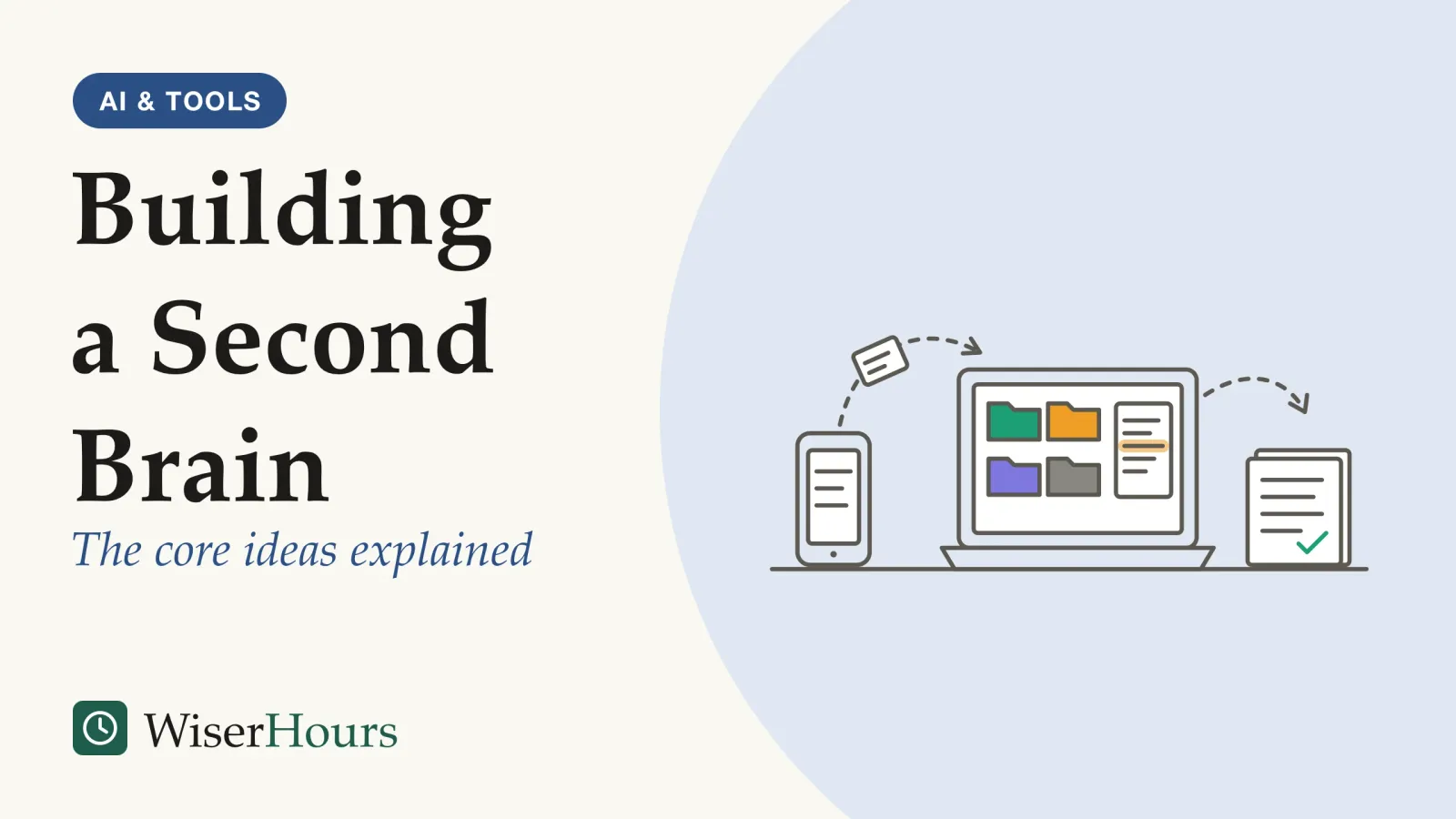
Building a second brain is Tiago Forte’s name for keeping what you learn in one trusted digital notes system and working it through four steps he calls CODE: capture, organize, distill and express. The aim, as he describes it, is to turn what you read and hear into finished work and to free your head from holding everything.1
No trial has tested the method itself, but research on external memory speaks to its central bet, and it adds a catch. In lab experiments published in 2021, people who leaned harder on an external store worked faster but remembered less of what they had stored; warning them about a memory test reduced that cost in some conditions, not all.2 In practice, that points to a lighter version of the method: put every commitment in the system, file by the project you are working on, let search find reference notes, and quiz yourself on anything you need to know.
Why notes help memory at all, and why reviewing them matters, is the subject of the guide to how notes help you learn and remember. Here the question is narrower: which parts of Forte’s system research supports, and which rest on his experience.
What building a second brain means, and where the idea comes from
Tiago Forte, who teaches the method through his books and paid courses, defines a second brain as an external, centralized, digital store for the things you learn and the sources they came from. He argues that offloading your thinking onto it frees your biological brain to imagine and create.1
The idea predates note-taking apps. In a 1998 paper, philosophers Andy Clark and David Chalmers described Otto, a man with Alzheimer’s disease who writes new information in a notebook and looks it up when he needs it, so that the notebook does for him what memory does for other people. They named what made the notebook count: it was a constant in his life, easy to consult, trusted without second-guessing, and filled with things he had once deliberately accepted.3
Those conditions explain why so many note collections never become anything like a second brain. Picture a team lead whose client decisions sit in a chat thread, a notes app and a paper pad. Everything is written down somewhere, yet before each call she asks a colleague, because checking her notes is slower and less certain than asking. Her notes are storage, not memory. Clark and Chalmers were making a philosophical argument, not reporting data, but their test is a useful one to hold any system to. The practical lesson: before adding more notes, make the one place you keep them quicker to search, and more trustworthy, than asking someone.
Four steps and four folders: how Forte’s method works
Forte’s method has two parts: a four-step routine for handling information (capture, organize, distill, express) and a four-folder filing scheme called PARA. He describes both on his company’s website.1
- 1Capturekeep only what resonates
- 2Organizefile by the project it will serve
- 3Distillbold and highlight the essence, in layers
- 4Expressturn notes into finished work
Capture means saving only what resonates with you, not everything you read; Forte asks readers to think like a curator. Express is the point of the whole exercise: using saved material to produce something, often by assembling small reusable pieces he calls intermediate packets, such as meeting notes or a list of research findings.1
Organize runs on PARA. Projects are short efforts with a goal; areas are ongoing responsibilities such as health or a team you manage; resources are topics you are interested in; archives hold anything from the other three that is no longer active. Forte’s rule is to file by actionability, meaning by the project you will use something for, not by its subject.4
Distill uses a technique Forte calls progressive summarization. Over repeated visits to a note, you bold its best passages, later highlight the best of the bold, and for the most useful notes write a short summary at the top. The goal he states is discoverability: a note your future self can grasp at a glance.5
An illustrative case: a manager planning an office move files the floor plan, the vendor quotes and her call notes in a project folder called “Office move”, not under “Real estate”. When the move is done, the folder goes to the archive. The practical lesson is one question at the moment of saving: which piece of work will I use this for?
Offloading to a second brain speeds you up but can cost memory
Relying on an external store trades memory for speed, according to a 2021 set of preregisteredpreregistration: Filing a study's hypotheses and analysis plan publicly before the data are collected or examined. It stops a planned test from being rewritten once the results are in, so a reader can tell a real confirmation from a hunt through the data.Full entry in the glossary experiments run at the University of Tübingen by Sandra Grinschgl, Frank Papenmeier and Hauke Meyerhoff: the more people relied on the external copy, the faster they worked and the less they later remembered of it.2
The study
Moderate evidence
Faster now, fuzzier later: three offloading experiments in Tübingen (2021)
Students rebuilt arrangements of everyday objects on a tablet and could look back at the model as often as they liked. When looking back was made slower, they offloaded less, worked more slowly, and later rebuilt the arrangements from memory more accurately. Across experiments, more offloading meant faster work and poorer memory. In the second experiment, people told about the memory test in advance offloaded less and remembered more; in the third, people made to offload fully but told about the test remembered almost as well as those who chose freely how much to offload.2
The authors’ reading is that the mental effort offloading frees up is not automatically spent on remembering; that takes an explicit goal to learn. They also describe the results of warning people about the test as more mixed: it helped in some conditions and not in others. The catch lies in the setting: one session of copying pictures in a lab, not months of reading and filing at work.
For a second brain, this cuts both ways. It supports Forte’s promise that a trusted store takes load off your head. It also warns that saving an article is not the same as knowing it. Picture clipping a long report on customer churn before a planning meeting: a week later you can find it in seconds, but in the meeting itself you may recall that you saved it and little of what it said.
Reminders for things you must do are the best-supported use
Handing future tasks to external reminders is highly effective in lab experiments, a 2023 review in Psychonomic Bulletin & Review by Sam Gilbert of the Institute of Cognitive Neuroscience in London and colleagues concluded. They call it intention offloading: using calendars, alerts and notes so that you remember to do something later.6
The same review found that people are not perfect judges of when to use reminders. In experiments that let them choose, younger adults leaned on reminders even when memory alone would have served them better, while older adults in one study were overconfident and did not fully make up for their weaker unaided recall.6 The authors add that a gap remains between these lab tasks and real-world use.
This is the part of capture with the firmest footing. A promise made in a meeting to send figures by Friday belongs in a system you check, with a date attached, the moment you make it. Writing a specific plan for a nagging task can also quiet it before you do it; the experiments behind that are described in a guide to getting organized from scratch. What this means for you: capture every commitment, but be pickier about ideas and articles, where the memory trade-off applies.
Further reading
Forte's own full account of CODE and PARA. Read it for the method; this article covers which parts research has tested.
As an Amazon Associate WiserHours earns from qualifying purchases.
Organizing by project: filing research gives mixed support
Research on how people refind their own email supports half of PARA’s logic. In a 2011 field study of email by Steve Whittaker and colleagues at IBM Research, people who filed heavily into folders were no more successful at finding old messages than people who filed little, and took slightly longer, because clicking through folders was slower than searching.7
The team logged how 345 people at IBM used an email client over about two months, and interviews showed why people built folders anyway: to keep the inbox clear as a to-do list, not mainly to find things later.7 The caveats are real. This was email, not notes; it was one company; and two months may be too short for habits to change. The authors also point to earlier studies in which better search did not stop people from browsing folders for their desktop files, and suggest email may differ because it is more structured and arrives in greater volume.
Read beside Forte’s advice, the finding fits better than it first appears. He tells readers not to agonize over where a note goes, because search will almost always find it.1 And like the email filers in the interviews, who filed mainly to manage their tasks, PARA organizes folders around the work in hand rather than around subjects.4 In everyday terms, typing a supplier’s name to find last spring’s contract is the search route; remembering which folder and subfolder you chose a year ago is the filing route, and in the email study the second was no more reliable. The lesson: keep a folder for each live project so the work in front of you is gathered in one place, and let search do the finding for reference material.
Distill and express: where the method runs ahead of the evidence
Progressive summarization is built from bolding and highlighting, and for learning, highlighting has a weak record. A 2013 review led by Kent State psychologist John Dunlosky, which graded ten study techniques, rated highlighting and underlining low utility: in most studies it did little to improve test performance, and it may even hurt on tests that ask you to draw inferences.8
That verdict does not settle Forte’s step, because he claims something different. His layers are meant to make notes easier to find and scan later, not to help you remember them.5 Nobody has measured whether they do. If your goal is to remember, that review gave practice testing, recalling material from memory, its top rating of high utility, which is why testing yourself instead of rereading belongs in any system where knowing matters.8
Express has even less research behind it. Forte presents the full sequence as a proven process, but the support his guide offers is experience, such as the more than a decade of personal experimentation and teaching he says lies behind PARA, not controlled studies.1 The closest research is descriptive: a small 2025 case study led by researchers at IBM Research Brazil interviewed seven computer scientists who keep notes in the app Obsidian and concluded that how they planned to retrieve notes influenced how they wrote and filed them. The study measured no outcomes such as output or recall.9 The practical reading: treat bold passages and summaries as signposts for your future self, not as study, and judge the express step by one test, whether finished work comes faster than it did before.
- Myth
- Building a second brain is a proven, research-backed method.
- Fact
- No controlled study has tested the method. Research supports some parts, such as external reminders, questions highlighting as a way to learn, and has not examined the rest.
How to try the method without overbuilding it
Start with the parts that have evidence behind them and keep the rest light. A reasonable first month uses one notes app, one folder per live project and search for everything else, while treating distill and express as experiments you judge by whether they help you finish work.
An illustrative start: a consultant sets up four top-level folders, creates one project folder for each client report due this quarter, and routes every promise from meetings into a dated list. She saves articles only when she can name the report they will feed. When a report ships, its folder moves to the archive, and she reuses its outline for the next one.
Watch for one warning sign: time spent reorganizing folders or reformatting notes while nothing ships. Forte himself calls much of what passes for organizing a form of procrastination.4
How much research sits behind each step
External reminders have the strongest support of any part of a second brain, since a 2023 review of lab experiments judged them highly effective; the memory cost of offloading is documented in lab experiments; search-first finding has support from one field study; and the distill and express steps rest mainly on Forte’s experience.6
| Part of the method | What the best evidence found | Evidence |
|---|---|---|
| Capturing commitments and reminders | Intention offloading highly effective; people’s choices about when to set reminders are often not optimal | Narrative review of lab experiments, moderate6 |
| Capturing reference material | Offloading sped up a lab task but weakened memory for the offloaded items; a test warning reduced the cost in some conditions | Randomized lab experiments, moderate2 |
| Filing into folders instead of searching | Heavy email filers found messages no more often than light filers; people filed mainly to keep the inbox clear as a to-do list | One field study at one company, limited7 |
| Distilling by bolding and highlighting | Highlighting rated low utility for learning; effect on finding notes untested | Expert review of trials, limited8 |
| The method as a whole | No controlled study; one small interview study describes users | Small interview study, gap9 |
supportedsupported, with a catchuntested, or weak for this purpose
- Capture: reminders for things you must do are well supported; saving reference material speeds work but can leave you remembering less of it
- Organize: in one email study, heavy filers found messages no more often than light filers; people filed mainly to keep the inbox clear as a to-do list
- Distill: highlighting rated low for learning; whether layered highlights help you find notes later is untested
- Express: no study has tested it, or the method as a whole
The bottom line
A second brain is a sound idea in its narrow form: put commitments in a system you trust, file by the work in front of you, and let search find the rest. Its broader promise, that layered notes will turn into better output, is Forte’s experience rather than a tested result. Save less than you think you should, and for anything you need to carry in your own head, quiz yourself on it rather than trusting the saved copy.
Frequently asked questions
Where does the term second brain come from?
The phrase is tied to Tiago Forte, whose book Building a Second Brain is the source a 2025 case study cites for it; he also teaches the method in paid courses. The idea is older. That study notes that research on personal knowledge bases often draws on Vannevar Bush's memex, a hypothetical personal information store proposed in a 1945 essay, and in 1998 philosophers Andy Clark and David Chalmers argued that a notebook can work as part of memory.
Can a second brain be on paper?
Forte defines a second brain as digital, and his advice leans on search to find notes again. The underlying idea does not require software, though. In Andy Clark and David Chalmers' 1998 paper, the example of an external memory is a paper notebook that its owner carries everywhere, consults by habit and trusts. Those habits matter more than the medium.
Should you save everything you read?
Forte advises against it. His introductory guide tells readers to capture only the most important information, to think like a curator and to keep what resonates with them rather than analyzing every item. Lab research on offloading adds a reason to be choosy: what you hand to a store, you tend to remember less well yourself, so a note is not a substitute for learning something you will need in your head.
Sources
- Building a Second Brain: The Definitive Introductory Guide. Forte, T. (2023). Forte Labs
- Consequences of cognitive offloading: Boosting performance but diminishing memory. Grinschgl, S., Papenmeier, F. & Meyerhoff, H. S. (2021). Quarterly Journal of Experimental Psychology, 74(9)
- The Extended Mind. Clark, A. & Chalmers, D. (1998). Analysis, 58(1)
- The PARA Method: The Simple System for Organizing Your Digital Life in Seconds. Forte, T. (2023, updated 2026). Forte Labs
- Progressive Summarization: A Practical Technique for Designing Discoverable Notes. Forte, T. (2017, updated 2023). Forte Labs
- Outsourcing Memory to External Tools: A Review of 'Intention Offloading'. Gilbert, S. J., Boldt, A., Sachdeva, C., Scarampi, C. & Tsai, P.-C. (2023). Psychonomic Bulletin & Review, 30(1)
- Am I wasting my time organizing email? A study of email refinding. Whittaker, S., Matthews, T., Cerruti, J., Badenes, H. & Tang, J. (2011). Proceedings of CHI 2011
- Improving Students' Learning With Effective Learning Techniques: Promising Directions From Cognitive and Educational Psychology. Dunlosky, J., Rawson, K. A., Marsh, E. J., Nathan, M. J. & Willingham, D. T. (2013). Psychological Science in the Public Interest, 14(1)
- How People Manage Knowledge in their "Second Brains": A Case Study with Industry Researchers Using Obsidian. Ferreira, J. J., Segura, V., Souza, J. G. & Brasil, J. H. G. (2025). arXiv preprint; short version in Human-Computer Interaction, INTERACT 2025, Lecture Notes in Computer Science
How we researched this
We read Tiago Forte's own descriptions of the method on his company's website, then searched PubMed, Europe PMC, Crossref, Semantic Scholar and the web in September 2026 for experiments, reviews and field studies on cognitive offloading, reminders, personal information management and highlighting. Sources date from 1998 to 2025; most were read in full. Main limitation: no study has tested the second brain method itself, so every link from research to the method is indirect.
Keep reading
How to Take Notes From Books So You Remember What You Read
How to take notes from a book: a 2022 review of 36 articles found highlighting did little for understanding. Recall each chapter from memory instead.

Best Note-Taking Apps Compared: How to Choose
The best note taking apps compared as 6 types, from phone notes to Markdown files: choose by how you capture, how you refind and how your notes can leave.
The Zettelkasten Method Explained: A Beginner's Guide
The Zettelkasten method explained: the 4 parts of Niklas Luhmann's slip-box, what note apps changed, and what research does and does not support.
The Cornell Note-Taking Method: How It Works and When to Use It
The Cornell note-taking method splits a page into 3 areas and adds 5 steps. Research backs its self-testing step far more than the layout itself.