The Zettelkasten Method Explained: A Beginner's Guide
The Zettelkasten method explained: the 4 parts of Niklas Luhmann's slip-box, what note apps changed, and what research does and does not support.

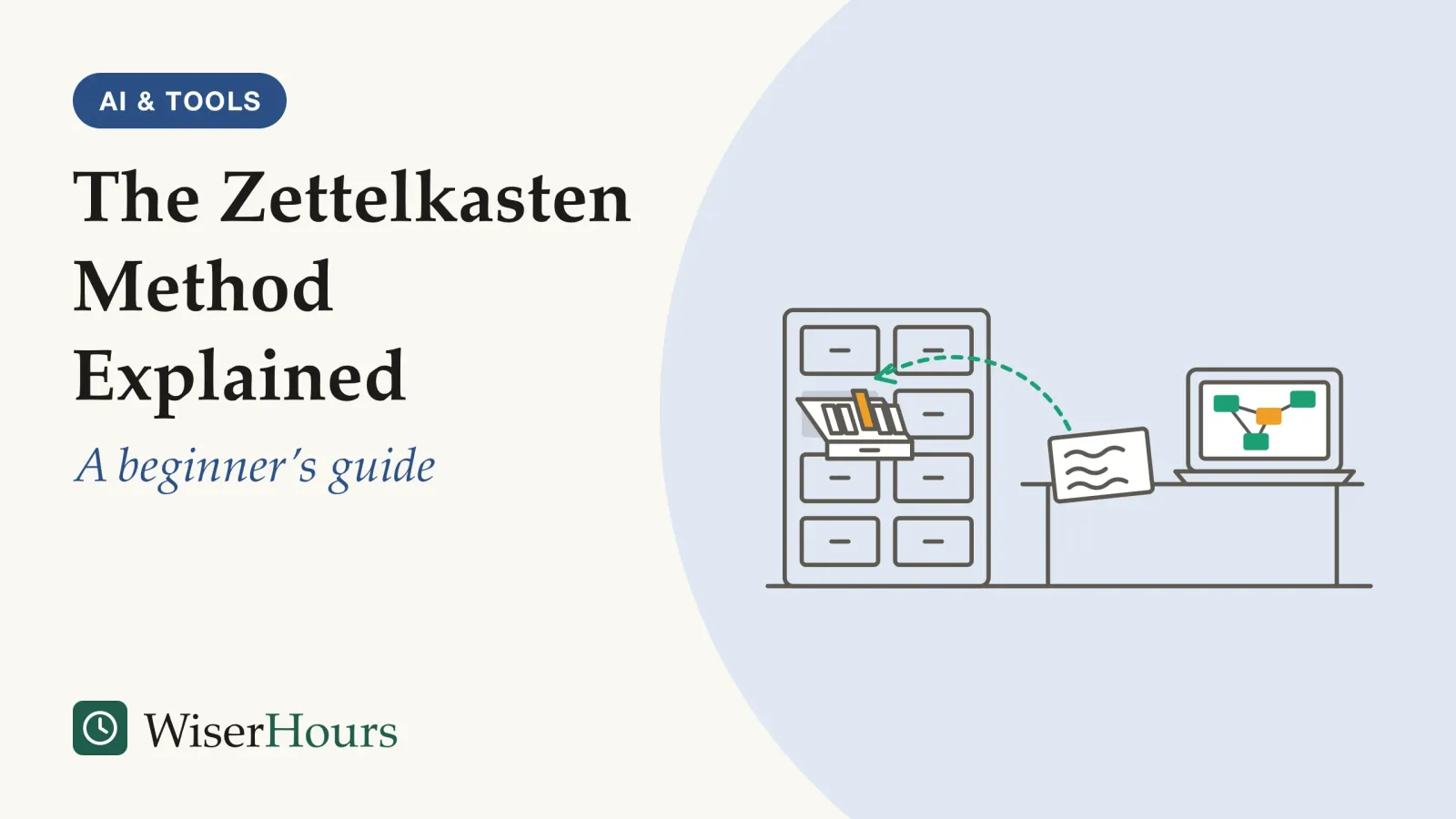
For more than four decades from the early 1950s, the German sociologist Niklas Luhmann kept his reading notes and his own ideas on small cards. Each card got a permanent number, went behind the card it most related to, and carried the numbers of related cards elsewhere in the cabinet.1 That cabinet, now held by Bielefeld University, is the original zettelkasten, German for “slip box”.2
The Zettelkasten method is a way of keeping notes as a network: one idea per note, written in your own words, with a fixed address and links to related notes, so that ideas meet and combine when you write. In practice it asks one thing of you each time you read something worth keeping: rewrite a single idea as a short note, file it beside the note it most relates to, and write down why the two belong together.
Nobody has run a controlled trial of the Zettelkasten method as a complete system; its best evidence is a single documented case, Luhmann’s own card index, described in 2018 by Johannes Schmidt of the Bielefeld team editing it, plus research on individual steps such as explaining ideas in your own words.1
What a zettelkasten is, and why it is not a folder of notes
A zettelkasten is a personal collection of short notes, each holding one idea, each with a unique address, and linked to one another so you can follow a line of thought from note to note. Sascha Fast of zettelkasten.de, a site that sells a notes app and coaching built around the method, describes it as a tool for thinking and writing that puts connection before collection.3
The difference lies in the unit. A folder or notebook stores sources and topics: everything from one book, everything about pricing. A zettelkasten stores ideas, so one book may produce ten notes that end up in ten different places, each beside an idea it speaks to. Over time the links, not the folders, carry the structure.
Picture an analyst reading a report on customer churn. In a folder system, her notes go under “Churn”. In a zettelkasten, she writes one note in her own words, that customers who never finish setting up tend to leave early, and links it to an older note, taken from a book on habits, about the first week of any new routine. Months later, drafting a memo on onboarding, she reaches either note from the other.
The same point separates the method from Tiago Forte’s approach to building a second brain, which files material by the project it will serve. A second brain is organized for finishing projects; a zettelkasten is organized for developing ideas over years. What this means for you: choose the method for work where your own thinking is the product, such as research, writing, strategy or teaching. If you mostly need documents for the job at hand, the simpler systems in note-taking and knowledge management will serve you better.
Inside Luhmann’s cabinet: fixed numbers, branches and cross-references
Luhmann’s card index ran on four devices, according to Johannes Schmidt, who coordinates Bielefeld University’s project to edit Luhmann’s papers: a fixed number for every card, a way to insert new cards beside related ones, cross-references between cards, and a keyword index. In the evening Luhmann rewrote the day’s rough reading notes as new cards, and he read with one question in mind: how could this book connect to the cards he already had? Where a new card went was decided as he wrote it, and there was usually more than one sensible place.1
Placement worked by branching. A card that pursued a side idea from an earlier card took that card’s number plus a letter or digit and was filed right behind it, so a line of thought could split and grow inward without a master scheme of categories. When a card belonged in two places, he filed it in one and added references to the others. The index listed only a few entry points for each term; from there, the references led on.1
- Branching numbers: a card that follows up a side idea gets a letter or number added to its parent’s, so it can be filed right behind it; the numbers never change
- Cross-references: a card can point to any other card by its number, often one far away on a different subject
- Keyword index: lists only a few entry points per term; from there, you follow the references
Schmidt’s account is the closest thing the method has to a study of how it worked in practice.
The study
Limited evidence
Ninety thousand cards and one weak spot: Schmidt's account of the Luhmann archive
Estimating from a sample count, Schmidt finds a cross-reference on nearly every card of the first collection and on nearly every second card of the second. He also names the system’s weak spot: a card or small section that no reference reaches gets lost in the mass, and some parts of the cabinet seem untouched since they were written.1
Luhmann’s output is the method’s main advertisement: the Bielefeld archive counts nearly 600 publications, including more than 40 books.2 But a description of one person’s cabinet cannot show that the cabinet caused the output. Nobody can rerun his career without it, and Schmidt adds that tending the file took up a great deal of Luhmann’s time.1
The practical lesson comes from the weak spot, not the success. A note that nothing links to is as good as lost, so every new note needs at least one reference to an older note, or an entry in an index, before you put it away. In an app, that can be a single link typed before you close the note.
How to add a note to a zettelkasten, step by step
Adding a note to a zettelkasten is a short loop: read with a question, jot rough notes, rewrite one idea as a note in your own words, file it beside its closest relative, and link it. Most of the steps come from Luhmann’s practice as Schmidt describes it.1
- 1Read with a questionwhat could this add to the notes I have?
- 2Jot rough notesquick phrases while reading
- 3Rewrite one idea per notein your own words, the same day
- 4File itbeside the note it most relates to
- 5Link itand write down why the link is there
- 6Index itonly if it starts a new line of thought
The rewrite is where the thinking happens. Copying a sentence takes no decision; restating it forces you to decide what the author claims, and whether you agree. Luhmann put the principle on one of his own cards:
Underlying the filing technique is the experience that without writing, there is no thinking.
Modern guides add a rule for links: write a sentence saying why two notes are connected, because a bare link gives your future self no reason to follow it.3
An illustrative case: a product manager reads an essay arguing that long free trials let customers put off deciding to buy. While reading she jots a phrase in the margin. That evening she writes one note in her own words, links it to an older note on deadlines with the line “same mechanism: a deadline forces a choice”, and files it behind that note. The lesson: budget time for the rewrite, ideally the same day, as Luhmann did each evening. A zettelkasten fed with copied highlights is a folder with extra steps.
Further reading
The book that popularized the slip-box: Ahrens on writing one idea per note in your own words and linking it, the loop this article describes.
As an Amazon Associate WiserHours earns from qualifying purchases.
From card drawers to apps: what modern versions keep
Digital versions keep Luhmann’s short notes, fixed addresses and links, and swap the drawers for software in which following a link takes a click. Schmidt points out that the paper design held the system back, since every lookup meant finding and pulling out a physical card.1
The modern revival owes much to Sönke Ahrens’s book How to Take Smart Notes, which, his website says, popularized the idea; he wrote it with students, academics and nonfiction writers in mind, and now sells a course on running a zettelkasten in the app Obsidian.4 zettelkasten.de recommends a unique ID for each note, such as a timestamp, so a title can change without breaking links; one idea per note, which it calls the principle of atomicity; and “structure notes” that list and order other notes, much as Luhmann’s hub cards did.3
Apps also change what is easy. Search can find any word, so an index matters less, and backlinks and graph views can draw the network for you. Something can be lost too. Luhmann’s register was a short list of entry points into the biggest clusters of notes, not a tag on every card, and he relied on links to go further.3 Tagging everything recreates the folder problem under another name.
The practical test for software is simple: can every note keep a permanent address, and can you move your notes to another app later? zettelkasten.de favors setups that work in any plain text editor for that reason.3 The finer points, such as named note types, maps of content and graph views, can wait until the basic loop is a habit.
Does the Zettelkasten method work? What research can and cannot say
Searches of PubMed, ERIC and Crossref in September 2026 found no controlled trial of the Zettelkasten method as a system. What exists is Luhmann’s case and research on single steps, which at least shows which parts of the routine to take most seriously.
The rewrite step has the most direct support. A 2013 review of study techniques, led by the Kent State psychologist John Dunlosky, rated self-explanation and elaborative interrogation, two ways of explaining new material and connecting it with prior knowledge, as moderate utility: promising, but not yet well tested in real classrooms.5 Explaining an idea in plain words is also the core of the Feynman technique. For a note-taker, the minutes spent restating an idea are the step with the closest match in the research.
Linking has indirect support. A 2018 meta-analysismeta-analysis: A study that combines the results of earlier studies on the same question into one overall estimate. Pooling makes the estimate more precise, but it cannot repair the studies it pools: a meta-analysis of surveys is still survey evidence.Full entry in the glossary by Noah Schroeder and colleagues pooled studies of concept maps, diagrams in which each link names how two ideas relate. Learning with concept maps was linked to moderately better results than comparison activities, across school levels and subjects, and building maps was linked to a larger benefit than studying ready-made ones.6 The participants were students and a zettelkasten is not a diagram, so the fit is loose, but the pattern agrees with the method’s advice to make the links yourself.
Linking is not the same as remembering, though. In a 2011 paper in Science, Karpicke and Blunt reported that students who practiced recalling texts like those used in science classes showed greater gains in learning than students who built concept maps of them, even when the final test asked for a concept map.7 Other researchers questioned the study’s methods and reasoning in a published comment.8
- Myth
- Luhmann's output proves the Zettelkasten method works.
- Fact
- Luhmann's case shows the method can work for one committed scholar. No controlled study of it exists, and one career cannot separate the tool from the person.
Taken together, the rewriting and linking steps are reasonable ways to understand material, with moderate support, but a slip-box is a thinking tool rather than a memory aid. The memory side of notes, including why going back over them pays, is the subject of why taking notes helps you remember. For anything you must recall on demand, quiz yourself from your notes with retrieval practice and spaced reviews.
| Slip-box element | What the best evidence found | Evidence |
|---|---|---|
| Complete system | No controlled trial found in searches of PubMed, ERIC and Crossref (September 2026) | Gap |
| Luhmann’s own slip-box | Supported decades of theory-building for one scholar; poorly linked cards got lost | Single documented case (anecdote)1 |
| Rewriting ideas in your own words | Self-explanation and elaborative interrogation rated moderate utility | Expert review of trials, moderate5 |
| Linking ideas | Building concept maps linked to more learning than comparison activities (142 effect sizes) | Meta-analysis, moderate; students6 |
| Linking versus recall | Recall practice showed greater gains than concept mapping in two experiments with undergraduates; a published comment questioned the methods | One paper, contested7 |
Who gains from a slip-box, and what it costs
A zettelkasten is designed for people who write or build arguments over months and years, and it costs steady upkeep: Schmidt reports that tending the file took up much of Luhmann’s time, and that he kept revising old cards by adding references as new ones arrived. The payoff is slow because a network’s value grows with its links. Schmidt describes Luhmann’s cabinet leading to connections that surprised even the man who had written the cards, but it had decades of linked cards behind it.1 zettelkasten.de warns beginners that at first they will feel they are doing nothing useful.3
The other risk is drift. Schmidt notes that following references through the file without a specific question and a deadline risks getting lost in it.1 A consultant who writes a monthly newsletter for clients fits the method well, because each issue can start from a cluster of linked notes and a clear question. A project manager who needs meeting records and contracts on demand is better served by project folders and search.
The bottom line
Start with one idea per note, in your own words, filed beside its closest relative and linked with a stated reason. Luhmann’s cabinet shows how far that can carry one scholar over a career, but it is a single case, and no controlled trial has isolated what the method adds. Use a slip-box to think and draft, quiz yourself separately on what you must remember, and never file a note that no other note can reach.
Frequently asked questions
What does zettelkasten mean?
Zettelkasten is German for slip box or card index: a Zettel is a slip of paper. The tool is old. Johannes Schmidt of Bielefeld University notes that card indexing grew out of early modern scholarship, as the number of available books rose from the sixteenth century on, so Luhmann refined an existing technique rather than inventing one.
Can you keep a zettelkasten on paper?
Yes. Luhmann's was entirely paper: handwritten cards in a cabinet of drawers. Paper works if every card gets a permanent number, references are written as card numbers and an index lists entry points. The cost is speed: Johannes Schmidt notes that each lookup meant physically finding and pulling out a card, which software reduces to a click.
Should you use tags in a zettelkasten?
Tags are optional. Luhmann did not tag his cards; according to zettelkasten.de, his register was a short list of entry points into the main clusters of notes, not a tag system, and from there he followed links. In an app, a few tags or a note that lists related notes can do the same job, as long as they mark entry points rather than label everything.
Is the Zettelkasten method only for academics?
No, although most of its keenest users write for a living. Sönke Ahrens's How to Take Smart Notes, the book that popularized it, was written with students, academics and nonfiction writers in mind, according to his website. It suits any work in which your own ideas are the product, such as strategy, policy or teaching, and suits less well work that mostly needs documents on demand.
Sources
- Niklas Luhmann's Card Index: The Fabrication of Serendipity. Schmidt, J. F. K. (2018). Sociologica, 12(1)
- Niklas-Luhmann-Archiv: Forschungsprojekt "Niklas Luhmann – Theorie als Passion". Bielefeld University, Faculty of Sociology (accessed 2026)
- Introduction to the Zettelkasten Method. Fast, S. (2020). zettelkasten.de
- How to Take Smart Notes (book and course homepage). Ahrens, S. (accessed 2026). takesmartnotes.com
- Improving Students' Learning With Effective Learning Techniques: Promising Directions From Cognitive and Educational Psychology. Dunlosky, J., Rawson, K. A., Marsh, E. J., Nathan, M. J. & Willingham, D. T. (2013). Psychological Science in the Public Interest, 14(1)
- Studying and Constructing Concept Maps: a Meta-Analysis. Schroeder, N. L., Nesbit, J. C., Anguiano, C. J. & Adesope, O. O. (2018). Educational Psychology Review, 30(2)
- Retrieval Practice Produces More Learning than Elaborative Studying with Concept Mapping. Karpicke, J. D. & Blunt, J. R. (2011). Science, 331(6018)
- Comment on "Retrieval practice produces more learning than elaborative studying with concept mapping". Mintzes, J. J., Cañas, A., Coffey, J., et al. (2011). Science, 334(6055)
How we researched this
The history rests on Johannes Schmidt's 2018 account of Niklas Luhmann's card index and Bielefeld University's Luhmann archive pages; practice rests on two practitioner guides. For evidence, a September 2026 search of PubMed, ERIC, Crossref and general web results looked for any study of the Zettelkasten method, and for reviews and experiments on its parts. The papers used were published between 2011 and 2018; only the abstract of a published comment in Science was available. Main limitation: there is no controlled study of the whole system.
Keep reading

How to Take Notes From Books So You Remember What You Read
How to take notes from a book: a 2022 review of 36 articles found highlighting did little for understanding. Recall each chapter from memory instead.

Best Note-Taking Apps Compared: How to Choose
The best note taking apps compared as 6 types, from phone notes to Markdown files: choose by how you capture, how you refind and how your notes can leave.
Building a Second Brain: The Core Ideas Explained
Building a second brain rests on 4 steps: capture, organize, distill, express. Here is Tiago Forte's method and what memory research backs.
The Cornell Note-Taking Method: How It Works and When to Use It
The Cornell note-taking method splits a page into 3 areas and adds 5 steps. Research backs its self-testing step far more than the layout itself.