How to Run a Kaizen Event: A Five-Day Format
How to run a kaizen event: two to four weeks of preparation, a five-day agenda for a team of 6 to 12, and the 30-day follow-up that decides if gains last.

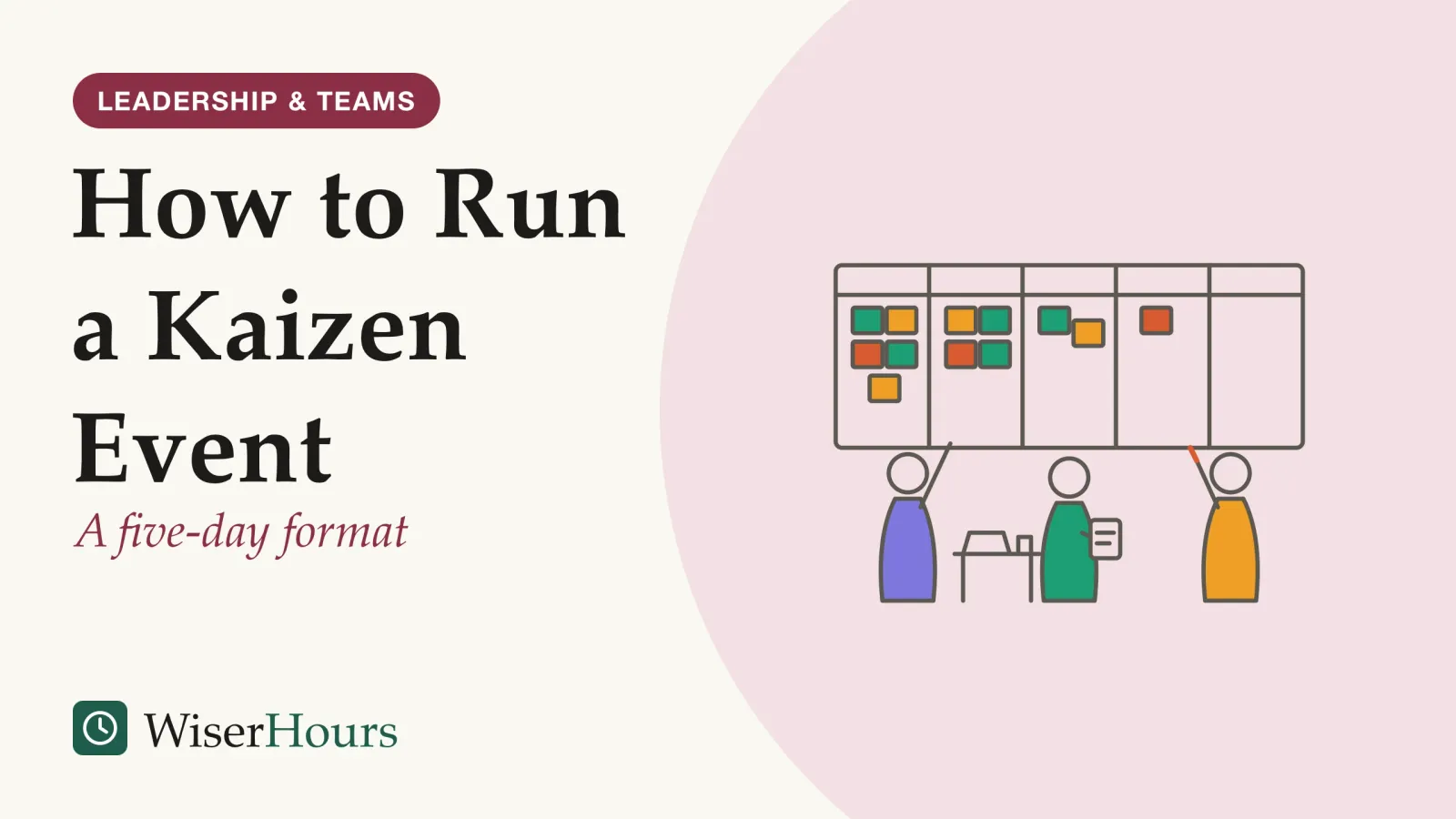
Five days in a meeting room get the attention, but the research on kaizen events often points to the weeks around them, from the planning weeks beforehand to the checks that follow. A kaizen event, also called a kaizen blitz or rapid improvement event, gives a small team one week to study and fix one process. In a Virginia Tech study of 65 events at eight manufacturing organizations, about half had kept their end-of-event results when researchers checked 9 to 18 months later.1 A team lead who wants to be in the better half works through seven stages:
- Prepare for two to four weeks
- Day 1: train the team and frame the problem
- Day 2: observe the work and map it
- Day 3: design changes and try them
- Day 4: implement and test
- Day 5: standardize and report out
- Follow up for 30 days
What is a kaizen event?
A kaizen event is a short, structured improvement project in which a dedicated team works on one process for a fixed number of days, usually five, toward goals set in advance. The Lean Enterprise Institute (LEI), a US non-profit, describes it as a group activity, commonly five days long, in which a team identifies and implements a significant improvement in a process.2
Hospitals often call the same format a rapid improvement event or rapid process improvement workshop, a 2025 systematic reviewsystematic review: A review that fixes its question and its rules for including studies in advance, then searches out every study that fits and weighs them together. Some systematic reviews pool the results into a meta-analysis; others describe what the studies found without combining the numbers.Full entry in the glossary of hospital research notes.3 Whatever the name, a cross-functional team leaves its normal work for the whole event, the scope is one process or part of one, and there is little or no budget for new equipment. Jennifer Farris, reviewing the practitioner literature for her 2006 Virginia Tech study, describes why the mix matters: varied members bring more knowledge to the problem, and those from the work area gain ownership of the result. She also notes the action orientation: many improvement projects end with recommendations, while an event is expected to make the change.4
A support team’s refund process, invented here for illustration, fits the format. Refunds have a clear start (the customer asks), a clear end (the money arrives) and a number everyone can count. “Improve customer service” does not fit. If you cannot write where the process starts and stops on one sticky note, the scope is too wide for a week. Starting with one recurring problem is also how process improvement in general works best.
The word itself is broader than the event. Kaizen is Japanese for improvement, with no built-in sense of “continuous” in everyday use; Masaaki Imai made the term famous with his 1986 book on Japan’s competitive success.5 In Lean, kaizen usually means small improvements made every day by the people doing the work, a habit big enough to need its own explanation.6 An event is one concentrated burst of it.
How to run a kaizen event, day by day
A five-day kaizen event runs the plan-do-check-act cycle at speed: plan in the preparation weeks, change the work during the event, then check and act in the follow-up. LEI’s outline of an event has the same arc: the team learns the principles, goes to see the work, makes and tests the change, then standardizes it and reports out to senior management.2 A Finnish hospital system organized its events in the same three stages of preparation, event and follow-up.7
1. Prepare for two to four weeks
Preparation fixes the scope, the sponsor, the team and the baseline before anyone books the room. At Finland’s largest hospital system, it meant choosing a mixed team, setting targets and measures, agreeing a timetable and studying the problem, the process and the data behind it.7
In Farris’s study of 51 event teams at six manufacturers, more hours of planning went with a larger share of goals met, and management support was among the most common predictors of good outcomes. Practitioner advice on team size runs from three people to 15, with 6 to 10 and 10 to 12 the ranges most often recommended; several sources suggest about half the team should come from the work area, and many advise adding “fresh eyes” from outside it.4
The sponsor is a manager who can approve changes, opens the event, attends the report-out and clears blockers in between. For the refund example, the team could be three support agents, the finance clerk who approves refunds, the team lead, the person who looks after the refund screen, someone from the returns warehouse and one outsider from sales. For the baseline, they log every refund for two weeks, with the date it was requested and the date it was paid.
The one-page charter
Write down where the process starts and ends, the goal, the one measure, the sponsor, the team, and what is out of bounds, such as buying new software. Add one line saying what will happen to any time the changes free up.
2. Day 1: train the team and frame the problem
The first day turns a group of colleagues into a team with one shared goal: half a day learning the tools of the week, then an afternoon on the charter and the baseline. Training comes first because many members will never have mapped a process or hunted for waste, and a shared vocabulary saves hours of argument later.
The sponsor opens by explaining why this process matters. Practitioner guides add rules for the week: avoid preconceived solutions, ask why each step happens as it does, and let the data decide.4 Close the day with the goal written on the wall and a “parking lot” sheet for problems outside the scope.
3. Day 2: observe the work and map it
Day 2 is spent where the work happens, watching real cases and drawing the process as it runs. LEI calls that place the gemba. Watching real cases shows the workarounds and waits that a written procedure leaves out. Managers who make this visit a regular habit call it a gemba walk, which is a separate subject.
A current-state value stream map is the usual tool. The refund team might follow three real requests from inbox to payment and find that each one sits in a shared inbox until someone claims it, then waits for a finance approval batch that runs twice a week. Map what you saw rather than what the procedure says, and write down how long each item waited at every step.
4. Day 3: design changes and try them
Day 3 moves from the problem to rough, testable changes. At the Finnish hospitals, the event week included brainstorming ideas, then testing and improving the best of them before putting them in place.7
Try ideas as cheap mock-ups the same day: a changed form, a new column in a spreadsheet, a marked-out shelf. With little or no budget, the best ideas usually remove a step, a wait or a handoff; ask why each wait exists before deciding how to remove it, a habit that root cause analysis makes systematic.
The refund team might let agents approve small refunds without finance sign-off, on that afternoon’s requests only. Write a prediction before each test, such as “these refunds will be paid within a day”, so the result can prove you wrong.
5. Day 4: implement and test
Day 4 puts the chosen changes into normal work and fixes what breaks. An office team switches the whole process to the new way for a day, then records the same measure as the baseline. Expect problems, such as a permission nobody has or a report that still expects the old step, and fix them while the team is together. Anything that cannot be finished by Day 5 goes on a 30-day action list with an owner, a practice many practitioner guides recommend.4
Treat the day’s numbers with care. Results reported at the end of an event can overstate what the process will do in ordinary weeks, earlier research cited in Wiljeana Glover’s study notes, partly because ordinary work runs at a sustainable pace with staff of mixed skill.1 Note the figure, and plan to measure again later.
6. Day 5: standardize and report out
The last day writes the new method down and hands it to the people who will run it. LEI quotes Taiichi Ohno, the creator of the Toyota Production System, saying that there can be no kaizen without a standard: the written method becomes the baseline for the next improvement.6 Use short, numbered steps, as in how to write an SOP people use; standard work, Lean’s stricter version, is a topic in itself.
The report-out hands the new method to its owners. In 20 minutes, show the before-and-after measure, what changed, what is still open on the action list and who owns each item. Ask the sponsor to put the follow-up dates in their calendar before leaving the room.
7. Follow up for 30 days
In the follow-up month the new method either becomes normal work or fades. At the Finnish hospital system, the most intensive follow-up lasted about one to three months, with new procedures stabilized, to-do lists worked through, managers helping with changes and regular follow-up meetings.7
The new way is fragile at first: old habits return under pressure, and nobody owns the open items once the room is cleared. Glover found that results were more likely to last in work areas whose staff learn from one another and share responsibility for the area, and, in an extra analysis of survey ratings, that events were judged more successful later where managers and staff had accepted the new methods and kept to them.1 A simple rhythm keeps that work visible.
- Day 7First check: open actions, first week of data
- Day 14Is the written method the one in use?
- Day 21Remove whatever keeps pulling people back
- Day 30Result to the sponsor; book the next look
- Month 3Measure again in ordinary weeks
A printable agenda for the whole event
Print this list or tick it off on screen. Each line is one stage and the output it should leave behind.
Kaizen event agenda
What decides whether the gains last
Two things go with kaizen results that last, according to a 2023 study of 26 events at Finland’s largest hospital system: steady follow-up after the event, and a work culture in which staff are motivated to keep improving. The hospital system ran the events between 2017 and 2020.7
The study
Limited evidence
Units that kept their gains rated their follow-up twice as highly: 26 Finnish hospital events, 2023
Researchers interviewed 21 of 26 units and read their reports and measures. Counting the five units that did not respond as unsuccessful, about half the units kept their improvements. Units that kept their results rated their own follow-up about twice as highly as units that did not. Lack of time and high workload stood out as the main reasons for decline.7
The study looks back at one organization, relies mainly on interviews with chief physicians and the units’ own ratings, and was paid for by the hospital system that ran the events.7 It cannot show that better follow-up caused better results; units that were already well run may simply have done both well.
- Preparation, two to four weeks: scope, sponsor, a team of about 6 to 12, and a baseline measure
- The event, five days: train, observe, design, implement, standardize and report out
- Follow-up, 30 days and more: weekly checks, the open action list and the measure in ordinary weeks
Glover’s predictors left about three quarters of the variation in lasting results unexplained, so much of what decides the outcome is still unmeasured.1 The same study found, unexpectedly, that more event planning and more post-event review went with results lasting less often, which Glover put down partly to how results were measured.1 In hospitals, the 2025 review notes, published reports range from clear benefits to modest gains or even negative results.3 For the refund team, that means checking on each Friday of the follow-up month that agents still approve small refunds themselves and that the twice-weekly finance batch has not crept back.
| Practice | What the best evidence found | Evidence |
|---|---|---|
| Plan the event properly, with visible management support | More planning hours went with more goals met; management support was a frequent predictor of good outcomes | Observational field study of manufacturers, limited4 |
| Follow up for weeks after the event | Follow-up was the clearest difference between units that kept their results and units that did not | Retrospective case series in one hospital system, limited7 |
| Run events where staff learn from one another | Work areas whose staff learn together and share responsibility kept results more often | Observational field study of manufacturers, limited1 |
If the answer is no, free that time first or pick a different process.
Kaizen events should not cost anyone their job
A kaizen event depends on the people who do the work showing the team where time is wasted, and they will not do that if they expect the savings to come out of their own jobs. A “no layoffs” policy is one of the conditions most often recommended in the practitioner literature that Farris reviewed.4
- Myth
- A kaizen event is a quick way to find headcount to cut.
- Fact
- Practitioner guides widely recommend promising no layoffs, because the event depends on staff openly showing where time is wasted.
The charter line about freed time makes that promise concrete: the refund team’s saved hours could go to the complaint backlog or to the next improvement. LEI lists the usual ways events go wrong: counting events instead of results such as safety, cost, quality and delivery; gains lost as people slip back to the old way; and leaving frontline workers out while specialist engineers lead. Its broader warning is that leaders should not rely on events alone, because steady daily kaizen builds frontline problem-solving skill.6
The bottom line
Plan a kaizen event around its follow-up as carefully as its five days. Before you book the room, name a sponsor, choose one process with a clear start and end, and log two weeks of baseline data. Before the team leaves on Day 5, put the four follow-up checks in everyone’s calendar.
Frequently asked questions
How long is a kaizen event?
The working session usually lasts five days, and the Lean Enterprise Institute describes five days as the common length. A review of practitioner sources by Virginia Tech researcher Jennifer Farris found most events run three to five days, with some shorter one- or two-day sessions. Add a few weeks of preparation before and at least a month of follow-up after.
What is the difference between kaizen and a kaizen event?
Kaizen is the Japanese word for improvement and, in Lean, the habit of making small improvements every day. A kaizen event is one structured project: a dedicated team working on one process for a few days. The Lean Enterprise Institute treats events as useful but warns leaders against relying on them in place of daily kaizen.
Can a kaizen event work in an office or a hospital?
Yes. The format began in factories, but hospitals use it widely under names such as rapid improvement event, according to a 2025 review of 64 hospital papers. Results there are mixed. Office processes such as approvals, refunds or onboarding suit it when the process has a clear start, a clear end and a measure the team can count.
How many kaizen events should a company run?
Fewer than many do. In Jennifer Farris's 2006 study of six manufacturers, most ran three or more events per facilitator each month. She suggested one or two per facilitator per month, so each event gets proper planning and follow-up. A small team running its first event should finish the 30-day follow-up before starting another.
Sources
- Critical Success Factors for Sustaining Kaizen Event Outcomes. Glover, W. J. (2010). Doctoral dissertation, Virginia Polytechnic Institute and State University
- Kaizen Workshop. Lean Enterprise Institute, Lean Lexicon (accessed 2026-10-24)
- An exploration of Kaizen events in hospitals using a systematic literature review and bibliometric analysis. Harry, K. D., Van Aken, E. M. & Glover, W. J. (2025). Management Decision
- An Empirical Investigation of Kaizen Event Effectiveness: Outcomes and Critical Success Factors. Farris, J. A. (2006). Doctoral dissertation, Virginia Polytechnic Institute and State University
- Kaizen. Wikipedia (accessed 2026-10-24)
- Kaizen: A Resource Guide. Lean Enterprise Institute, Lean Lexicon (accessed 2026-10-24)
- Sustainability of performance improvements after 26 Kaizen events in a large academic hospital system: a mixed methods study. Haapatalo, E., Reponen, E. & Torkki, P. (2023). BMJ Open, 13(8), e071743
How we researched this
We read the Lean Enterprise Institute's lexicon entries, Wikipedia's kaizen entry and the iSixSigma guide, then searched Crossref, OpenAlex and Europe PMC in October 2026 for studies of kaizen event results and sustainability. Sources date from 2006 to 2025. Main limitation: the studies are field studies and case series without control groups, mostly in manufacturing and hospitals; the Farris and Glover journal papers were not opened, so their dissertations were read instead.
Keep reading
Value-Stream Mapping: A Step-by-Step Guide With a Worked Example
Value stream mapping in 7 steps, worked through on an invoice-approval example, plus what reviews find and the step most published maps skip.
Statistical Process Control (SPC) for Non-Statisticians
Statistical process control for managers: common and special causes, a run chart, then an XmR chart with limits worked out on 21 days of help-desk data.
Little's Law Explained: The Simple Formula Behind Lead Time
Little's law links three averages: work in progress = throughput x lead time. How to use it, the 5 conditions it needs, and the mistake to avoid.
Systems Integration: When Your Tools Don't Talk to Each Other
Systems integration in plain words: 4 ways to connect a CRM, invoicing tool and spreadsheet, their hidden costs, and when a manual step is fine.