Analysis Paralysis: Why You Can't Decide and How to Get Unstuck
Analysis paralysis ties to hard trade-offs and fear of regret. Why choices stall, how solid the research is, and 5 ways to get unstuck.

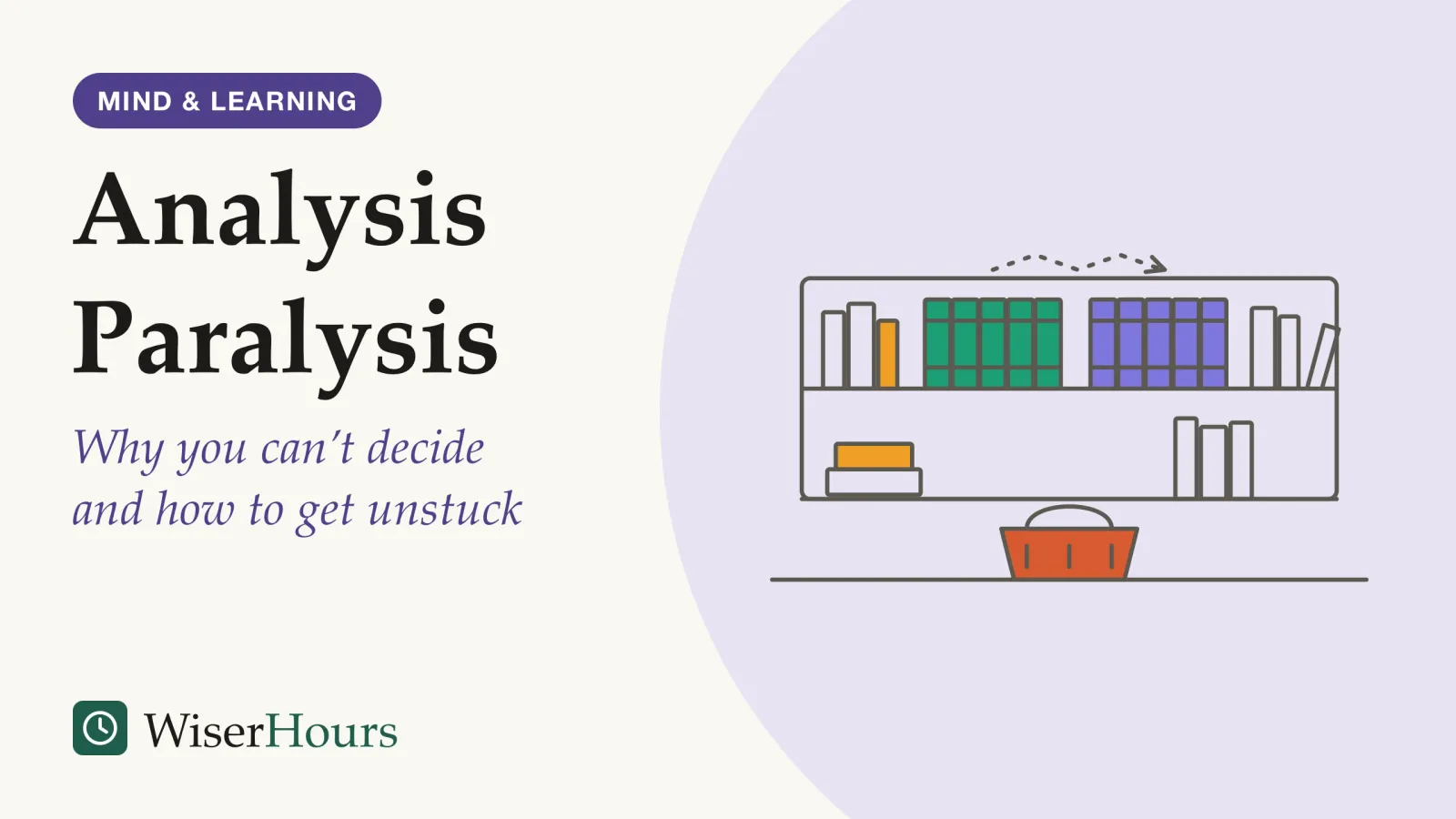
The economist Thomas Schelling once set out to buy an encyclopedia for his children and found two in the bookstore. Either would have done. He found it so hard to choose between them that he bought neither, a story Amos Tversky and Eldar Shafir retold in 1992 because it matched what their experiments showed.1
Analysis paralysis is getting stuck before a choice because comparing the options feels safer than committing to one. The classic explanation points less to the number of options than to how close they are: when each one wins on something, choosing means giving something up, and waiting looks free. In experiments with American university students, Tversky and Shafir found that adding a second attractive option led more people to put off choosing altogether.1 Forty larger replications published in 2023 cast doubt on effects of this kind, so treat the pattern as plausible, not settled.2 Five habits help you get unstuck:
- Sort the decision: can you undo it?
- Set a good-enough bar before you look again
- Name the one fact that would change your mind
- Let one or two features decide
- Put a date on it, and choose what happens if it passes
Why “not yet” feels safer than choosing
Analysis paralysis belongs to a family of behaviors that the psychologist Christopher Anderson called decision avoidance: putting a choice off, sticking with the status quo, or choosing to do nothing. In a 2003 narrative reviewnarrative review: A review in which an expert summarizes a body of research in prose, choosing which studies to discuss. It can be a good map of a field, but without a stated search and pooling method it is easier for selection and opinion to shape the conclusions than in a systematic review.Full entry in the glossary in Psychological Bulletin, he traced it to a mix of sound reasons and emotions, chiefly the regret people expect if they pick wrong and the discomfort of a hard trade-off.3
While a decision stays open, you cannot yet be wrong about it. Every week of comparing buys a little relief from the sting you imagine feeling if the option you pass up turns out better. Anderson’s point is that the relief has a price: delays turn into lost opportunities, and staying put is often not justified by the alternatives on offer.3
Picture someone weighing two flats to rent. One is cheaper, the other closer to work, and both landlords want an answer this week. Asking one more friend, checking one more listing and walking past both again all feel like progress. Then one of the flats is let to someone else, and the calendar has made the choice.
So when you catch yourself “still researching,” ask what the delay is protecting you from. Anderson’s review suggests two checks: whether the delay is justified, for instance by a real cost of deciding too soon, and whether the time you gain is spent on finding things that could settle the question rather than on avoiding it. He presents these as preliminary suggestions, not tested treatments.3
Close options, not long lists, are the classic suspect
Conflict between options, more than their number, is the classic explanation for a stalled choice. When one option is plainly better, choosing is easy; when each option wins on something different, people became more likely to put the decision off or keep what they already had, in a set of experiments Tversky and Shafir published in 1992.1
The study
Mixed evidence
A cheap CD player, a better one, and more people choosing to wait
Students imagined passing a one-day sale. When it offered one popular CD player at a low price, 34% said they would wait to learn more about other models. When it also offered a better, pricier model, 46% chose to wait. Adding a clearly worse second player did not raise waiting. In a real choice, when participants could swap a US$1.50 payment for one pen, only a quarter kept the cash; offered that pen or a pair of other pens, more than half kept it.1
Look at what changed between the versions. In the authors’ reading, the extra good option did not make the first player any worse; it gave people a reason to doubt it. Whichever player you pick, you can already see what the other would have given you, and “wait” is the only answer that gives up nothing today. A plainly worse alternative creates no such doubt, and in the experiment it did not raise waiting. The study’s limits: small student samples and mostly imagined purchases. In 2023, Ioannis Evangelidis, Jonathan Levav and Itamar Simonson reported 40 direct and conceptual replications with about 27,000 participants in total, and their results cast doubt on this kind of effect; our account rests on the abstract.2
The same pattern shows up in everyday shopping. Two laptops cost the same; one is lighter, the other faster. Each time you lean toward one, the other’s advantage comes back to mind, and “I’ll read a few more reviews” wins by default.
In a 1995 mailed survey with randomly assigned versions, family physicians in Ontario, Canada, were less likely to prescribe anything for a patient with osteoarthritis when choosing between two drugs than when considering one; the authors report similar shifts among neurologists and neurosurgeons in a North American surgery trial and among Ontario legislators (abstract only).4
This also explains why the popular claim that long menus freeze shoppers has shrunk, as the guide to how people make everyday decisions describes. Pooling earlier experiments, a 2010 meta-analysismeta-analysis: A study that combines the results of earlier studies on the same question into one overall estimate. Pooling makes the estimate more precise, but it cannot repair the studies it pools: a meta-analysis of surveys is still survey evidence.Full entry in the glossary put the typical effect of offering more options close to zero, with results that differed widely from study to study.5 A second meta-analysis, in 2015, named when a bigger set does backfire: complex options, a hard task, unclear preferences or a wish to decide with little effort, and putting the choice off was one of the signs it measured. With those conditions taken into account, it found a significant overall effect of offering more options.6 A long list is not the problem by itself; a list you cannot rank is.
Before you add another option to a comparison, then, ask whether it makes the ranking clearer or just adds one more trade-off.
How to get unstuck from analysis paralysis
To get unstuck, match your effort to how easily the choice can be undone, then close the search on purpose: a bar that is good enough, a fact that would decide it, one or two features that matter and a date. No study has tried the five steps together, so each one says what stands behind it, from experiments to one executive’s rule of thumb.
1. Sort the decision: can you undo it?
Jeff Bezos, Amazon’s founder, split decisions into one-way doors, which are consequential and hard to reverse and deserve slow, careful deliberation, and two-way doors, which can be reopened if they go wrong and should be made quickly. In his 2015 letter to shareholders he warned that growing organizations tend to give many two-way decisions the heavy one-way treatment.7 This is a chief executive’s rule of thumb, not research, but it answers the paralyzed person’s real question: how much care does this choice deserve?
A monthly phone plan is a two-way door; moving country for a job is closer to one-way. A one-year lease sits in between: you can leave, at a cost, so the flats deserve a few days, not a few months. One caution on the easy doors: in a study of photography students, those who were allowed to change their minds about which print to keep liked their print less than those whose choice was final (abstract only).8 So decide quickly, then treat the choice as settled for a set period instead of keeping the exchange window open in your head.
- The sorting question: if this turns out wrong, how hard is it to undo?
- Two-way door: easy to reverse: set a good-enough bar, decide quickly, then let the choice stand for a while
- One-way door: hard to reverse: slow down, name the fact that would change your mind, weigh the trade-offs on paper
- Both doors: set a date, and decide in advance what happens if it passes
2. Set a good-enough bar before you look again
Write down two or three must-haves and a threshold for each, then take the first option that clears them all. For the flats, that might be rent under your limit, a commute under half an hour and a second bedroom. Barry Schwartz and colleagues, borrowing a term from the economist Herbert Simon, call this satisficing: going after a good-enough option rather than the best one.9
The opposite habit, maximizing, has a cost. In seven samples in their 2002 study, people whose questionnaire answers marked them as maximizers, with habits such as checking other radio stations while fairly happy with the song playing, reported less happiness and more regret than satisficers. The data were correlational, and the authors state that their first study says nothing about which causes which.9
A study that followed graduating students through a year of job hunting shows the trade most sharply. Maximizers landed better-paid jobs, yet they were less satisfied with those jobs and felt worse during the search, which the authors link to leaning on outside information and dwelling on the options they did and did not take (abstract only).10
The cost is not the same everywhere. A 2012 study of adults in the US, Western Europe and China found that maximizers reported lower well-being in the two Western samples, largely through regret, while in China maximizing was unrelated to well-being.11 A 2022 meta-analysis of 108 papers found the well-being gap smaller when people focus on the process of choosing rather than on the result (abstract only).12
The bar does not ask you to lower your standards; it asks you to write them down once and stop when something meets them. Afterwards, judge the choice by whether you kept to your bar, not by what you later hear about the flat you turned down. Nobody has yet tested a good-enough bar as a fix for stalling, as far as we could find, and the support here is correlational: use it as a default, not a promise.
3. Name the one fact that would change your mind
Before researching further, finish this sentence: “If I learn X, I choose A; otherwise B.” For the flats: “If the cheaper one turns out to have damp, I take the closer one; otherwise the cheaper one.” If no answer would change your choice, stop looking. In experiments published in 1998, Anthony Bastardi and Eldar Shafir found that people chase information that would not have changed their decision had it simply been available, then let it sway them once they have it, ending up with choices they would not otherwise have made; our account rests on the abstract.13
- Myth
- One more round of research can only make a decision better.
- Fact
- Information that would not have changed the choice can still sway it once you have gone looking for it.
Extra research is not neutral: it can move a decision for reasons that do not matter.
4. Let one or two features decide
Weighing every trade-off takes time and tends to encourage deferral, Anderson notes, so for choices that do not merit that effort he suggests a simpler rule based on one or a few important features.3 Consumer experiments point the same way: time pressure reduced choice deferral when the options were in close conflict, as people leaned on simpler rules, but only when each option had its own attractions, not when each had its own drawbacks (abstract only).14 If the two rents are close, let the commute alone decide.
Keep full analysis for the one-way doors. For those, a weighted decision matrix puts the trade-offs on paper where you can see them.
5. Put a date on it, and choose what happens if it passes
A deadline may also help with delay itself. In the same 1992 paper, students paid to return a long questionnaire were more likely to send it back when given five days than when given three weeks or no deadline at all.1 That was a task, not a choice, but the lesson carries: open-ended time invites open-ended stalling.
Then choose your default. Across 58 studies, a 2019 meta-analysis found that options pre-selected for people were chosen considerably more often, though effects varied and several studies found no clear effect.15 Those defaults were set by others, such as governments and companies. Your own is our suggestion, based on the pen experiment above, where conflict pushed people toward whatever they already had: write down what happens if the date passes (“if I haven’t chosen by Friday, I sign for the cheaper flat”), so that stalling lands on something you picked on purpose.
When a decision has stalled
Solid findings, lightly tested fixes
The best-supported finding here is that a habit of maximizing goes with regret and lower well-being in Western samples; the link between close options and stalling is plausible but contested, and the fixes rest mostly on small experiments and on reasoning from them. So treat the steps as sensible habits to try rather than proven treatments.
| What it is | What the best evidence found | Evidence |
|---|---|---|
| Close options and deferral | A second attractive option raised waiting in 1992; 40 larger replications cast doubt | Trials, mixed: small originals, replications read as abstract12 |
| Too many options in general | Little effect on average; overload shows up under particular conditions | Meta-analyses, mixed56 |
| Maximizing and well-being | Linked to lower well-being through regret in the US and Western Europe, not in China | Observational, moderate11 |
| Chasing irrelevant information | People pursue it, then let it change their choice | Trials, limited: abstract only13 |
| Defaults | Pre-selected options chosen more often; effects vary | Meta-analysis of 58 studies, moderate15 |
| One-way and two-way doors | A rule of thumb from business practice | Expert opinion7 |
In practice, trust the pattern when you spot it in yourself, such as two good job offers and a third week of rereading the same company reviews, and adapt the steps freely. A different bar or a later date is fine, as long as something closes the search.
The bottom line
In the research here, analysis paralysis looks less like a shortage of information than a hard trade-off plus the fear of regret, and delay makes the choice for you. Start by asking how hard the decision would be to undo. If it is easy, set a good-enough bar, decide by a date and let the choice stand; save the slow, careful analysis for the few doors that only open one way.
Frequently asked questions
Is analysis paralysis just procrastination?
Not quite. In his 2003 review of decision avoidance, Christopher Anderson separates the two: procrastination means intending to act and stalling against that intention, while putting off a decision can sometimes fit what a person intends. Stalling on a choice you do intend to make, week after week, fits his description of procrastination better.
Can flipping a coin help when you are stuck between two options?
It can reveal what you want. Christopher Anderson's 2003 review suggests that when you are torn between two courses of action, you flip a coin and notice which side you hope it lands on before you see the result. That hope may settle your preference, and then the coin itself no longer matters. He calls his suggestions preliminary, and they have not been tested as interventions.
Why do whole teams and organizations get stuck?
One common reason, in Jeff Bezos's 2015 letter to Amazon shareholders, is that as organizations grow they tend to give easily reversed decisions the slow, heavy process meant for irreversible ones. He named the results as slowness, risk aversion and too little experimenting. That letter is a chief executive's view, not research, but it is the source of the one-way and two-way door rule.
Sources
- Choice under Conflict: The Dynamics of Deferred Decision. Tversky, A. & Shafir, E. (1992). Psychological Science, 3(6)
- A Reexamination of the Impact of Decision Conflict on Choice Deferral. Evangelidis, I., Levav, J. & Simonson, I. (2023). Management Science, 69(5)
- The psychology of doing nothing: Forms of decision avoidance result from reason and emotion. Anderson, C. J. (2003). Psychological Bulletin, 129(1)
- Medical decision making in situations that offer multiple alternatives. Redelmeier, D. A. & Shafir, E. (1995). JAMA, 273(4)
- Can There Ever Be Too Many Options? A Meta-Analytic Review of Choice Overload. Scheibehenne, B., Greifeneder, R. & Todd, P. M. (2010). Journal of Consumer Research, 37(3)
- Choice overload: A conceptual review and meta-analysis. Chernev, A., Böckenholt, U. & Goodman, J. (2015). Journal of Consumer Psychology, 25(2)
- 2015 Letter to Shareholders (Amazon.com, Inc., exhibit 99.1 to Form 8-K). Bezos, J. (2016). Amazon.com, Inc., filed with the US Securities and Exchange Commission
- Decisions and revisions: The affective forecasting of changeable outcomes. Gilbert, D. T. & Ebert, J. E. J. (2002). Journal of Personality and Social Psychology, 82(4)
- Maximizing versus satisficing: Happiness is a matter of choice. Schwartz, B., Ward, A., Monterosso, J., Lyubomirsky, S., White, K. & Lehman, D. R. (2002). Journal of Personality and Social Psychology, 83(5)
- Doing better but feeling worse: Looking for the “best” job undermines satisfaction. Iyengar, S. S., Wells, R. E. & Schwartz, B. (2006). Psychological Science, 17(2)
- The tyranny of choice: A cross-cultural investigation of maximizing-satisficing effects on well-being. Roets, A., Schwartz, B. & Guan, Y. (2012). Judgment and Decision Making, 7(6)
- The wellbeing implications of maximizing: A conceptual framework and meta-analysis. Belli, A., Carrillat, F. A., Zlatevska, N. & Cowley, E. (2022). Journal of Consumer Psychology, 32(4)
- On the pursuit and misuse of useless information. Bastardi, A. & Shafir, E. (1998). Journal of Personality and Social Psychology, 75(1)
- The Effect of Time Pressure on Consumer Choice Deferral. Dhar, R. & Nowlis, S. M. (1999). Journal of Consumer Research, 25(4)
- When and why defaults influence decisions: a meta-analysis of default effects. Jachimowicz, J. M., Duncan, S., Weber, E. U. & Johnson, E. J. (2019). Behavioural Public Policy, 3(2)
How we researched this
Sources came from Crossref, PubMed, OpenAlex and a general web search run in September 2026 on decision avoidance, choice deferral, maximizing and satisficing, time pressure and defaults; reviews and meta-analyses came first, then the experiments beneath them. The sources span 1992 to 2023. Six were read in full and nine only as abstracts, flagged in the text. Main limitation: most studies use students and short or imagined choices.
Keep reading
The Dunning–Kruger Effect: What It Really Says and What It Doesn't
The 1999 Dunning-Kruger paper never drew 'Mount Stupid'. Statistics explain part of its pattern, but two 2021 studies of about 4,000 people each found a gap.
Groupthink: What It Is, Famous Examples, and How to Prevent It
Groupthink is a group's wish to agree overriding its judgment. Janis's 8 warning signs, the Bay of Pigs and Challenger, and what research says prevents it.
How to Use a Decision Matrix: Comparing Options With Weighted Criteria
How to build a decision matrix in 6 steps: pick criteria that don't overlap, score one column at a time, weight the gaps, then test the winner.
How We Make Decisions: The Psychology in Plain English
How we make decisions: fast impressions, slower checks and mental shortcuts, plus which classic findings held up across 36 samples and which did not.