Where to invest · Lesson 8 of 11
Tax Breaks and Employer Match: Extra Money to Save
Learn how tax-friendly accounts and an employer match can help your savings grow, and the two things to check before you pay in.
 Video coming soon
Some of the best help for investors comes from the government and from employers. In this lesson you will see how tax breaks and employer money can help your savings grow faster, and what to check before you use them. The rules differ from country to country, so use this lesson as a map of what to look for, not as a list of rules for your country.
Tax-friendly accounts
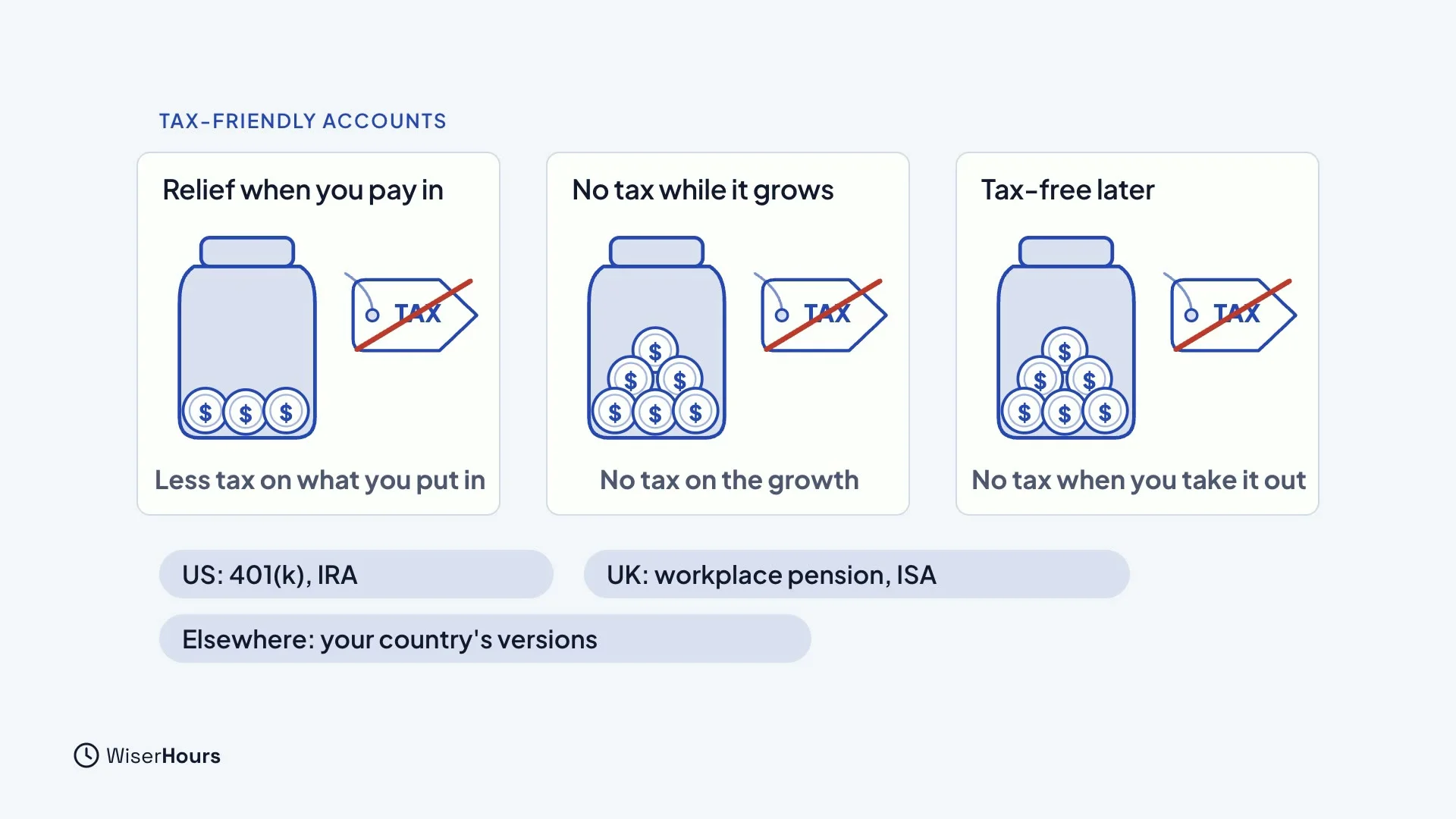
Many countries offer special accounts for retirement or investing. Depending on the account, you might get tax relief when you pay in, pay no tax while the money grows, or take it out tax-free later. In the US, these include 401(k)s and IRAs. In the UK, they include workplace pensions and ISAs. Elsewhere, look for your own country’s versions.
 (opens the full-size picture)
The rules that come with them
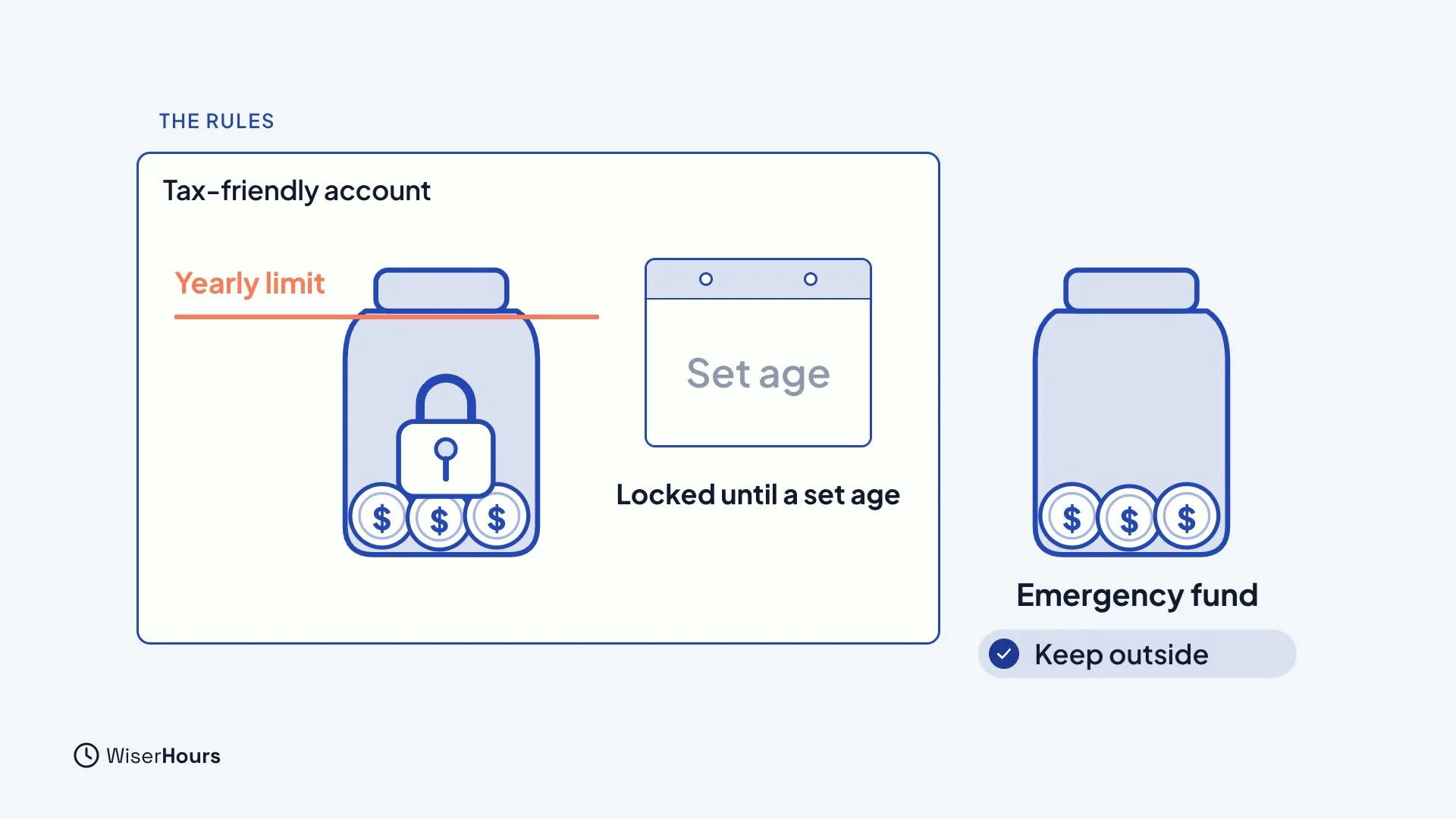
These accounts come with rules. There are yearly limits on how much you can pay in, and some lock your money until a certain age. So they suit long-term goals, and your emergency cash should stay outside them. If you might need the money soon, you want it where you can reach it.
 (opens the full-size picture)
What an employer match is
Some employers add money when you save for retirement. This is called a match. A common example is that your employer adds 50 cents for every dollar you put in, on the first 6 percent of your pay. A match pays only on what you put in, up to a cap.
A worked example
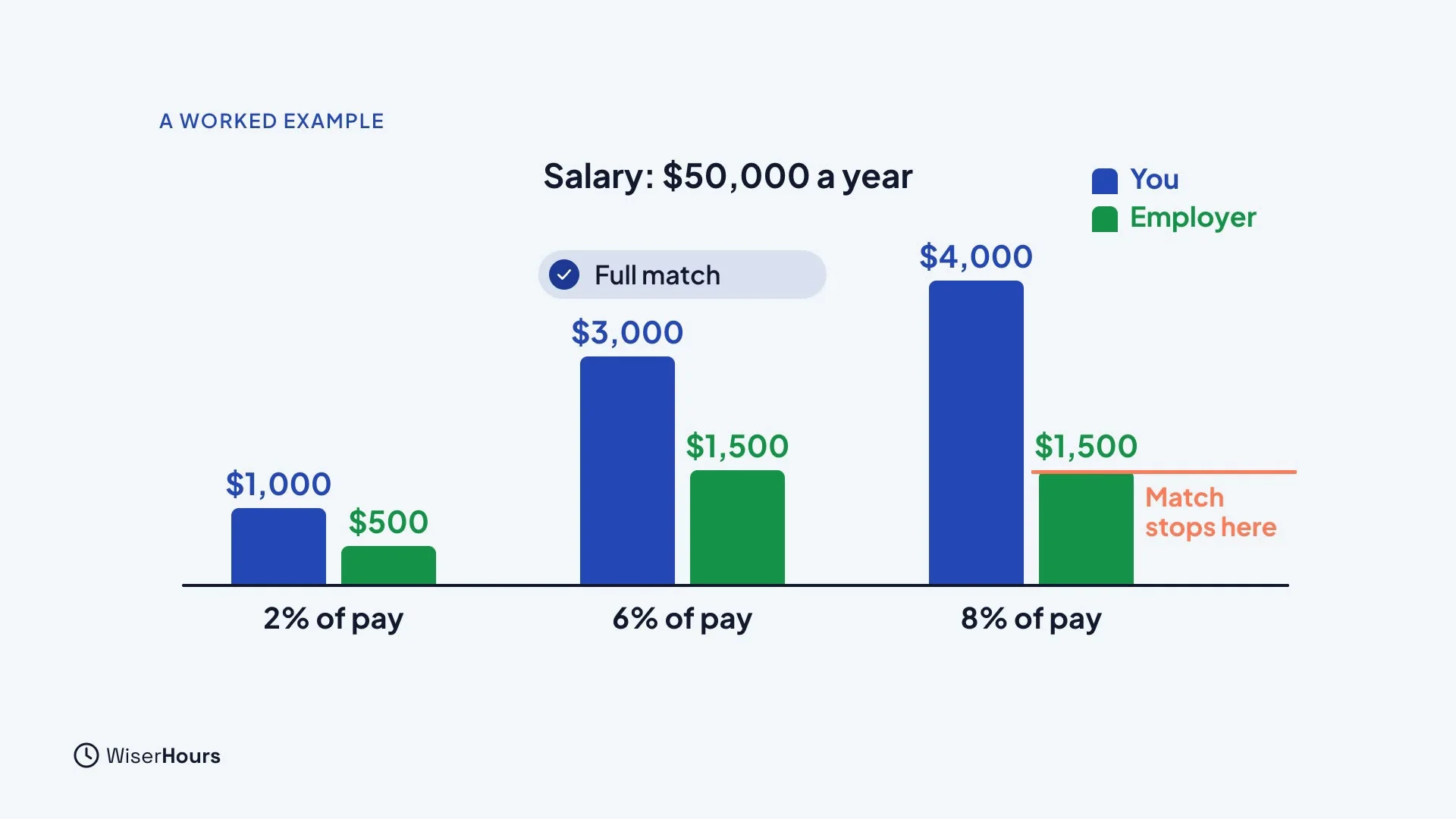
Say you earn 50,000 dollars a year. If you put in 2 percent, that is 1,000 dollars, and your employer adds 500. If you put in 6 percent, that is 3,000 dollars, and they add 1,500, the full match. If you put in 8 percent, they still add 1,500. The match stops at its cap. So an employer match is extra pay, but you only get all of it if you pay in enough.
 (opens the full-size picture)
Two things to check
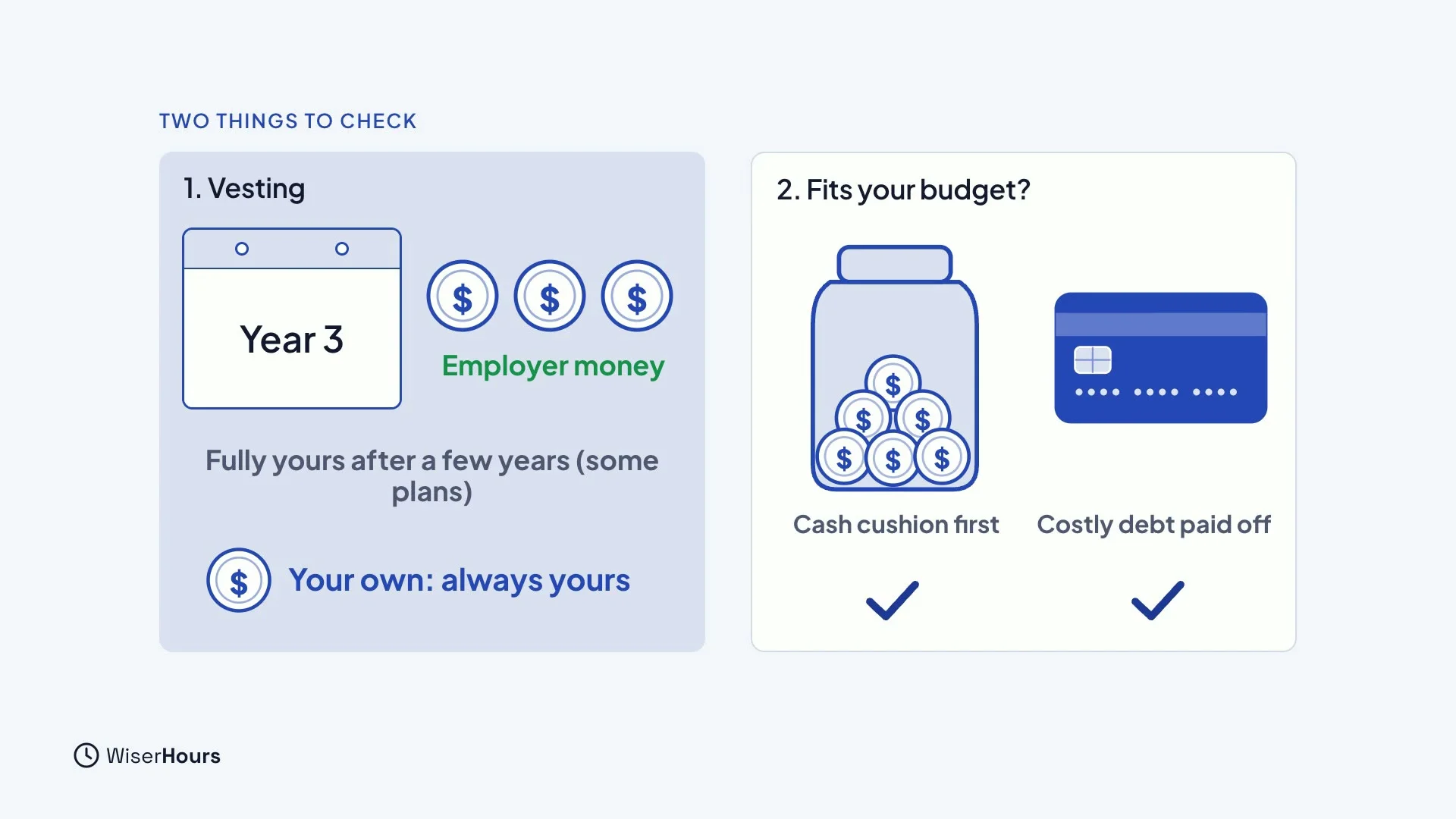
First, vesting. In some plans, the employer’s money only becomes fully yours after you have worked there for a few years, although your own contributions are always yours. Second, check that paying in fits your budget, after your cash cushion and costly debt.
 (opens the full-size picture)
The rules differ by country
In the UK, for example, most workers are enrolled in a workplace pension automatically, and employers must pay in at least 3 percent of qualifying earnings. If you opt out, your employer does not pay it. Other countries have their own rules, so ask your employer or your national pension or tax authority.
YOUR TURN
Read more
- Employer Match Explained: how the rate and the cap work, how vesting works, and the UK minimum.
- Investing for Beginners: how these accounts fit into the steps of starting to invest.
- Pension Basics: Defined Benefit vs. Defined Contribution Plans: the two main kinds of workplace pension and how they differ.
Read the full lesson script
Some of the best help for investors comes from the government and from employers. In this lesson, you'll see how tax breaks and employer money can help your savings grow faster.
Many countries offer special accounts for retirement or investing. Depending on the account, you might get tax relief when you pay in, pay no tax while the money grows, or take it out tax-free later. In the US, these include 401(k)s and IRAs. In the UK, they include workplace pensions and ISAs. Elsewhere, look for your own country's versions.
These accounts come with rules. There are yearly limits on how much you can pay in, and some lock your money until a certain age. So they suit long-term goals, and your emergency cash should stay outside them.
Some employers add money when you save for retirement. This is called a match. A common example is that your employer adds 50 cents for every dollar you put in, on the first 6 percent of your pay.
Say you earn 50,000 dollars a year. If you put in 2 percent, that's 1,000 dollars, and your employer adds 500. If you put in 6 percent, that's 3,000 dollars, and they add 1,500, the full match. If you put in 8 percent, they still add 1,500. The match stops at its cap.
Check two things. First, vesting. In some plans, the employer's money only becomes fully yours after you've worked there for a few years, although your own contributions are always yours. Second, check that paying in fits your budget, after your cash cushion and costly debt.
The rules differ by country. In the UK, for example, most workers are enrolled in a workplace pension automatically, and employers must pay in at least 3 percent of qualifying earnings. If you opt out, your employer doesn't pay it.
So remember: tax-friendly accounts can help your money grow. An employer match is extra pay, but only if you pay in. And check the cap and the vesting rules. Before the next lesson, find out whether your workplace adds money, and how much you need to put in to get all of it. In the next lesson, you'll see why investing regularly works so well.
MAKE IT A SMALL WIN
Finished this lesson?
Mark it complete to save your progress on this device.