Budgeting & Saving Money
How to Budget With Irregular Income: A Guide for Freelancers and Gig Workers
In a 2025 Fed survey, 58% of self-employed US adults said their income varied month to month. How to budget around a lean month, a buffer and tax.
In a 2025 Fed survey, 58% of self-employed US adults said their income varied month to month. How to budget around a lean month, a buffer and tax.
US wages and salaries rose 3.2% in the year to June 2026. How to ask for a raise in six steps, from checking pay data to naming a figure and handling a no.
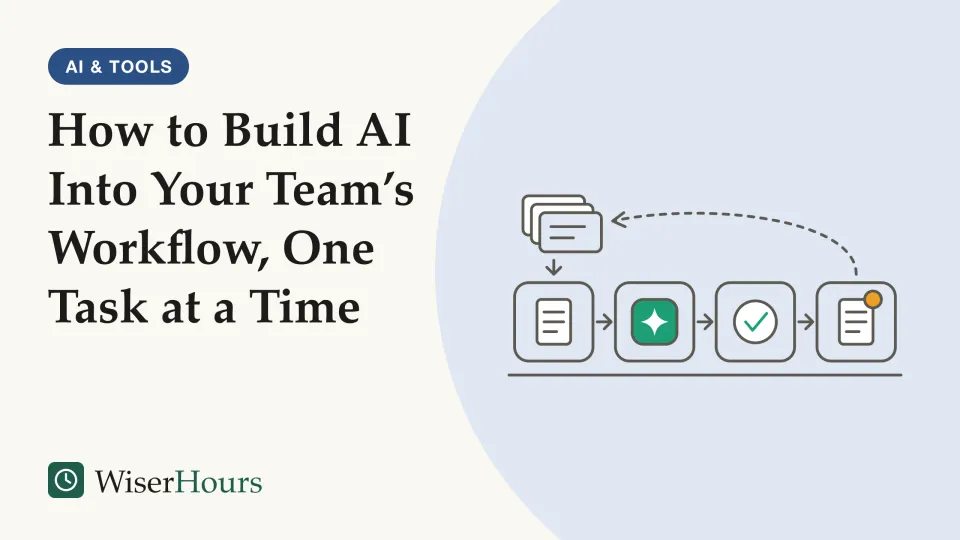
How to put AI in team workflows in 6 steps, and why, in a large trial, an AI tool for each person sped up solo work but not the work a team shares.
Transferable skills are skills you can use across jobs. The US O*NET database lists 25 of them. How to find yours, and why the job you aim for matters.
An emergency fund keeps a shock from becoming debt. Why 3 to 6 months is a rule of thumb, a smaller first target, and where the cash is protected.
A career change at 30: US data show job moves are still common from 25 to 34, but pay built on years in your old field mostly stays behind.
Design a hiring process in 8 steps, from defining the job to onboarding, and why structured interviews top a 2022 review of how to predict job performance.
How to choose productivity apps in 5 steps: name the problem, pick the smallest fix, test it on real work, judge it on set criteria, then review.
Insomnia is trouble sleeping when you had the chance to sleep. What the 3-night, 3-month line means, what causes it, and when to see a doctor.
Cover letters are barely studied. What a 2025 study of 183 co-op students, a US audit experiment and hiring research suggest about writing one.
What is passive income? The IRS's narrow tax meaning versus everyday use, what it costs in money, work and risk, and a 4-question test for any pitch.
Nearly 9 in 10 educators surveyed believe matching teaching to a learning style helps. The few experiments designed to test that claim found no benefit.
One-on-one meetings make up nearly half of all workplace meetings, yet a 2023 review found no empirical research on them as a topic.
A 2005 study of 115 transferring students found habits survived a move only when their setting did. How to break a bad habit: change the cue, plan a swap.
An index fund copies a market index instead of trying to beat it. How tracking works, why the copy is never exact, and 5 questions to ask before you buy.
A flow state is complete absorption in what you are doing. What the research since 1975 actually shows, and the 3 conditions you can set up.
Should you start a business? About half of new US business locations with staff close within 5 years, but not every closure is a failure. How to weigh it.
Cognitive biases are shortcuts that misfire. Anchoring and framing survived a retest in 36 samples; bias scores barely correlate.
Does financial independence mean never working again? A plain definition, why it comes in degrees, and why the 4% rule is a US rule of thumb, not a promise.
A Getting Things Done summary and critique: what 2011 experiments support in David Allen's method, what no trial has tested, and which parts look dated.
What causes burnout? Maslach and Leiter name 6 areas where person and job pull apart. Long-term studies back low control and low support the most.